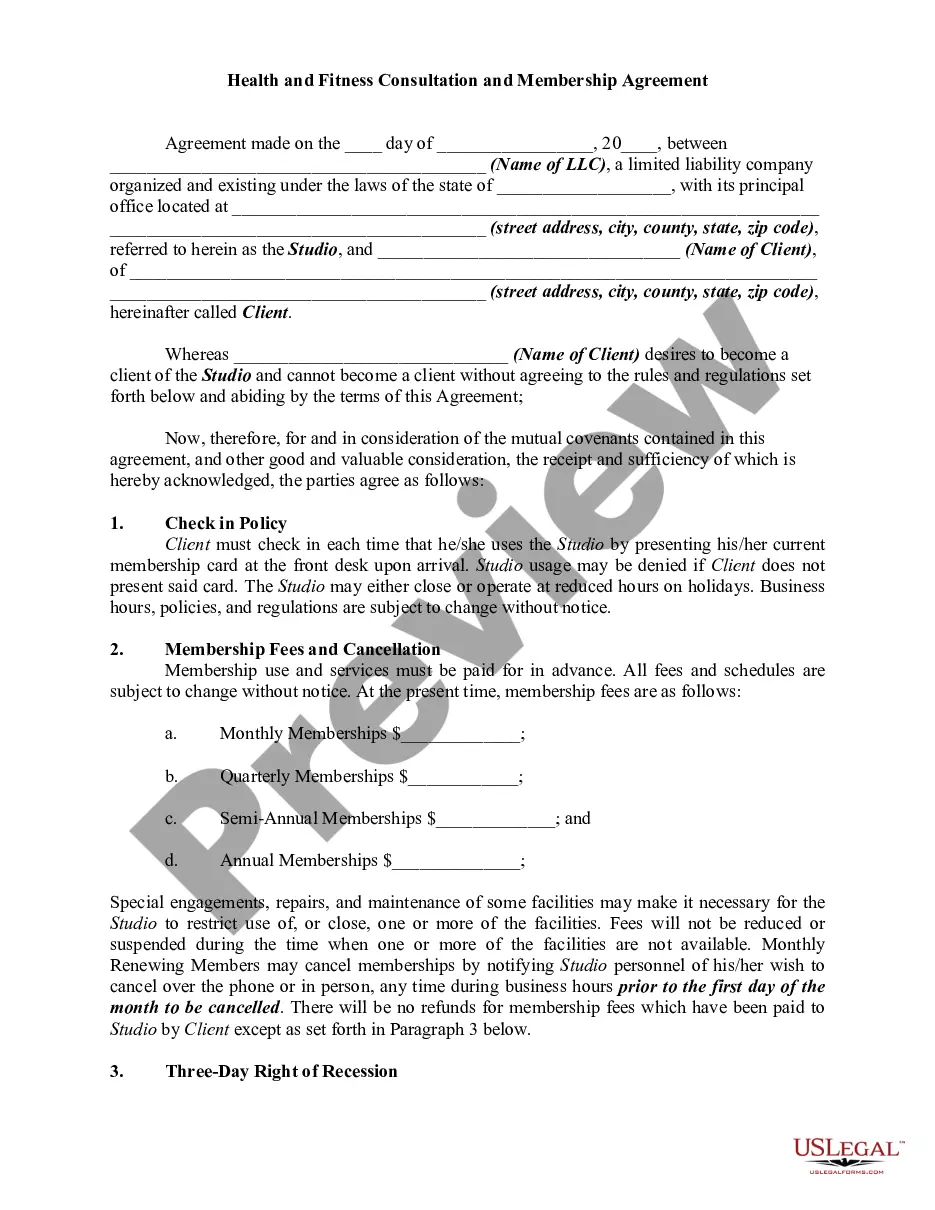
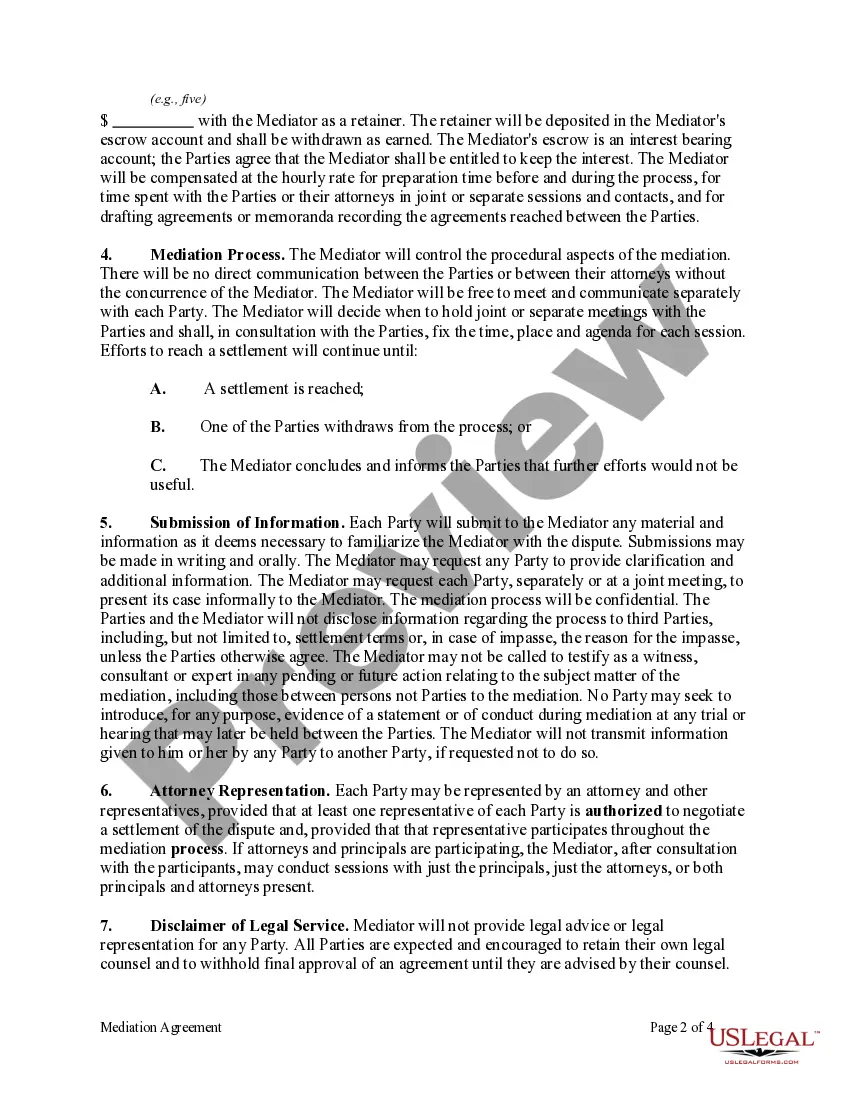
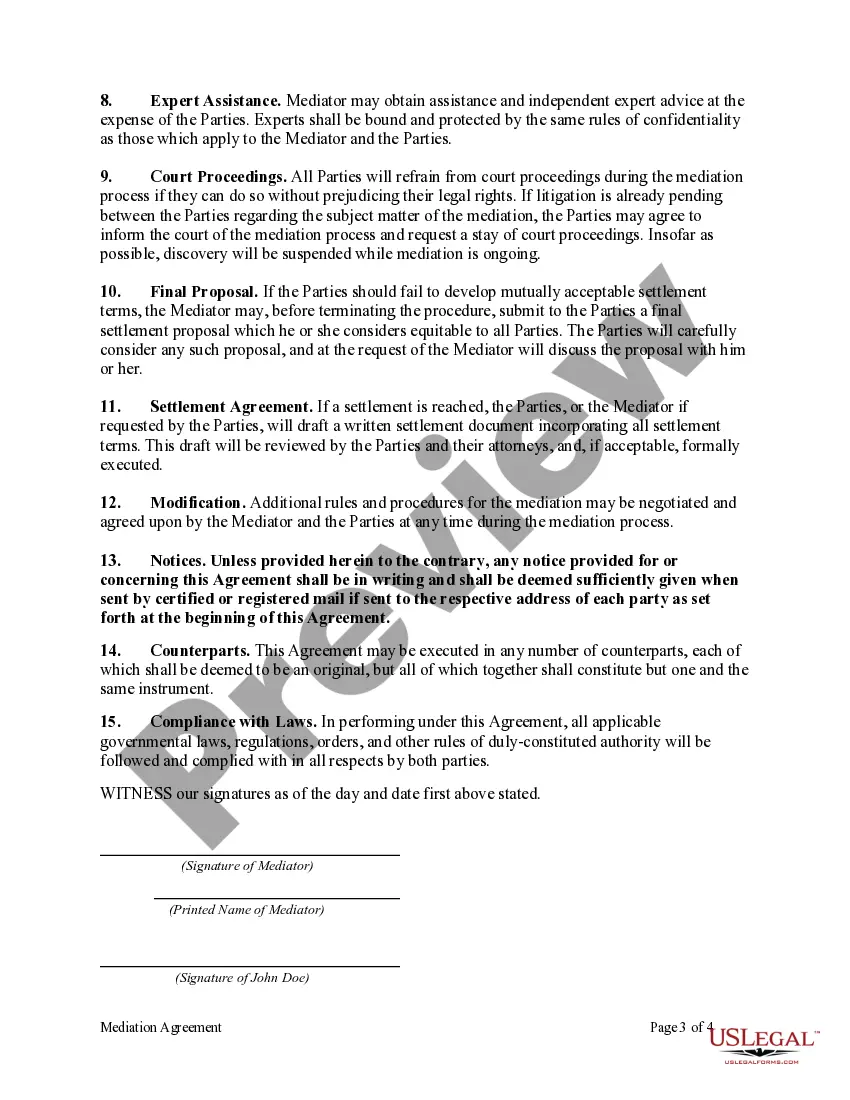
Connecticut Mediation Agreement
Description

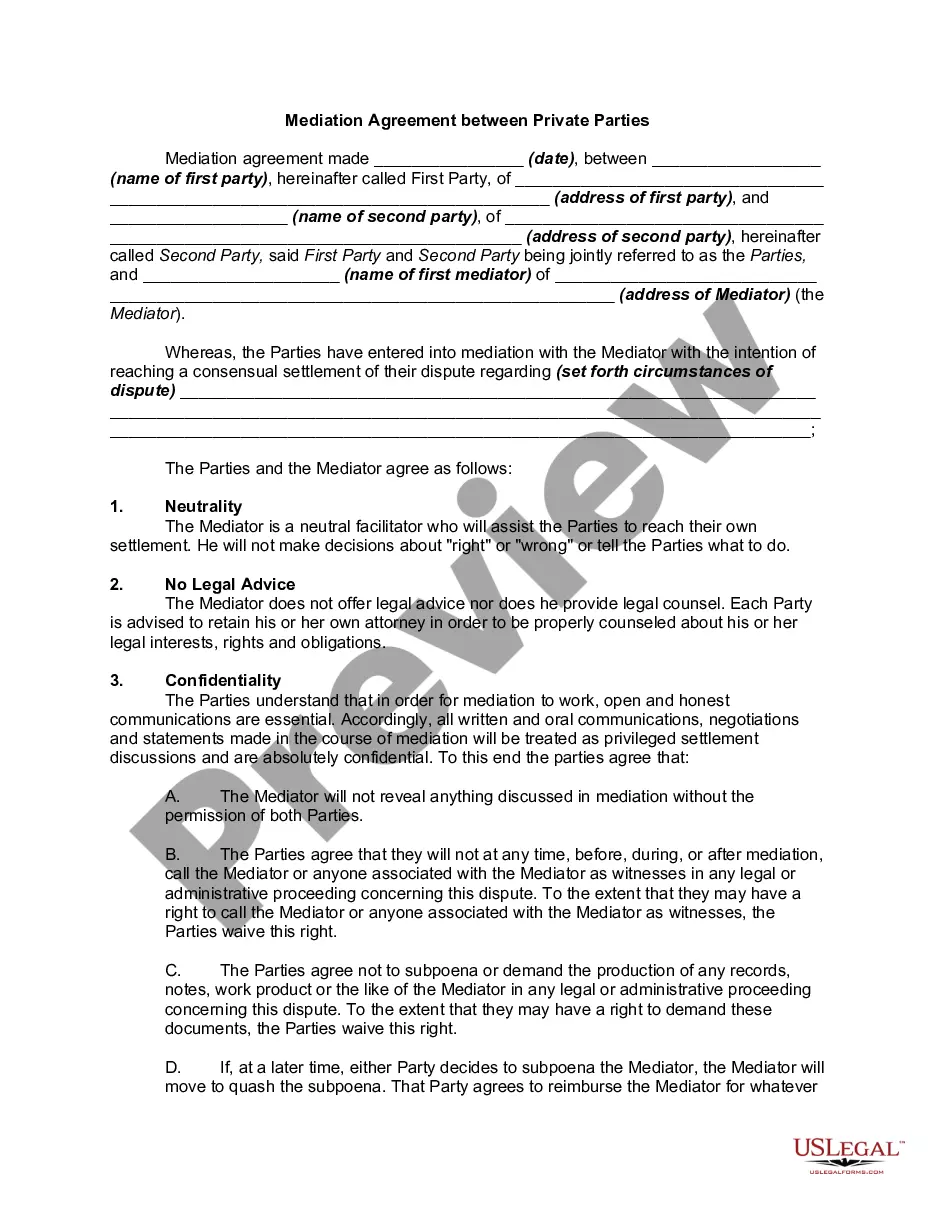
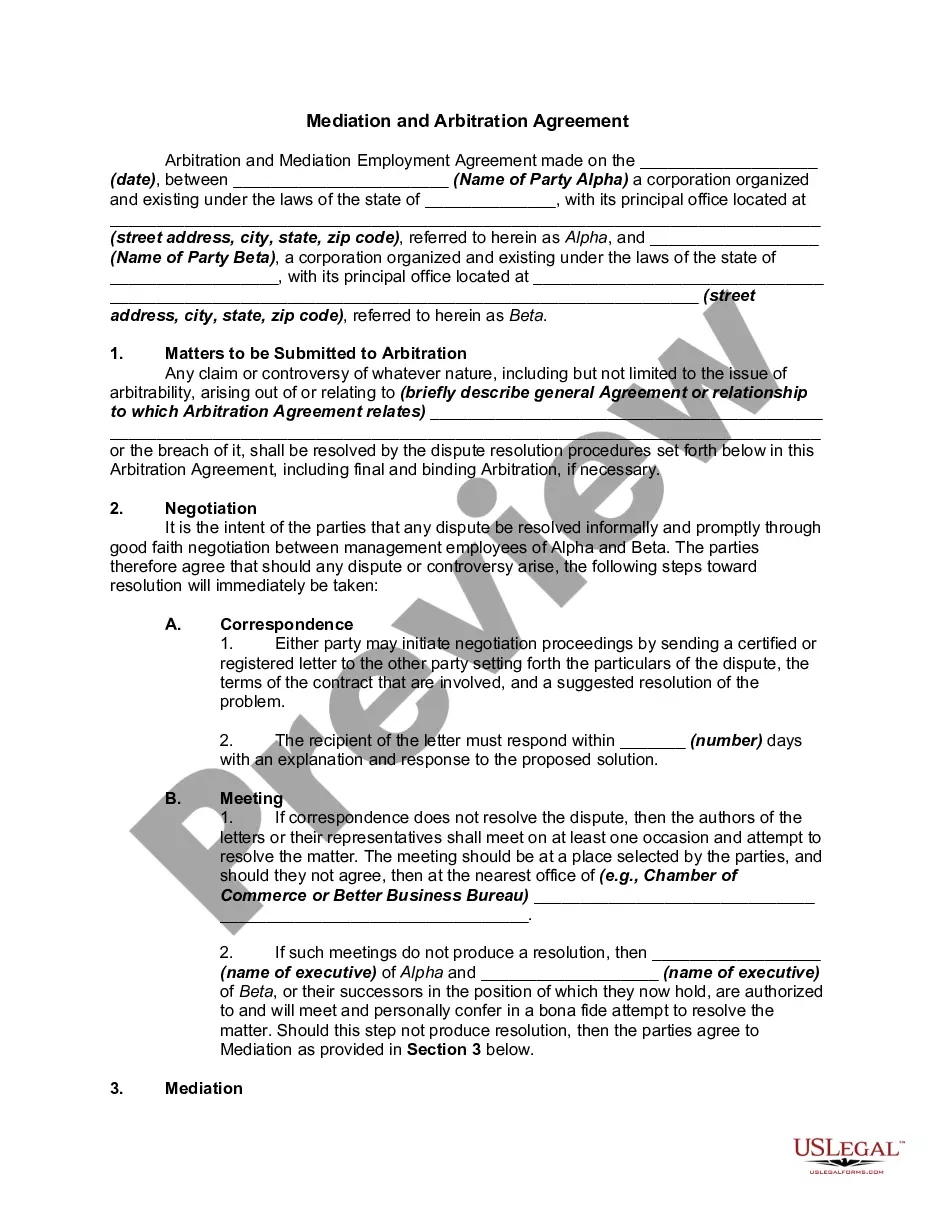
Get your form ready online
Our built-in tools help you complete, sign, share, and store your documents in one place.
Make edits, fill in missing information, and update formatting in US Legal Forms—just like you would in MS Word.
Download a copy, print it, send it by email, or mail it via USPS—whatever works best for your next step.
Sign and collect signatures with our SignNow integration. Send to multiple recipients, set reminders, and more. Go Premium to unlock E-Sign.
If this form requires notarization, complete it online through a secure video call—no need to meet a notary in person or wait for an appointment.
We protect your documents and personal data by following strict security and privacy standards.

Make edits, fill in missing information, and update formatting in US Legal Forms—just like you would in MS Word.

Download a copy, print it, send it by email, or mail it via USPS—whatever works best for your next step.

Sign and collect signatures with our SignNow integration. Send to multiple recipients, set reminders, and more. Go Premium to unlock E-Sign.

If this form requires notarization, complete it online through a secure video call—no need to meet a notary in person or wait for an appointment.

We protect your documents and personal data by following strict security and privacy standards.
Looking for another form?





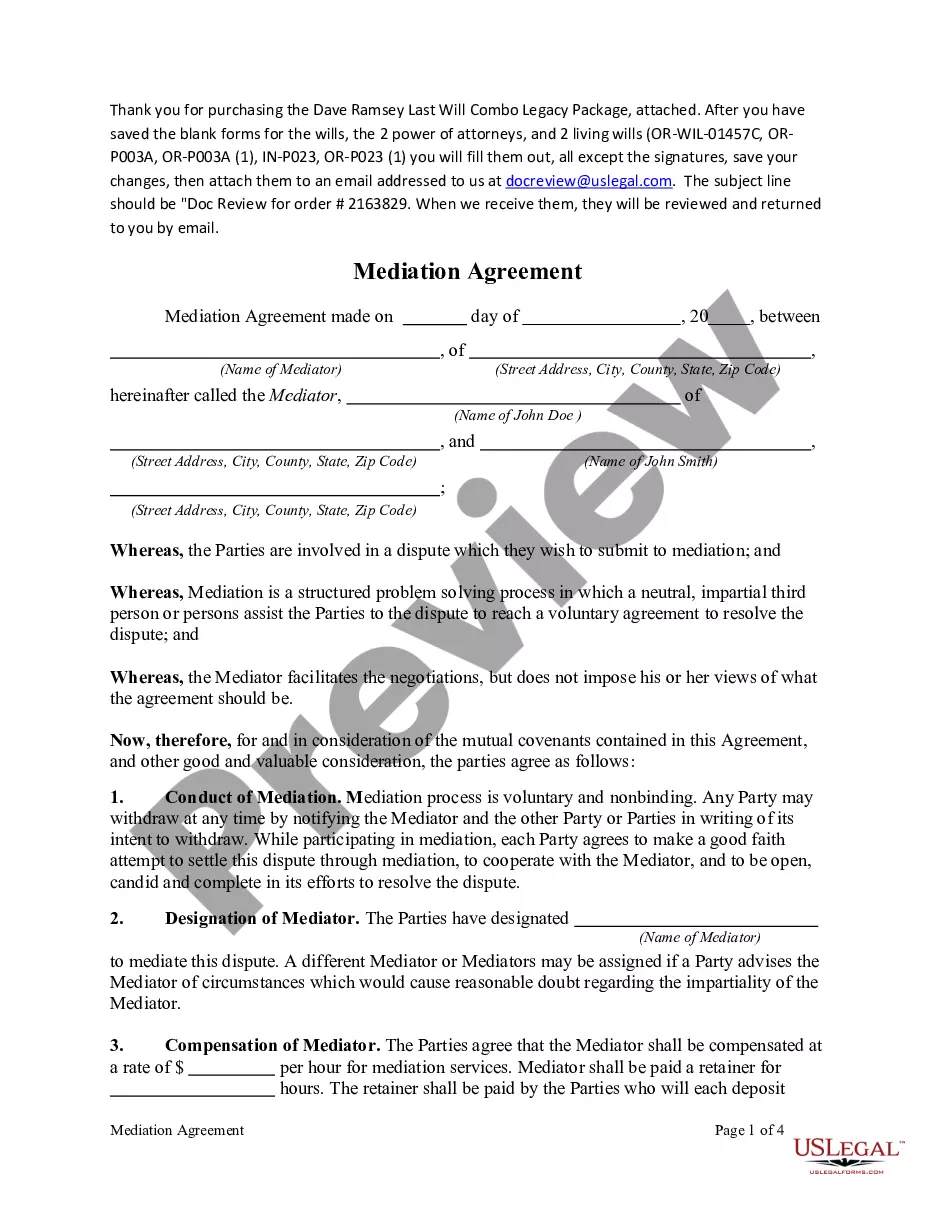
How to fill out Mediation Agreement?
You may commit several hours online trying to find the legitimate document template which fits the state and federal requirements you require. US Legal Forms supplies thousands of legitimate varieties which are evaluated by experts. It is simple to obtain or produce the Connecticut Mediation Agreement from our assistance.
If you already have a US Legal Forms account, it is possible to log in and click the Acquire switch. Following that, it is possible to complete, edit, produce, or sign the Connecticut Mediation Agreement. Every single legitimate document template you get is your own for a long time. To obtain another copy for any purchased type, check out the My Forms tab and click the related switch.
Should you use the US Legal Forms site the first time, adhere to the easy directions under:
- Very first, make sure that you have chosen the correct document template for the county/town of your choosing. Look at the type outline to ensure you have chosen the correct type. If readily available, make use of the Preview switch to appear with the document template at the same time.
- If you would like discover another version of the type, make use of the Lookup area to get the template that meets your requirements and requirements.
- Once you have found the template you would like, just click Get now to carry on.
- Choose the pricing prepare you would like, type in your qualifications, and register for a free account on US Legal Forms.
- Total the purchase. You should use your Visa or Mastercard or PayPal account to pay for the legitimate type.
- Choose the file format of the document and obtain it to the device.
- Make changes to the document if needed. You may complete, edit and sign and produce Connecticut Mediation Agreement.
Acquire and produce thousands of document themes making use of the US Legal Forms website, that offers the largest assortment of legitimate varieties. Use professional and express-specific themes to tackle your small business or individual requirements.
Form popularity
FAQ
These agreements are usually a brief summary of important issues that the parties have agreed on, and use the parties' own words to detail how they have decided to move forward.
It may be easy to establish who is at fault, but you do not want to go into mediation saying things like, ?This is all your fault? or ?If not for you, I wouldn't have been injured.? Placing blame can raise the other party's guard, which could make them less likely to compromise.
A mediation agreement becomes binding once both parties sign it. Therefore, you should thoroughly review mediation agreements before signing them, as the contract becomes legally enforceable once you sign the document. In some circumstances, a mediation agreement will be found unenforceable.
Contents of a Mediation Settlement Agreement Identification of the Parties. The names and addresses of the parties to the dispute. Summary of the Dispute. A brief description of the nature of the dispute. Terms of Settlement. ... Payment Provisions. ... Confidentiality Provisions. ... Governing Law. ... Signature Blocks.
The mediator's proposal By such proposals, the mediator typically proposes a settlement amount falling somewhere between the parties' ?final? negotiating positions for the parties to accept or reject confidentially. If both parties accept, the matter is settled, but if either party rejects, no settlement occurs.
Provide a concise summary of the facts and claims. The mediator will not have the patience or need to read an appellate brief. Avoid prose but use headings and bullet points to organize the section, and to summarize the claims, defenses and background about the parties.
After mediation ends, your attorney will file documents with the court, if necessary, and prepare a settlement agreement for review by both parties. A mediation agreement is legally binding, so you must follow through with agreed actions, like transferring assets, delivering titles, etc.
The non-binding nature of mediation means also that a decision cannot be imposed on the parties. In order for any settlement to be concluded, the parties must voluntarily agree to accept it. Unlike a judge or an arbitrator, therefore, the mediator is not a decision-maker.