Once a patent issues, the patentee has a right to demand that others infringing on the claimed invention stop using, selling, offering for sale, manufacturing and importing the claimed invention into the United States. A patent holder may wish to send a notice letter to a suspected infringer for various reasons, including:
A notice letter provides a practical means for contacting the infringer and beginning a dialogue over licensing or determining how to end the infringement.
Connecticut Letter to Alleged Patent Infringer
State:
Multi-State
Control #:
US-02626BG
Format:
Word;
Rich Text
Instant download
Description
Free preview
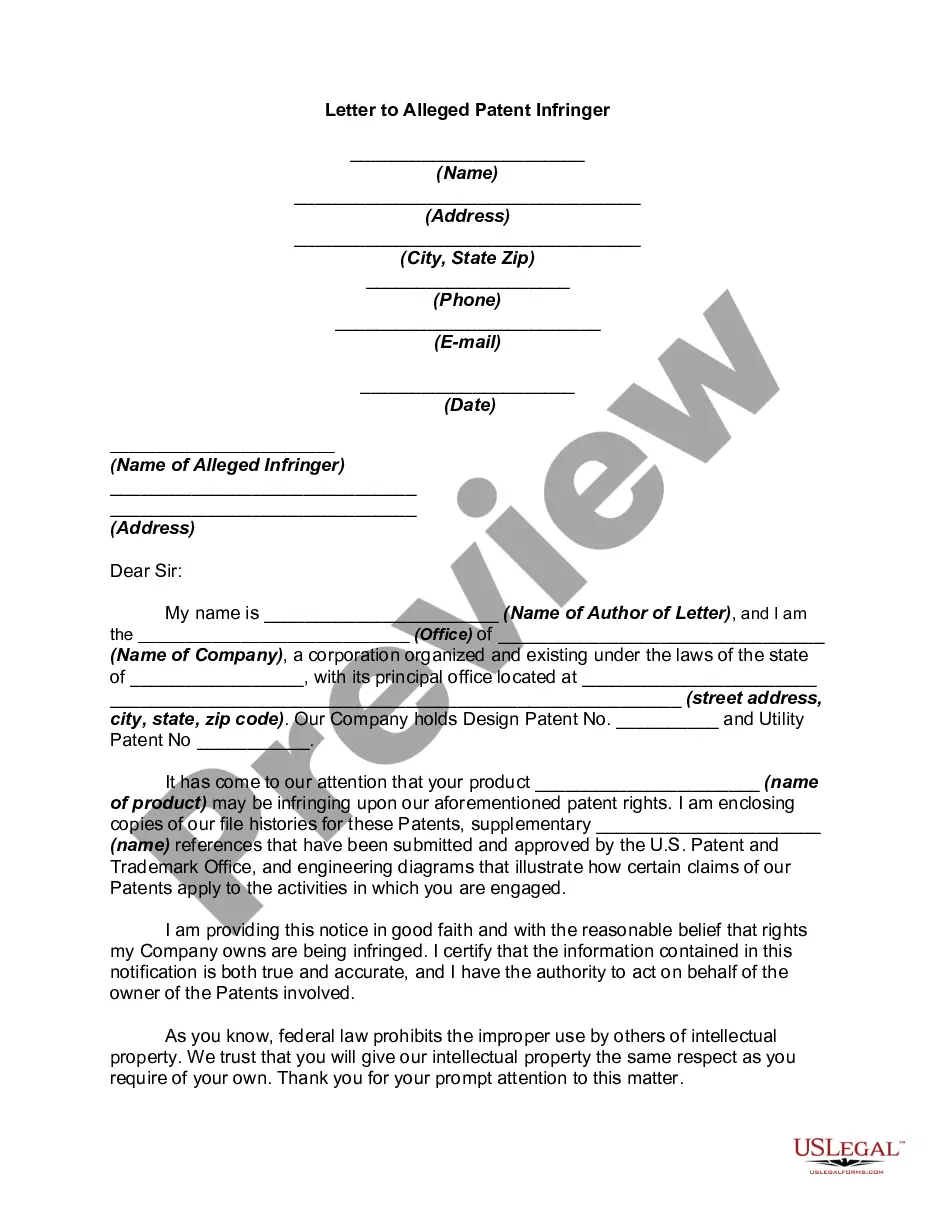

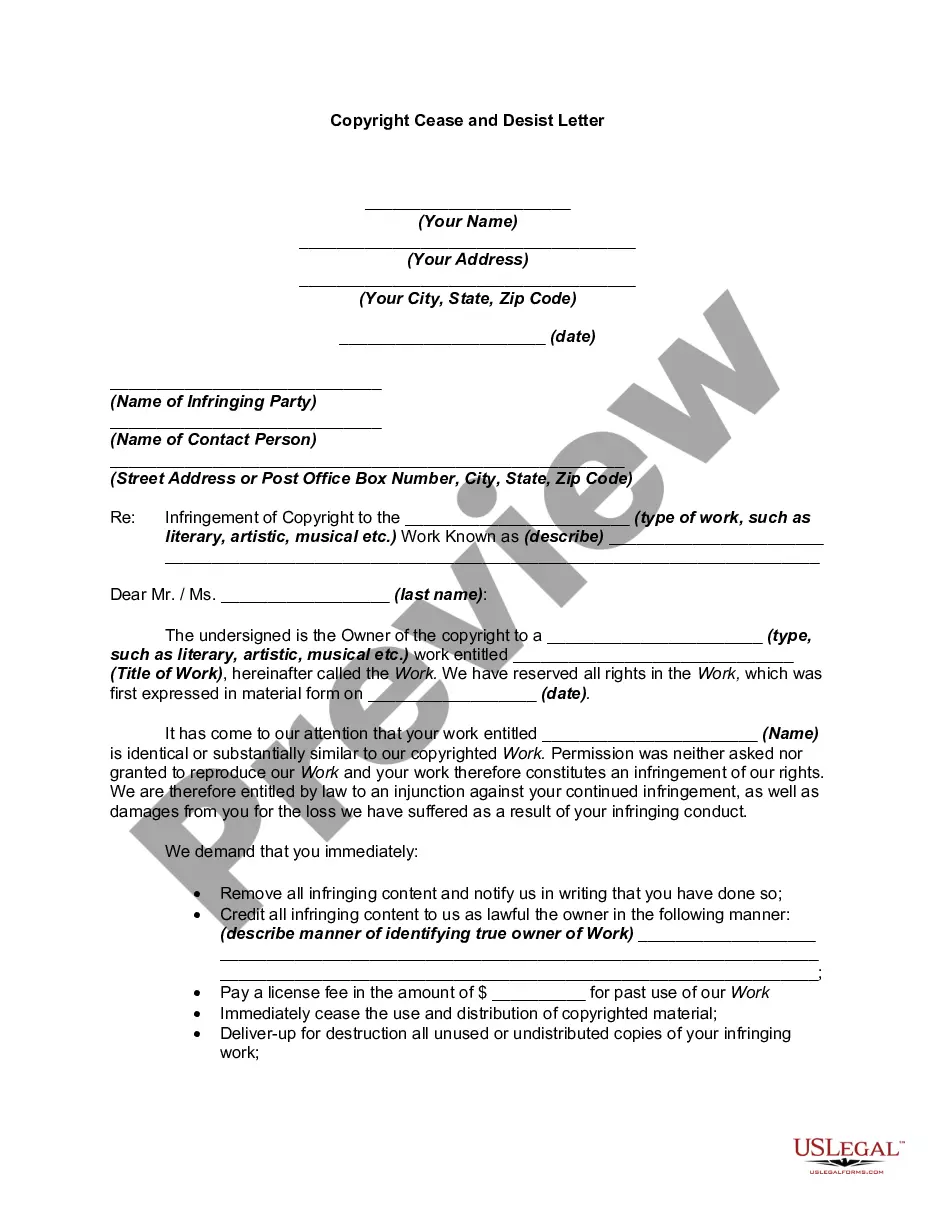
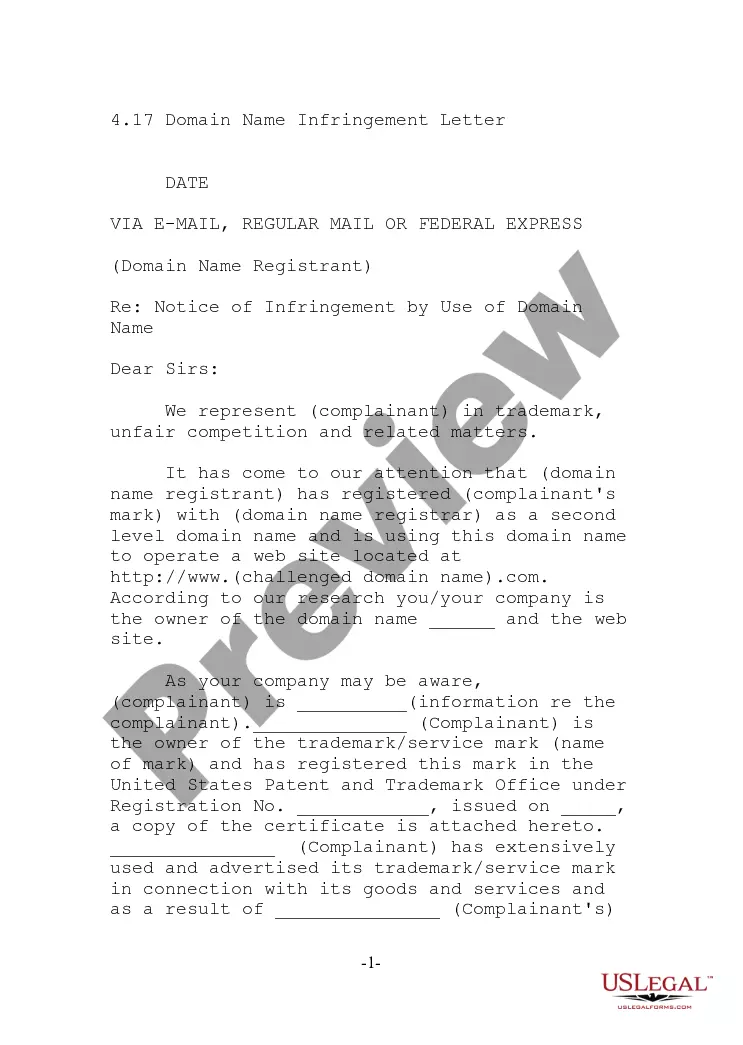



How to fill out Letter To Alleged Patent Infringer?
It is feasible to dedicate multiple hours online looking for the sanctioned document format that fulfills the state and federal stipulations you will require.
US Legal Forms offers an extensive collection of legal templates that are examined by specialists.
You can easily download or print the Connecticut Letter to Alleged Patent Infringer from the services.
If available, utilize the Preview button to review the document format as well. If you wish to find an additional version of the template, use the Search box to discover the format that meets your needs and specifications.
- If you already possess a US Legal Forms account, you can Log In and then click the Obtain button.
- Subsequently, you can complete, modify, print, or sign the Connecticut Letter to Alleged Patent Infringer.
- Every legal document template you obtain is yours indefinitely.
- To acquire an additional copy of the downloaded template, navigate to the My documents tab and click the corresponding button.
- If you are utilizing the US Legal Forms website for the first time, follow the simple instructions outlined below.
- Initially, ensure you have chosen the correct document format for the area/region of your choice.
- Review the form details to confirm you have selected the appropriate template.
Form popularity
FAQ
The 18-month publication rule for patents requires patent applications to be published 18 months after their filing date, thus making details publicly accessible. This rule aims to inform others about potential patents while balancing the applicant’s interests. Understanding this rule is essential for inventors planning to protect their innovations, especially in the context of sending a Connecticut Letter to Alleged Patent Infringer.
To show copyright infringement, you must prove ownership of the copyright and demonstrate that the infringer copied protected material without permission. This process often includes documentation of original works and examples of the alleged infringement. While copyright and patent law differ, understanding these distinctions can aid in assertiveness when dealing with related issues, such as those highlighted in a Connecticut Letter to Alleged Patent Infringer.
The notice requirement for patent infringement means that a patent owner must inform the infringer of the patent rights. This notice can be verbal or written but is more effective in a documented form, like a Connecticut Letter to Alleged Patent Infringer. Providing notice can impact the amount of damages you can claim in a lawsuit.
Defending against patent infringement claims involves examining the validity of the patent itself. You might argue that your product does not violate any patent claims or that the patent is invalid. Consulting with legal professionals is vital in crafting a solid defense strategy. If you receive a Connecticut Letter to Alleged Patent Infringer, take it seriously and seek legal counsel.
Induced patent infringement occurs when someone actively encourages or aids another party to infringe your patent. To establish this, you must prove that the inducer had knowledge of the patent and intended for infringement to occur. A Connecticut Letter to Alleged Patent Infringer can be instrumental in notifying the alleged inducer of your patent rights.
To show patent infringement, you must demonstrate that the accused product contains elements that match your patent claims. This often requires a legal analysis and comparison of features. Using a Connecticut Letter to Alleged Patent Infringer helps assert your rights and sets the stage for potential legal actions.
Patent infringement examples can vary widely. They include manufacturing a product that uses a patented method without permission or selling an item that contains patented technology. These situations can arise in many industries, from pharmaceuticals to software. A Connecticut Letter to Alleged Patent Infringer can address these violations effectively.
The process of patent infringement involves several steps, starting with the identification of the infringement. Next, you will need to document your findings and possibly send a Connecticut Letter to Alleged Patent Infringer. If the issue is not resolved, you may escalate the matter by filing a lawsuit to enforce your patent rights.
If someone infringes on your patent, first confirm the infringement by comparing their product to your patent claims. Gather any relevant evidence, such as sales data or advertisements. Following this, consider sending a Connecticut Letter to Alleged Patent Infringer to formally address the infringement and potentially negotiate a resolution.
Showing patent infringement requires a thorough comparison of your patented claims with the accused product or process. You need to identify how the accused product embodies all elements of at least one claim of your patent. A Connecticut Letter to Alleged Patent Infringer can be a useful first step in this process, as it formally outlines your claims.