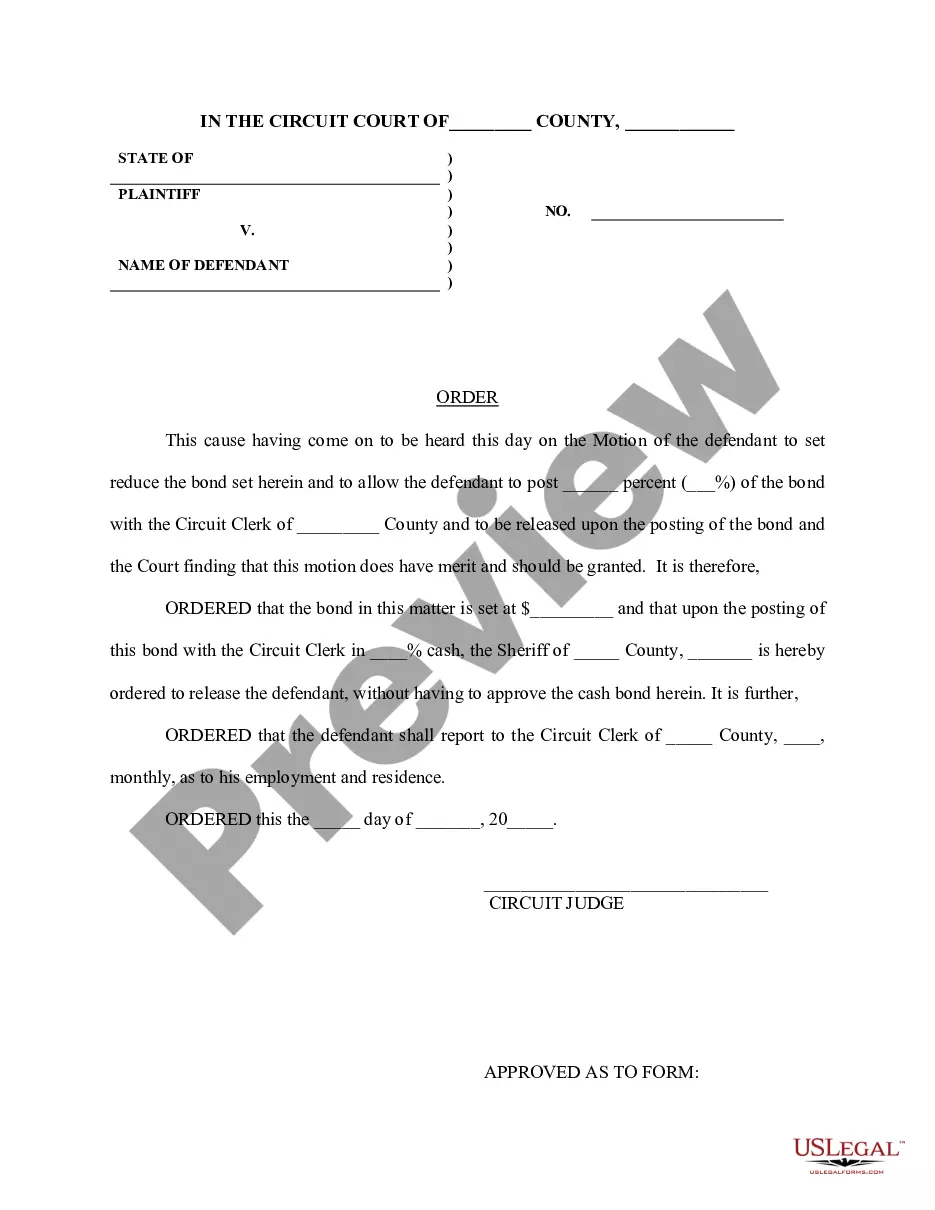
Connecticut Order to reduce bond
Description
Get your form ready online
Our built-in tools help you complete, sign, share, and store your documents in one place.
Make edits, fill in missing information, and update formatting in US Legal Forms—just like you would in MS Word.
Download a copy, print it, send it by email, or mail it via USPS—whatever works best for your next step.
Sign and collect signatures with our SignNow integration. Send to multiple recipients, set reminders, and more. Go Premium to unlock E-Sign.
If this form requires notarization, complete it online through a secure video call—no need to meet a notary in person or wait for an appointment.
We protect your documents and personal data by following strict security and privacy standards.

Make edits, fill in missing information, and update formatting in US Legal Forms—just like you would in MS Word.

Download a copy, print it, send it by email, or mail it via USPS—whatever works best for your next step.

Sign and collect signatures with our SignNow integration. Send to multiple recipients, set reminders, and more. Go Premium to unlock E-Sign.

If this form requires notarization, complete it online through a secure video call—no need to meet a notary in person or wait for an appointment.

We protect your documents and personal data by following strict security and privacy standards.
Looking for another form?



How to fill out Order To Reduce Bond?
If you need to thorough, download, or print sanctioned document templates, utilize US Legal Forms, the largest collection of legal forms, that are available online.
Employ the site’s straightforward and user-friendly search to locate the documents you require. Numerous templates for business and personal purposes are organized by categories and states, or keywords.
Utilize US Legal Forms to find the Connecticut Order to reduce bond with a few clicks.
Every legal document template you acquire is yours permanently. You have access to every form you saved in your account. Navigate to the My documents section and select a form to print or download again.
Complete and download, and print the Connecticut Order to reduce bond with US Legal Forms. There are numerous professional and state-specific forms you can use for your business or personal needs.
- If you are already a US Legal Forms client, Log In to your account and click the Acquire option to obtain the Connecticut Order to reduce bond.
- You can also access forms you previously saved from the My documents tab of your account.
- If you are using US Legal Forms for the first time, follow the instructions below.
- Step 1. Ensure you have selected the form for the correct city/state.
- Step 2. Use the Review feature to examine the form’s content. Remember to read through the description.
- Step 3. If you are not satisfied with the form, use the Search field near the top of the screen to find other versions of the legal form design.
- Step 4. Once you have identified the form you need, click the Get now option. Choose the pricing plan you prefer and enter your details to register for an account.
- Step 5. Complete the transaction. You can use your credit card or PayPal account to finalize the purchase.
- Step 6. Select the format of your legal form and download it to your device.
- Step 7. Complete, edit, and print or sign the Connecticut Order to reduce bond.
Form popularity
FAQ
In order to post Bail, a person can either post the full cash value, a ten percent cash option, or contact a licensed Bondsperson who may post a person's bail for a non-refundable fee.
You can get money back if you paid the bail in full in cash to the courthouse or police department in Connecticut. You can only get bail money back at the end of the case not while the case is pending.
A bail bondsman is a person or company that provides bail money for a fee. In Connecticut, this fee is typically 7 -15% of the total bail amount. The bail bondsman will also require collateral?like a house or car?that will be forfeited if the defendant fails to appear in court.
Bail, also known as bond, is the money, property, or signature given to assure that a person charged with a crime (defendant) will appear in court for trial. Under the Connecticut constitution, bond must be set in all cases except when the defendant is charged with a capital felony (death penalty cases).
In February 2021, Illinois became the first state to fully abolish cash bail (set to go into effect in January 2023). In March 2021, the California Supreme Court ruled that people cannot be detained simply because they cannot afford to pay cash bail.
The bail bond industry in Connecticut operates for profit and benefits from restrictions on the availability of the ten percent cash option. Significantly, financial bonds are forfeited only if the accused person fails to appear in court. They are not forfeited if the accused person is re- arrested.
Among the important bail laws are bail fees which are mandated by the State. The premiums bondsmen in Connecticut charge are set at 10% up to a maximum of $5,000 and 7% thereafter. So if a bail amount was set at $5,100 the fee would be $507. These fees are mandated.