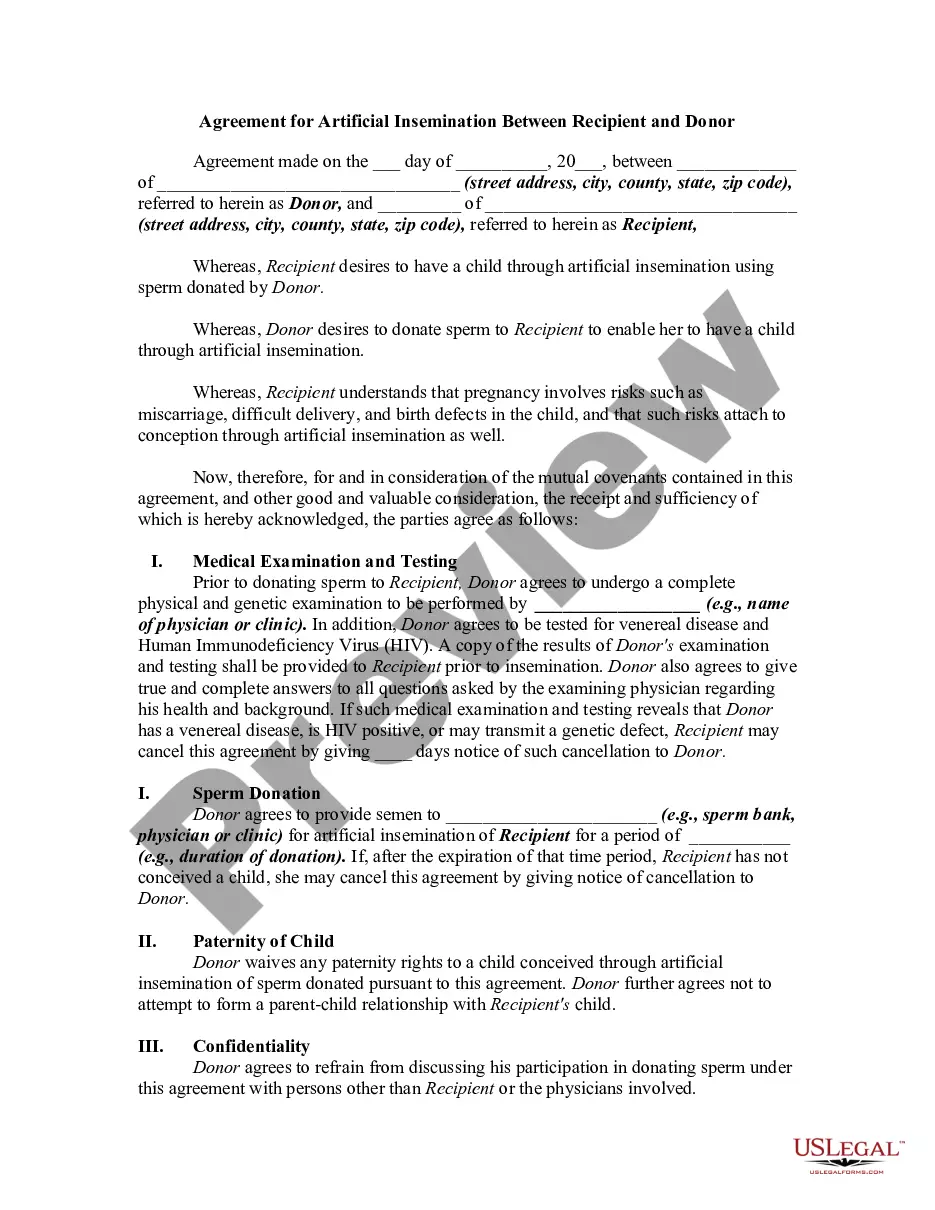
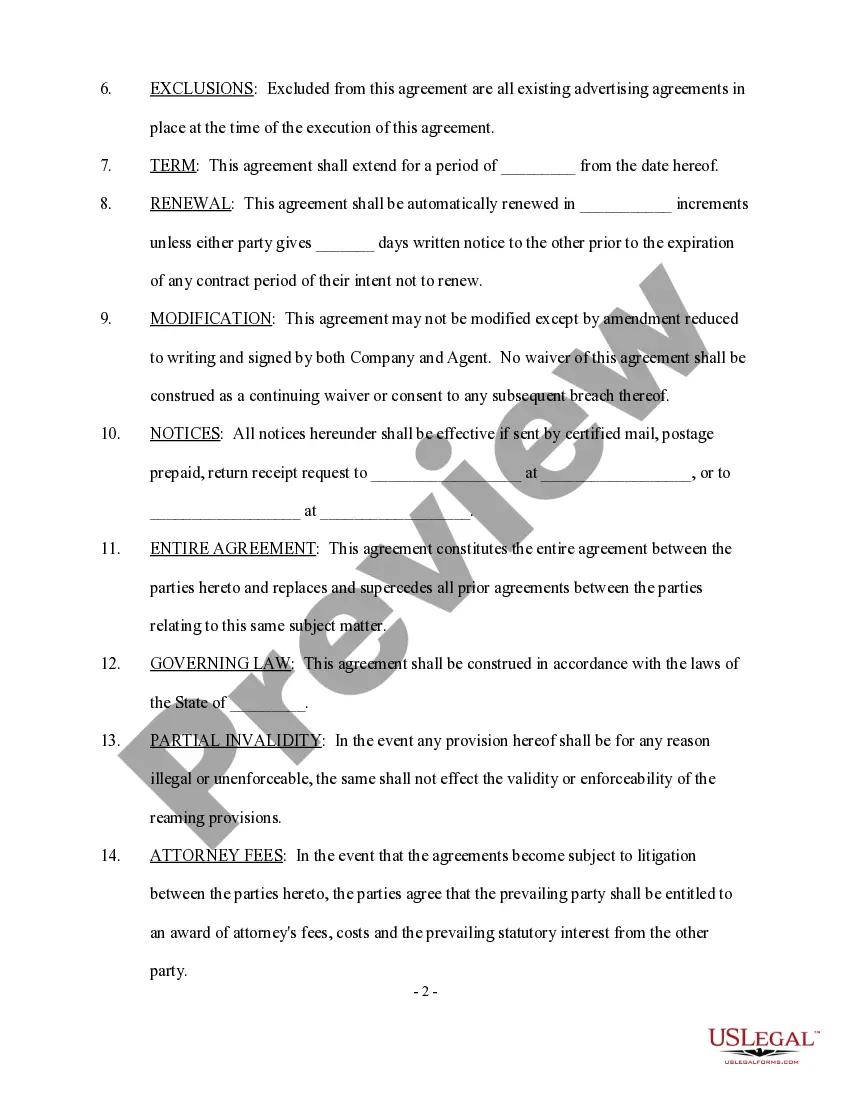
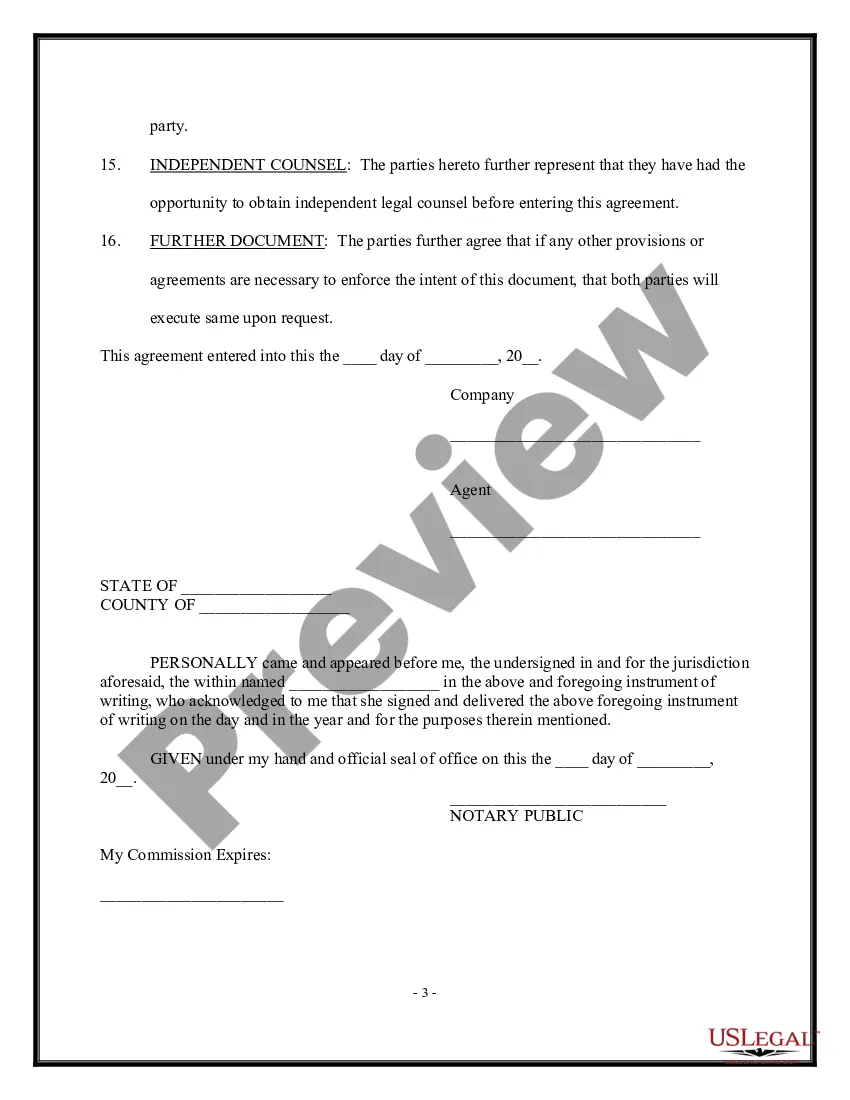
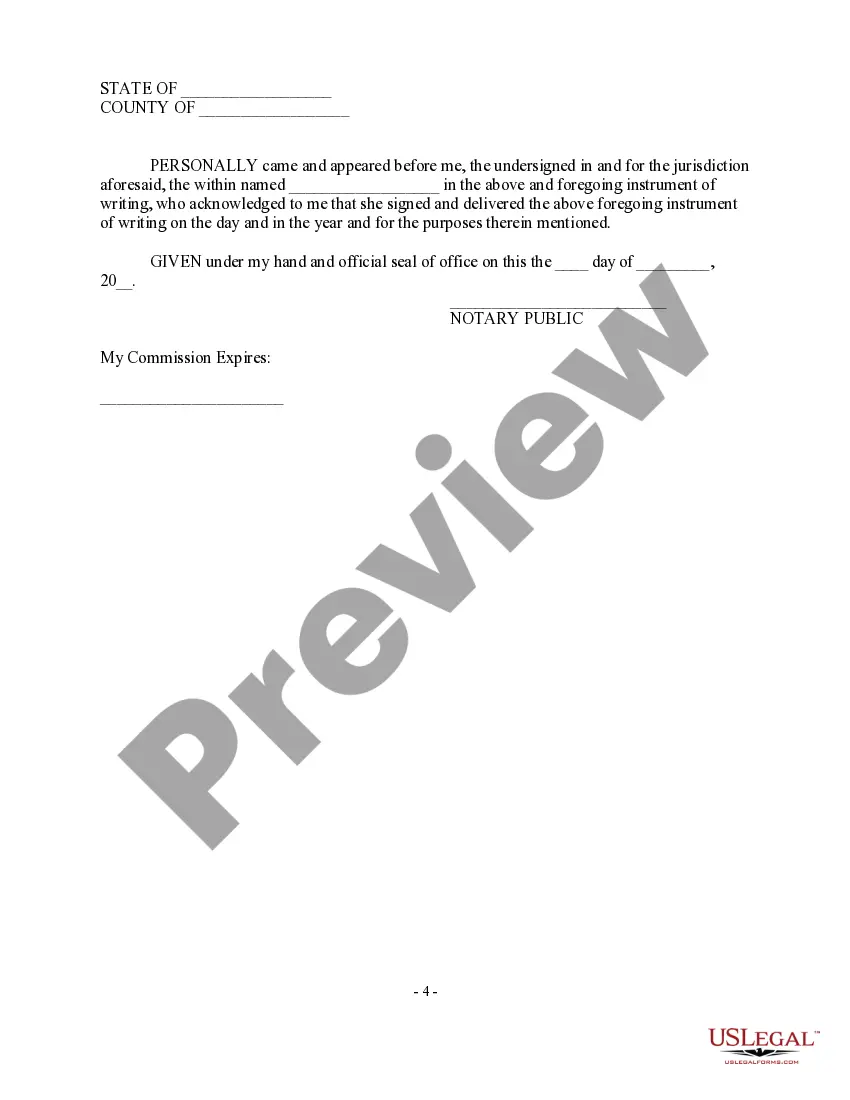
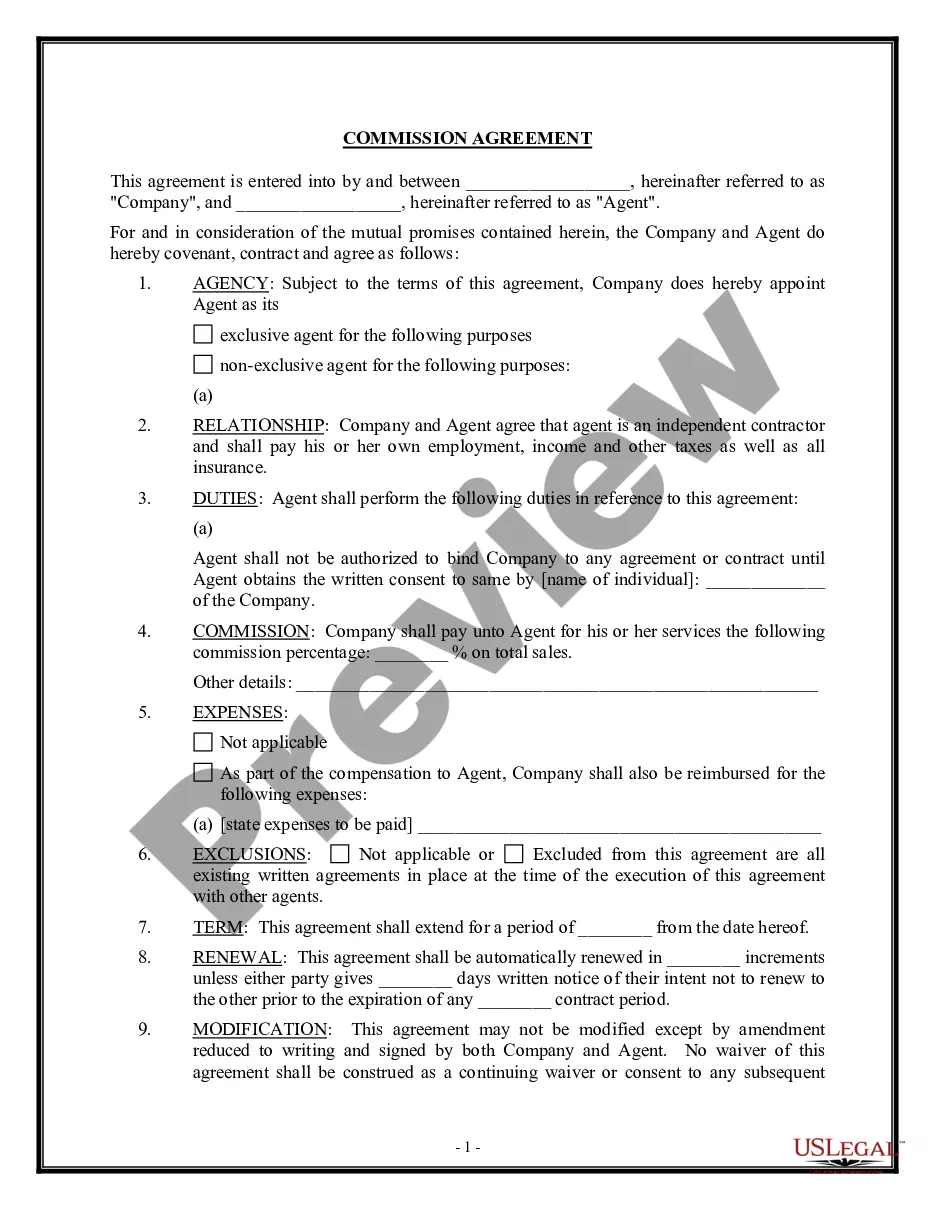
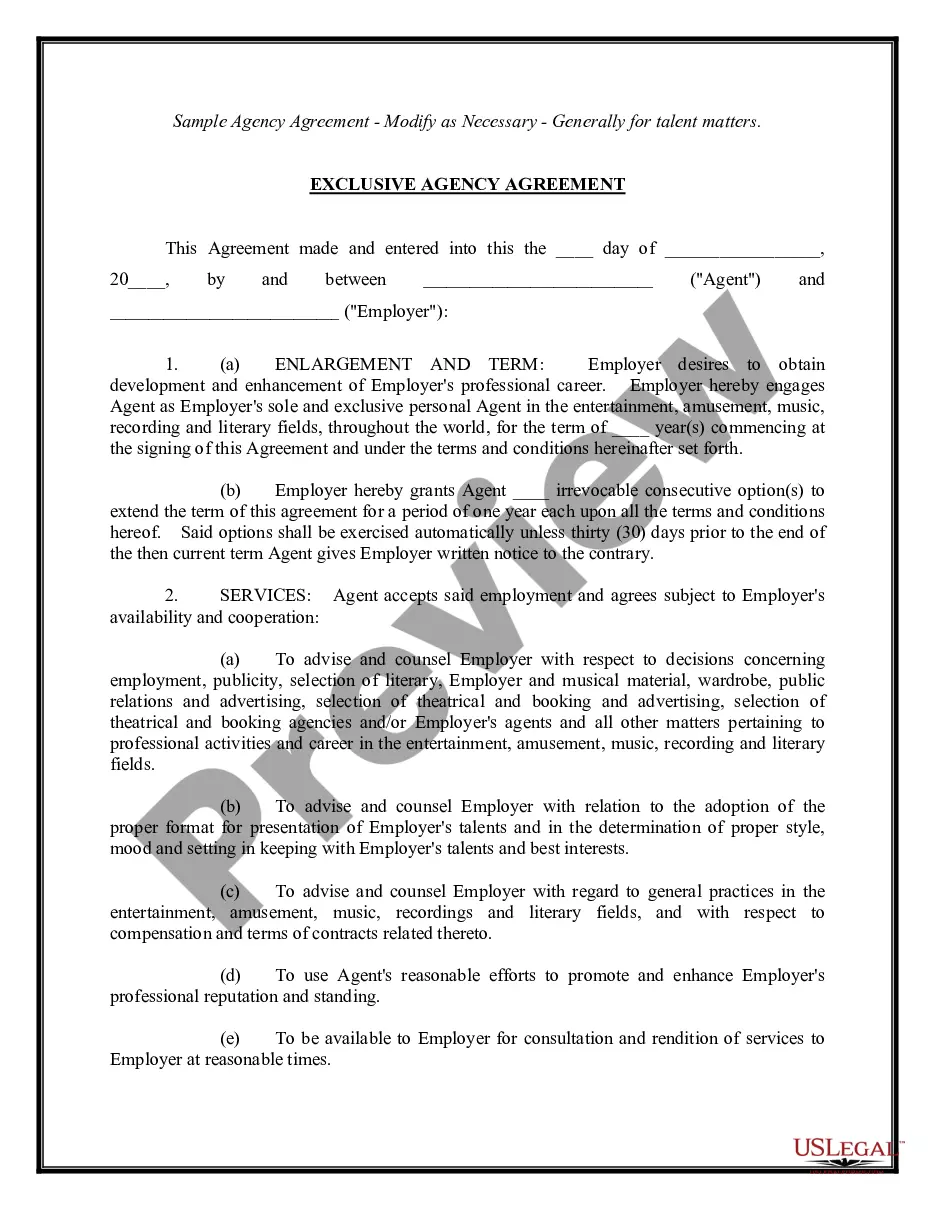
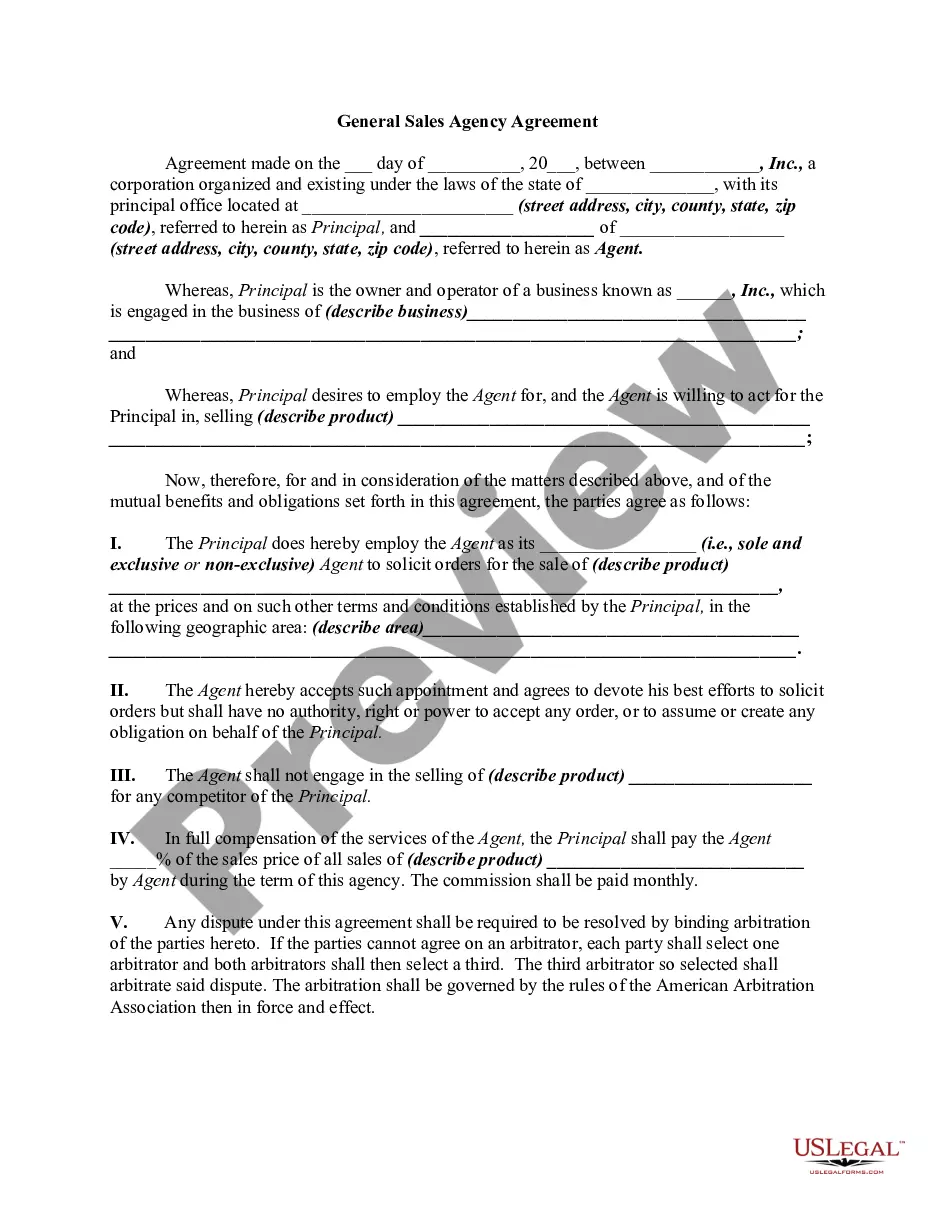
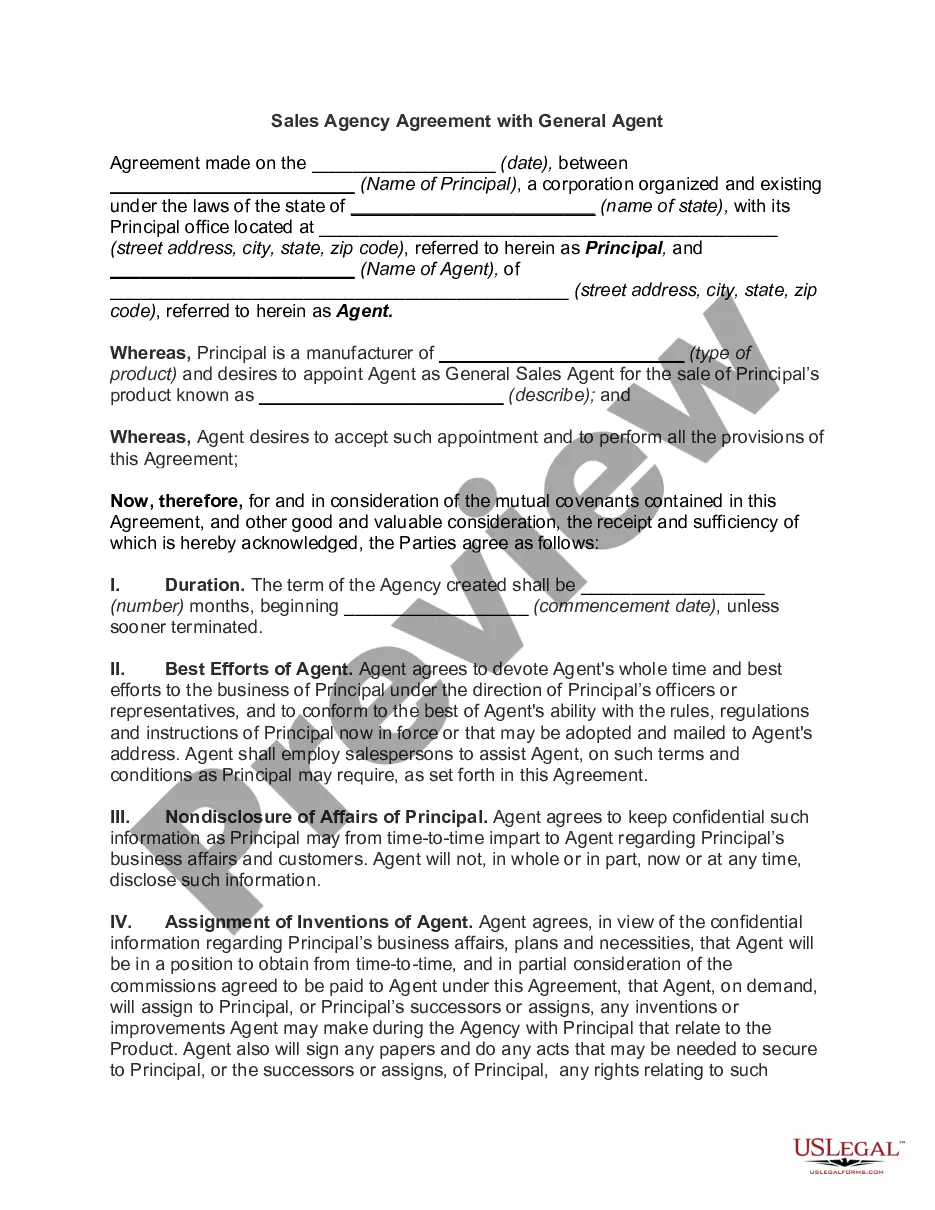
This form is an Exclusive Agency Agreement. The form provides that the company and agent have agreed to enter into a contract. The company has agreed to appoint the agent as its exclusive agent for the purposes listed in the form.
Connecticut Agency Agreement - General
Instant download
Description
Free preview
Get your form ready online
Our built-in tools help you complete, sign, share, and store your documents in one place.
Built-in online Word editor
Make edits, fill in missing information, and update formatting in US Legal Forms—just like you would in MS Word.
Export easily
Download a copy, print it, send it by email, or mail it via USPS—whatever works best for your next step.
E-sign your document
Sign and collect signatures with our SignNow integration. Send to multiple recipients, set reminders, and more. Go Premium to unlock E-Sign.
Notarize online 24/7
If this form requires notarization, complete it online through a secure video call—no need to meet a notary in person or wait for an appointment.
Store your document securely
We protect your documents and personal data by following strict security and privacy standards.

Make edits, fill in missing information, and update formatting in US Legal Forms—just like you would in MS Word.

Download a copy, print it, send it by email, or mail it via USPS—whatever works best for your next step.

Sign and collect signatures with our SignNow integration. Send to multiple recipients, set reminders, and more. Go Premium to unlock E-Sign.

If this form requires notarization, complete it online through a secure video call—no need to meet a notary in person or wait for an appointment.

We protect your documents and personal data by following strict security and privacy standards.
Looking for another form?






How to fill out Agency Agreement - General?
If you require extensive, obtain, or print authentic document templates, utilize US Legal Forms, the largest collection of legal documents available online.
Take benefit of the site’s easy and convenient search to acquire the materials you need.
Numerous templates for business and personal purposes are organized by categories and states, or keywords.
Step 4. Once you have found the form you need, select the Purchase Now button. Choose the pricing plan you prefer and enter your credentials to sign up for an account.
Step 5. Complete the transaction. You can use your credit card or PayPal account to process the payment.Step 6. Choose the format of your legal document and download it to your device. Step 7. Complete, modify, and print or sign the Connecticut Agency Agreement - General. Every legal document template you purchase is yours permanently. You can access every form you saved in your account. Go to the My documents section and select a form to print or download again.
- Use US Legal Forms to acquire the Connecticut Agency Agreement - General with a few clicks.
- If you are already a US Legal Forms user, Log In to your account and click the Download button to find the Connecticut Agency Agreement - General.
- You can also access forms you previously saved in the My documents tab of your account.
- If this is your first time using US Legal Forms, follow the steps below.
- Step 1. Ensure you have chosen the form for the correct city/state.
- Step 2. Use the Preview option to review the form's content. Don’t forget to read the details.
- Step 3. If you are not satisfied with the form, use the Search field at the top of the screen to find alternative versions of the legal form template.
Form popularity
FAQ
Using one agent for both buying and selling might seem like the easiest solution, but that's true only if your agent is up to the task on both ends of the sale. This means your agent is comfortable with representing you as both a seller and a buyer, and also that she's familiar with both neighborhoods.
Sub-agency is illegal in Connecticut. A dual agent is required to act in the best interests of both the seller and the buyer. Dual agency consent can be obtained at the time an agency agreement is signed. A designated agent only represents one party and is not a dual agent.
The most common is the Exclusive Right to Sell or Lease Listing Agreement. The means there is an agency agreement between the seller and the broker, granting the broker the exclusive right to represent the seller in the sale or lease of the seller's property.
For in-house sales, where only one brokerage firm is involved, the brokerage firm can represent both the buyer and seller as a dual agent, provided that this consent is obtained. The forms provide guidance as to what type of disclosures cannot be made in a dual agency relationship.
Dual agent A real estate agent may act as a double agent representing both the buyer and the seller in a real estate transaction but only with both parties' express consent. A dual agent shall be neutral concerning any conflicting interests of the seller and buyer.
Sub-agency is illegal in Connecticut. A dual agent is required to act in the best interests of both the seller and the buyer. Dual agency consent can be obtained at the time an agency agreement is signed. A designated agent only represents one party and is not a dual agent.
Types of agency agreementsExclusive agency agreements. Exclusive agency agreements are commonly used for the sale of residential property.Sole agency agreements. A sole agency agreement is similar to an exclusive agency agreement.General listing / open agency agreement.Multiple listing.Auction agency agreement.
To protect your finances and ensure you are selling or buying at the best possible price, it is probably best to avoid dual agency. Buyers or sellers may be inclined to work with a dual agent because they want to obtain confidential information about the person buying or selling the home.
Connecticut has a law that requires agents and buyers to sign an agreement in order to show a home that is not listed by the agent's brokerage. Agents who do not have buyers sign a representation agreement are breaking the law!