Connecticut Quitclaim Deed - Two Individuals to One Individual

What this document covers
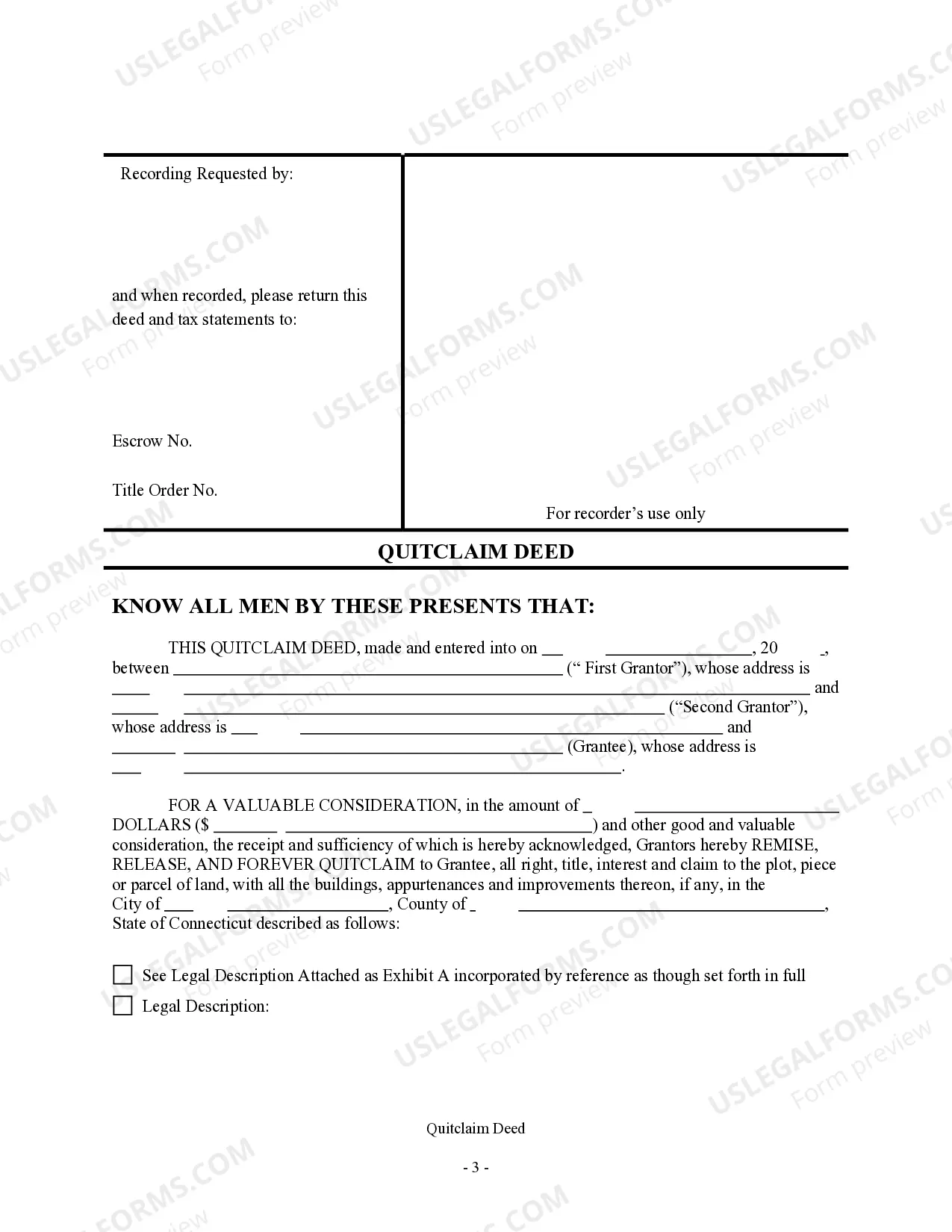
The Quitclaim Deed - Two Individuals to One Individual is a legal document used to transfer ownership of real estate from two grantors (individuals) to one grantee (individual). Unlike other types of deeds, a quitclaim deed does not guarantee that the property title is clear; it simply conveys the grantors' interest in the property. This form is commonly used in situations where the grantors wish to relinquish their rights without making any promises regarding the ownership status of the property.
Key components of this form
- Identification of Grantors: Details about the two individuals transferring their property rights.
- Identification of Grantee: Information about the individual receiving the property.
- Description of Property: A clear and detailed description of the property being transferred.
- Intent to Convey: A statement that confirms the grantors are willing to transfer their interests in the property.
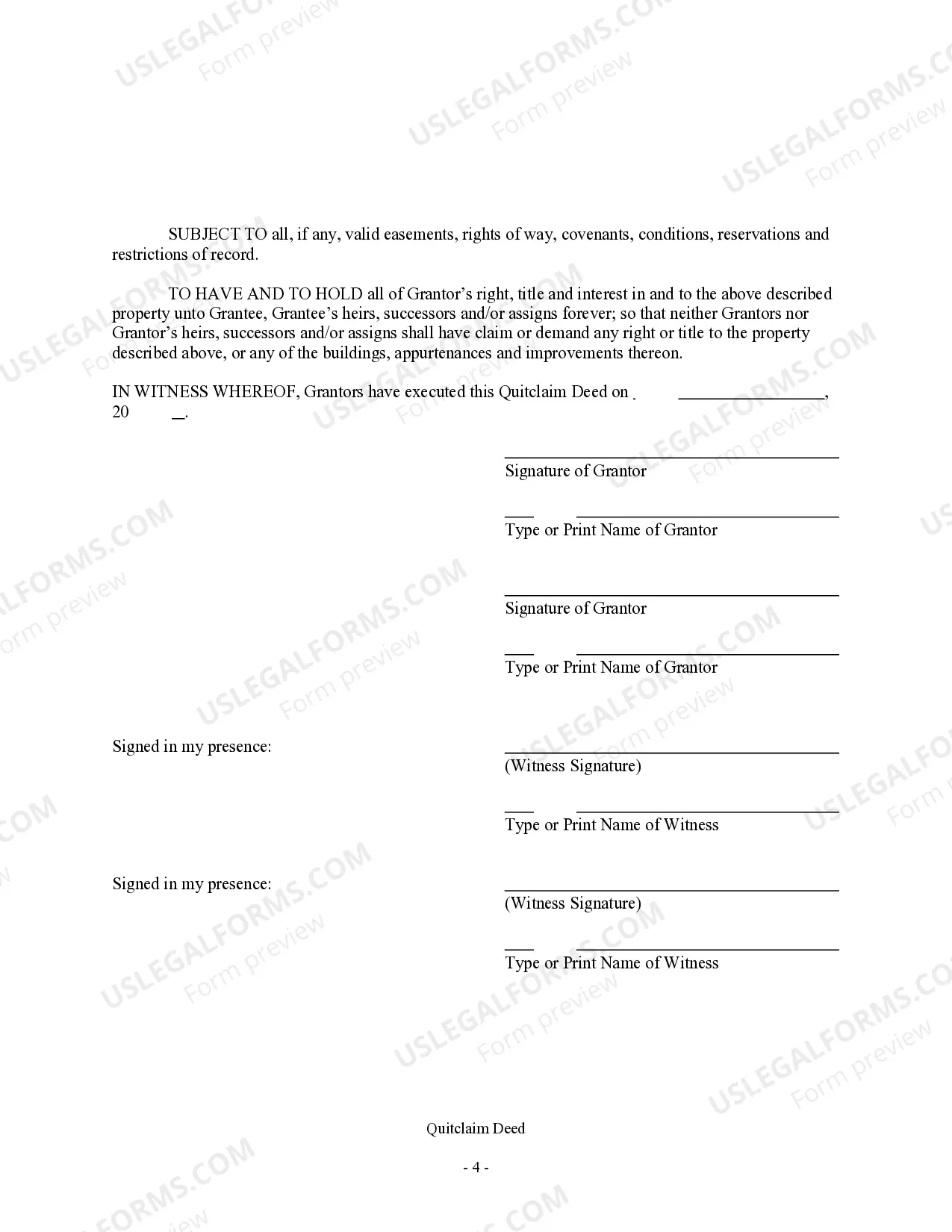
- Signatures: The required signatures of the grantors to validate the deed.








When to use this document
This form is needed in scenarios such as when two owners decide to transfer their interests in a property to a single individual, which can occur in relationships like divorce settlements, family property transfers, or estate distributions. It is essential to employ this deed when the grantors wish to relinquish their claims to the property without providing any further warranties about the title.
Who should use this form
This form is suitable for:
- Individuals who jointly own property and want to transfer their interests to a single person.
- People involved in settling an estate or divorce where property division is necessary.
- Any individual who requires a simple property transfer without warranty of title.
Instructions for completing this form
- Identify the parties involved as grantors and grantee.
- Clearly specify the property being transferred.
- Include the date of the transaction.
- Obtain signatures from both grantors.
- Consider notarizing the deed for added legal protection.
Does this form need to be notarized?
This form needs to be notarized to ensure legal validity. US Legal Forms provides secure online notarization powered by Notarize, allowing you to complete the process through a verified video call, available anytime.
Get your form ready online
Our built-in tools help you complete, sign, share, and store your documents in one place.
Make edits, fill in missing information, and update formatting in US Legal Forms—just like you would in MS Word.
Download a copy, print it, send it by email, or mail it via USPS—whatever works best for your next step.
Sign and collect signatures with our SignNow integration. Send to multiple recipients, set reminders, and more. Go Premium to unlock E-Sign.
If this form requires notarization, complete it online through a secure video call—no need to meet a notary in person or wait for an appointment.
We protect your documents and personal data by following strict security and privacy standards.

Make edits, fill in missing information, and update formatting in US Legal Forms—just like you would in MS Word.

Download a copy, print it, send it by email, or mail it via USPS—whatever works best for your next step.

Sign and collect signatures with our SignNow integration. Send to multiple recipients, set reminders, and more. Go Premium to unlock E-Sign.

If this form requires notarization, complete it online through a secure video call—no need to meet a notary in person or wait for an appointment.

We protect your documents and personal data by following strict security and privacy standards.
Typical mistakes to avoid
- Failing to provide a complete and accurate property description.
- Not obtaining signatures from both grantors.
- Neglecting to consider the need for notarization in certain jurisdictions.
Benefits of completing this form online
- Convenient access to customizable templates tailored to state laws.
- Editability allows users to complete the form at their own pace.
- Secure and quick download format ensures reliable documentation.
Looking for another form?
Form popularity
FAQ
When two individuals are named on a deed, all parties have an equal share of ownership unless specified otherwise. If you need to consolidate ownership to just one person, a Connecticut Quitclaim Deed - Two Individuals to One Individual can facilitate this change. This process allows one owner to transfer their interest, making the remaining individual the sole owner. It is an essential step to ensure that ownership rights are clear and undisputed.
Individuals involved in personal relationships, such as family members or partners, often benefit the most from a Connecticut Quitclaim Deed - Two Individuals to One Individual. This tool is particularly useful for resolving ownership disputes or transferring property rights with minimal friction. People who want to simplify property ownership transfers or ensure that one party holds sole rights find this option advantageous. By using this deed, you can foster clarity and avoid potential conflicts.
The typical reason for using a Connecticut Quitclaim Deed - Two Individuals to One Individual is transferring ownership rights without complex legal procedures. This deed allows one party to relinquish their interest in a property to another, ensuring a straightforward transition. People often utilize it during family matters like divorce or to add or remove individuals from the deed. It's a simple solution for those looking to clarify ownership.
To remove someone from a deed in Connecticut, you should draft a new Connecticut Quitclaim Deed - Two Individuals to One Individual, indicating the change in ownership. Both parties usually need to agree on this transfer, and it should be recorded to be effective. Legal assistance can simplify this process, ensuring that all necessary steps are completed correctly. US Legal Forms offers resources to assist you in preparing the required documents.
Evicting someone whose name is on the deed can be challenging, as they have legal ownership rights. The Connecticut Quitclaim Deed - Two Individuals to One Individual grants both parties certain rights to the property. Therefore, legal processes must be followed strictly to remove a co-owner. Consider consulting with a legal expert to discuss your options and ensure compliance with local laws.
To remove someone's name from a property deed, you can execute a new Connecticut Quitclaim Deed - Two Individuals to One Individual, transferring the property to the remaining owner. This process typically requires both parties' consent, especially if there are any financial obligations. Consulting professionals can help navigate the associated legal intricacies efficiently. US Legal Forms provides templates that simplify this process.
The disadvantages of a quitclaim deed primarily stem from the lack of warranties associated with it. Using the Connecticut Quitclaim Deed - Two Individuals to One Individual means accepting the property’s condition without any title guarantees. This puts the buyer at risk for unseen debts or claims on the property. Additionally, this type of deed may not be appropriate for significant transactions or for transferring property between strangers.
The Connecticut Quitclaim Deed - Two Individuals to One Individual allows for flexibility in the number of individuals involved. While it often includes two grantors transferring to one grantee, you can include additional names. Just remember that including multiple parties can complicate ownership and responsibilities. Clarity on everyone's role is vital for a smooth transaction.
A quitclaim deed can be problematic because it offers no guarantee about the title's status. When using the Connecticut Quitclaim Deed - Two Individuals to One Individual, the buyer accepts the property 'as is,' which may include existing liens or claims. This can leave the buyer in a vulnerable position if issues arise after the transfer. It is essential to evaluate these risks before engaging in a quitclaim transaction.
Quitclaim deeds, such as the Connecticut Quitclaim Deed - Two Individuals to One Individual, are sometimes viewed negatively due to the lack of warranties. Unlike other types of deeds, a quitclaim deed does not guarantee the grantor's ownership or the absence of liens on the property. This means buyers should perform due diligence, as they could inherit potential problems. Awareness of these risks is crucial when considering a quitclaim deed.