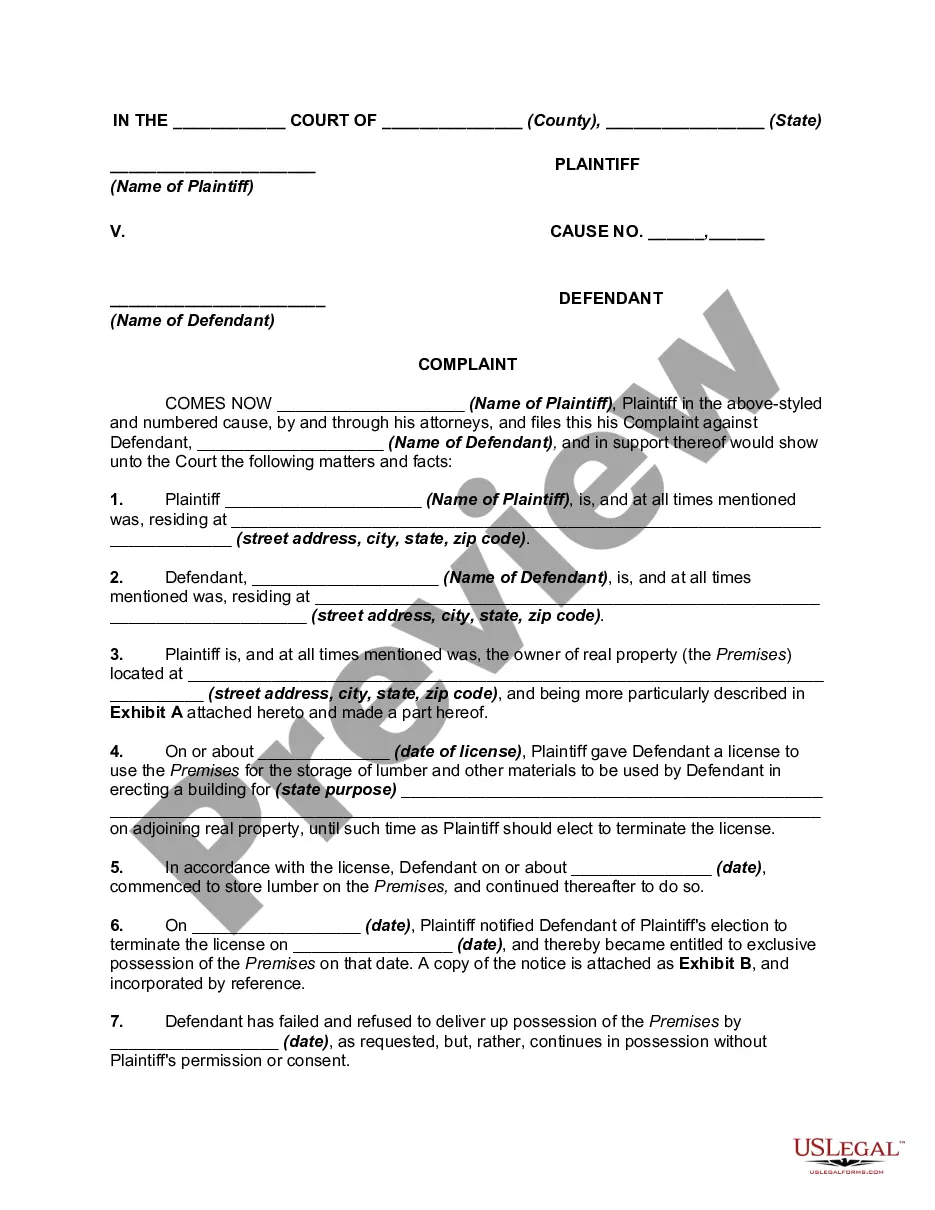
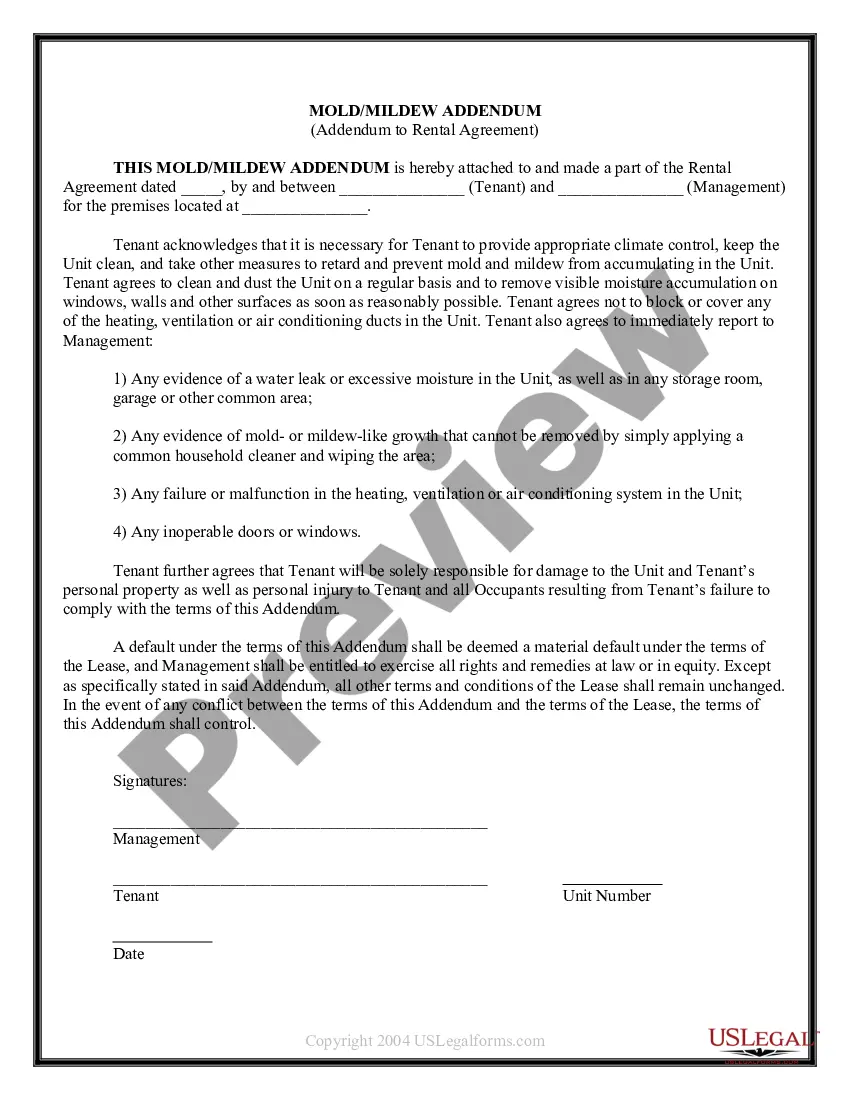
Addendum to rental agreement addressing mold/mildew issues.
Colorado Addendum To Apartment Lease regarding Mold
State:
Multi-State
Control #:
US-891LT
Format:
Word;
Rich Text
147 downloads
Description
Get your form ready online
Our built-in tools help you complete, sign, share, and store your documents in one place.
Built-in online Word editor
Make edits, fill in missing information, and update formatting in US Legal Forms—just like you would in MS Word.
Export easily
Download a copy, print it, send it by email, or mail it via USPS—whatever works best for your next step.
E-sign your document
Sign and collect signatures with our SignNow integration. Send to multiple recipients, set reminders, and more. Go Premium to unlock E-Sign.
Notarize online 24/7
If this form requires notarization, complete it online through a secure video call—no need to meet a notary in person or wait for an appointment.
Store your document securely
We protect your documents and personal data by following strict security and privacy standards.

Make edits, fill in missing information, and update formatting in US Legal Forms—just like you would in MS Word.

Download a copy, print it, send it by email, or mail it via USPS—whatever works best for your next step.

Sign and collect signatures with our SignNow integration. Send to multiple recipients, set reminders, and more. Go Premium to unlock E-Sign.

If this form requires notarization, complete it online through a secure video call—no need to meet a notary in person or wait for an appointment.

We protect your documents and personal data by following strict security and privacy standards.
Looking for another form?

How to fill out Addendum To Apartment Lease Regarding Mold?
Selecting the appropriate authorized documents template can be challenging.
Of course, there are numerous designs accessible online, but how can you locate the legal form you need.
Utilize the US Legal Forms website.
First, ensure you have selected the correct form for your area/region. You can browse the form using the Review button and read the form description to confirm it is the right one for you. If the form does not meet your needs, utilize the Search feature to find the correct form. When you are confident the form is suitable, click the Purchase now button to obtain the form. Choose the payment plan you want and enter the required information. Create your account and pay for your order using your PayPal account or credit card. Select the format and download the legal document template to your device. Complete, modify, print, and sign the obtained Colorado Addendum To Apartment Lease concerning Mold. US Legal Forms is the largest collection of legal forms where you can find various document templates. Leverage the service to download professionally crafted documents that comply with state requirements.
- The platform offers a vast array of templates, including the Colorado Addendum To Apartment Lease concerning Mold, suitable for both business and personal purposes.
- All forms are verified by professionals, ensuring compliance with federal and state regulations.
- If you are already registered, Log In to your account and click the Acquire button to obtain the Colorado Addendum To Apartment Lease concerning Mold.
- Use your account to review the legal documents you may have purchased previously.
- Go to the My documents section of your account to download another copy of any documents you need.
- If you are a new user of US Legal Forms, here are simple steps for you to follow.
Form popularity
FAQ
A minor mold issue won't provide tenants with ample legal justification to stop paying rent.
Whether mould is considered to be fair wear and tear depends on the cause. If there is evidence to show that the mould has been caused by the negligence of the tenants and advice and regular maintenance has been supplied by the landlord or letting agent, then compensation can be claimed.
If the problem relates to a nonemergency repair, a landlord has 96 hours to start fixing the problem. If the issue is mold, a landlord must respond within 96 hours with a plan to contain the mold, stop the water sources causing the mold and install an air filter.
More specifically, the bill states that a residential premises is uninhabitable if there is mold that is associated with dampness, or there is any other condition causing the residential premises to be damp, which condition, if not remedied, would materially interfere with the health or safety of the tenant, excluding
Tenant Self-Help Strategies in ColoradoThe first, known as "rent withholding," is when tenants decide to stop paying rent, claiming the mold has made their apartment uninhabitable.
Technically, there's no state law that gives tenants the right to withhold rent. But the law does protect tenants from eviction if they stop paying rent when their landlord violates Colorado's implied warranty of habitabilityin essence, creating the right to withhold rent in a backdoor way.