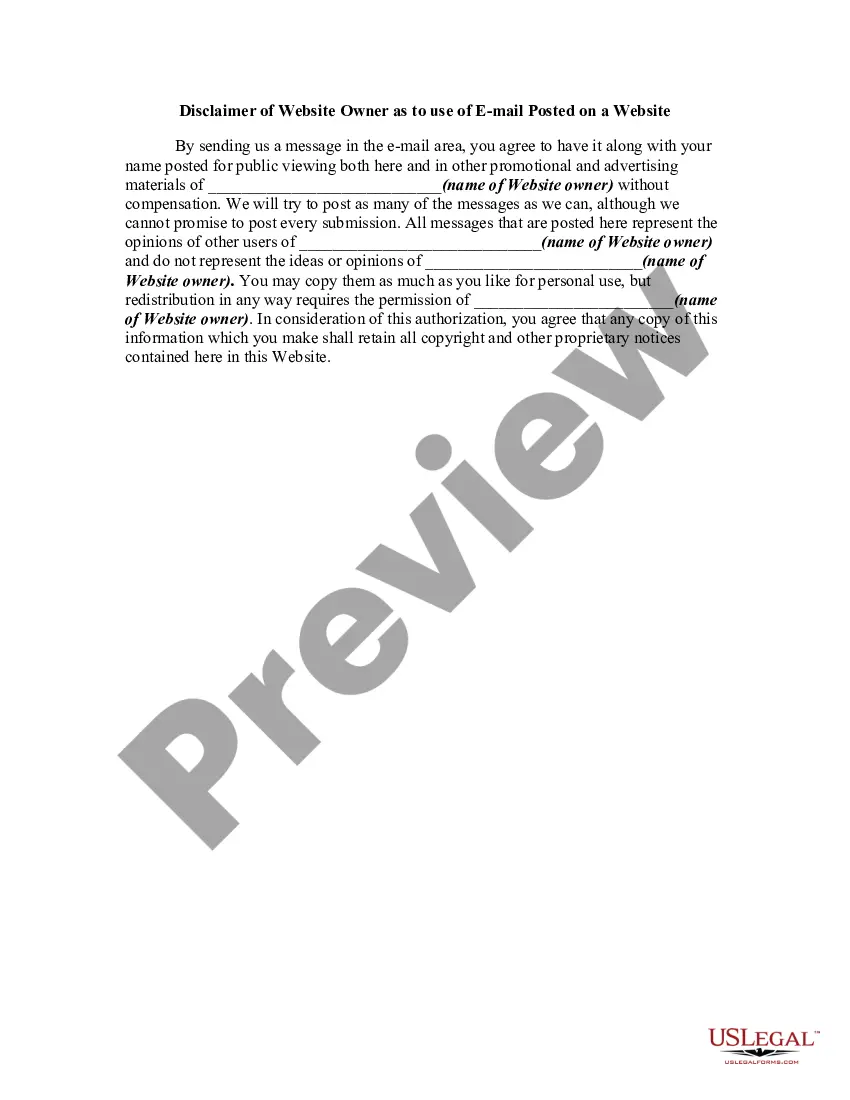
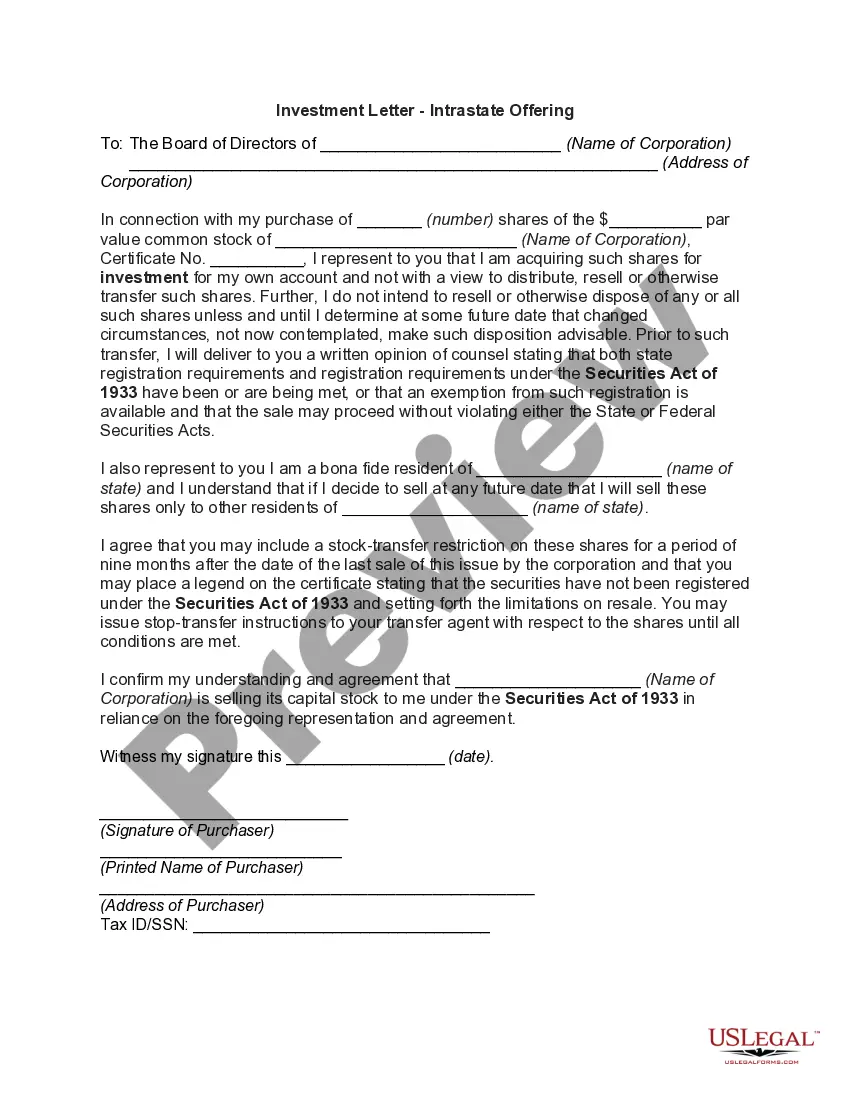
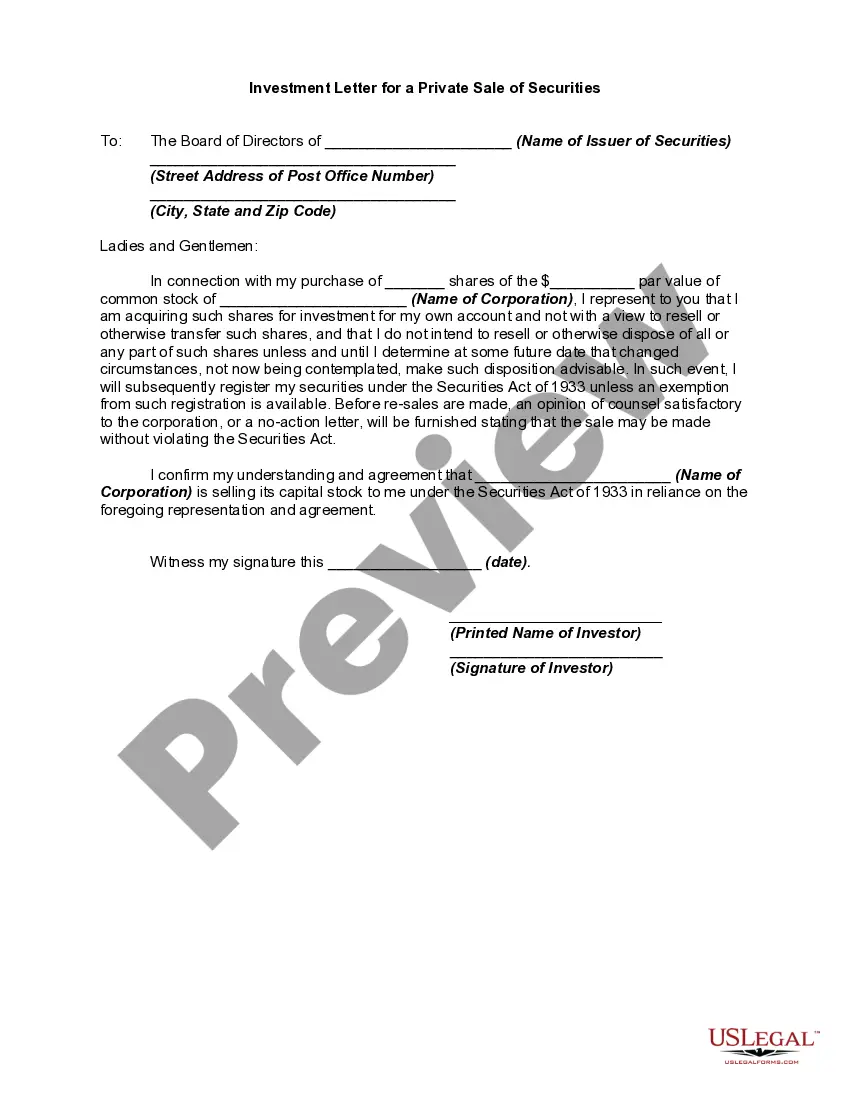
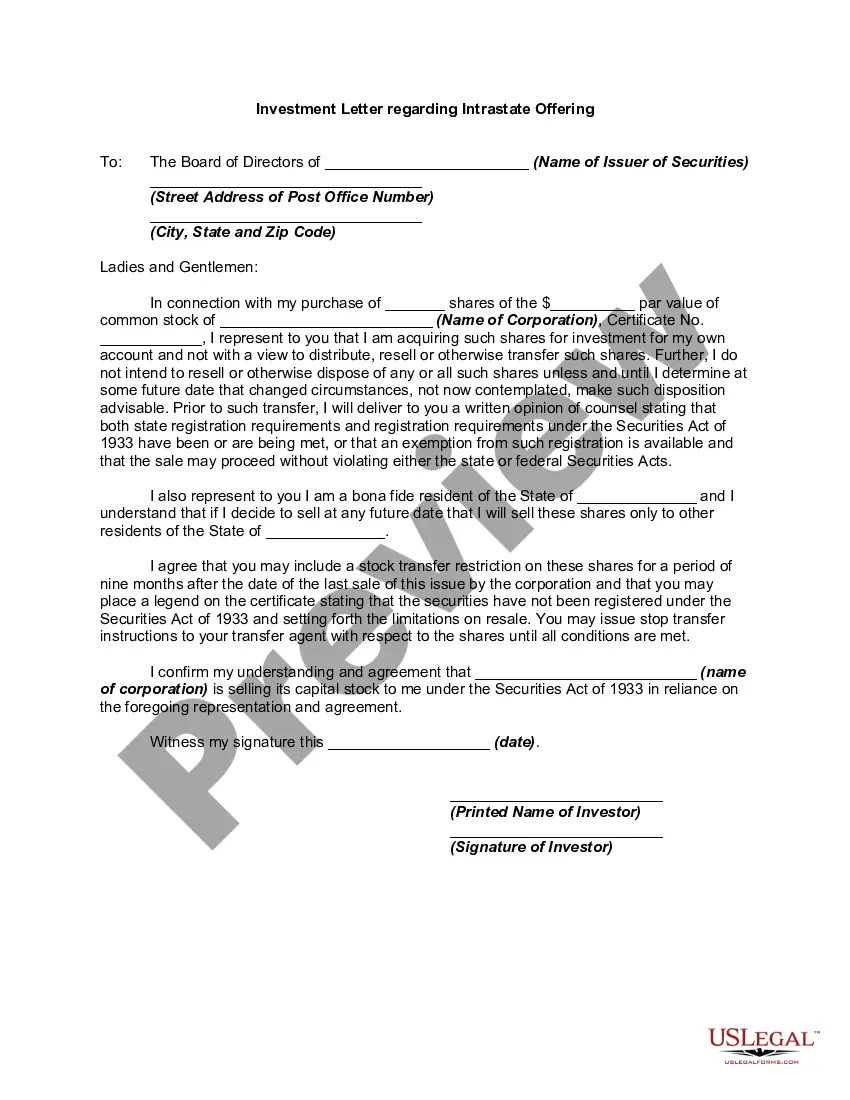
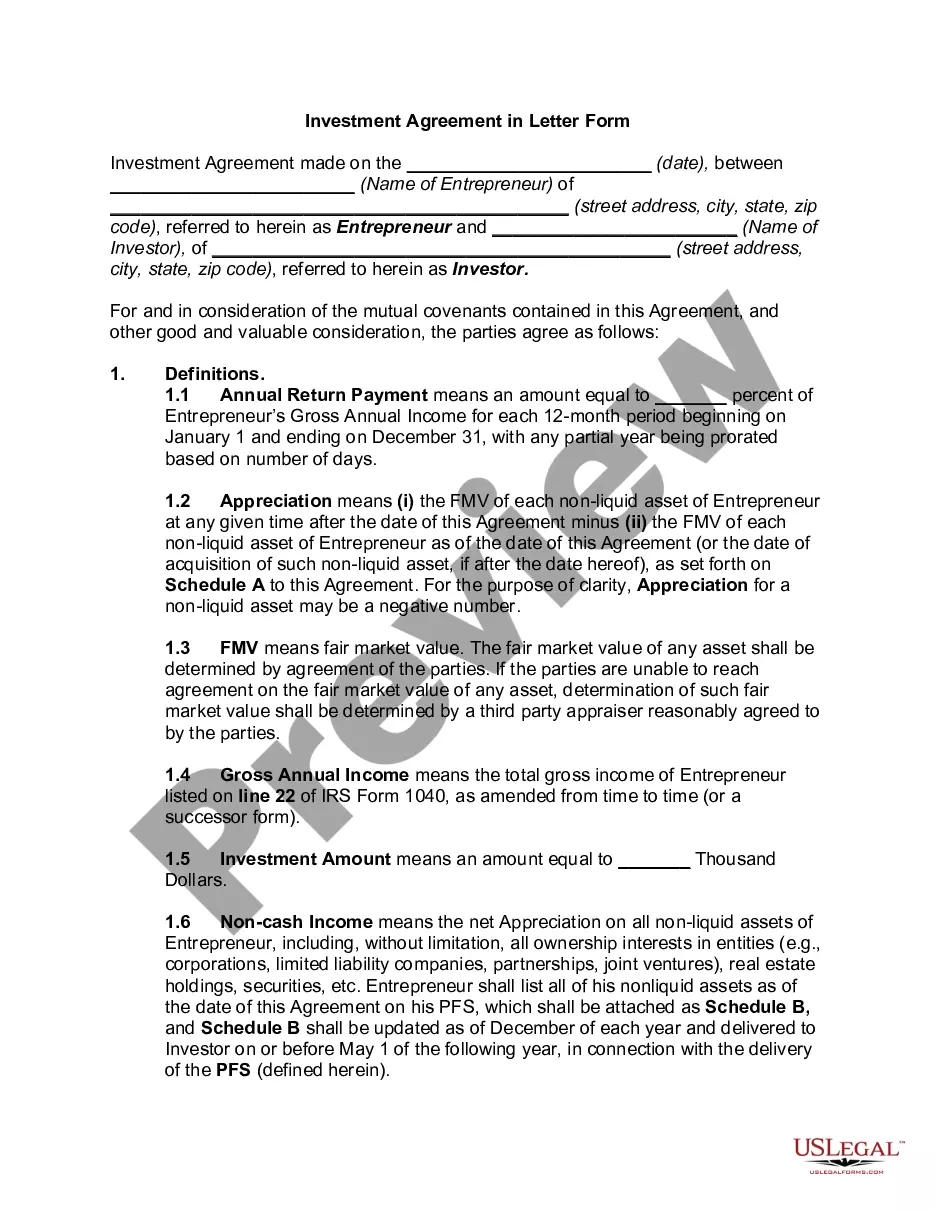
Colorado Investment Letter - Intrastate Offering
Description
Get your form ready online
Our built-in tools help you complete, sign, share, and store your documents in one place.
Make edits, fill in missing information, and update formatting in US Legal Forms—just like you would in MS Word.
Download a copy, print it, send it by email, or mail it via USPS—whatever works best for your next step.
Sign and collect signatures with our SignNow integration. Send to multiple recipients, set reminders, and more. Go Premium to unlock E-Sign.
If this form requires notarization, complete it online through a secure video call—no need to meet a notary in person or wait for an appointment.
We protect your documents and personal data by following strict security and privacy standards.

Make edits, fill in missing information, and update formatting in US Legal Forms—just like you would in MS Word.

Download a copy, print it, send it by email, or mail it via USPS—whatever works best for your next step.

Sign and collect signatures with our SignNow integration. Send to multiple recipients, set reminders, and more. Go Premium to unlock E-Sign.

If this form requires notarization, complete it online through a secure video call—no need to meet a notary in person or wait for an appointment.

We protect your documents and personal data by following strict security and privacy standards.
Looking for another form?

How to fill out Investment Letter - Intrastate Offering?
Have you ever found yourself in a situation where you require documentation for various business or particular purposes almost every day.
There are numerous legal document templates accessible online, but locating ones you can trust isn't easy.
US Legal Forms provides thousands of form templates, such as the Colorado Investment Letter - Intrastate Offering, which are designed to fulfill state and federal requirements.
Once you find the correct form, click Purchase now.
Choose the payment plan you prefer, fill in the necessary information to create your account, and pay for the order using your PayPal or credit card.
- If you are already familiar with the US Legal Forms website and have an account, simply Log In.
- After that, you can download the Colorado Investment Letter - Intrastate Offering template.
- If you do not have an account and wish to start using US Legal Forms, follow these instructions.
- Find the form you require and ensure it is for the correct area/region.
- Use the Review button to examine the form.
- Check the description to make sure you have selected the right form.
- If the form isn't what you're looking for, utilize the Search field to find the form that suits your needs.
Form popularity
FAQ
An example of an intrastate offering might be a Colorado-based company that raises funds by selling shares exclusively to Colorado residents. This falls under the Colorado Investment Letter - Intrastate Offering, helping businesses connect directly with local investors. Such offerings create a community-focused investment climate.
Section 11-51-308 is part of Colorado's securities statutes that outlines provisions for intrastate offerings. This section is significant for businesses looking to utilize the Colorado Investment Letter - Intrastate Offering, as it provides a legal framework for local securities sales. Familiarity with this section can help entities navigate compliance effectively.
An unregistered mutual fund is a general name given to investment companies that are not formally registered with the Securities and Exchange Commission (SEC). On some occasions, these companies are actually breaking the law by running unregistered investment portfolios.
2 Section 3(a)(11) of the Securities Act is generally known as the intrastate offering exemption. To qualify for the exemption, an issuer must be organized in the state where it is offering the securities; carry out a significant amount of its business in that state; and make offers and sales only to residents of
Rule 144 provides an exemption and permits the public resale of restricted or control securities if a number of conditions are met, including how long the securities are held, the way in which they are sold, and the amount that can be sold at any one time.
Rule 504 of Regulation D exempts from registration the offer and sale of up to $10 million of securities in a 12-month period. A company is required to file a notice with the Commission on Form D within 15 days after the first sale of securities in the offering.
Unregistered shares have fewer investor protections and pose different kinds of risks than registered securities. As a result, companies can only sell unregistered shares to "qualified investors." To be considered a "qualified investor," you must be a high-net-worth individual (HNWI) or a high-income investor.
In order to be exempt from SEC regulations, intrastate offerings must meet the following requirements: It must be sold and offered only to residents of the state in which it is issued; The issuing company must be registered in that state; The company must do a significant amount of business in the state; and.
An unregistered offering is the offer and sale of securities in a transaction that is not registered with the Securities and Exchange Commission (the SEC) under Section 5 of the Securities Act of 1933, as amended (the Securities Act), in reliance on an exemption from registration under that act.
Under the federal securities laws, any offer or sale of a security must either be registered with the SEC or meet an exemption. Regulation A is an exemption from the registration requirements, allowing companies to offer and sell their securities without having to register the offering with the SEC.