Colorado Visitor Nondisclosure Agreement
Description



How to fill out Visitor Nondisclosure Agreement?
It is feasible to spend time online looking for the legal document template that satisfies the federal and state requirements you need.
US Legal Forms offers thousands of legal templates that have been reviewed by professionals.
You can easily obtain or create the Colorado Visitor Nondisclosure Agreement from the platform.
If applicable, use the Preview button to view the document template as well.
- If you already possess a US Legal Forms account, you can Log In and click on the Download button.
- After that, you can fill out, modify, print, or sign the Colorado Visitor Nondisclosure Agreement.
- Every legal document template you acquire is yours permanently.
- To obtain another copy of any purchased form, go to the My documents section and click on the appropriate button.
- If you are using the US Legal Forms website for the first time, follow the simple instructions provided below.
- First, ensure that you have chosen the correct document template for the state/city of your choice.
- Review the form description to confirm that you have selected the accurate form.
Form popularity
FAQ
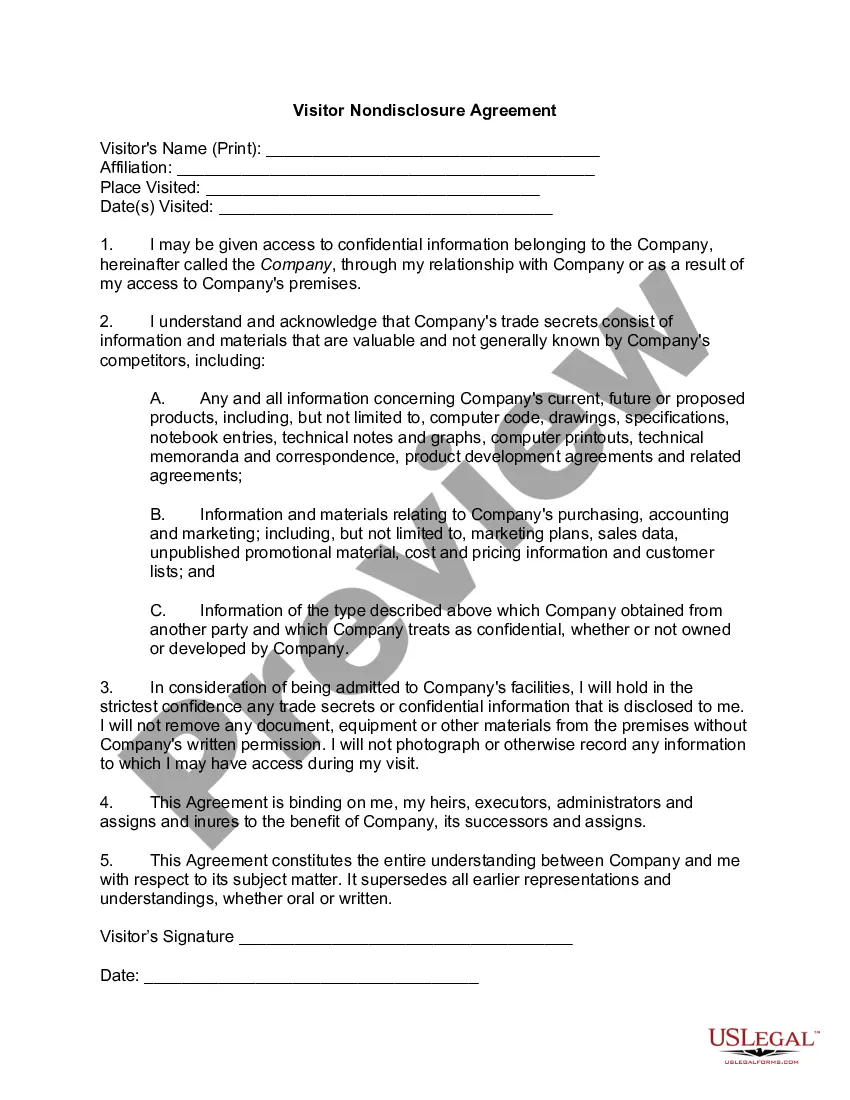
A Colorado Visitor Nondisclosure Agreement is a legal document used to protect sensitive information shared with visitors, such as guests, contractors, or consultants. This agreement prevents visitors from disclosing confidential information learned during their interaction with a company. By using a well-defined NDA, businesses can safeguard their intellectual property and trade secrets. Platforms like US Legal Forms can help you create an NDA tailored to your needs.
Yes, NDAs are enforceable in Colorado, as long as they comply with state law. The Colorado Visitor Nondisclosure Agreement needs to adequately define the confidential information, restrictions, and terms regarding the agreement. It is critical to ensure all parties understand the implications of the NDA. Utilizing services like US Legal Forms can assist in crafting an effective and enforceable NDA.
Non-compete agreements in Colorado have specific restrictions and are not universally enforceable. Colorado law requires that these agreements protect a legitimate business interest, not impose undue hardship on the employee. Therefore, if you are considering drafting a non-compete or a Colorado Visitor Nondisclosure Agreement, seeking guidance from resources like US Legal Forms will provide clarity on enforceability.
Yes, non-disclosure agreements are generally enforceable in Colorado, provided they meet certain legal requirements. The Colorado Visitor Nondisclosure Agreement must clearly define what information is confidential. Additionally, it should include the duration of confidentiality and the purpose for sharing the confidential information. To ensure your agreement is valid, consulting resources or services like US Legal Forms can help.
In the United States, there are no states where non-disclosure agreements (NDAs) are entirely illegal. However, laws vary by state, and some agreements may be restricted or void in specific contexts. It’s essential to understand the laws in your state before creating a Colorado Visitor Nondisclosure Agreement. For clarity and legal guidance, consider using platforms like US Legal Forms.
To fill out a nondisclosure agreement like the Colorado Visitor Nondisclosure Agreement, start by entering the title of the agreement at the top. Include the names and signatures of all parties to establish their commitment. Specify the type of information considered confidential and detail the duration of confidentiality. Utilizing a platform like USLegalForms can streamline this process, providing templates that simplify the completion of your NDA.
Filling in a Colorado Visitor Nondisclosure Agreement involves several essential steps. First, clearly identify the parties involved, including names and addresses. Next, define the confidential information to be protected, ensuring that both parties understand its scope. Lastly, outline any specific obligations or timeframes related to confidentiality to finalize the agreement effectively.
An example of an NDA violation occurs when a party discloses sensitive information covered by the agreement without authorization. For instance, if an employee shares proprietary company details with a competitor, this act breaches the terms of the Colorado Visitor Nondisclosure Agreement. Such violations can lead to legal consequences, emphasizing the importance of diligently protecting confidential information. Utilizing platforms like US Legal Forms can help create a solid NDA to prevent these situations.
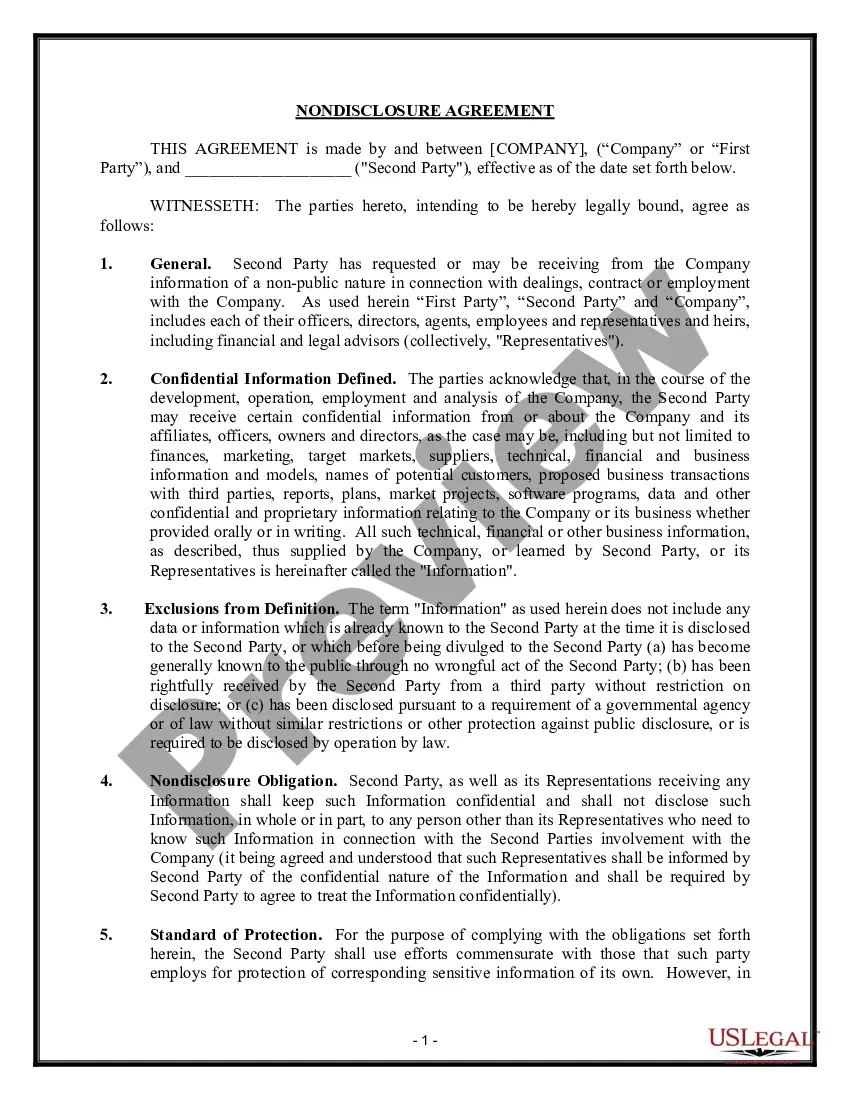
The three types of nondisclosure agreements (NDAs) include unilateral, mutual, and multilateral. A unilateral NDA involves one party disclosing information to another without expecting to share any information in return. Mutual NDAs are when both parties exchange confidential information, ensuring protection for both sides. Multilateral NDAs involve three or more parties, allowing them to share sensitive information while maintaining confidentiality through the Colorado Visitor Nondisclosure Agreement.