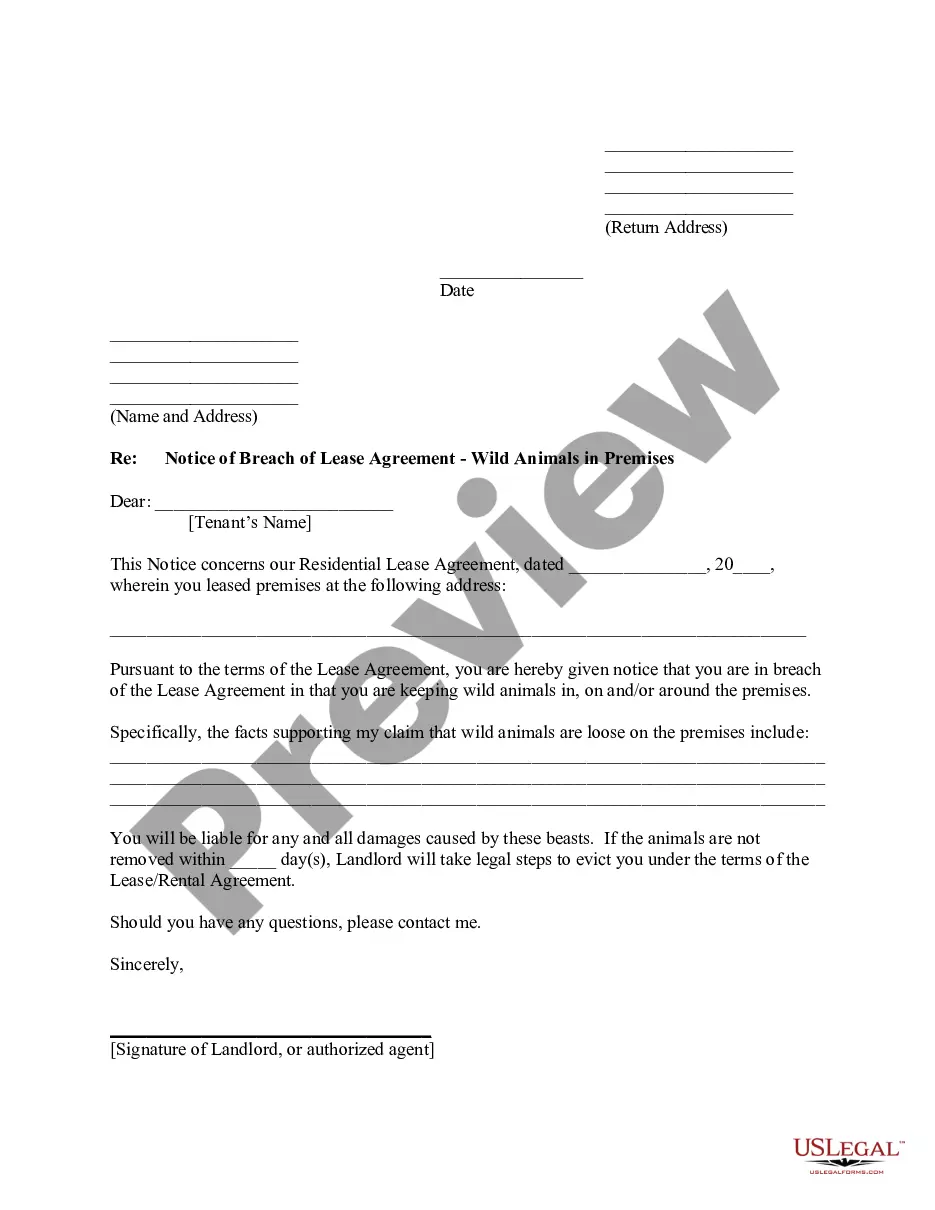
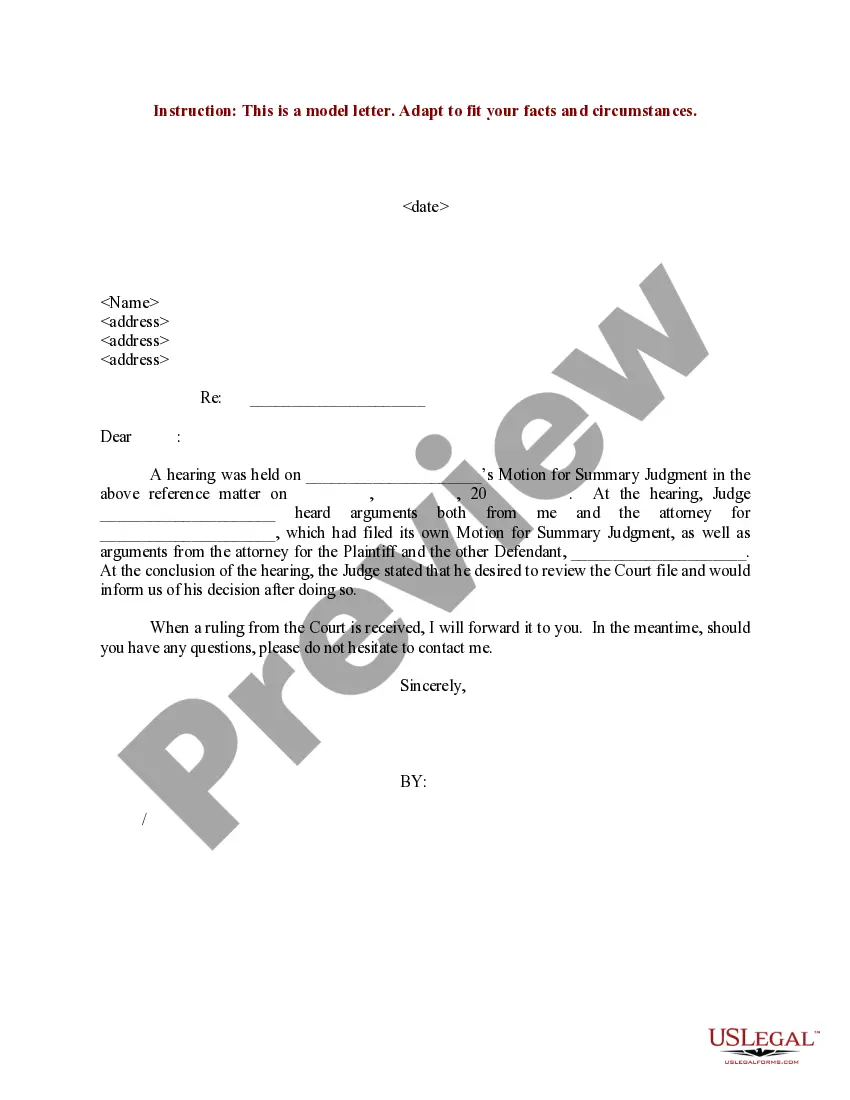
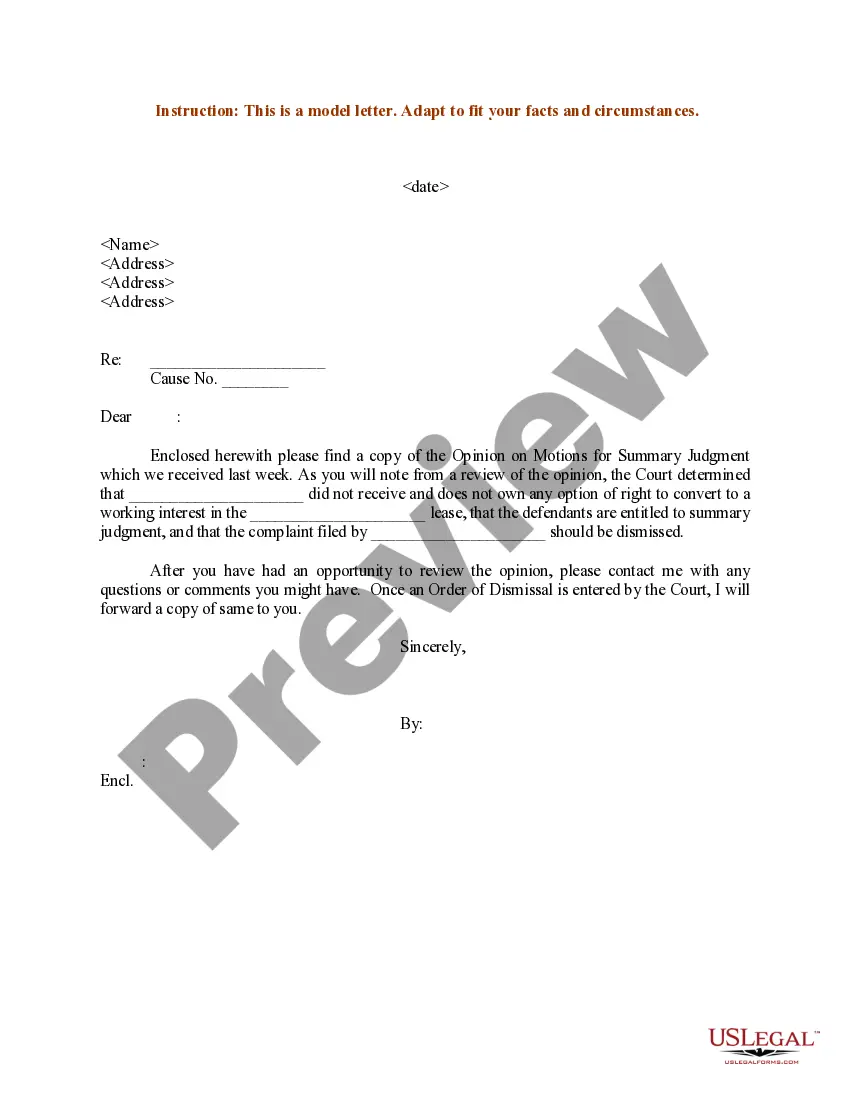
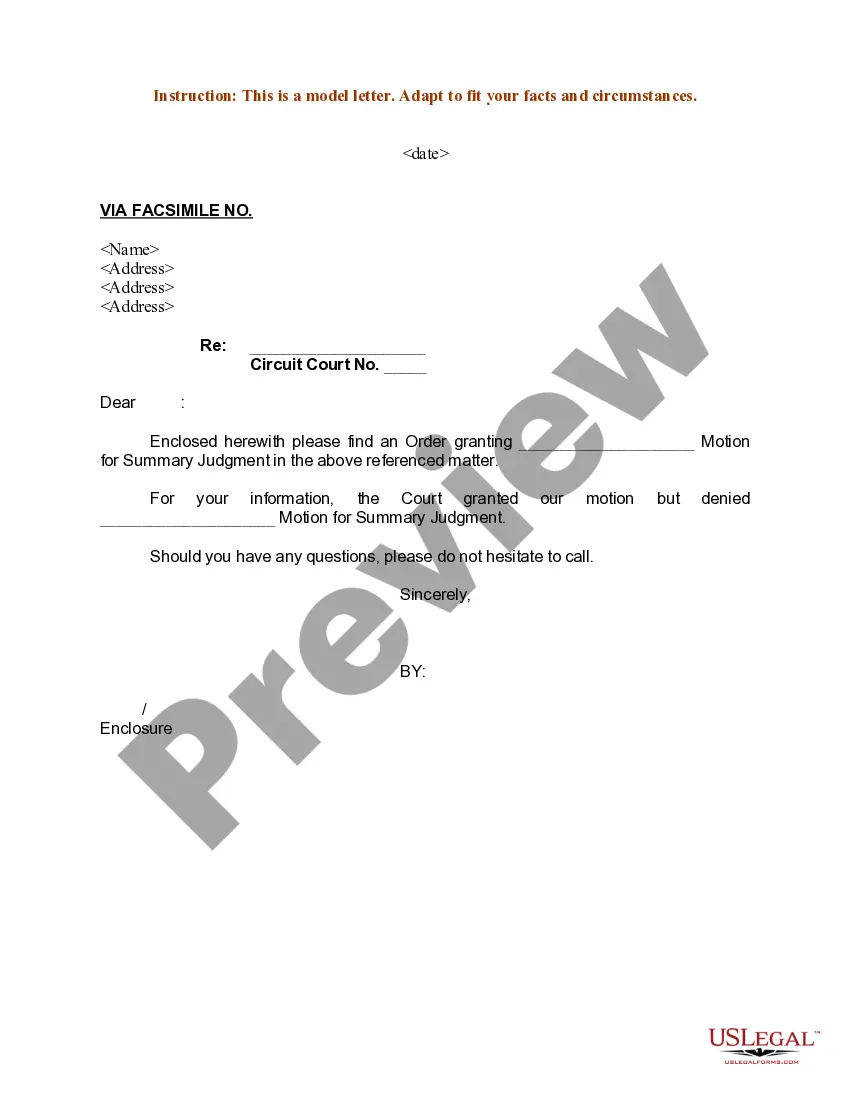
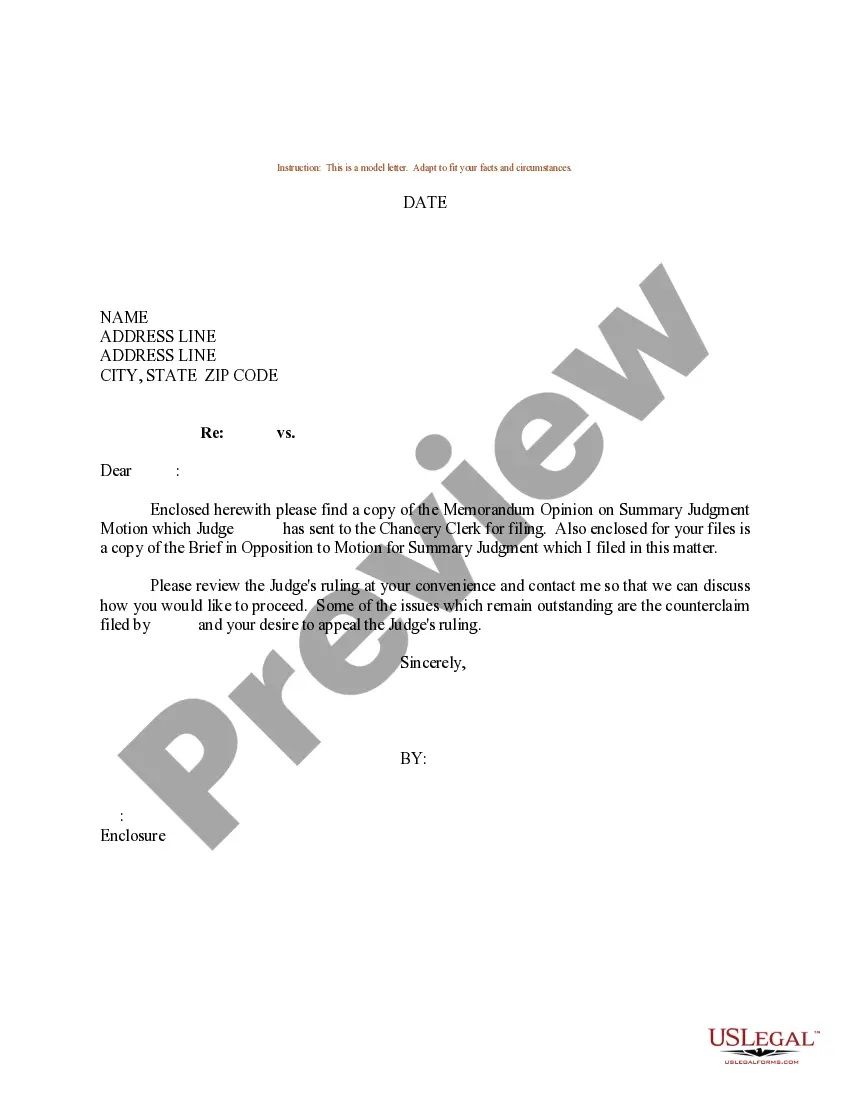
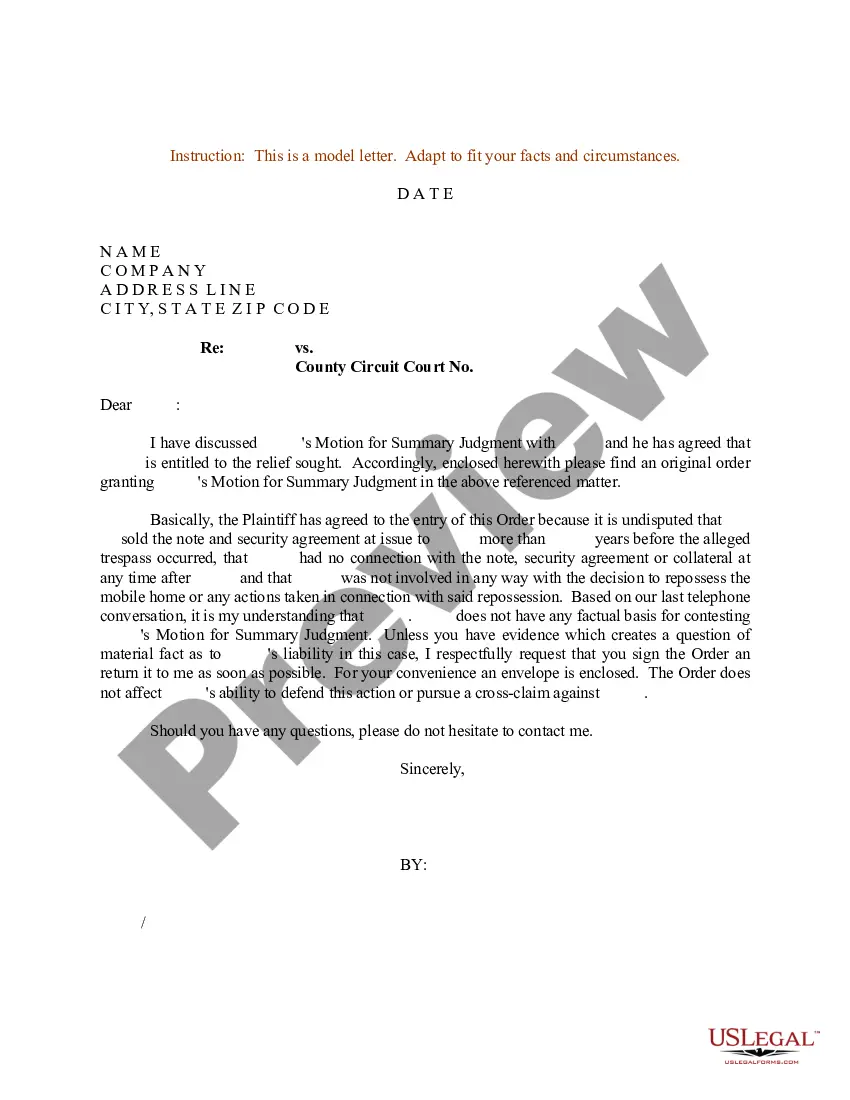
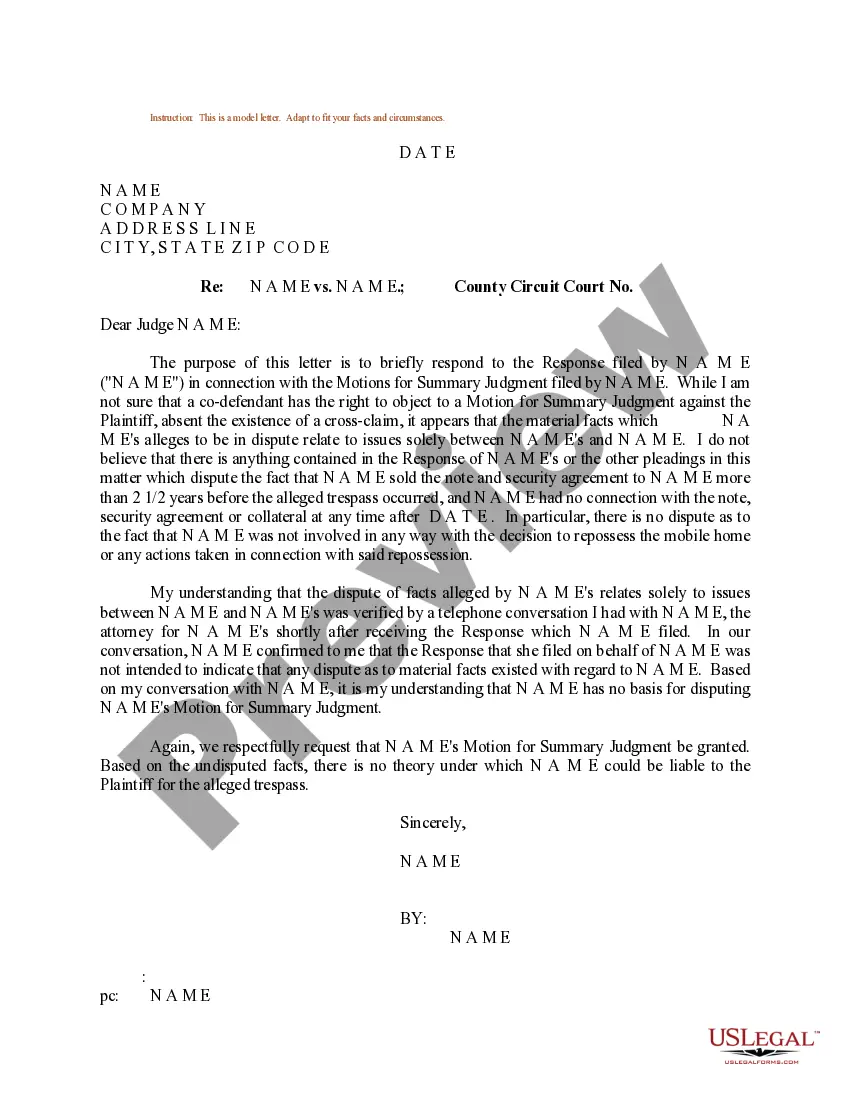
This form is a sample letter in Word format covering the subject matter of the title of the form.
Colorado Sample Letter to Client concerning Hearing on Motion of Summary Judgment
Category:
State:
Multi-State
Control #:
US-0007LTR
Format:
Word;
Rich Text
Instant download
Description
Get your form ready online
Our built-in tools help you complete, sign, share, and store your documents in one place.
Built-in online Word editor
Make edits, fill in missing information, and update formatting in US Legal Forms—just like you would in MS Word.
Export easily
Download a copy, print it, send it by email, or mail it via USPS—whatever works best for your next step.
E-sign your document
Sign and collect signatures with our SignNow integration. Send to multiple recipients, set reminders, and more. Go Premium to unlock E-Sign.
Notarize online 24/7
If this form requires notarization, complete it online through a secure video call—no need to meet a notary in person or wait for an appointment.
Store your document securely
We protect your documents and personal data by following strict security and privacy standards.

Make edits, fill in missing information, and update formatting in US Legal Forms—just like you would in MS Word.

Download a copy, print it, send it by email, or mail it via USPS—whatever works best for your next step.

Sign and collect signatures with our SignNow integration. Send to multiple recipients, set reminders, and more. Go Premium to unlock E-Sign.

If this form requires notarization, complete it online through a secure video call—no need to meet a notary in person or wait for an appointment.

We protect your documents and personal data by following strict security and privacy standards.
Looking for another form?




How to fill out Sample Letter To Client Concerning Hearing On Motion Of Summary Judgment?
Have you found yourself in a situation where you require documents for either business or personal activities almost every day.
There are numerous legal document templates available online, but finding reliable ones isn't simple.
US Legal Forms offers a vast collection of form templates, such as the Colorado Sample Letter to Client regarding Hearing on Motion of Summary Judgment, that are designed to meet federal and state requirements.
- If you are already familiar with the US Legal Forms website and have an account, simply Log In.
- After that, you can download the Colorado Sample Letter to Client regarding Hearing on Motion of Summary Judgment template.
- If you do not have an account and wish to start using US Legal Forms, follow these steps.
- Obtain the form you need and ensure it is for the correct region/state.
- Utilize the Review feature to evaluate the document.
- Check the summary to confirm you have selected the right form.
- If the form isn't what you're looking for, use the Search field to find the form that suits your needs and requirements.
- Once you find the appropriate form, click Buy now.
- Choose the payment plan you desire, fill in the necessary information to create your account, and complete the transaction with your PayPal or Visa or Mastercard.
- Select a convenient file format and download your copy.
- Find all the document templates you have purchased in the My documents section. You can download an additional copy of the Colorado Sample Letter to Client regarding Hearing on Motion of Summary Judgment anytime if needed. Click on the required form to download or print the document template.
- Use US Legal Forms, the largest collection of legal forms, to save time and avoid errors. The service offers professionally crafted legal document templates that can be used for a variety of purposes. Create an account on US Legal Forms and start making your life easier.
Form popularity
FAQ
To create a sample motion for summary judgment, begin with a title and a caption identifying the parties involved. Then, include a concise introduction, followed by the statement of facts, legal arguments, and conclusion. Ensuring clarity and precision in your writing is crucial. You can refer to a Colorado Sample Letter to Client concerning Hearing on Motion of Summary Judgment for a structured approach to this task.
A motion for summary judgment typically includes several key components: a statement of undisputed facts, legal arguments, and a request for relief. Each section should be well-organized and clearly articulated. Understanding these parts aids in crafting a persuasive motion. Moreover, a Colorado Sample Letter to Client concerning Hearing on Motion of Summary Judgment can help ensure you effectively inform your client about each aspect.
To write a good motion for summary judgment, start by clearly stating the facts of the case and the legal basis for your request. Support your arguments with evidence, such as affidavits or documents. Additionally, anticipate counterarguments from the opposing party. Utilizing a Colorado Sample Letter to Client concerning Hearing on Motion of Summary Judgment can streamline this communication process.
A Rule 59 motion in Colorado allows a party to request the court to alter or amend its judgment. This means the party believes there was a mistake in the ruling or wishes to present new evidence. Understanding this process is essential for effective legal strategy. A Colorado Sample Letter to Client concerning Hearing on Motion of Summary Judgment can guide clients on how to proceed with such motions.
A summary judgment is a legal decision made by a court without a full trial. For instance, if a party can prove there are no material facts in dispute, the court may grant a summary judgment in their favor. This process can save time and resources for all parties involved. A Colorado Sample Letter to Client concerning Hearing on Motion of Summary Judgment can help communicate this decision clearly.
1. A responding party should file additional proposed findings of fact if it needs them to defeat the motion for summary judgment. 2. The purpose of additional proposed findings of fact is to SUPPLEMENT the moving party's proposed findings of fact, not to dispute any facts proposed by the moving party.
Motion for summary judgment: The court can consider all evidence in the record, even if the evidence was not cited in the pleadings. However, the court can only consider evidence that would be admissible at trial.
The chance of success in these cases is less than 10% [1]. Another study found that summary judgment is mostly granted in Title VII cases, for example, cases involving equal pay or employment discrimination [2]. When it comes to federal cases, summary judgments are filed in 17% of total cases.
Be as persuasive as possible as you write your motion in a sequential, logical format. Express your ideas clearly, and make sure you outline what steps are necessary and how they will help your case. Use facts of the case whenever you can to avoid baseless emotional appeals.
Examples of summary judgement motions John says that Linda ran a red light and caused the crash. John happens to have a video of Linda running the red light and crashing into him. John's attorney files a motion for summary judgment claiming that: There are no material facts that can be reasonably disputed.