Colorado Quitclaim Deed - Husband and Wife to Three Individuals
About this form
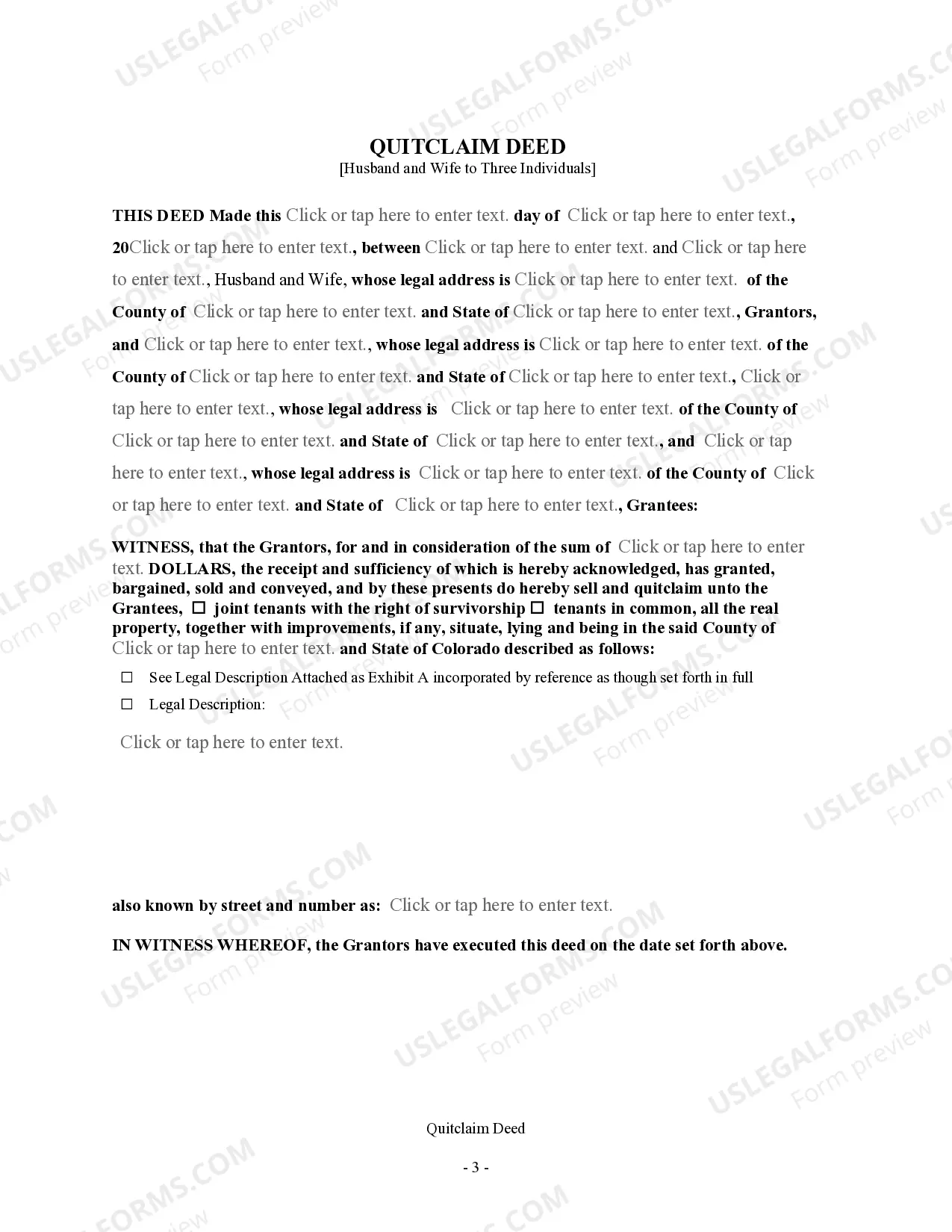
The Quitclaim Deed - Husband and Wife to Three Individuals is a legal document that allows a married couple (the grantors) to transfer their interest in a property to three individuals (the grantees). This form conveys ownership without warranty, meaning the grantors do not guarantee the title's validity. It offers flexibility as grantees can hold the property either as tenants in common or as joint tenants with the right of survivorship, distinguishing it from standard deeds that may include warranty provisions.
Key components of this form
- Names and addresses of the grantors (husband and wife)
- Names and addresses of the grantees (three individuals)
- Description of the property being transferred
- Consideration amount (the value exchanged for the property)
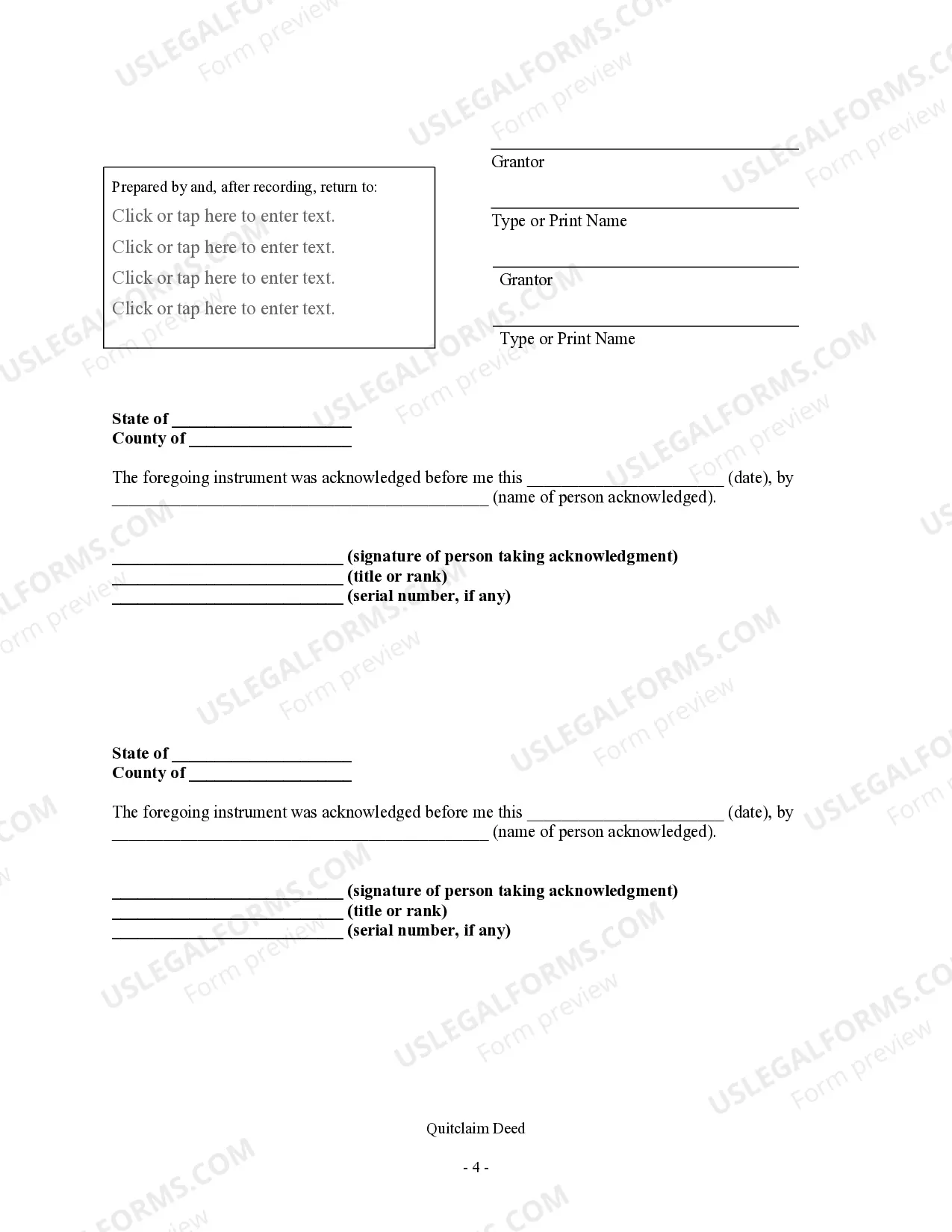
- Signatures of the grantors with date and acknowledgment section





When to use this document
This form is appropriate when a married couple wishes to transfer ownership of real estate to multiple parties without a warranty on the property title. Common scenarios include family property transfers, estate planning, or informal transfers among friends or relatives. When one or both spouses possess the property outright and want to equally distribute ownership to three other individuals, this deed facilitates such a transaction.
Intended users of this form
This form is intended for:
- Married couples looking to transfer property ownership
- Individuals involved in co-ownership arrangements with multiple parties
- People who are familiar with the implications of quitclaim deeds
- Those seeking a straightforward means of property transfer without formal guarantees
Completing this form step by step
- Identify and enter the names and addresses of the grantors (husband and wife).
- List the names and addresses of the grantees (three individuals).
- Provide a clear description of the property being transferred.
- Indicate the consideration amount (the sum or value exchanged).
- Sign and date the document, ensuring acknowledgment before a notary if required.
Does this form need to be notarized?
This form needs to be notarized to ensure legal validity. US Legal Forms provides secure online notarization powered by Notarize, allowing you to complete the process through a verified video call, available anytime.
Get your form ready online
Our built-in tools help you complete, sign, share, and store your documents in one place.
Make edits, fill in missing information, and update formatting in US Legal Forms—just like you would in MS Word.
Download a copy, print it, send it by email, or mail it via USPS—whatever works best for your next step.
Sign and collect signatures with our SignNow integration. Send to multiple recipients, set reminders, and more. Go Premium to unlock E-Sign.
If this form requires notarization, complete it online through a secure video call—no need to meet a notary in person or wait for an appointment.
We protect your documents and personal data by following strict security and privacy standards.

Make edits, fill in missing information, and update formatting in US Legal Forms—just like you would in MS Word.

Download a copy, print it, send it by email, or mail it via USPS—whatever works best for your next step.

Sign and collect signatures with our SignNow integration. Send to multiple recipients, set reminders, and more. Go Premium to unlock E-Sign.

If this form requires notarization, complete it online through a secure video call—no need to meet a notary in person or wait for an appointment.

We protect your documents and personal data by following strict security and privacy standards.
Avoid these common issues
- Failing to include all grantees' names and addresses correctly.
- Not providing a complete property description.
- Omitting signatures or not dating the document properly.
- Incorrectly entering the consideration amount.
Why complete this form online
- Convenience of accessing the form anytime from anywhere.
- Editability allows for easy correction of errors before finalizing.
- Immediate availability of the form without waiting for shipping.
- Guidance is often available to help with completion.
Looking for another form?

Form popularity
FAQ
To add someone to your deed in Colorado, you can use a Colorado Quitclaim Deed - Husband and Wife to Three Individuals. This deed allows you to transfer your interest in the property to additional individuals without complicated processes. First, you will need to prepare the quitclaim deed, making sure to include the names of all parties involved. After the deed is completed, you must sign it in front of a notary and then record it with your local county clerk office to update the public record.
Adding someone to a deed generally transfers ownership rights to that individual. In a Colorado Quitclaim Deed - Husband and Wife to Three Individuals, it means the new party shares ownership with the existing owners. This can impact decisions about the property, so it's important to communicate openly with all parties involved.
Yes, you can add someone to your deed without refinancing, as long as you use a Colorado Quitclaim Deed - Husband and Wife to Three Individuals. This process allows you to add an individual without affecting your current mortgage. However, make sure to consult with your lender to avoid any complications.
Filling out a Colorado Quitclaim Deed requires you to provide specific details such as the names of all parties involved, the property description, and the county where the property is located. Be sure to follow the correct format as outlined by Colorado law. Once you complete the deed, it needs to be signed by the parties and notarized to validate the transfer.
No, you cannot add someone’s name to a deed without their permission. The Colorado Quitclaim Deed - Husband and Wife to Three Individuals requires consent from all parties involved to legally transfer ownership rights. Attempting to add a name without permission can lead to legal issues and disputes over property ownership.
To fill out a Colorado Quitclaim Deed - Husband and Wife to Three Individuals, start by entering the names of the current owners and the spouse being added. Make sure to provide the legal description of the property, along with the county information. Finally, both spouses should sign the deed in front of a notary public to ensure it is legally binding.
There is no strict limit on the number of people that can be on a quitclaim deed in Colorado. A Colorado Quitclaim Deed - Husband and Wife to Three Individuals can include any number of owners, making it flexible for various family and ownership situations. It’s important to accurately list all names in the deed for legal recognition. If you need assistance with the process, consider using resources from USLegalForms for streamlined solutions.
Yes, you can add a third person to your deed by using a Colorado Quitclaim Deed - Husband and Wife to Three Individuals. This deed allows existing owners to transfer partial ownership to another individual. However, it’s crucial to ensure all parties are in agreement and understand their new ownership rights. Utilizing platforms like USLegalForms can simplify this process with templates and guidance.
To add a spouse to a deed in Colorado, you can execute a Colorado Quitclaim Deed - Husband and Wife to Three Individuals, transferring ownership to include your spouse. You will need to complete the deed document, ensuring it includes both names and the correct property description. After signing, the deed must be filed with the county clerk’s office to record the change officially. This process ensures that both parties are recognized as joint owners.
Many people view quitclaim deeds, including the Colorado Quitclaim Deed - Husband and Wife to Three Individuals, as risky because they do not guarantee ownership title. Unlike warranty deeds, quitclaims provide no protection against previous claims on the property. This lack of assurance can lead to complications later, especially if issues arise regarding ownership or liens. Therefore, it's essential to understand the implications before proceeding.