Colorado Statutory Designated Beneficiary Agreement
About this form
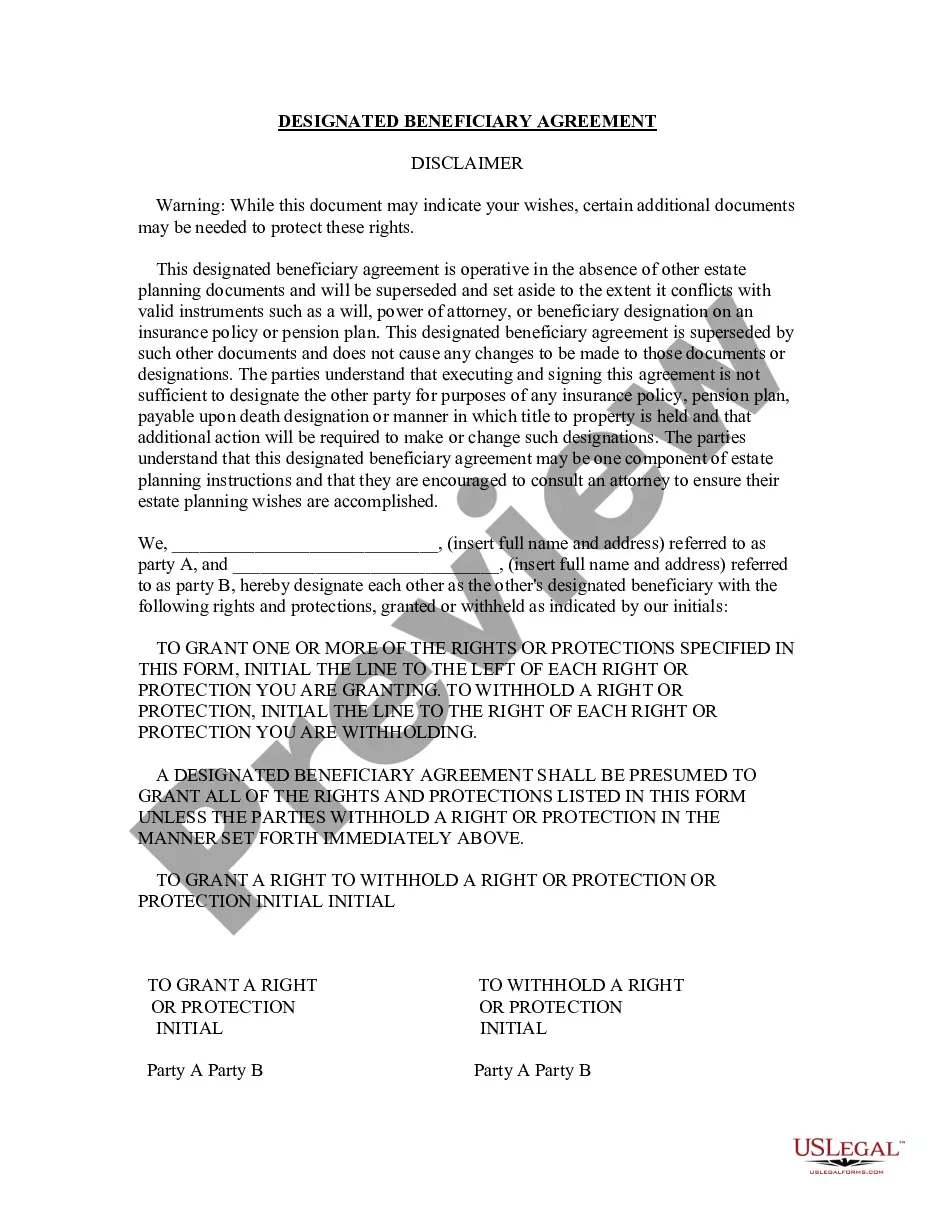
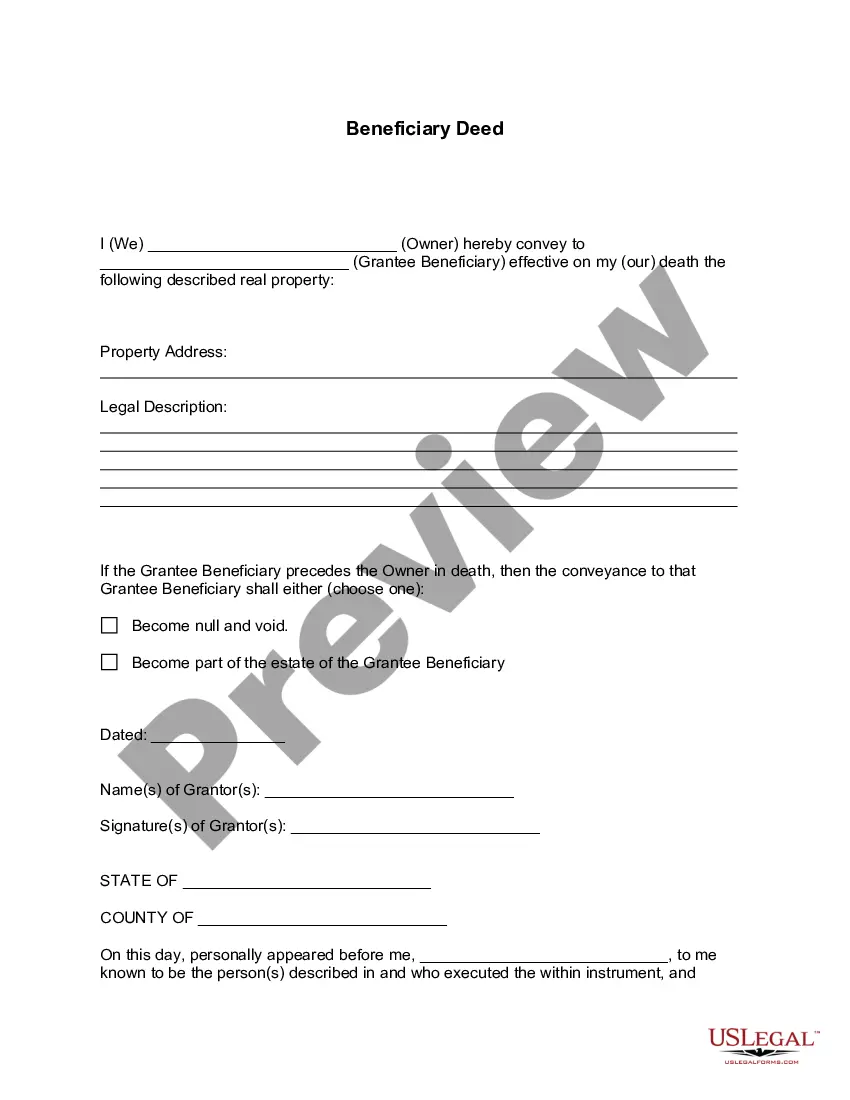
The Statutory Designated Beneficiary Agreement is a legal document available in Colorado that allows individuals to designate a specific person as a beneficiary in the absence of other estate planning documents like a will or power of attorney. This form outlines the rights and protections available to the designated beneficiary, ensuring that certain statutory provisions apply even without more comprehensive estate planning instruments. Unlike a will, this form specifically addresses beneficiary designations, making it a crucial tool for those without extensive estate plans.
Key components of this form
- Identification of parties: Full names and addresses of the individuals entering the agreement.
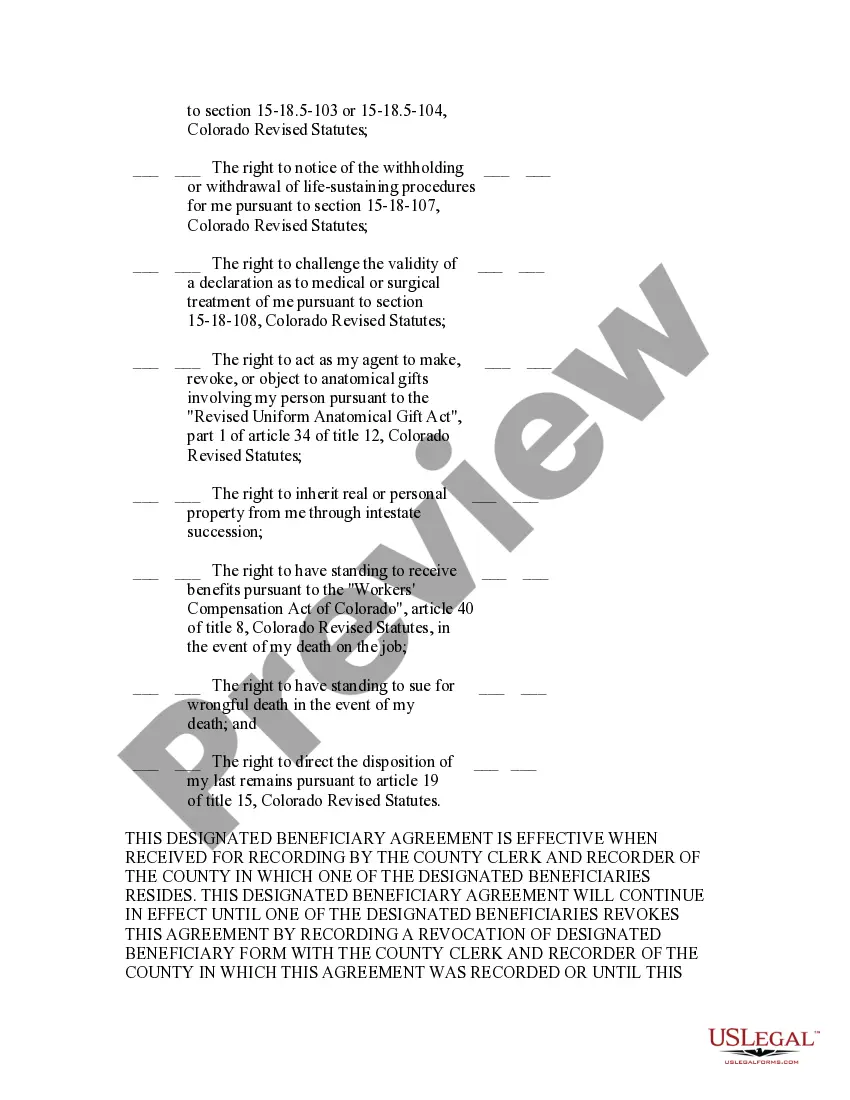
- Rights and protections: A list of specific rights that can be granted or withheld, such as property ownership, beneficiary designations, and healthcare decision-making.
- Initials for consent: Parties must indicate their consent for each right by initialing the designated areas.
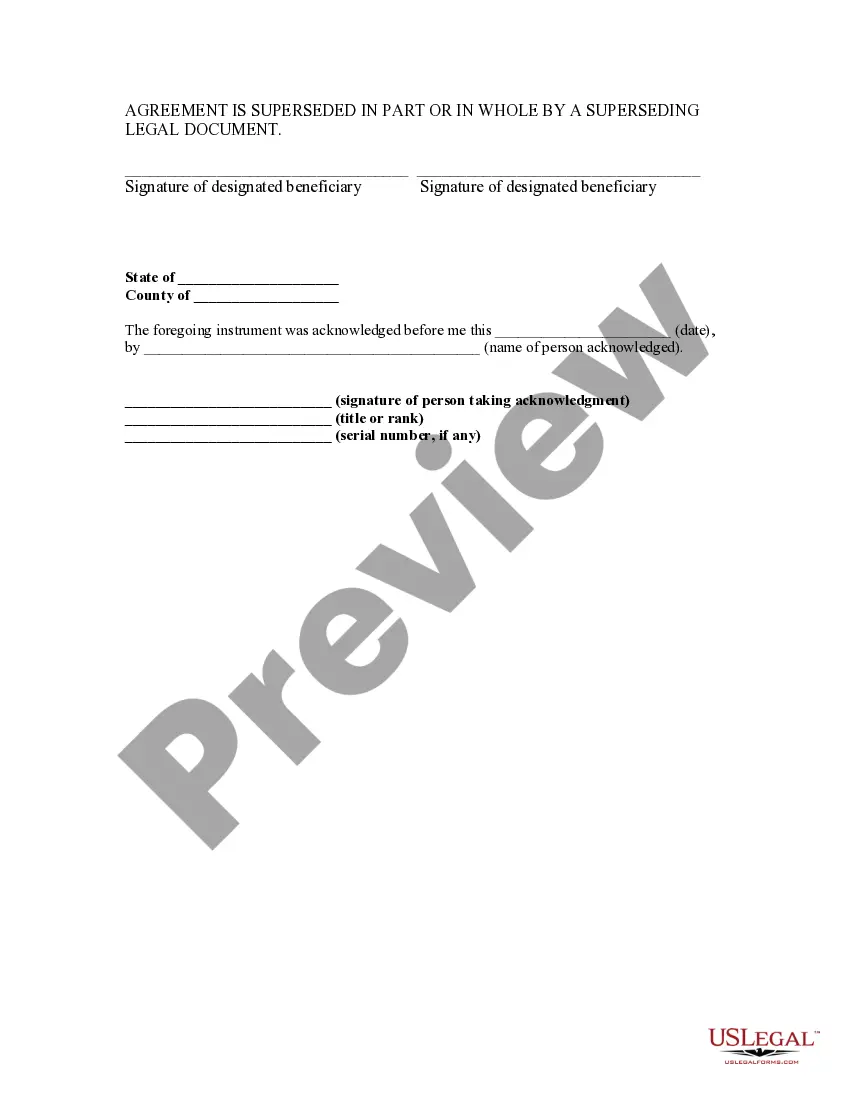
- Conditions for effectiveness: The agreement becomes effective when recorded with the local county clerk and remains valid until revoked or superseded.
- Signatures: Both parties must sign the document to validate their agreement.

Common use cases
This form is typically used when individuals want to ensure that specific rights are granted to a designated beneficiary without having formal estate planning documents like a will or power of attorney in place. Scenarios include when individuals are looking to provide immediate rights to a significant other, partner, or family member related to property ownership, healthcare decisions, or financial benefits after their passing.
Intended users of this form
- Individuals in Colorado who do not have a will or other estate planning documents.
- Partners, including unmarried couples, wanting to secure rights for one another.
- Parents wishing to designate a minor child or dependent as a beneficiary for specific rights.
- Anyone needing to ensure their wishes regarding healthcare decisions and property disposition are legally recognized.
Steps to complete this form
- Identify the parties: Clearly state the full names and addresses of both individuals involved.
- Review the rights and protections: Carefully read through the list of rights available to ensure all relevant ones are considered.
- Initial consent: For each right, initial next to the rights you are granting or withholding.
- Sign the document: Both parties need to sign the agreement to indicate acceptance and validity.
- Record the form: Submit the signed agreement to the county clerk and recorder's office to formalize the designation.
Is notarization required?
Notarization is required for this form to take effect. Our online notarization service, powered by Notarize, lets you verify and sign documents remotely through an encrypted video session, available 24/7.
Get your form ready online
Our built-in tools help you complete, sign, share, and store your documents in one place.
Make edits, fill in missing information, and update formatting in US Legal Forms—just like you would in MS Word.
Download a copy, print it, send it by email, or mail it via USPS—whatever works best for your next step.
Sign and collect signatures with our SignNow integration. Send to multiple recipients, set reminders, and more. Go Premium to unlock E-Sign.
If this form requires notarization, complete it online through a secure video call—no need to meet a notary in person or wait for an appointment.
We protect your documents and personal data by following strict security and privacy standards.

Make edits, fill in missing information, and update formatting in US Legal Forms—just like you would in MS Word.

Download a copy, print it, send it by email, or mail it via USPS—whatever works best for your next step.

Sign and collect signatures with our SignNow integration. Send to multiple recipients, set reminders, and more. Go Premium to unlock E-Sign.

If this form requires notarization, complete it online through a secure video call—no need to meet a notary in person or wait for an appointment.

We protect your documents and personal data by following strict security and privacy standards.
Common mistakes to avoid
- Failing to include both parties' signatures, which can invalidate the agreement.
- Not recording the form with the county clerk, resulting in unenforceability.
- Overlooking the need to update the form if any of the designated rights change in the future.
- Confusing this form with other estate planning documents, such as wills or powers of attorney, which serve different purposes.
Benefits of completing this form online
- Convenience: Download the form anytime without leaving your home.
- Editability: Customize the form easily before finalizing it.
- Reliability: Access accurate and up-to-date legal language drafted by licensed attorneys.
Looking for another form?



Form popularity
FAQ
In Colorado, the statute governing beneficiary deeds is outlined in Colorado Revised Statutes Section 15-15-402. This statute allows property owners to transfer assets to designated beneficiaries without the need for probate, simplifying the process for heirs. A Colorado Statutory Designated Beneficiary Agreement can complement this deed by ensuring that all financial matters are addressed according to your wishes. To navigate this process smoothly, consider using US Legal Forms for comprehensive guidance and forms.
Yes, a beneficiary designation functions as a legal agreement that specifies who will receive your assets upon your passing. In the context of a Colorado Statutory Designated Beneficiary Agreement, this designation allows individuals to clearly outline their intentions. It is crucial to ensure that your designation is clearly documented to avoid any misunderstandings or disputes. Utilizing platforms like US Legal Forms can help you create a valid and effective beneficiary designation.
Generally, a beneficiary designation typically takes precedence over what is stated in a will. In the case of a Colorado Statutory Designated Beneficiary Agreement, any assets designated to a beneficiary will be distributed according to that agreement, regardless of the provisions outlined in a will. Understanding this can help you make informed decisions about your estate planning.
To obtain a beneficiary deed in Colorado, you must complete a specific form that designates your property to a beneficiary upon your death. You can find this form through local Colorado government resources or platforms like USLegalForms, which provide comprehensive legal documentation. Proper execution of this deed ensures a smooth transfer of your property without going through probate.
A beneficiary arrangement refers to the structured approach of outlining who will receive your assets in the event of your death. This includes specifying the individuals or entities named in your Colorado Statutory Designated Beneficiary Agreement. Such arrangements provide clarity and reassurance, ensuring that your estate is handled according to your wishes.
Yes, in many cases, it is necessary to fill out a beneficiary designation form to ensure that your assets are passed on according to your wishes. This form clearly indicates who will benefit from your Colorado Statutory Designated Beneficiary Agreement. Not filling out this form can lead to conflicts and delays in transferring your assets after your passing.
In the context of a Colorado Statutory Designated Beneficiary Agreement, a beneficiary is the person or entity designated to receive assets upon the death of the individual who created the agreement. This term encompasses a wide range of asset types, such as real estate, bank accounts, and retirement benefits. Establishing clear beneficiary designations can simplify the transfer of your assets and streamline the process for your loved ones.
A beneficiary is an individual or entity entitled to receive benefits from a will, trust, or insurance policy. A designated beneficiary, specifically in the context of a Colorado Statutory Designated Beneficiary Agreement, is someone who is specifically named to receive property or benefits upon an individual’s death, typically avoiding probate. Knowing this distinction helps in ensuring that your assets are distributed as you intend.
When choosing beneficiaries, avoid naming individuals who may not manage the benefits responsibly, such as minors or individuals with financial difficulties. Additionally, consider excluding anyone you do not wish to inherit your assets, including estranged family members. A Colorado Statutory Designated Beneficiary Agreement allows you to express your intentions clearly, helping you make the right choices.
Beneficiary designations can vary based on the type of account or policy. Common examples include naming a spouse as a primary beneficiary and children as contingent beneficiaries for life insurance policies or retirement accounts. A Colorado Statutory Designated Beneficiary Agreement might often provide examples that can guide you in making effective designations.