Colorado Acknowledgment for Corporation
What is this form?
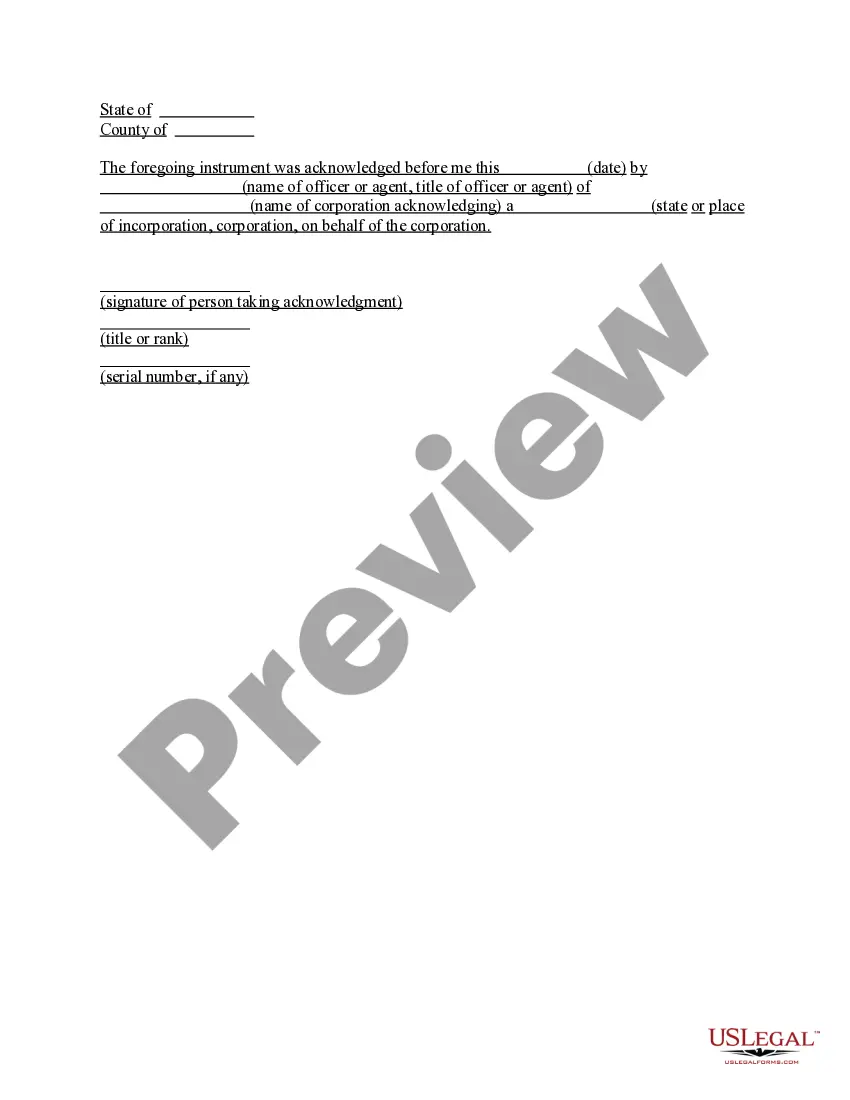
The Acknowledgment for Corporation is a legal document that certifies the acknowledgment of an action or document by a corporation's authorized representative. This form serves to confirm that the specified individual is acting on behalf of the corporation and has the authority to do so. It differs from other corporate forms in that it explicitly focuses on the acknowledgment process, which is important for various legal filings and documentation in business operations.
Main sections of this form
- Date of acknowledgment
- Name and title of the officer or agent
- Name of the corporation
- State or place of incorporation
- Signature of the person taking the acknowledgment
- Serial number, if applicable
When to use this form
This form is typically used when a corporation needs to acknowledge the signing of important documents, such as contracts, agreements, or transactions. It is particularly useful in situations where proof of authorization is required, ensuring that the actions taken are legally recognized and enforceable. Common scenarios include real estate transactions, business loans, and formal agreements with other entities.
Who needs this form
Eligibility for this form includes:
- Corporate officers or agents authorized to act on behalf of the corporation
- Individuals involved in formal corporate transactions
- Legal professionals handling corporate matters
Instructions for completing this form
- Identify the date of acknowledgment.
- Enter the name and title of the corporate officer or agent.
- Specify the name of the corporation.
- Provide the state or place of incorporation.
- Sign the form in the designated area.
- If applicable, include the serial number.
Notarization requirements for this form
This form needs to be notarized to ensure legal validity. US Legal Forms provides secure online notarization powered by Notarize, allowing you to complete the process through a verified video call, available anytime.
Get your form ready online
Our built-in tools help you complete, sign, share, and store your documents in one place.
Make edits, fill in missing information, and update formatting in US Legal Forms—just like you would in MS Word.
Download a copy, print it, send it by email, or mail it via USPS—whatever works best for your next step.
Sign and collect signatures with our SignNow integration. Send to multiple recipients, set reminders, and more. Go Premium to unlock E-Sign.
If this form requires notarization, complete it online through a secure video call—no need to meet a notary in person or wait for an appointment.
We protect your documents and personal data by following strict security and privacy standards.

Make edits, fill in missing information, and update formatting in US Legal Forms—just like you would in MS Word.

Download a copy, print it, send it by email, or mail it via USPS—whatever works best for your next step.

Sign and collect signatures with our SignNow integration. Send to multiple recipients, set reminders, and more. Go Premium to unlock E-Sign.

If this form requires notarization, complete it online through a secure video call—no need to meet a notary in person or wait for an appointment.

We protect your documents and personal data by following strict security and privacy standards.
Common mistakes to avoid
- Leaving out the date of acknowledgment.
- Failing to include the correct name and title of the signing officer.
- Not providing the corporation's full legal name.
- Omitting the necessary signatures.
- Not checking state-specific requirements before submission.
Advantages of online completion
- Convenient and easy to download at any time.
- Editable format allows for quick customization.
- Access to forms drafted by licensed attorneys ensures reliability.
- Immediate availability reduces time spent on paperwork.
Looking for another form?
Form popularity
FAQ
In Colorado, a notarial stamp must include the notary's name, the title 'Notary Public', and the commission's expiration date. The stamp should also contain the state seal and be legible. For businesses, understanding the Colorado Acknowledgment for Corporation is crucial to ensure compliance with these notarial requirements. Utilizing a platform like USLegalForms can simplify the creation of necessary documents and help you meet all statutory obligations.
A notarized document can become invalid if essential elements are missing, such as the notary's seal, signature, or an accurate date. Additionally, if the notary didn't follow proper procedures, such as failing to confirm the signer’s identity, the validity of the Colorado Acknowledgment for Corporation may be questioned. Always ensure that notarizations are done thoroughly to avoid complications.
Another frequent mistake by notaries is neglecting to complete all required fields on the notarial certificate. This oversight can cause a Colorado Acknowledgment for Corporation to be challenged or deemed invalid. Ensuring accuracy and completeness in documentation guarantees smoother legal processes.
To perform a proper acknowledgment, the notary must identify the signer and ensure they understand the document they are signing. The signer should then state that they signed the document freely and willingly. After verifying these conditions, the notary will complete the acknowledgment section, which is vital for the Colorado Acknowledgment for Corporation.
A common mistake a notary makes is failing to verify the identity of the signer. For a valid Colorado Acknowledgment for Corporation, the notary must confirm that the person signing the document is indeed who they claim to be. This step ensures the integrity of the signed document and protects against fraud.
Once a document has been notarized, you cannot make changes to it without rendering the notarization invalid. If you need to edit a document after a Colorado Acknowledgment for Corporation has been completed, you will have to create a new document and go through the notarization process again. This assures that every version is officially recognized and can stand up to legal scrutiny.
No, acknowledgment and witnessing a signature are not the same in Colorado. Acknowledgment involves the notary certifying that the signer has willingly signed, while witnessing focuses on the notary observing the signing process. Understanding this difference is crucial, especially when engaging with processes regarding the Colorado Acknowledgment for Corporation.
A Colorado form of Acknowledgment is a standardized document that notaries use to perform acknowledgments in the state. This form includes details such as the signer's name, the date, and the notary's official seal. Utilizing the proper form is important for legal processes like the Colorado Acknowledgment for Corporation, ensuring all requirements are met for recognition.
The main difference between signature witnessing and acknowledgment lies in the notary's role. Witnessing involves the notary observing the signer sign the document, while acknowledgment confirms that the signer has already signed in the notary's presence. This distinction is vital in legal contexts such as the Colorado Acknowledgment for Corporation, where proper documentation impacts the authenticity.
An acknowledgment from a Colorado notary is a formal declaration made by a notary public. It confirms that the signer has personally appeared before them, acknowledged the signature, and that they willingly signed the document. This acknowledgment plays a crucial role in maintaining the integrity of legal documents, especially for those involving corporations.