Colorado Transfer on Death Deed or TOD - Beneficiary Deed for Individual to Individual
What this document covers
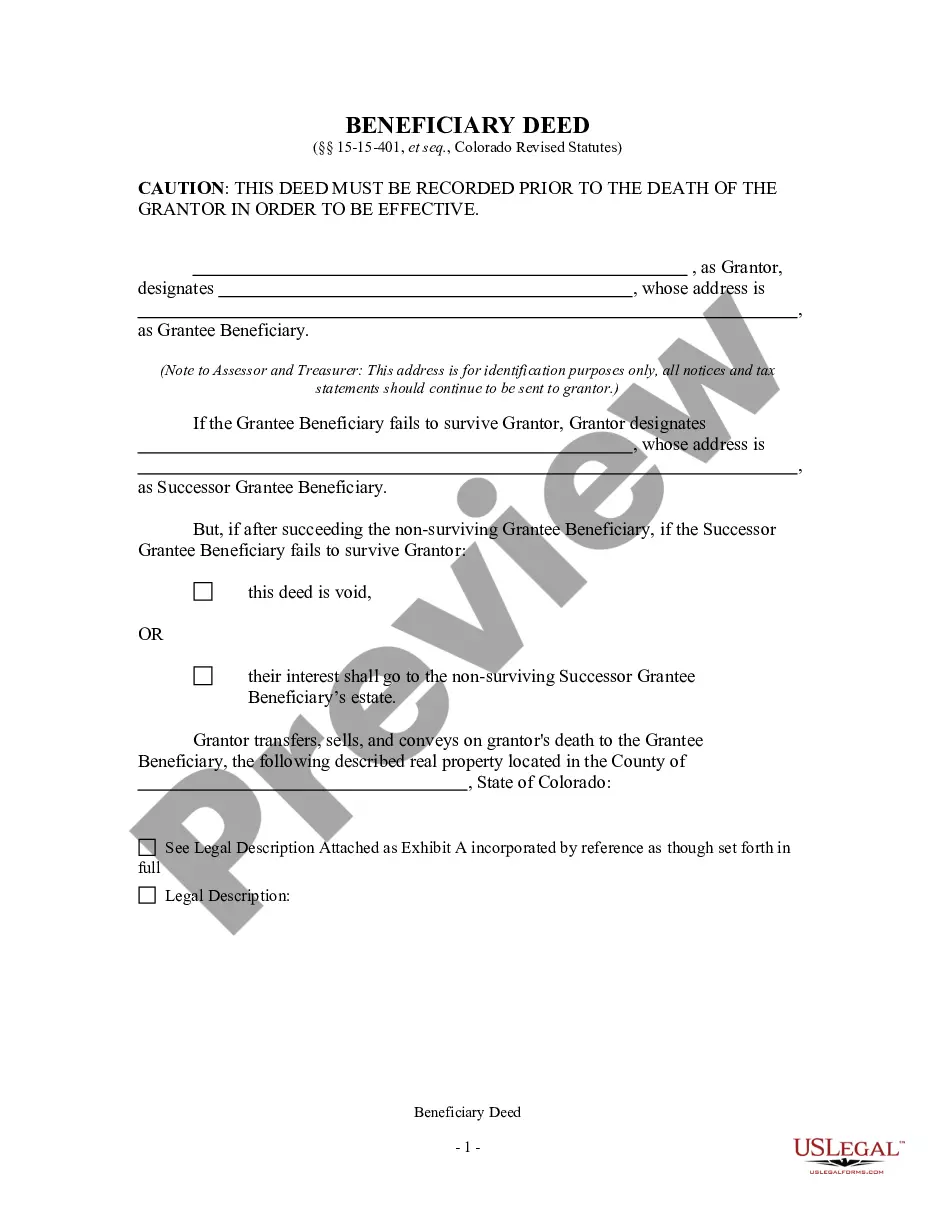
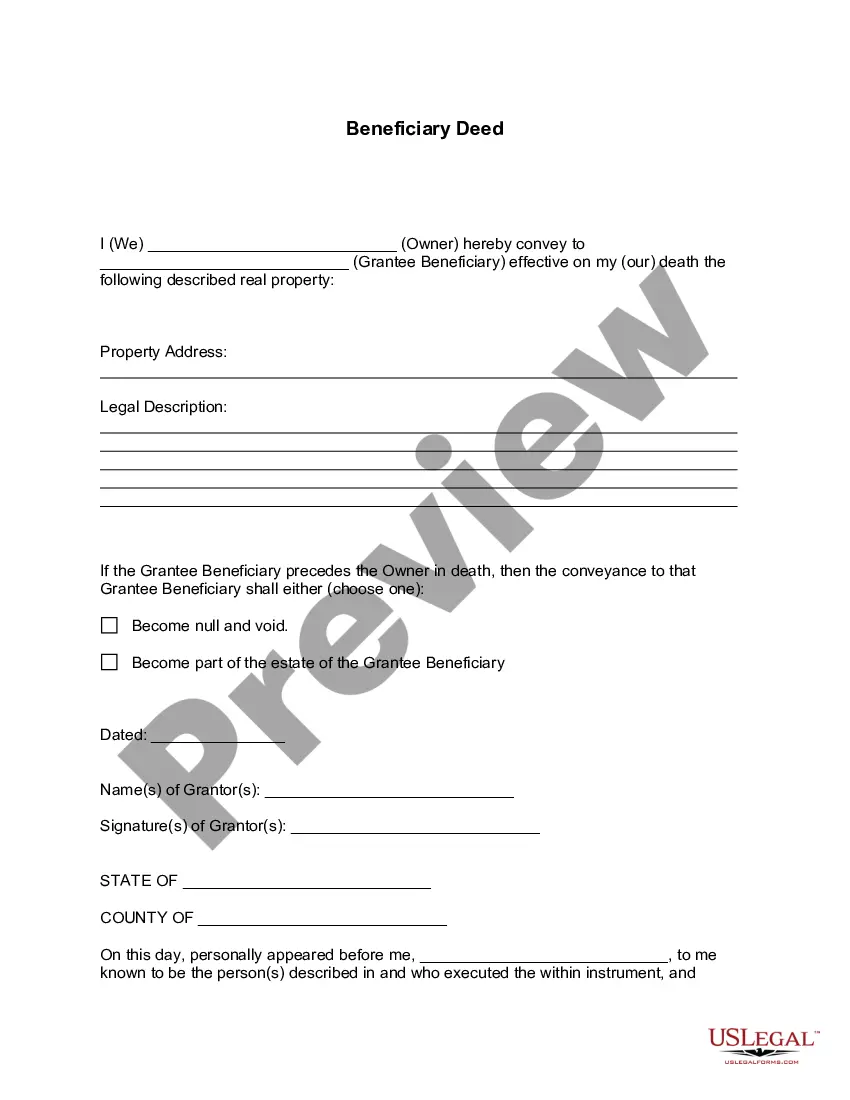
The Transfer on Death Deed, or TOD, allows an individual to transfer ownership of real property to a designated beneficiary upon their death. This deed does not transfer the property while the grantor is living, making it reversible at any point. Its primary purpose is to facilitate the transfer of property without the need for probate, distinguishing it from traditional deeds or wills that may require court intervention after death.
Form components explained
- Grantor's name and contact information
- Grantee's name (the beneficiary who will receive the property)
- Description of the property being transferred
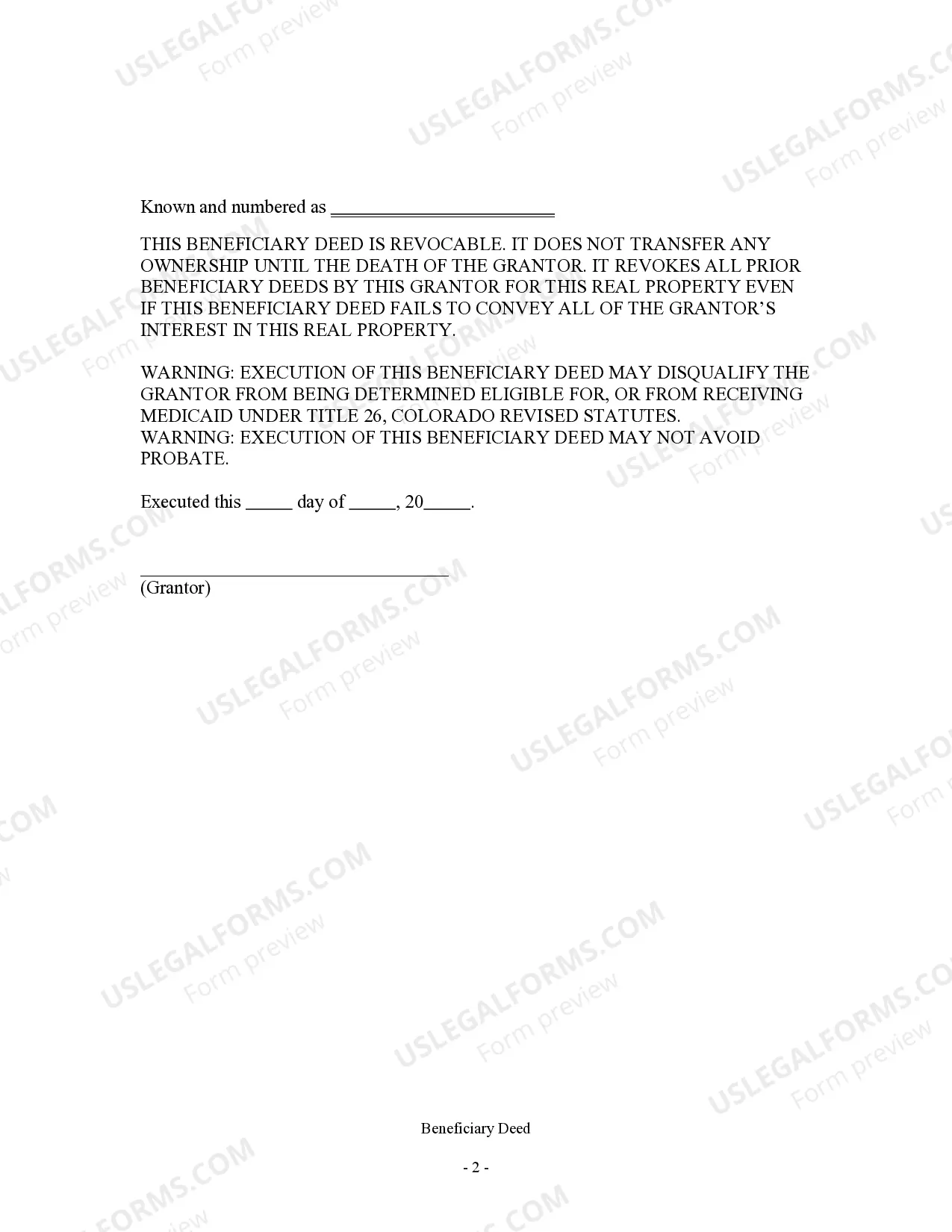
- Legal language outlining the conditions of transfer upon death
- Signature of the grantor and date of signing




When this form is needed
This form is ideal for individuals wishing to ensure that their real property is transferred directly to a chosen beneficiary upon their death. It is commonly used by property owners wanting to avoid probate, simplify estate transfer, or facilitate the estate planning process without assigning ownership during their lifetime.
Who this form is for
- Property owners looking to designate a beneficiary for real property
- Individuals seeking to simplify their estate planning
- Those who want to avoid probate for real estate transfers
Instructions for completing this form
- Identify the parties involved: Enter the names of the grantor and grantee.
- Specify the property: Provide a clear description of the real property being transferred.
- Outline transfer conditions: Include any specific conditions regarding the transfer upon death.
- Review the form for accuracy: Ensure all information is correct and complete.
- Sign and date the form: The grantor must sign the form to validate the transfer.
Notarization requirements for this form
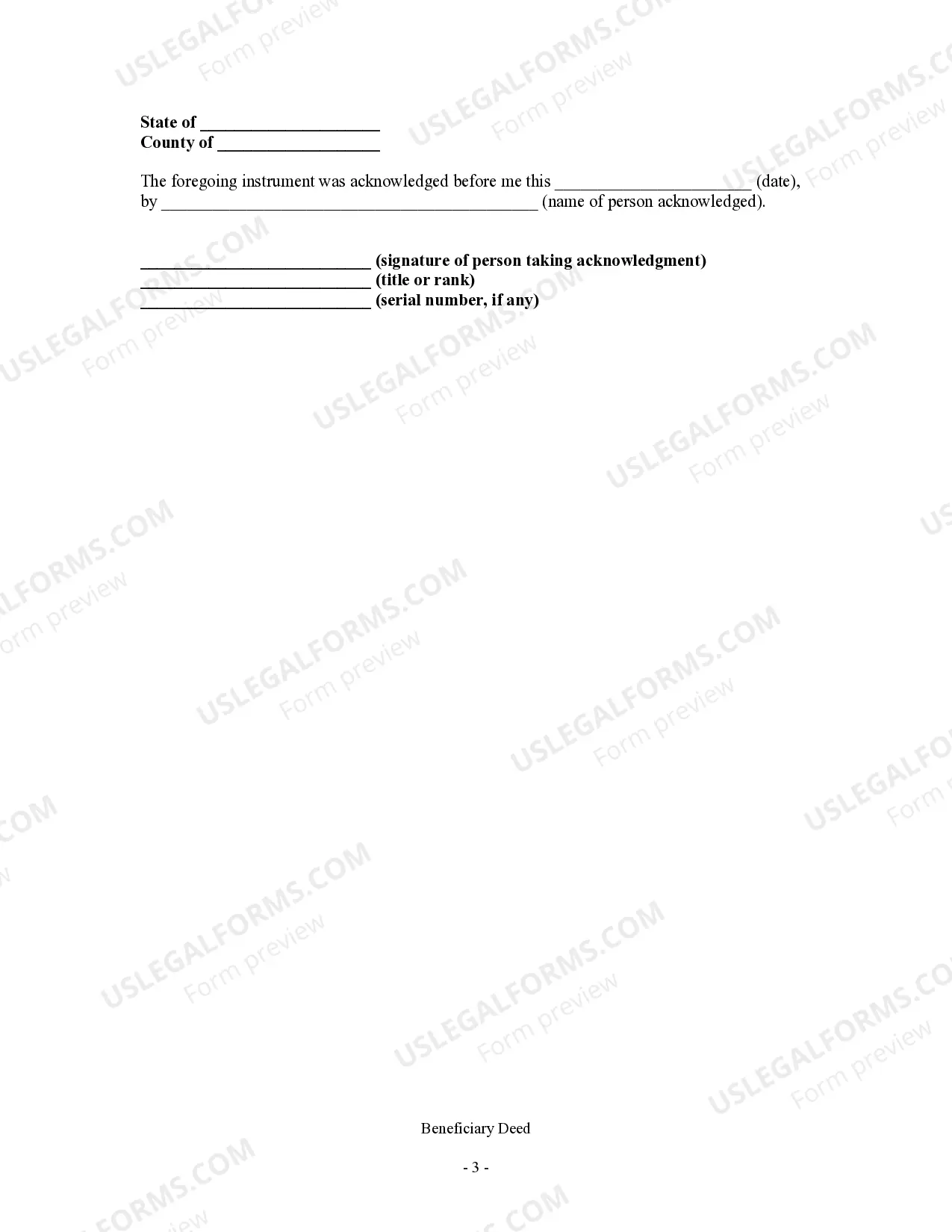
To make this form legally binding, it must be notarized. Our online notarization service, powered by Notarize, lets you verify and sign documents remotely through an encrypted video session.
Get your form ready online
Our built-in tools help you complete, sign, share, and store your documents in one place.
Make edits, fill in missing information, and update formatting in US Legal Forms—just like you would in MS Word.
Download a copy, print it, send it by email, or mail it via USPS—whatever works best for your next step.
Sign and collect signatures with our SignNow integration. Send to multiple recipients, set reminders, and more. Go Premium to unlock E-Sign.
If this form requires notarization, complete it online through a secure video call—no need to meet a notary in person or wait for an appointment.
We protect your documents and personal data by following strict security and privacy standards.

Make edits, fill in missing information, and update formatting in US Legal Forms—just like you would in MS Word.

Download a copy, print it, send it by email, or mail it via USPS—whatever works best for your next step.

Sign and collect signatures with our SignNow integration. Send to multiple recipients, set reminders, and more. Go Premium to unlock E-Sign.

If this form requires notarization, complete it online through a secure video call—no need to meet a notary in person or wait for an appointment.

We protect your documents and personal data by following strict security and privacy standards.
Mistakes to watch out for
- Failing to provide a clear description of the property.
- Not signing or dating the deed.
- Leaving out the grantee's name or providing incorrect information.
Benefits of using this form online
- Convenient access and easy download options.
- Editable templates that allow for customization to suit individual needs.
- Reliable forms created by licensed attorneys to ensure legal compliance.
Looking for another form?
Form popularity
FAQ
Yes, a transfer on death deed is often referred to as a beneficiary deed. Both terms describe the same legal instrument that allows property owners to transfer their property to beneficiaries upon death without going through probate. This distinction is crucial, as understanding the terminology will help you navigate the process of creating a Colorado Transfer on Death Deed or TOD - Beneficiary Deed for Individual to Individual with confidence.
To fill out a Colorado beneficiary deed, start by accurately entering your name, information about the property, and your beneficiary's details. Make sure to include a clause indicating this is a transfer on death, which will become effective after your passing. Using guides from sites like USLegalForms will help you in crafting a concise and compliant Colorado Transfer on Death Deed or TOD - Beneficiary Deed for Individual to Individual.
Just like with a beneficiary deed, hiring a lawyer for a transfer on death deed is not mandatory. You can complete the necessary forms on your own, particularly if you utilize user-friendly platforms such as USLegalForms. However, engaging a legal professional can provide peace of mind and help ensure that your Colorado Transfer on Death Deed or TOD - Beneficiary Deed for Individual to Individual adheres to state regulations.
You do not necessarily need a lawyer to create a beneficiary deed, especially if you feel comfortable with the paperwork. However, consulting a legal professional can help ensure compliance with Colorado laws. Whether you choose to go it alone or seek help, using templates from platforms like USLegalForms can simplify the process of executing a Colorado Transfer on Death Deed or TOD - Beneficiary Deed for Individual to Individual.
Filling out beneficiary paperwork requires careful attention to detail. First, download the appropriate legal form, like those from USLegalForms. Provide the property owner's information, the beneficiary's name, and the property description. It's important to clearly specify that the document serves as a Colorado Transfer on Death Deed or TOD - Beneficiary Deed for Individual to Individual to limit any potential confusion.
Filling out a Colorado beneficiary deed involves providing essential information about the property, the owner's name, and the beneficiary's details. Make sure the language clearly states the transfer is effective upon your death. To ensure accuracy, consider using resources available at USLegalForms to assist you in correctly stating that this is a Colorado Transfer on Death Deed or TOD - Beneficiary Deed for Individual to Individual.
To write a beneficiary deed, begin with the correct legal form, which you can easily find on platforms like USLegalForms. Clearly state the name of the property owner and the intended beneficiary. Include a detailed description of the property, and ensure you include a statement designating it a Colorado Transfer on Death Deed or TOD - Beneficiary Deed for Individual to Individual. Lastly, sign the deed and have it notarized for it to be legally binding.
To file a Transfer on Death deed in Colorado, you must first complete the appropriate form, ensuring it meets all legal requirements. Then, the deed must be signed, dated, and notarized before it can be recorded with the local county clerk and recorder. For assistance with this process, consider using the U.S. Legal Forms platform, which provides resources and templates specifically for the Colorado Transfer on Death Deed or TOD - Beneficiary Deed for Individual to Individual.
A transfer on death is not synonymous with a beneficiary, although they are related concepts. A beneficiary is the person designated to receive property or assets as per a transfer on death deed. Therefore, while an individual may be identified as a beneficiary, the transfer on death deed itself is the legal document that facilitates that transfer.
While both a Transfer on Death deed and a beneficiary designation serve similar purposes in transferring assets upon death, they are distinct legal instruments. A TOD deed specifically applies to real estate, whereas beneficiary designations are typically found in financial accounts or insurance policies. Understanding these differences can help you choose the right option for your estate planning.