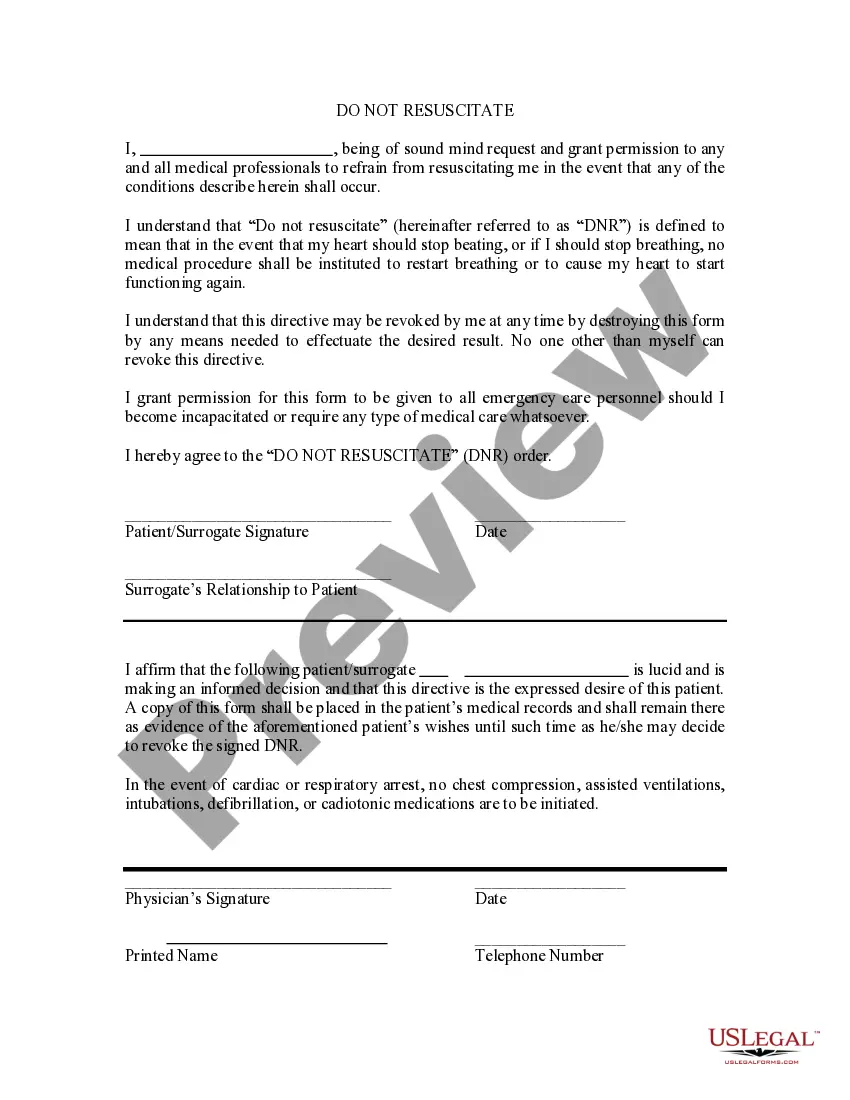
This is a form initiated by a patient requesting that he/she not be resuscitated should he/she stop breathing or should his/her heart stop beating. This form is also to be signed by a physician attesting to patient's wishes and to be placed in the patient's file.
California Do Not Resuscitate Request - DNR
State:
Multi-State
Control #:
US-PRM-12
Format:
Word;
Rich Text
Instant download
Description
Free preview

Get your form ready online
Our built-in tools help you complete, sign, share, and store your documents in one place.
Built-in online Word editor
Make edits, fill in missing information, and update formatting in US Legal Forms—just like you would in MS Word.
Export easily
Download a copy, print it, send it by email, or mail it via USPS—whatever works best for your next step.
E-sign your document
Sign and collect signatures with our SignNow integration. Send to multiple recipients, set reminders, and more. Go Premium to unlock E-Sign.
Notarize online 24/7
If this form requires notarization, complete it online through a secure video call—no need to meet a notary in person or wait for an appointment.
Store your document securely
We protect your documents and personal data by following strict security and privacy standards.

Make edits, fill in missing information, and update formatting in US Legal Forms—just like you would in MS Word.

Download a copy, print it, send it by email, or mail it via USPS—whatever works best for your next step.

Sign and collect signatures with our SignNow integration. Send to multiple recipients, set reminders, and more. Go Premium to unlock E-Sign.

If this form requires notarization, complete it online through a secure video call—no need to meet a notary in person or wait for an appointment.

We protect your documents and personal data by following strict security and privacy standards.
Looking for another form?






How to fill out Do Not Resuscitate Request - DNR?
Selecting the appropriate legal document design can be quite a challenge. Of course, there are numerous templates accessible online, but how can you obtain the legal form you require? Utilize the US Legal Forms website. The service provides a vast array of templates, including the California Do Not Resuscitate Request - DNR, that you can utilize for both business and personal purposes. All of the documents are reviewed by professionals and adhere to state and federal regulations.
If you are already registered, Log In to your account and click the Download button to acquire the California Do Not Resuscitate Request - DNR. Use your account to review the legal documents you have obtained previously. Navigate to the My documents section of your account and retrieve another copy of the documents you need.
If you are a new user of US Legal Forms, here are simple instructions for you to follow: First, ensure you have selected the correct form for your specific city/region. You can examine the form using the Preview button and review the form details to confirm it is suitable for you. If the form does not meet your requirements, use the Search section to find the appropriate form. Once you are confident that the form is correct, select the Get now button to obtain the form. Choose the pricing plan you desire and enter the necessary information. Create your account and pay for the order using your PayPal account or credit card. Choose the document format and download the legal document design to your device. Finally, complete, modify, print, and sign the received California Do Not Resuscitate Request - DNR.
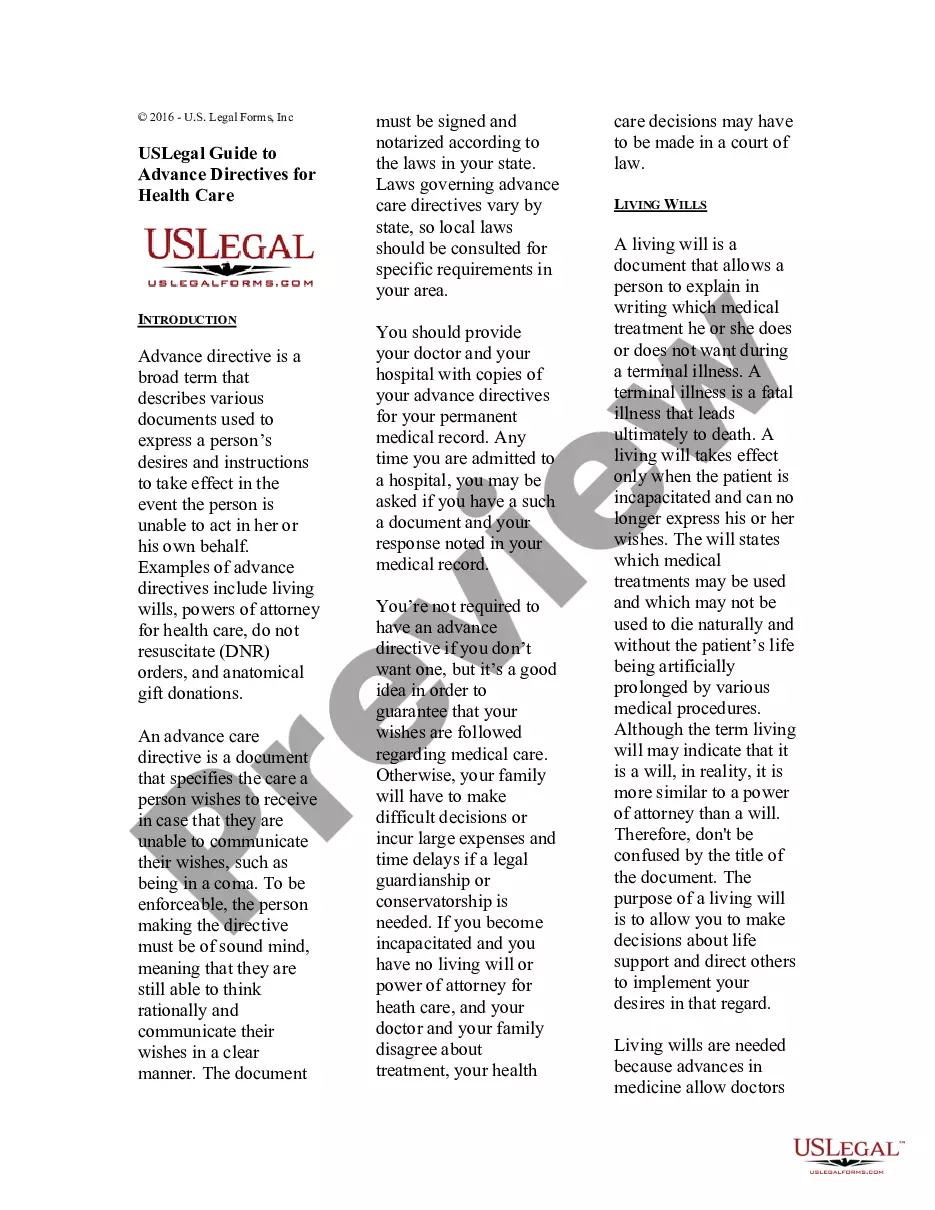
- US Legal Forms is the largest collection of legal documents where you can find various document templates.
- Utilize the service to download well-structured documents that meet state requirements.
- Access a wide range of templates for both business and personal use.
- Ensure compliance with state and federal regulations through expert-reviewed forms.
- Retrieve previously obtained documents easily from your account.
- Follow simple steps to obtain the correct legal forms you need.
Form popularity
FAQ
Do not resuscitate orderA DNR is a request not to have CPR if your heart stops or if you stop breathing. You can use an advance directive form or tell your doctor that you don't want to be resuscitated. Your doctor will put the DNR order in your medical chart. Doctors and hospitals in all states accept DNR orders.
POLST stands for Physician Orders for Life-Sustaining Treatment. A POLST form is a signed medical order for documenting the life-sustaining treatment wishes of seriously ill patients. It travels with the patient to assure that treatment preferences are honored across settings of care.
The DNR form should be clearly posted or maintained near the patient. You may download the form or call us at (916) 322-4336 to have the form mailed to you. If you wish to obtain a large supply, you should contact the CMA publications office directly, at 1(800) 882-1262 or the California Medical Association website.
Summary. The main point is this: as a bystander, i.e. a non-medical professional, you cannot get into any legal trouble for giving CPR to a person with a DNR, and should always give CPR as soon as possible to all victims of sudden cardiac arrest.
The primary difference between and POLST and DNR is that a POLST covers a variety of end-of-life treatments. A DNR only gives instructions about CPR. With a POLST, seniors can specify: If they do or don't want CPR.
If you decide you wish to have a DNR order put in place, inform your doctor. Your doctor is required to follow your wishes or transfer your care to a physician who is willing to carry them out. The doctor will fill out a form for a DNR order and add it to your medical record.
The DNR form should be clearly posted or maintained near the patient. You may download the form or call us at (916) 322-4336 to have the form mailed to you. If you wish to obtain a large supply, you should contact the CMA publications office directly, at 1(800) 882-1262 or the California Medical Association website.
Do not resuscitate order A DNR is a request not to have CPR if your heart stops or if you stop breathing. You can use an advance directive form or tell your doctor that you don't want to be resuscitated. Your doctor will put the DNR order in your medical chart. Doctors and hospitals in all states accept DNR orders.
DNR means that no CPR (chest compressions, cardiac drugs, or placement of a breathing tube) will be performed. A DNI or Do Not Intubate order means that chest compressions and cardiac drugs may be used, but no breathing tube will be placed.
The usual circumstances in which it is appropriate not to resuscitate are: when it will not restart the heart or breathing. when there is no benefit to the patient. when the benefits are outweighed by the burdens.