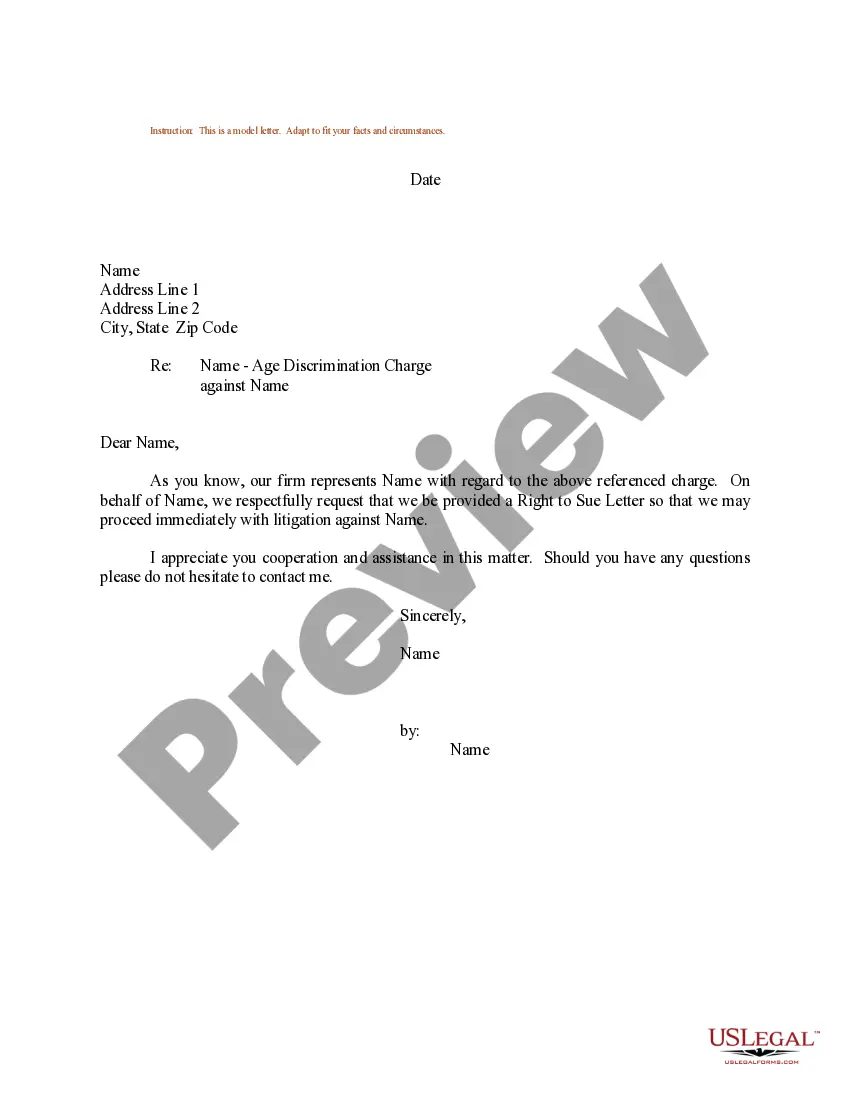
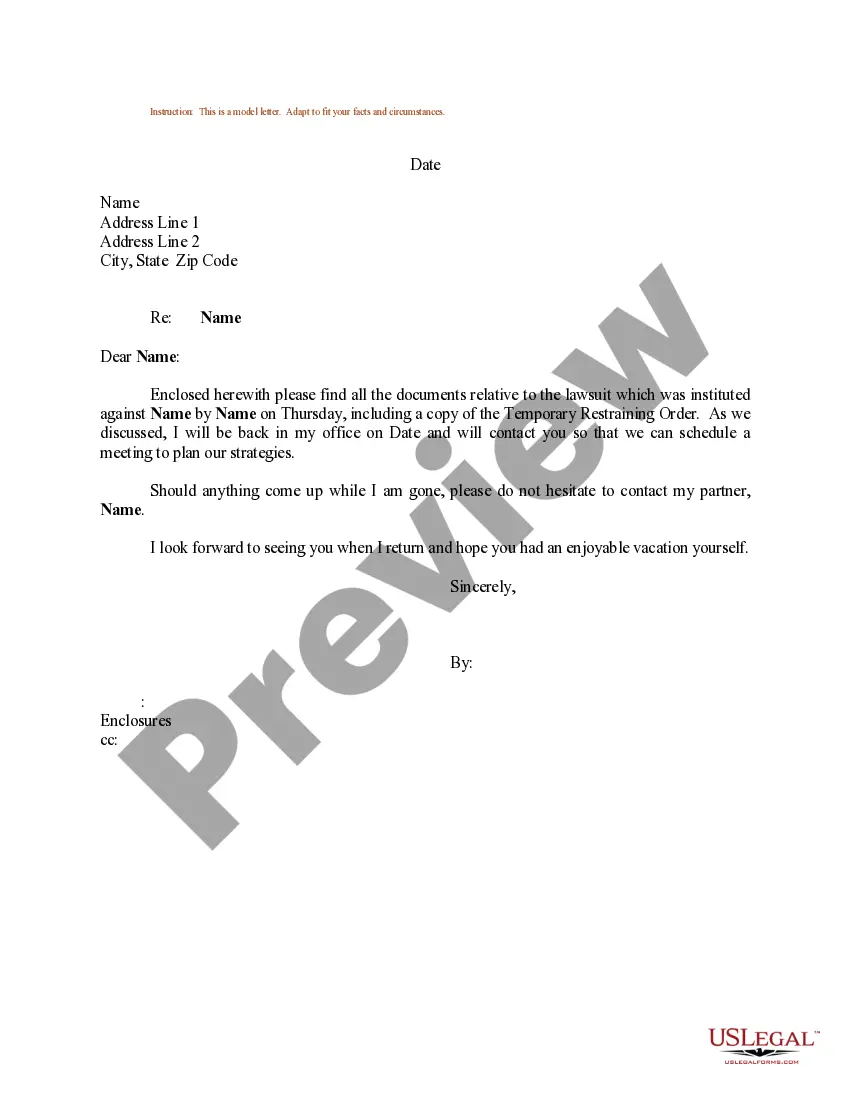
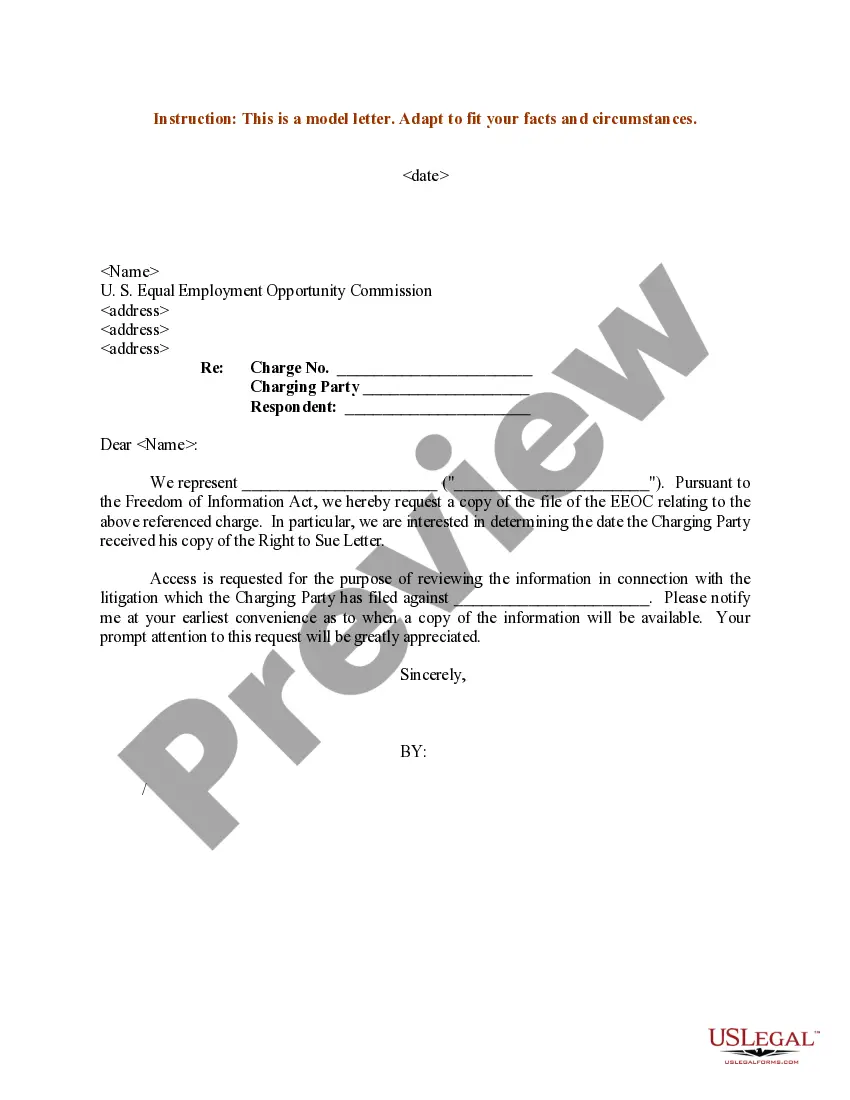
California Sample Letter for Right to Sue Letter
Description
Get your form ready online
Our built-in tools help you complete, sign, share, and store your documents in one place.
Make edits, fill in missing information, and update formatting in US Legal Forms—just like you would in MS Word.
Download a copy, print it, send it by email, or mail it via USPS—whatever works best for your next step.
Sign and collect signatures with our SignNow integration. Send to multiple recipients, set reminders, and more. Go Premium to unlock E-Sign.
If this form requires notarization, complete it online through a secure video call—no need to meet a notary in person or wait for an appointment.
We protect your documents and personal data by following strict security and privacy standards.

Make edits, fill in missing information, and update formatting in US Legal Forms—just like you would in MS Word.

Download a copy, print it, send it by email, or mail it via USPS—whatever works best for your next step.

Sign and collect signatures with our SignNow integration. Send to multiple recipients, set reminders, and more. Go Premium to unlock E-Sign.

If this form requires notarization, complete it online through a secure video call—no need to meet a notary in person or wait for an appointment.

We protect your documents and personal data by following strict security and privacy standards.
Looking for another form?

How to fill out Sample Letter For Right To Sue Letter?
Have you been in a position that you will need documents for possibly company or individual uses almost every time? There are tons of legitimate document web templates accessible on the Internet, but getting versions you can trust is not effortless. US Legal Forms delivers a huge number of type web templates, just like the California Sample Letter for Right to Sue Letter, that are written in order to meet federal and state requirements.
If you are previously acquainted with US Legal Forms site and get an account, merely log in. Next, you can download the California Sample Letter for Right to Sue Letter design.
Should you not offer an account and would like to begin using US Legal Forms, follow these steps:
- Obtain the type you want and ensure it is for that right area/state.
- Utilize the Preview key to analyze the shape.
- Look at the description to ensure that you have chosen the correct type.
- If the type is not what you are searching for, take advantage of the Research discipline to discover the type that suits you and requirements.
- Whenever you find the right type, click Buy now.
- Pick the rates plan you desire, fill in the desired info to create your bank account, and purchase an order making use of your PayPal or charge card.
- Decide on a practical paper file format and download your duplicate.
Discover all the document web templates you have bought in the My Forms menus. You may get a additional duplicate of California Sample Letter for Right to Sue Letter any time, if required. Just click the essential type to download or printing the document design.
Use US Legal Forms, by far the most considerable variety of legitimate kinds, to save some time and prevent mistakes. The services delivers professionally created legitimate document web templates which can be used for an array of uses. Make an account on US Legal Forms and commence generating your daily life easier.
Form popularity
FAQ
To submit an appeal, please state in writing that you are appealing your FOIA decision, attach a copy of your determination letter, and send it to: Assistant Legal Counsel FOIA Programs Office of Legal Counsel, Equal Employment Opportunity Commission, 131 M Street, N.E., Suite 5NW02E, Washington, D.C. 20507.
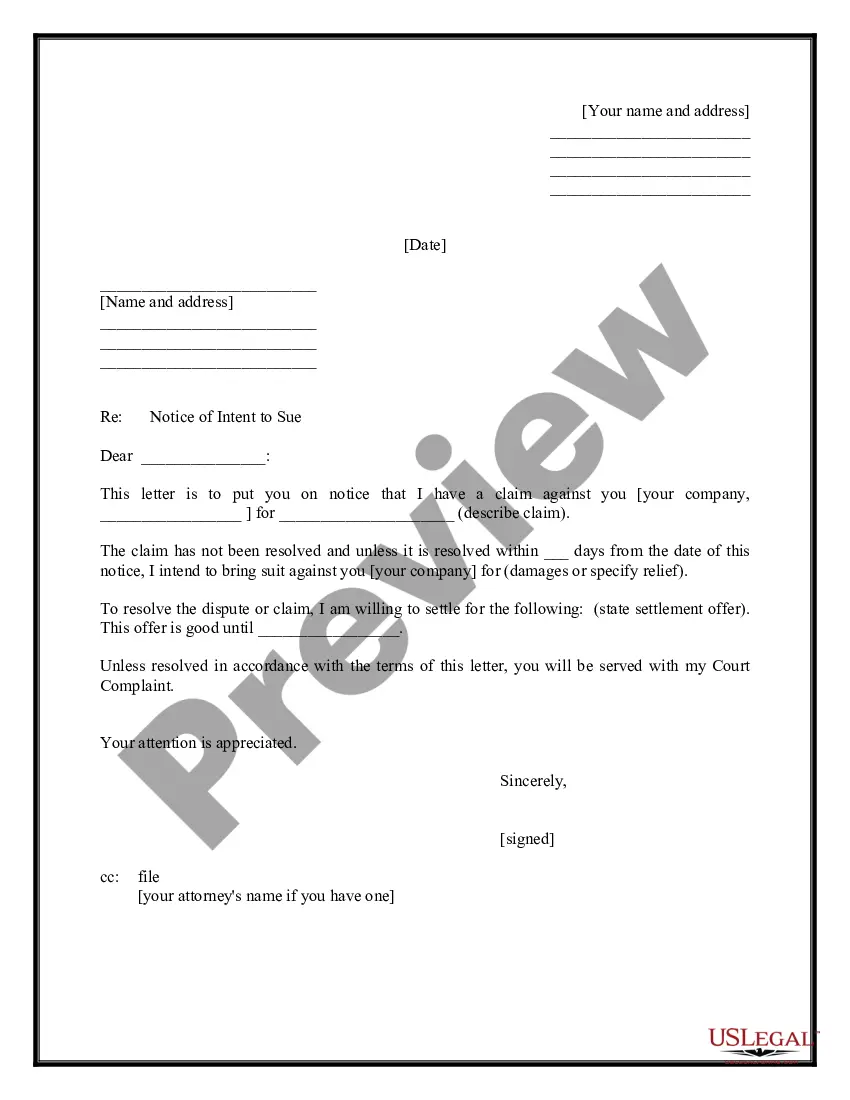
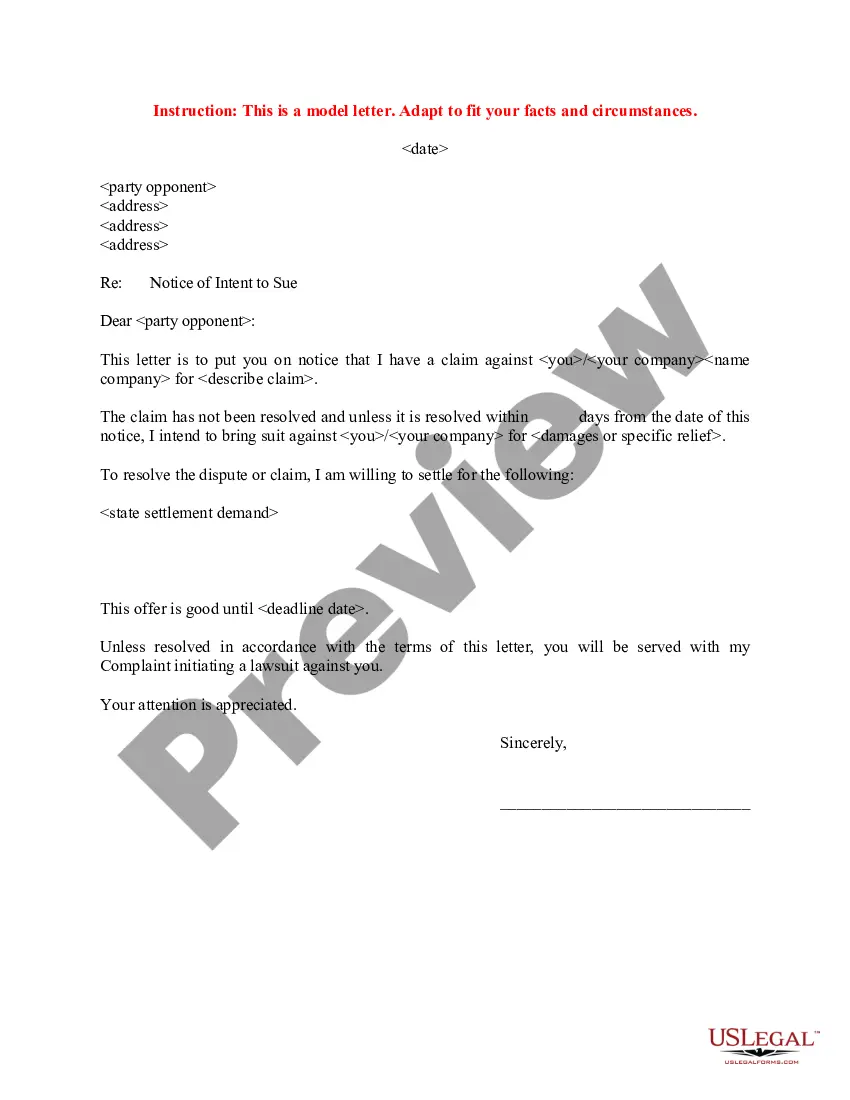
An intent to sue letter should have the addresses of both parties, a detailed description of the dispute, the settlement demand (e.g., payment amount, cease and desist, repair damages, etc.), the sender's contact information, and the deadline for the proposed settlement.
If mediation fails, and the EEOC decides not to litigate the case itself, then the EEOC will issue a right to sue letter. This gives you permission to pursue your case in court on your own. In some cases, an employment attorney can demand a right to sue letter right after filing the charge with the EEOC.
You may send your written request to EEOC by mail (131 M. Street, NE, Washington, D.C. 20507), email (FOIA@eeoc.gov), fax (202-653-6034) , or by Internet ( ). District Offices FOIA email addresses are found at , or .
To receive a federal Right-to-Sue notice, you must contact EEOC at .eeoc.gov or at (800) 669-4000 or TTY (800) 669-6820. Rather than receiving a Right-to-Sue notice to file a lawsuit, you may ask CRD to investigate your complaint.
If no violation is found as a result of our investigation, the EEOC sends you and your employer a notice closing the case called a "Dismissal and Notice of Rights." You then have 90 days to file your own lawsuit, should you decide to do so.
You may also obtain a Right-to-Sue notice using our online system at .dfeh.ca.gov. After you have submitted your form, we will send you a Right-to-Sue letter with the information you provided.
Pursuant to [STATUTE / CONTRACTUAL PROVISION], you are hereby given notice that [CLIENT] intends to commence a lawsuit against you for [AMOUNT OF DAMAGES OR EQUITABLE RELIEF] due to [DESCRIBE CONDUCT OR INCIDENT THAT SERVES AS THE BASIS FOR THE LAWSUIT].