California Certification of Group Health Plan Coverage
Overview of this form
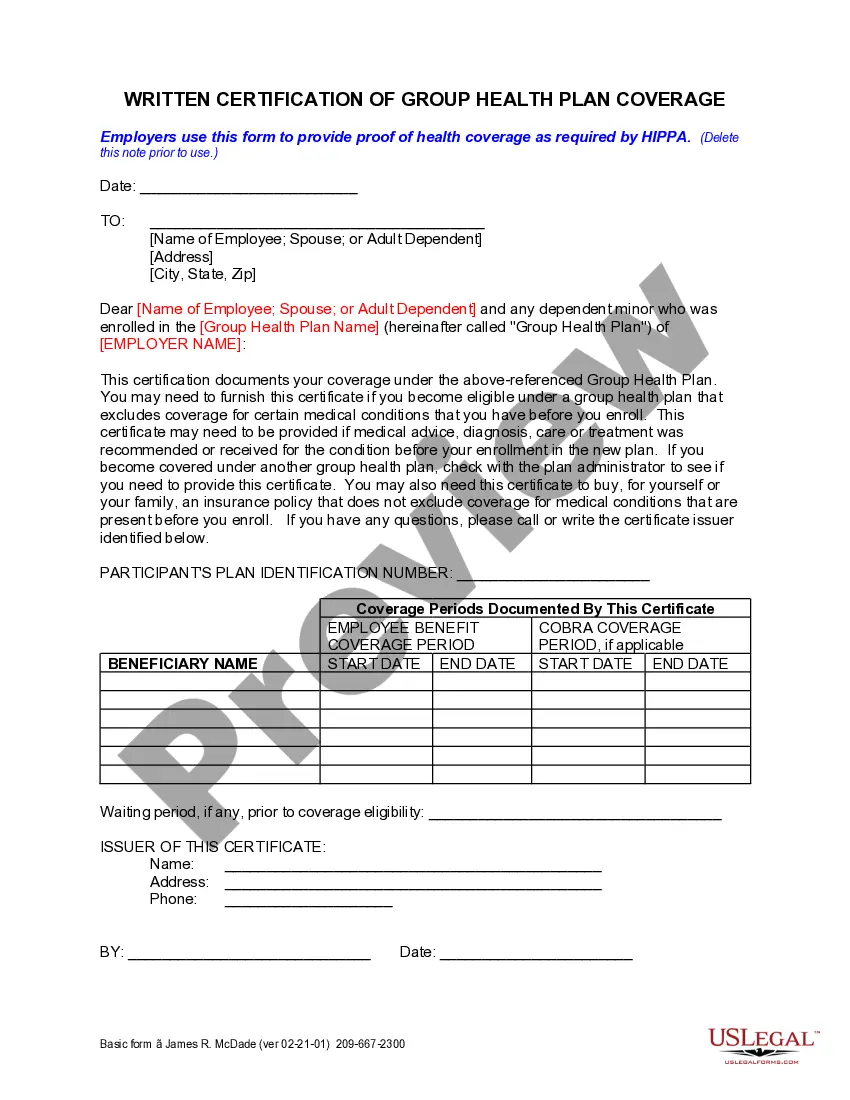
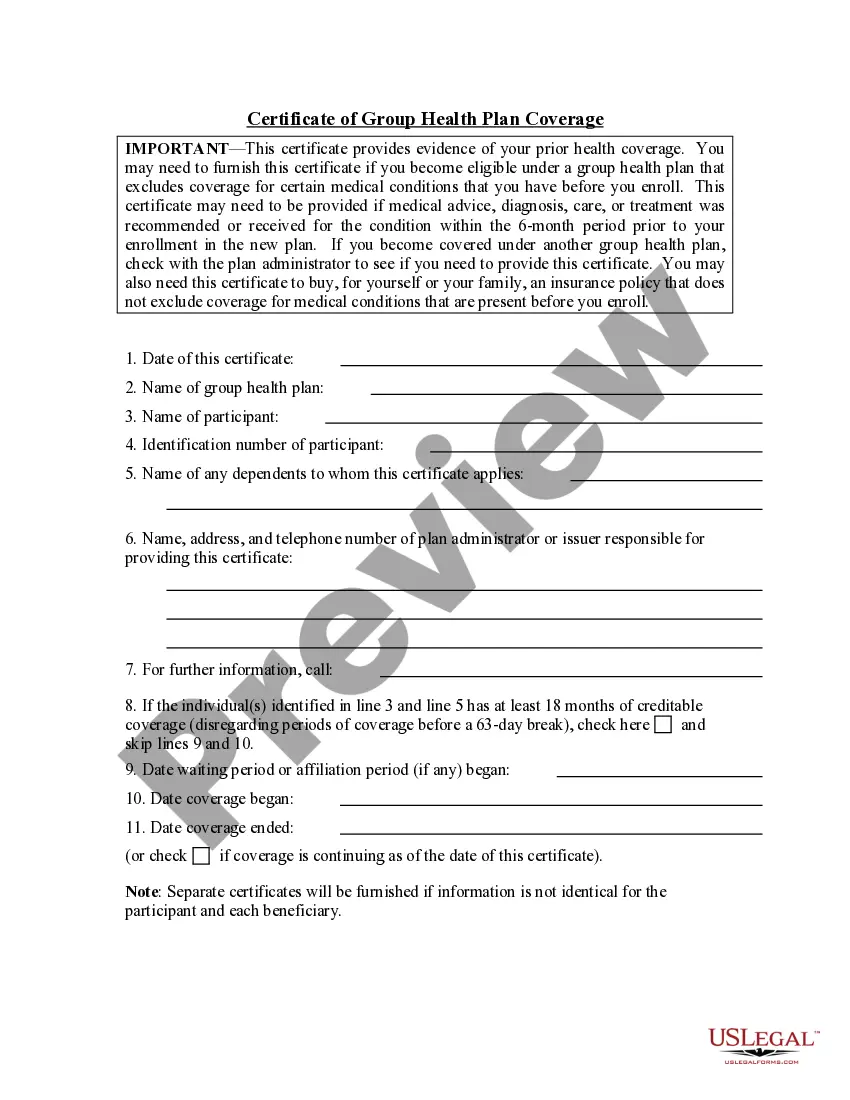
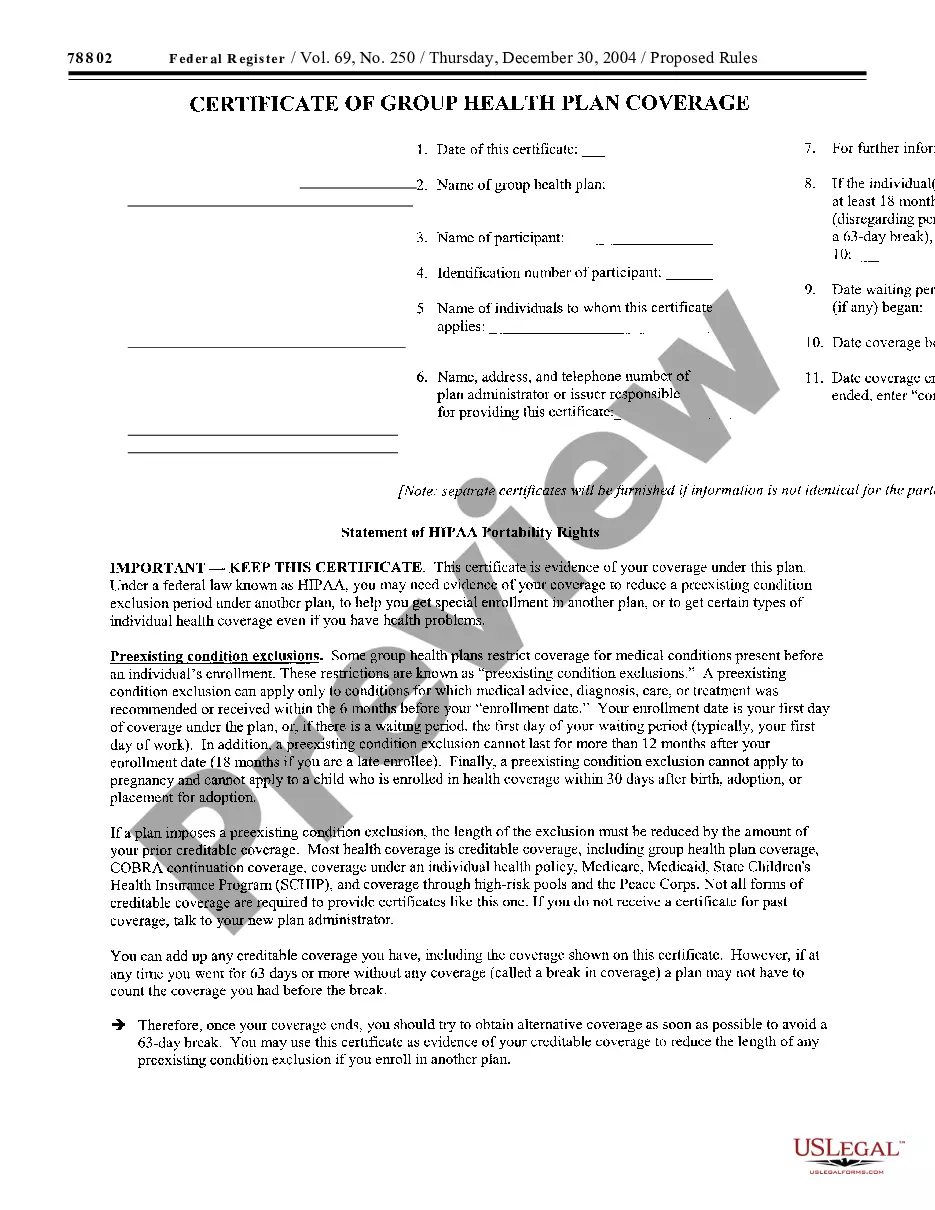
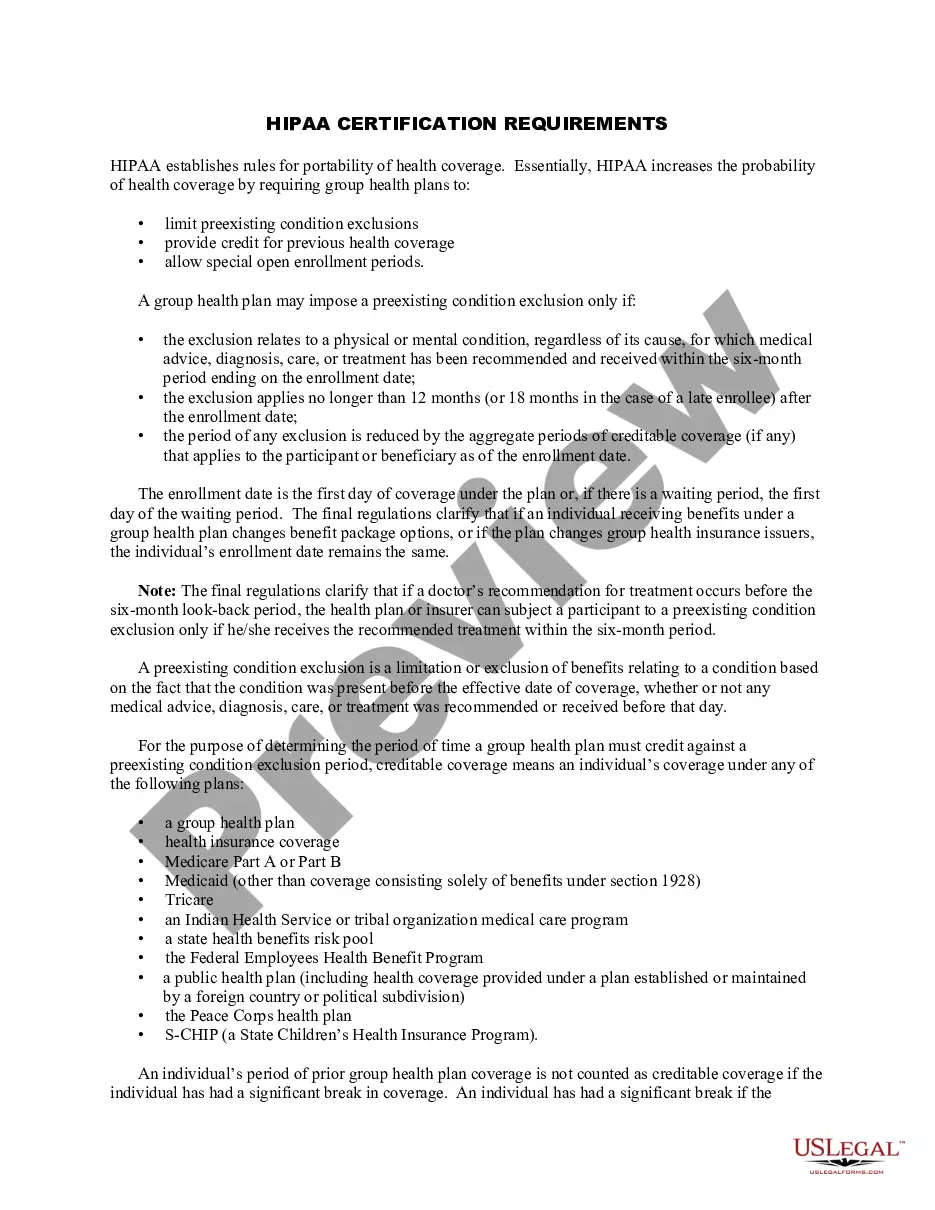
The Certification of Group Health Plan Coverage is an important document that employers provide to employees to confirm their health coverage as mandated by the Health Insurance Portability and Accountability Act (HIPAA). This form is essential for employees who may need to demonstrate their prior health coverage when enrolling in a new group health plan, particularly if there are pre-existing condition exclusions. Unlike other forms related to health insurance, this certification serves specifically to verify existing coverage, ensuring a smoother transition to new plans.
Key parts of this document
- Date of the certification.
- Recipient's name (employee, spouse, or adult dependent).
- Employerâs name and information about the Group Health Plan.
- Coverage periods documented by the certificate.
- Contact information for the issuer of the certificate.
- Space for signature and date by the certifying party.
When this form is needed
This form should be used when an employee, or their dependents, need to provide proof of their health coverage to a new group health plan. It is particularly necessary if the new plan has exclusions for pre-existing conditions. Additionally, this certification might be required when obtaining a private insurance policy or enrolling in a different employer's health plan.
Who needs this form
- Employees who want to prove their prior health coverage for enrollment in a new health plan.
- Spouses or adult dependents who are part of the existing group health plan.
- Employers who need to provide proof of health coverage for their employees.
Instructions for completing this form
- Input the current date at the beginning of the form.
- Enter the name of the employee, spouse, or adult dependent in the designated section.
- Fill in the employer's name associated with the Group Health Plan.
- Document the coverage periods clearly in the specified fields.
- Provide the contact information of the issuer for any inquiries.
- Sign and date the form at the bottom to authenticate it.
Is notarization required?
This form does not typically require notarization unless specified by local law. It is important to confirm whether your specific health plan requirements demand notarization before submission.
Get your form ready online
Our built-in tools help you complete, sign, share, and store your documents in one place.
Make edits, fill in missing information, and update formatting in US Legal Forms—just like you would in MS Word.
Download a copy, print it, send it by email, or mail it via USPS—whatever works best for your next step.
Sign and collect signatures with our SignNow integration. Send to multiple recipients, set reminders, and more. Go Premium to unlock E-Sign.
If this form requires notarization, complete it online through a secure video call—no need to meet a notary in person or wait for an appointment.
We protect your documents and personal data by following strict security and privacy standards.

Make edits, fill in missing information, and update formatting in US Legal Forms—just like you would in MS Word.

Download a copy, print it, send it by email, or mail it via USPS—whatever works best for your next step.

Sign and collect signatures with our SignNow integration. Send to multiple recipients, set reminders, and more. Go Premium to unlock E-Sign.

If this form requires notarization, complete it online through a secure video call—no need to meet a notary in person or wait for an appointment.

We protect your documents and personal data by following strict security and privacy standards.
Mistakes to watch out for
- Not providing accurate coverage periods.
- Forgetting to sign the document before submitting.
- Failing to include the correct contact information for the issuer.
- Leaving out the classification of the recipient (employee, spouse, or dependent).
Benefits of using this form online
- Immediate access to professionally drafted forms.
- Easily downloadable and printable format.
- Editable fields to ensure accuracy of information.
- Convenience of completing the form from any location.
When completed correctly, this certification is legally binding and can be used to satisfy enrollment requirements for new health plans. It may also be necessary to secure health insurance coverage that does not impose exclusions for pre-existing conditions.
Summary of main points
- The Certification of Group Health Plan Coverage documents an employee's health insurance status.
- It is vital for employees transitioning between health plans, especially if pre-existing condition exclusions may apply.
- Proper completion of the form is essential for it to fulfill its function legally.
Looking for another form?

Form popularity
FAQ
To obtain an insurance certificate, contact your insurance company or agent for assistance. They will likely require details about your coverage to issue the document. For specific needs related to the California Certification of Group Health Plan Coverage, consider using the US Legal Forms platform, which provides templates and guidance for common insurance forms.
To get a certificate of health insurance, reach out to your insurance provider and request the document. You may need to provide specific details regarding your policy or coverage. If you require the California Certification of Group Health Plan Coverage, ensure you specify this when making your request.
Form 3853 is typically required for individuals applying for premium tax credits under the Affordable Care Act related to their health insurance coverage. It's crucial for those who received premium assistance and need to report their enrollment. This process aligns with maintaining compliance with the California Certification of Group Health Plan Coverage.
A certificate of insurance in a group health plan serves as proof of coverage for group members. It outlines the specifics of the health plan, including benefits and eligibility. Obtaining this certificate is essential for demonstrating compliance with the California Certification of Group Health Plan Coverage requirements.
Covered California is not classified as a group health plan, but it offers individual and family health insurance options. However, it does help individuals access quality healthcare through various plans. If you're looking for group health plan coverage, you may still need to review options outside of Covered California for your specific requirements.
To obtain a health insurance certificate, first, contact your health insurance provider directly. They usually issue certificates upon request, and you may need to provide basic personal information. Additionally, consider exploring the California Certification of Group Health Plan Coverage, as it may meet your needs for official documentation.
Yes, qualified health plans must be certified to ensure they meet both federal and state criteria for coverage. This process often includes the California Certification of Group Health Plan Coverage. By obtaining this certification, plans demonstrate their compliance and commitment to providing quality healthcare services.
Yes, all health insurance plans that are issued in the United States must comply with the Affordable Care Act regulations. This means they need to meet essential coverage standards, including those outlined in the California Certification of Group Health Plan Coverage. Understanding these requirements is vital for ensuring you have adequate protection.
A qualified group health plan is a type of insurance that meets essential health benefit requirements while complying with state and federal regulations. These plans must provide comprehensive coverage and undergo the California Certification of Group Health Plan Coverage to ensure compliance. As a consumer, you can benefit from protections afforded to these plans.
A qualified health plan is defined by its adherence to specific criteria set forth by the Affordable Care Act. This includes coverage for essential health benefits and consumer protections. Plans must also achieve the California Certification of Group Health Plan Coverage to be considered qualified in the state.