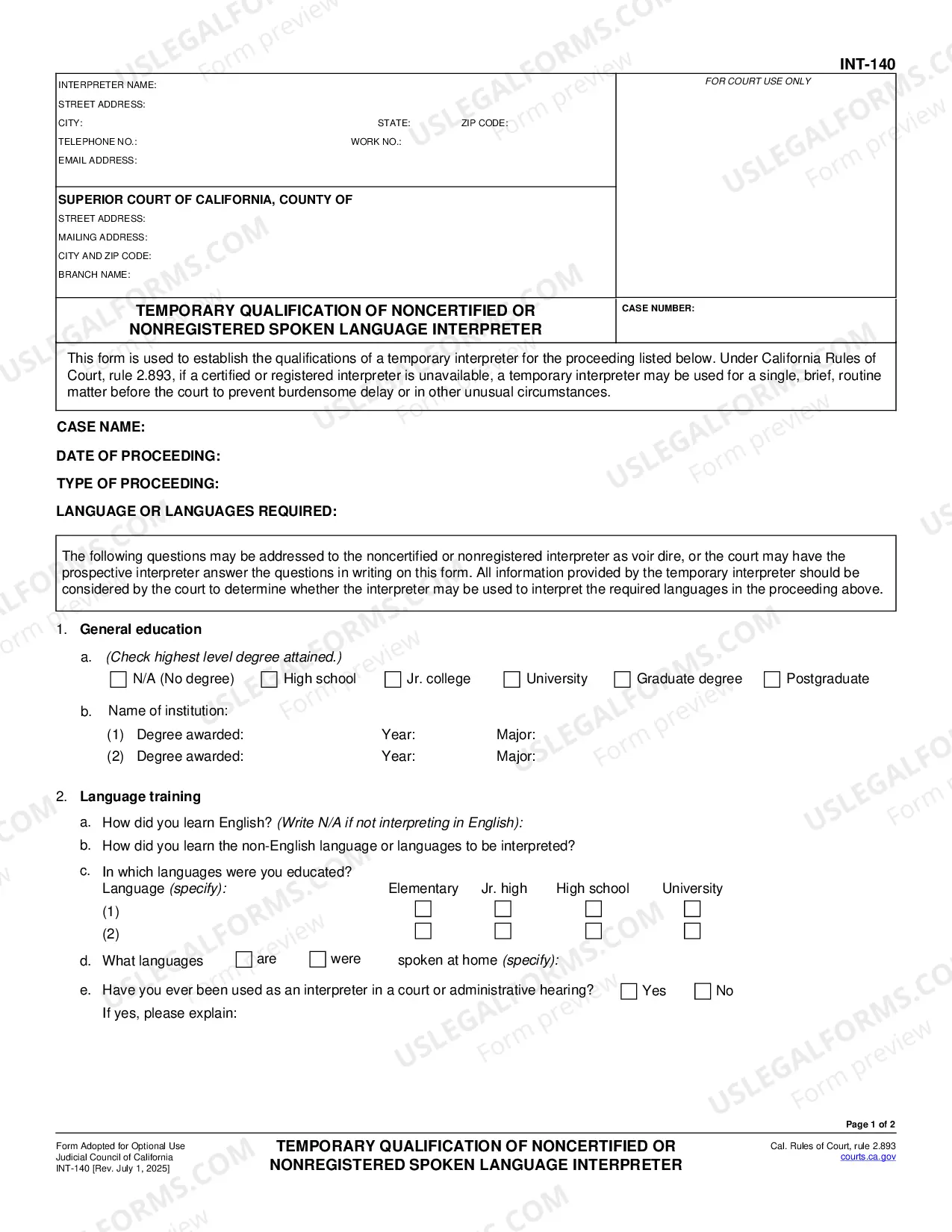
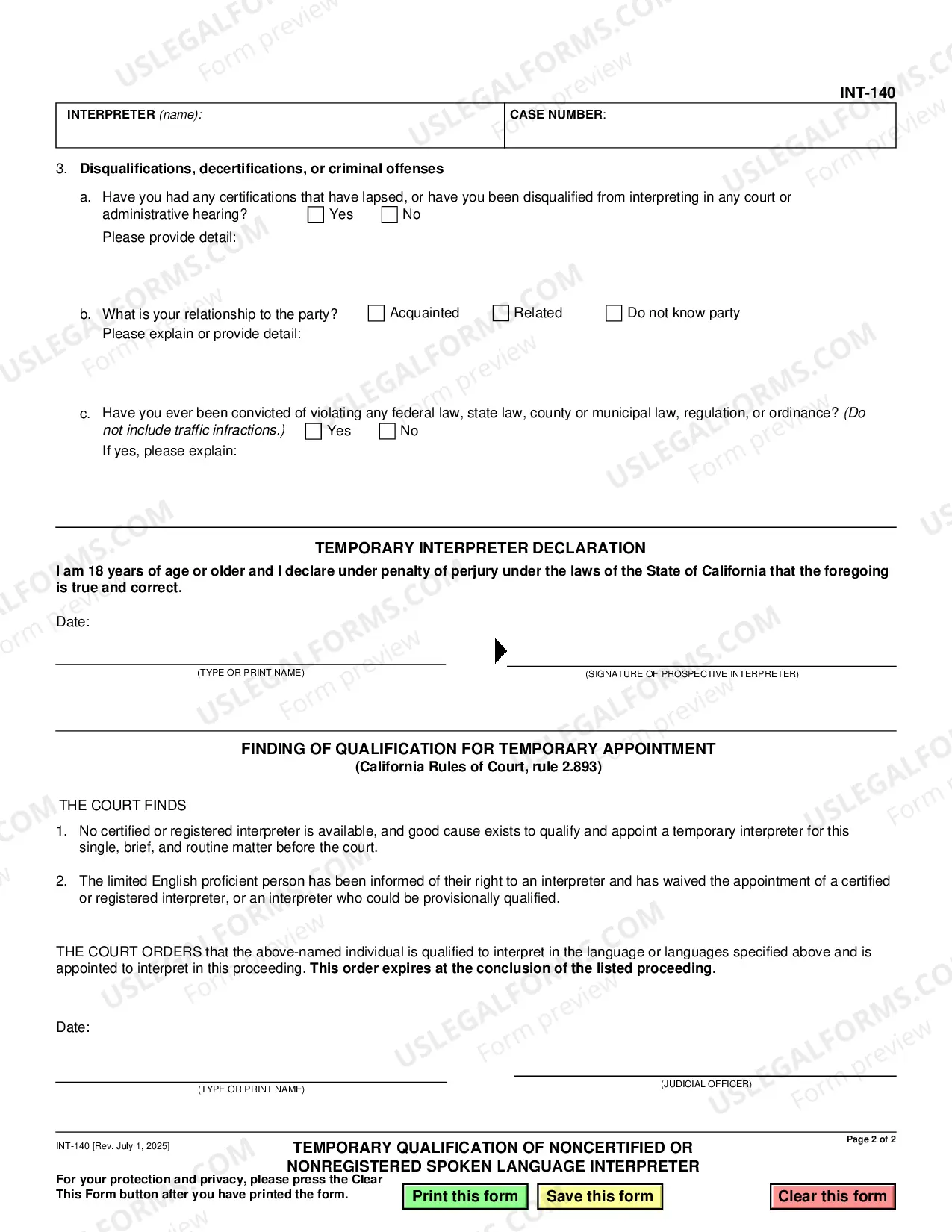
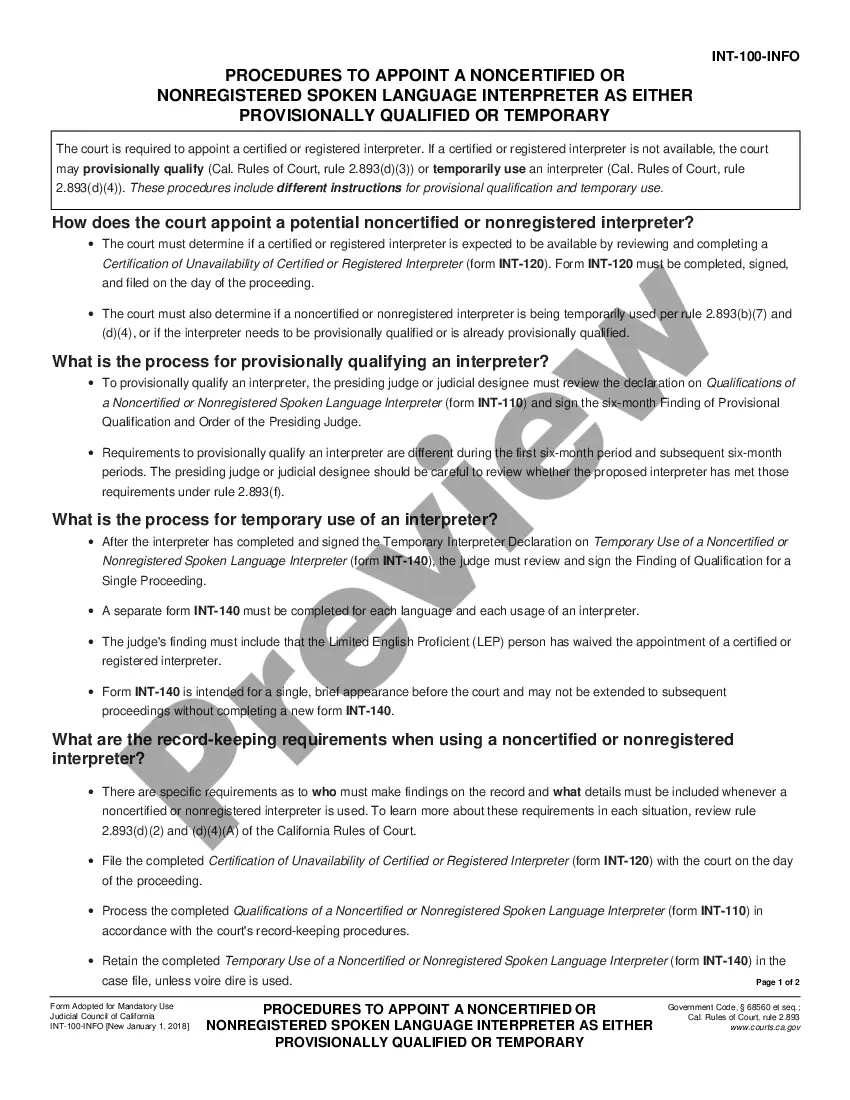
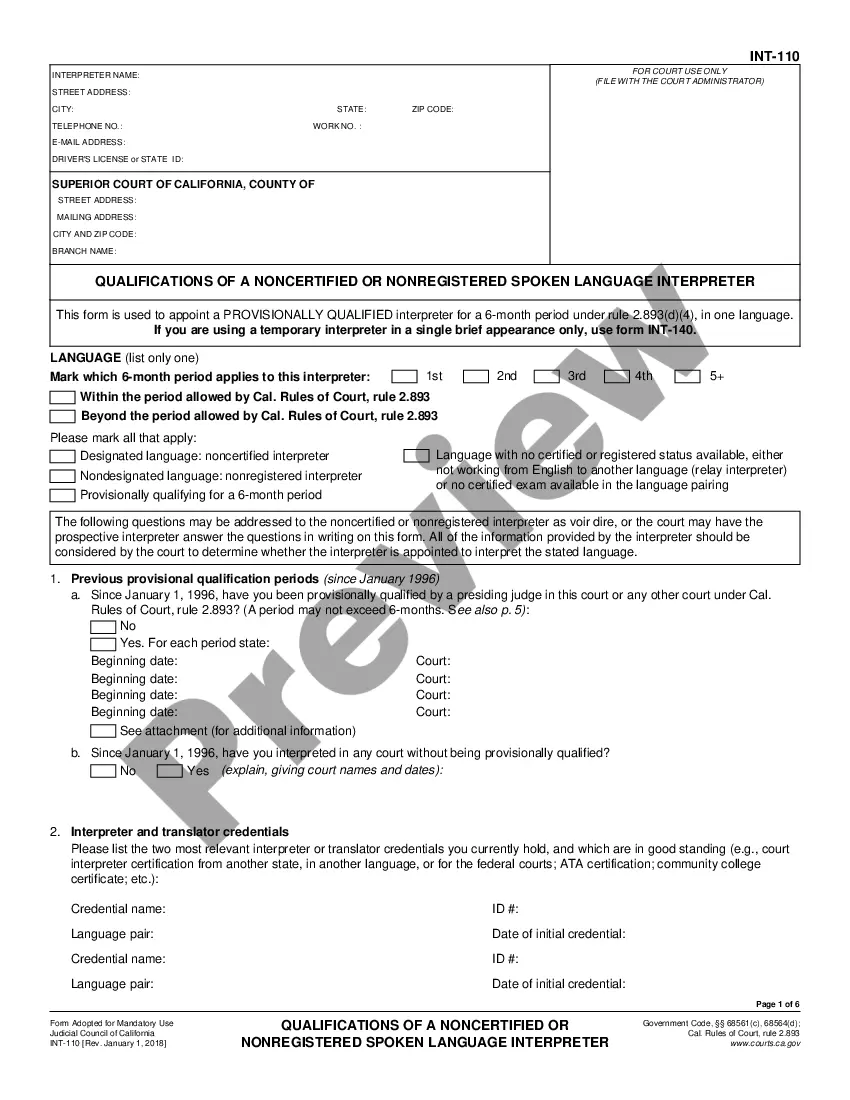
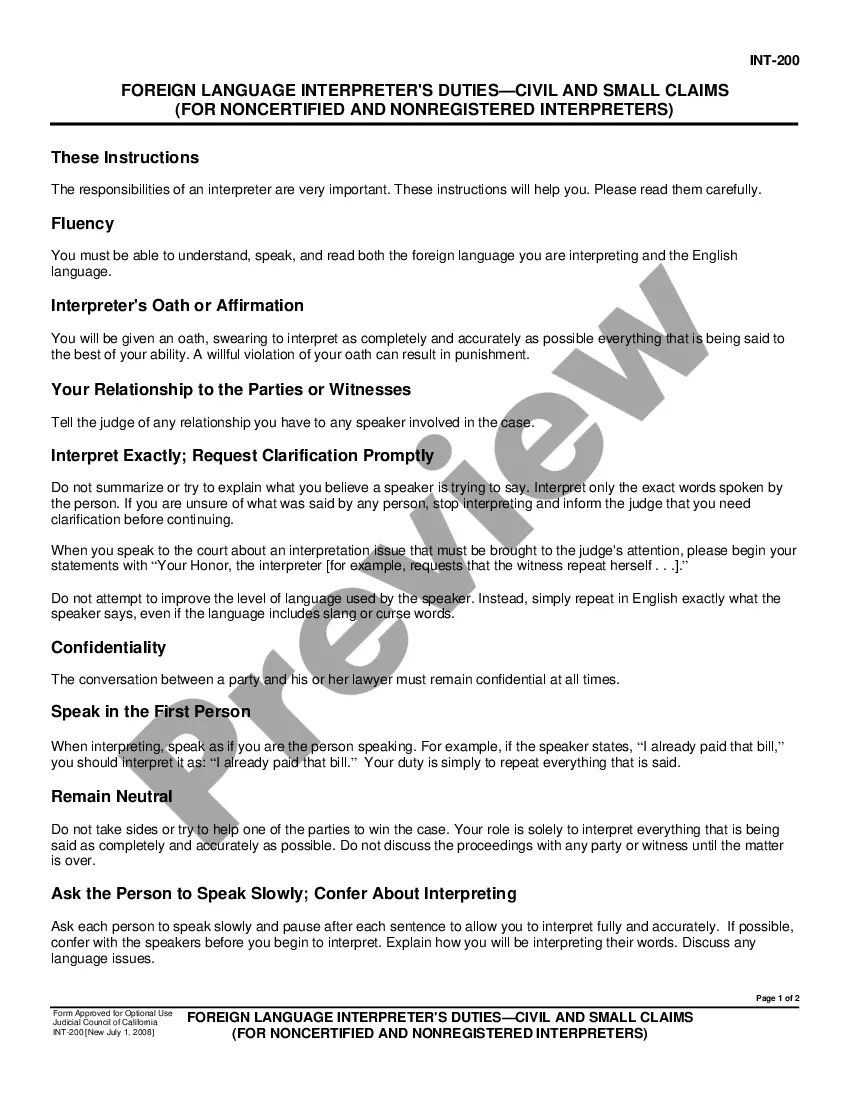
California Temporary Use of a Noncertified or Nonregistered Spoken Language Interpreter is a service that provides language interpreting services for short-term or one-time events in order to bridge the communication gap between people who do not share a common language. This service is available for a variety of settings, including court proceedings, medical appointments, business meetings, and educational activities. There are three types of California Temporary Use of a Noncertified or Nonregistered Spoken Language Interpreter: 1) Interpreter for the Deaf (IFD), 2) Interpreter for Limited English Proficiency (LEP) individuals, and 3) Interpreter for Non-English Speakers (NEW). IFD interpreters provide language interpreting services for individuals who are deaf or hard of hearing. LEP interpreters provide language interpreting services for individuals who have limited English proficiency. NEW interpreters provide language interpreting services for individuals who do not speak English. California Temporary Use of a Noncertified or Nonregistered Spoken Language Interpreter is a valuable service that helps bridge the communication gap between people of different language backgrounds.
California Temporary Use of a Noncertified or Nonregistered Spoken Language Interpreter
Description
Get your form ready online
Our built-in tools help you complete, sign, share, and store your documents in one place.
Make edits, fill in missing information, and update formatting in US Legal Forms—just like you would in MS Word.
Download a copy, print it, send it by email, or mail it via USPS—whatever works best for your next step.
Sign and collect signatures with our SignNow integration. Send to multiple recipients, set reminders, and more. Go Premium to unlock E-Sign.
If this form requires notarization, complete it online through a secure video call—no need to meet a notary in person or wait for an appointment.
We protect your documents and personal data by following strict security and privacy standards.

Make edits, fill in missing information, and update formatting in US Legal Forms—just like you would in MS Word.

Download a copy, print it, send it by email, or mail it via USPS—whatever works best for your next step.

Sign and collect signatures with our SignNow integration. Send to multiple recipients, set reminders, and more. Go Premium to unlock E-Sign.

If this form requires notarization, complete it online through a secure video call—no need to meet a notary in person or wait for an appointment.

We protect your documents and personal data by following strict security and privacy standards.
Looking for another form?
How to fill out California Temporary Use Of A Noncertified Or Nonregistered Spoken Language Interpreter?
Creating legal documents can be quite taxing unless you have accessible, fillable templates ready to use.
With the US Legal Forms online repository of official documents, you can be confident in the forms you acquire, as they all adhere to federal and state regulations and have been reviewed by our experts.
However, even if you are a newcomer to our service, signing up for a valid subscription will only take a few moments. Here’s a quick walkthrough for you: Document compliance verification. You should carefully review the details of the form you require to ensure it fulfills your requirements and complies with your state laws. Previewing your document and reviewing its general description will assist you in achieving this.Alternative search (optional). In case of any discrepancies, search the library using the Search tab above until you find an appropriate blank, and click Buy Now once you find what you need.Account registration and document purchase. Create an account with US Legal Forms. After verifying your account, Log In and choose your preferred subscription plan. Proceed with payment (PayPal and credit card options are available). Template download and future usage. Choose the file format for your California Temporary Use of a Noncertified or Nonregistered Spoken Language Interpreter and click Download to store it on your device. Print it to finish your documents manually, or use a multifunctional online editor to prepare an electronic copy more swiftly and effectively. Haven’t you experienced US Legal Forms yet? Register for our service now to acquire any official document quickly and effortlessly whenever you need to, and keep your paperwork organized!
- If you need to fill out the California Temporary Use of a Noncertified or Nonregistered Spoken Language Interpreter, our platform is the ideal source to obtain it.
- Retrieving your California Temporary Use of a Noncertified or Nonregistered Spoken Language Interpreter from our collection is as simple as 1-2-3.
- Previous users with an active subscription just need to Log In and click the Download button after locating the desired template.
- If they wish, users can access the same document from the My documents section of their account.
Form popularity
FAQ
The earnings for a certified interpreter in California can vary based on experience and specialization. On average, certified interpreters earn between $25 to $50 per hour. Those working in specialized fields or with higher qualifications may command higher rates. Understanding the financial landscape can help you better plan your career, especially if you consider the California Temporary Use of a Noncertified or Nonregistered Spoken Language Interpreter as a starting point.
Getting your interpreter certification involves several steps, starting with education and training in interpretation. After completing necessary coursework, you need to pass the certification exam offered by the state. It's essential to prepare thoroughly, as this exam evaluates your skills and knowledge in interpreting. Utilizing resources like USLegalForms can help you navigate the requirements for the California Temporary Use of a Noncertified or Nonregistered Spoken Language Interpreter.
To become a certified interpreter in California, you must pass a state-administered examination. This process includes demonstrating your proficiency in both English and the target language. Once you pass the exam, you will receive your certification. The California Temporary Use of a Noncertified or Nonregistered Spoken Language Interpreter often occurs during the period when individuals are completing this certification process.
Pagination in California courts refers to the organization of documents, ensuring clarity and ease of navigation. Proper pagination allows attorneys, judges, and interpreters to reference documents efficiently during proceedings. While not directly tied to the California Temporary Use of a Noncertified or Nonregistered Spoken Language Interpreter, understanding these rules can enhance the overall structure of court documents and improve communication within the legal process.
Court-certified translations in California require interpreters to meet specific standards and accreditation, ensuring reliable communication. However, under the California Temporary Use of a Noncertified or Nonregistered Spoken Language Interpreter, the rules are more relaxed, allowing individuals to choose interpreters based on their discretion. It's crucial to recognize that while these interpreters may not hold formal certification, they still play a critical role in the legal process.
California law governs translation practices to ensure accessibility and fairness in legal proceedings. The California Temporary Use of a Noncertified or Nonregistered Spoken Language Interpreter allows individuals to access language assistance, even if the interpreter is not certified. This underscores the state's commitment to ensuring that all parties can fully participate in legal processes, regardless of language barriers.
In the context of the California Temporary Use of a Noncertified or Nonregistered Spoken Language Interpreter, it's vital to understand the distinctions. A court translator primarily focuses on converting written documents from one language to another, ensuring accuracy in text. In contrast, an interpreter works during live interactions, translating spoken dialogue in real time to facilitate communication between parties who speak different languages.
The language access law in California encompasses various regulations aimed at providing communication access to individuals with limited English proficiency in state-funded programs. This law ensures that non-English speakers receive adequate support in legal contexts. Engaging the California Temporary Use of a Noncertified or Nonregistered Spoken Language Interpreter can provide necessary assistance when certified interpreters are unavailable. For comprehensive legal resources, consider platforms like UsLegalForms to navigate these laws.
The Bilingual Services Act in California mandates that state agencies provide services in languages other than English when a significant portion of the population speaks those languages. This act aims to improve access to services for non-English speakers. When dealing with the California Temporary Use of a Noncertified or Nonregistered Spoken Language Interpreter, awareness of this act can enhance your access to necessary services. UsLegalForms offers comprehensive guides to ensure compliance with this act.
The federal law for language access, particularly Title VI of the Civil Rights Act, prohibits discrimination based on national origin, which includes limited English proficiency individuals. This law requires federally funded programs to provide adequate language assistance. When considering the California Temporary Use of a Noncertified or Nonregistered Spoken Language Interpreter, being aware of these federal protections can help navigate legal challenges. Staying informed with legal resources can strengthen your position.