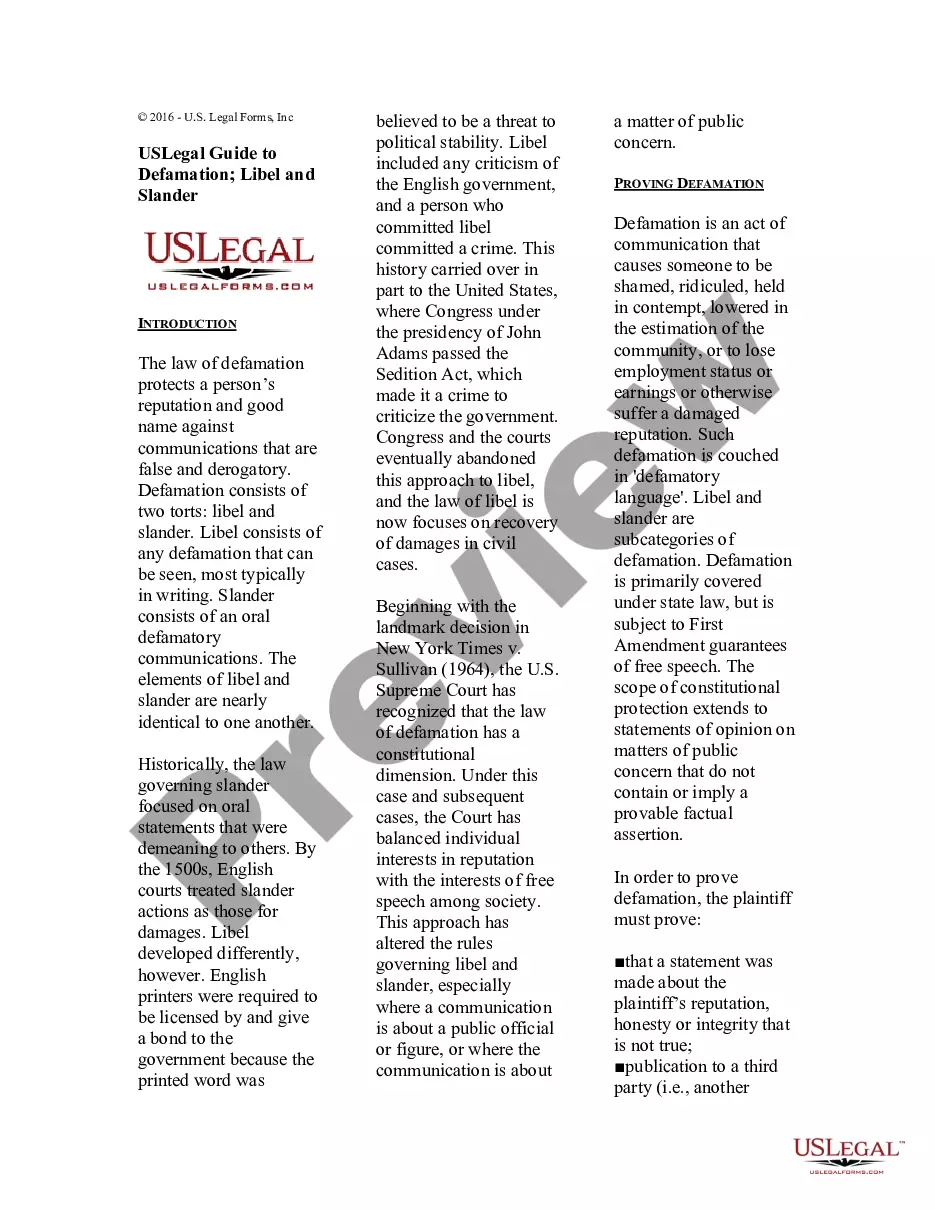
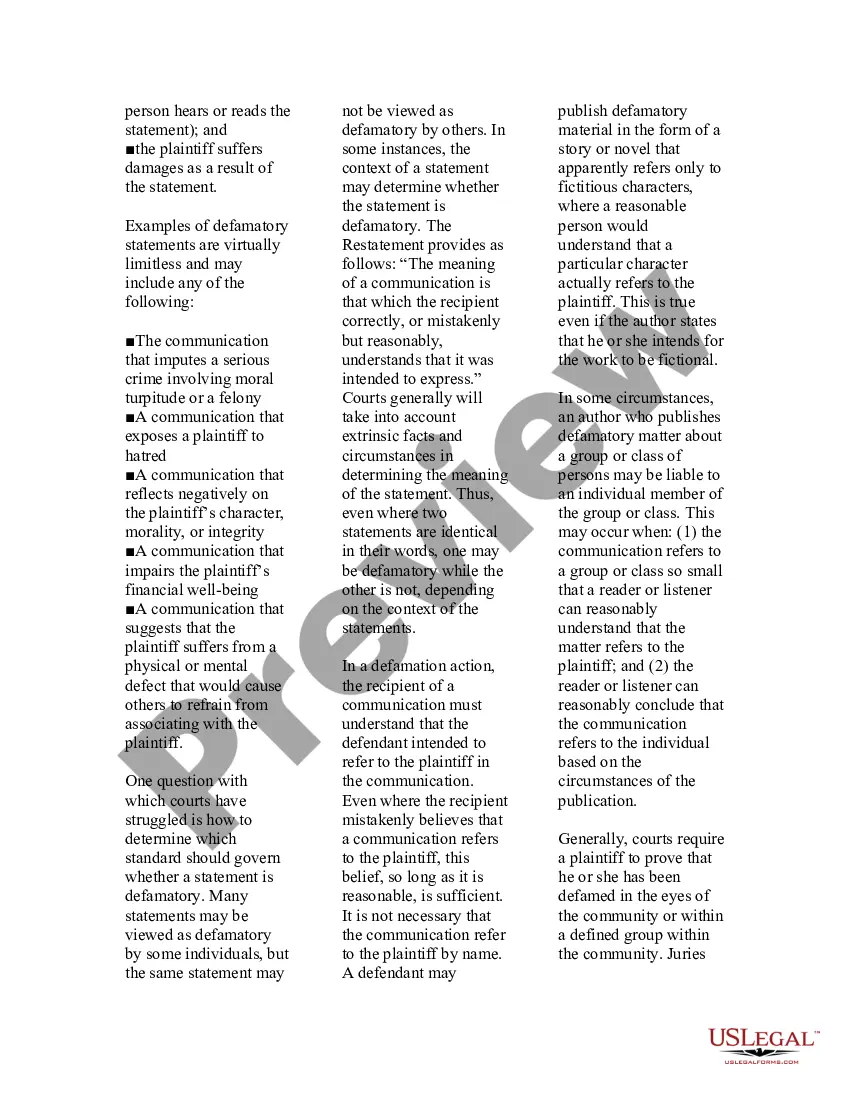
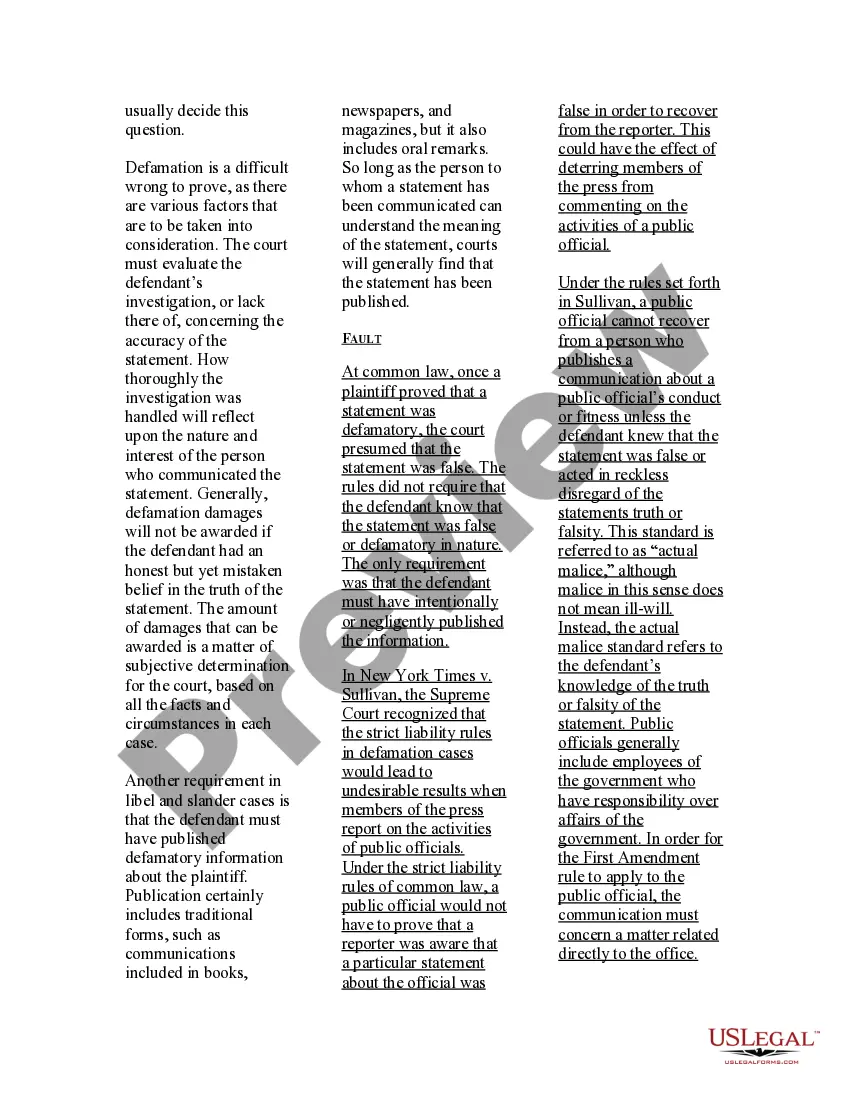
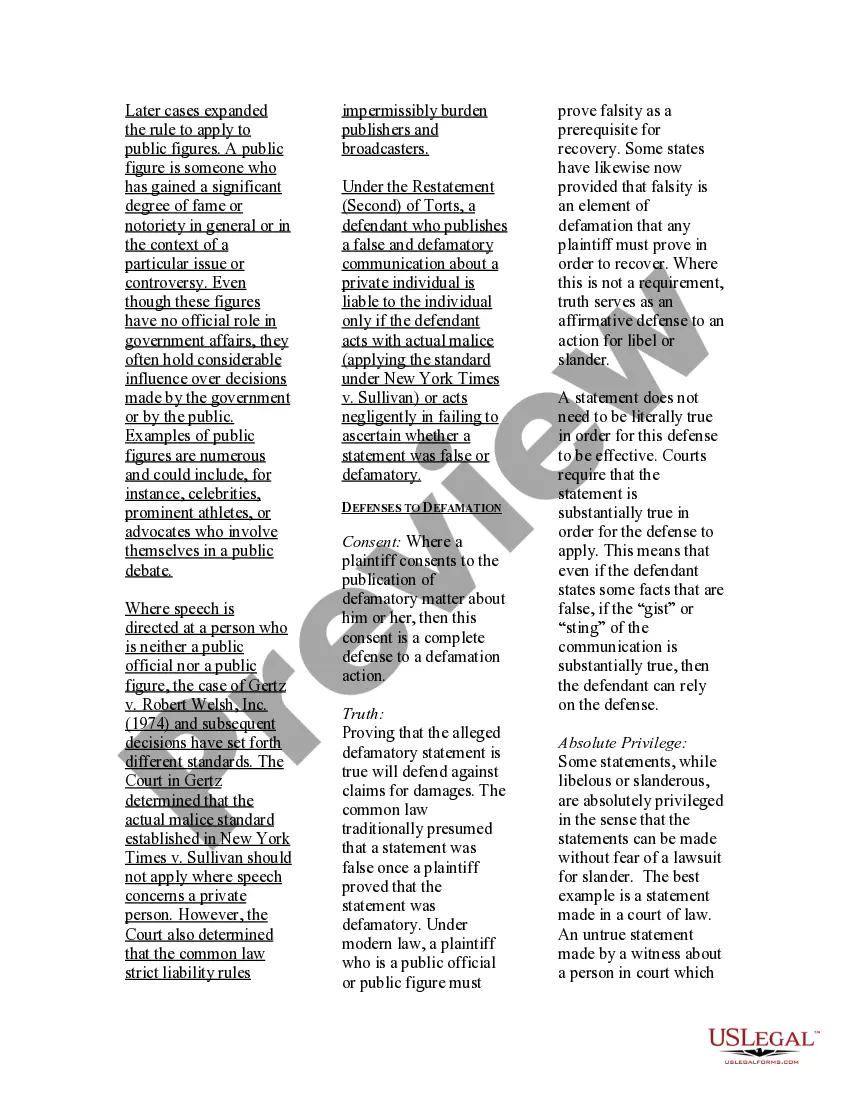
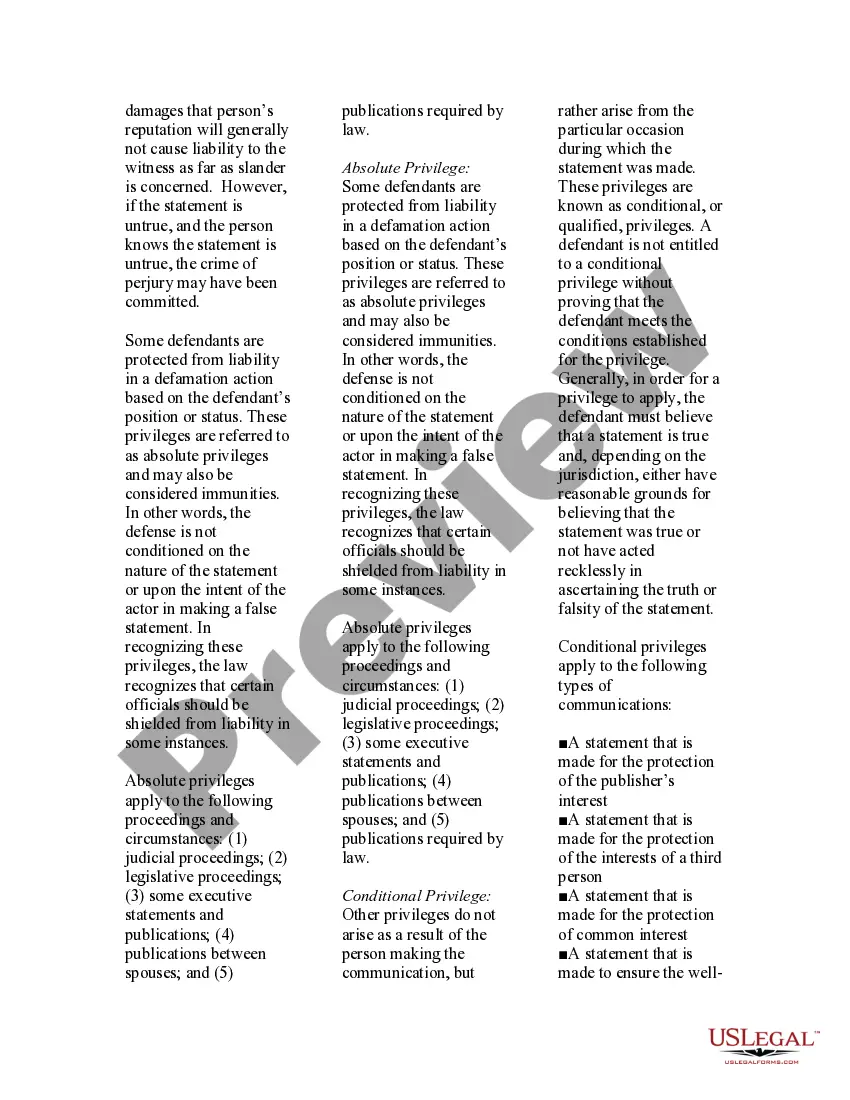
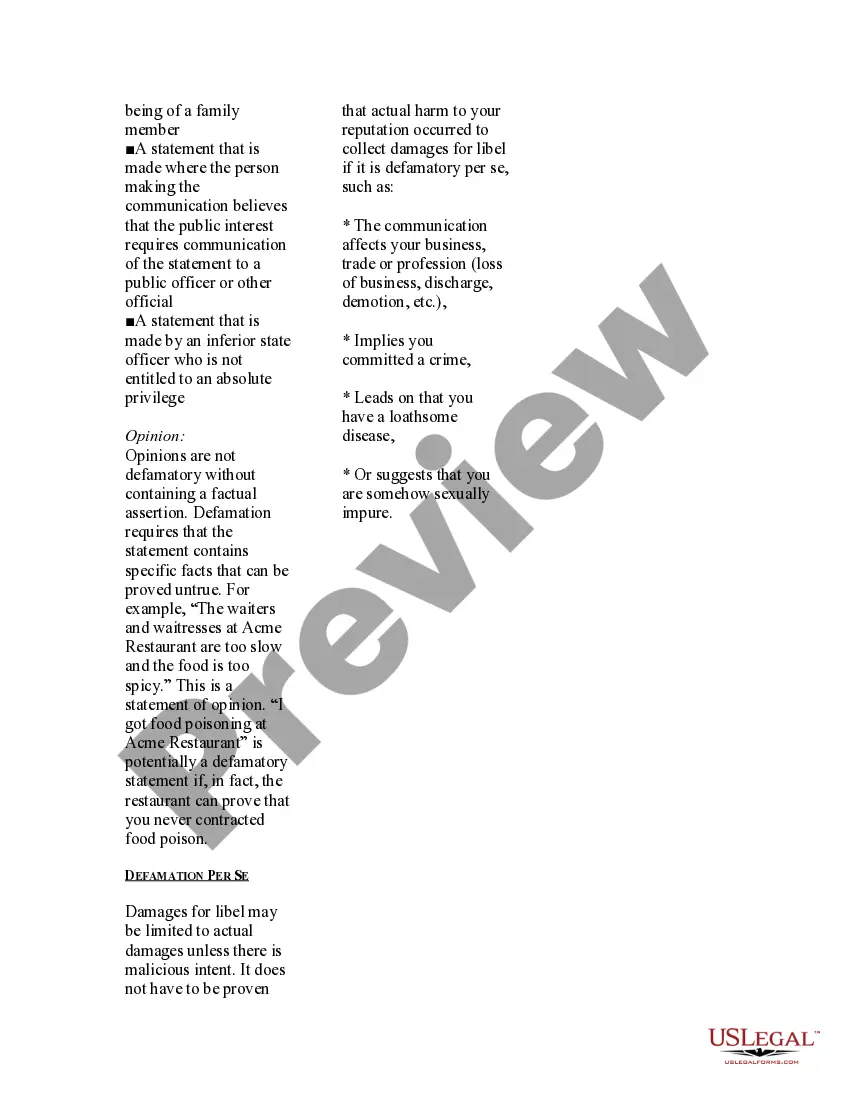
This guide provides an overview of defamation law. Topics included cover the definitions of libel and slander, proving defamation, defenses to defamation, and more.
Arizona USLegal Guide to Defamation; Libel and Slander
Category:
State:
Multi-State
Control #:
US-GDE-14
Format:
Word;
Rich Text
Instant download
Description
Free preview

How to fill out USLegal Guide To Defamation; Libel And Slander?
US Legal Forms - among the most significant libraries of authorized types in the United States - delivers a wide array of authorized record layouts you can obtain or produce. Utilizing the web site, you can find 1000s of types for enterprise and personal reasons, categorized by types, claims, or key phrases.You will discover the latest variations of types much like the Arizona USLegal Guide to Defamation; Libel and Slander in seconds.
If you currently have a subscription, log in and obtain Arizona USLegal Guide to Defamation; Libel and Slander through the US Legal Forms catalogue. The Down load button will appear on every form you look at. You have access to all earlier acquired types within the My Forms tab of your respective profile.
In order to use US Legal Forms for the first time, here are simple guidelines to obtain started out:
- Be sure to have selected the right form for the city/region. Click on the Preview button to examine the form`s content. See the form outline to ensure that you have selected the appropriate form.
- In case the form does not match your demands, make use of the Search field at the top of the screen to obtain the the one that does.
- When you are satisfied with the form, validate your selection by visiting the Get now button. Then, pick the rates prepare you prefer and give your qualifications to sign up for the profile.
- Method the deal. Use your bank card or PayPal profile to finish the deal.
- Find the structure and obtain the form on the system.
- Make modifications. Fill up, change and produce and sign the acquired Arizona USLegal Guide to Defamation; Libel and Slander .
Every design you included in your money does not have an expiry day and it is your own property forever. So, if you wish to obtain or produce one more backup, just proceed to the My Forms area and then click on the form you will need.
Obtain access to the Arizona USLegal Guide to Defamation; Libel and Slander with US Legal Forms, probably the most considerable catalogue of authorized record layouts. Use 1000s of skilled and state-distinct layouts that meet your organization or personal needs and demands.
Form popularity
FAQ
The four elements of defamation are: A defendant made an oral or written factual and defamatory statement; Regarding the plaintiff; That was published without privilege or authorization to others by the defendant; and. There was resultant injury, unless the statement falls within a category of ?per se? harm.
4th 551 (?A public official or a limited public figure must prove the defendant published defamatory statements about the plaintiff with actual malice, or, in other words, with knowledge of the statements' falsity or in reckless disregard of their truth or falsity.
How to File a Defamation Lawsuit Step 1 ? Gather the False Statements. Collect any and all evidence of the false statements made. ... Step 2 ? Show the Statement is Inaccurate. ... Step 3 ? Write the Cease and Desist Letter. ... Step 4 ? Claiming Damages. ... Step 5 ? Prepare and File the Lawsuit.
In a slander lawsuit, you have to prove the following: The defendant spoke a false statement of fact. The untrue statement does not fall into any privileged category. The defendant acted negligently or intentionally in making the statement.
To win a libel suit, a public figure must prove the publisher of the false statements acted with actual malice. Actual malice means that the publisher knew that the statements were false or acted with reckless disregard for whether they were true or false.
In an action for slander, the plaintiff must prove special damages, namely proof of actual pecuniary loss, unless the statement complained of falls into one of the four ?per se? categories of defamation requiring no proof of special damage: allegations that (1) plaintiff committed a crime, (2) are likely to cause ...
It may be libel or slander. (California Civil section 44; herein, ?Civ. Code § __.?) The tort involves (a) a publication that is (b) false, (c) defamatory, and (d) unprivileged, and that (e) has a natural tendency to injure or that causes special damage.
To prove prima facie defamation, a plaintiff must show four things: 1) a false statement purporting to be fact; 2) publication or communication of that statement to a third person; 3) fault amounting to at least negligence; and 4) damages, or some harm caused to the reputation of the person or entity who is the subject ...