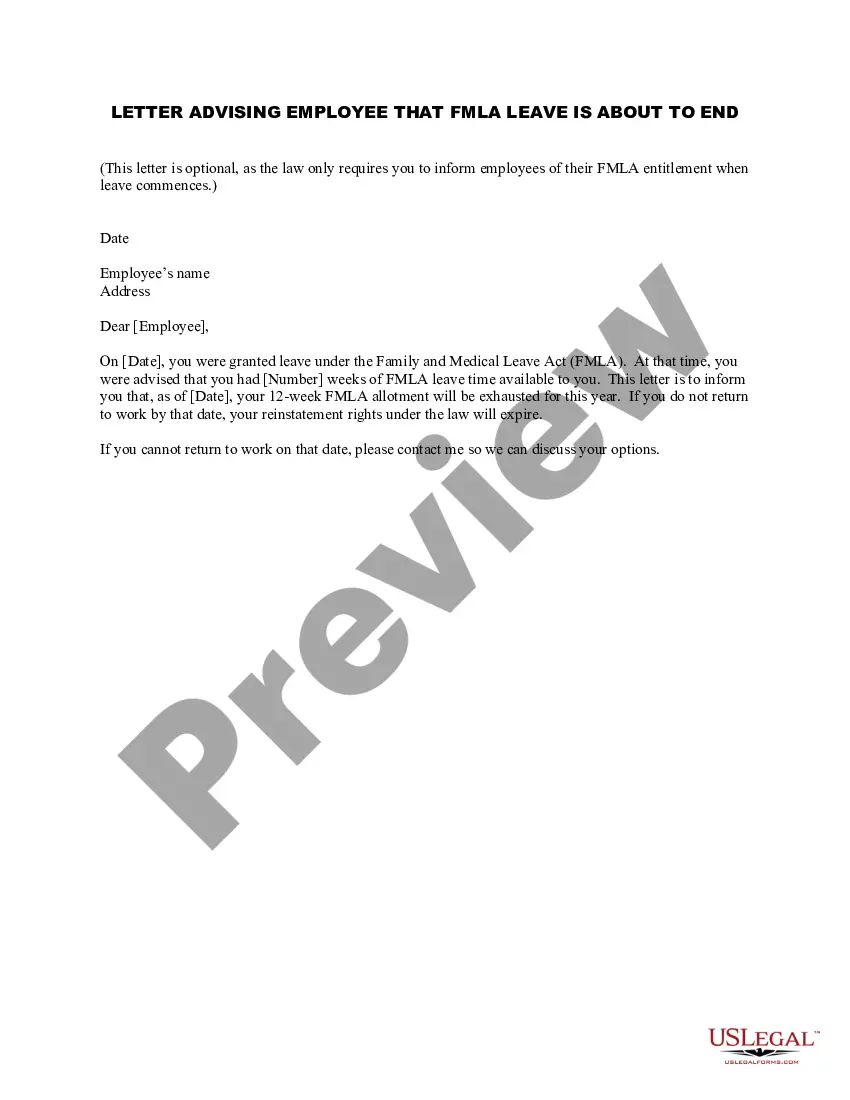
Arizona Letter Advising Employee that FMLA Leave is About to End
Description

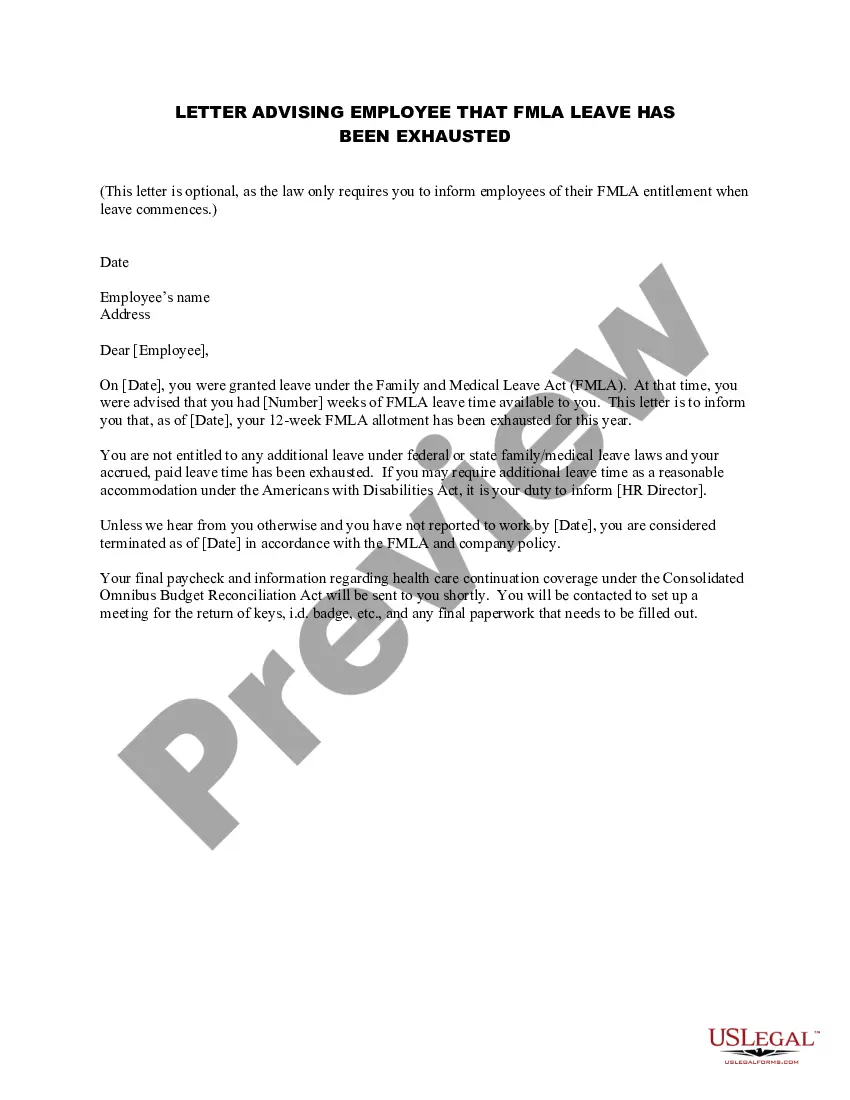

How to fill out Letter Advising Employee That FMLA Leave Is About To End?
If you wish to be thorough, acquire, or printing authentic document templates, utilize US Legal Forms, the largest selection of valid forms, that are accessible online.
Make use of the site’s easy and user-friendly search to find the documents you require.
Various templates for corporate and personal purposes are organized by categories and states, or keywords.
Step 4. Once you have found the form you need, click the Download now button. Select the payment plan you prefer and provide your information to create an account.
Step 5. Process the payment. You can use your credit card or PayPal account to complete the transaction.
- Utilize US Legal Forms to acquire the Arizona Letter Informing Employee that FMLA Leave is Nearing Its Conclusion in just a few clicks.
- If you are already a US Legal Forms user, sign in to your account and select the Download option to find the Arizona Letter Informing Employee that FMLA Leave is Nearing Its Conclusion.
- You can also access forms you previously downloaded in the My documents section of your account.
- If you are using US Legal Forms for the first time, adhere to the guidelines below.
- Step 1. Ensure you have selected the form for the correct city/state.
- Step 2. Take advantage of the Review option to examine the form’s details. Be sure to check the description.
- Step 3. If you are dissatisfied with the document, use the Search field at the top of the screen to locate alternative versions of your legal document template.
Form popularity
FAQ
While the employee is on leave, an employer can ask the employee to provide status updates, including asking the employee to obtain a second opinion regarding her condition. The caveat is that you may only ask the employee; you cannot ask anyone else about a particular employee's leave.
Is a termination letter required in Arizona? While a termination letter is considered good practice, no federal or Arizona laws require it. In fact, because Arizona is an at-will employment state, an employer is under no obligation to provide a reason for firing an employee.
A: Yes. An employee is allowed 12 weeks of FMLA protected leave in a 12 month time period. An employee could be covered for multiple claims as long as the total FMLA coverage does not exceed 12 weeks in a 12 month period and the employee has worked 1250 hours in the preceding 12 months of the request.
No federal law prohibits employers from asking employees why they are out sick. They are free to ask questions such as when you expect to return to work. They may also require you to furnish proof of your illness, such as a note from a physician.
In general, when an employee is out, we recommend informing coworkers only that the employee is on a leave of absence. The reasons for the leave are not any of the coworkers' business, and the employee might not want the reasons known by others.
When an employee fails to return to work, any health and non-health benefit premiums that the FMLA permits an employer to recover are a debt owed by the non-returning employee to the employer.
When employees exhaust their leave under the Family and Medical Leave Act (FMLA), they may want to return to work or take additional leave. Here are some tips to help employers manage the return-to-work process and decide if providing more leave is appropriate.
The court stated unequivocally, job burnout and job fatigue do not constitute FMLA-qualifying medical conditions, especially when they are unaccompanied by any medical evidence, as is the case here. Indeed, other courts have similarly rejected employees' arguments by employees that they suffered from an FMLA
Once the employee has exhausted his or her remaining FMLA leave entitlement while working the reduced (part-time) schedule, if the employee is a qualified individual with a disability, and if the employee is unable to return to the same full-time position at that time, the employee might continue to work part-time as a
Under the FMLA and CFRA, an employee cannot be fired simply because he or she is on medical leave.