Arizona Independent Contractor Agreement Between Licensed Counselor and Therapist and Licensed Counselor and Therapist Practicing as a Solo Practitioner

State:
Multi-State
Control #:
US-02565BG
Format:
Word; 
Rich Text
Instant download

Description

An independent contractor is a person or business who performs services for another person pursuant to an agreement and who is not subject to the other's control, or right to control, the manner and means of performing the services. The exact nature of the independent contractor's relationship with the hiring party is important since an independent contractor pays his/her own Social Security, income taxes without payroll deduction, has no retirement or health plan rights, and often is not entitled to worker's compensation coverage. The traditional tests to determine whether a worker is an employee or independent contractor involve the concept of control. The Internal Revenue Service (IRS) developed 20 factors used to determine whether a worker is an independent contractor under the common law. A "yes" answer to any of these questions would be evidence of an employer-employee relationship.

" Does the principal provide instructions to the worker about when, where, and how he or she is to perform the work?


" Does the principal provide training to the worker?

" Are the services provided by the worker integrated into the principal's business operations?

" Must the services be rendered personally by the worker?

" Does the principal hire, supervise and pay assistants to the worker?

" Is there a continuing relationship between the principal and the worker?

" Does the principal set the work hours and schedule?

" Does the worker devote substantially full time to the business of the principal?

" Is the work performed on the principal's premises?

" Is the worker required to perform the services in an order or sequence set by the principal?

" Is the worker required to submit oral or written reports to the principal?

" Is the worker paid by the hour, week, or month?

" Does the principal have the right to discharge the worker at will?

" Can the worker terminate his or her relationship with the principal any time he or she wishes without incurring liability to the principal?

" Does the principal pay the business or traveling expenses of the worker?

A "yes" answer to any of these questions would be evidence of an independent contractor relationship.


" Does the worker furnish significant tools, materials and equipment?

" Does the worker have a significant investment in facilities?

" Can the worker realize a profit or loss as a result of his or her services?

" Does the worker provide services for more than one firm at a time?

" Does the worker make his or her services available to the general public?
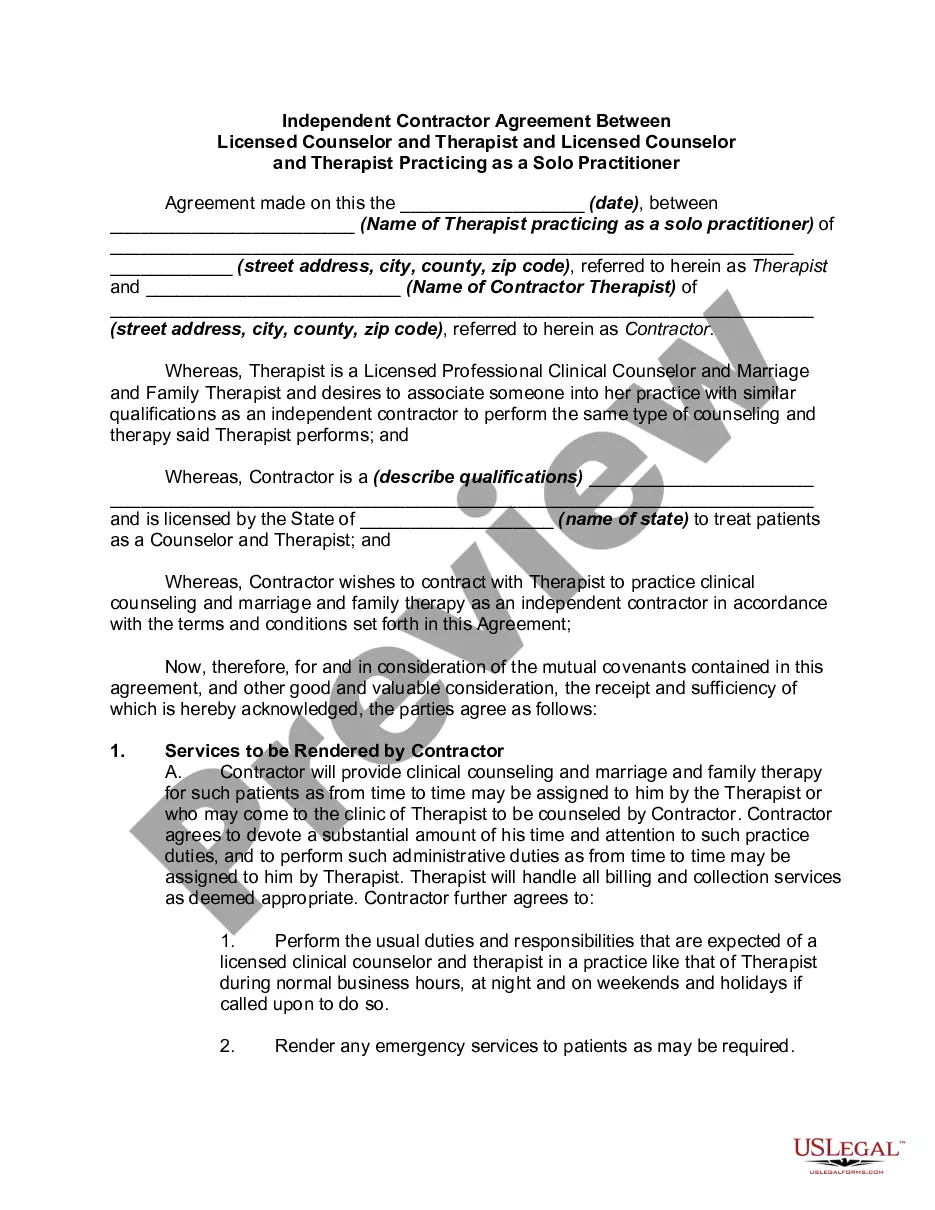
Free preview
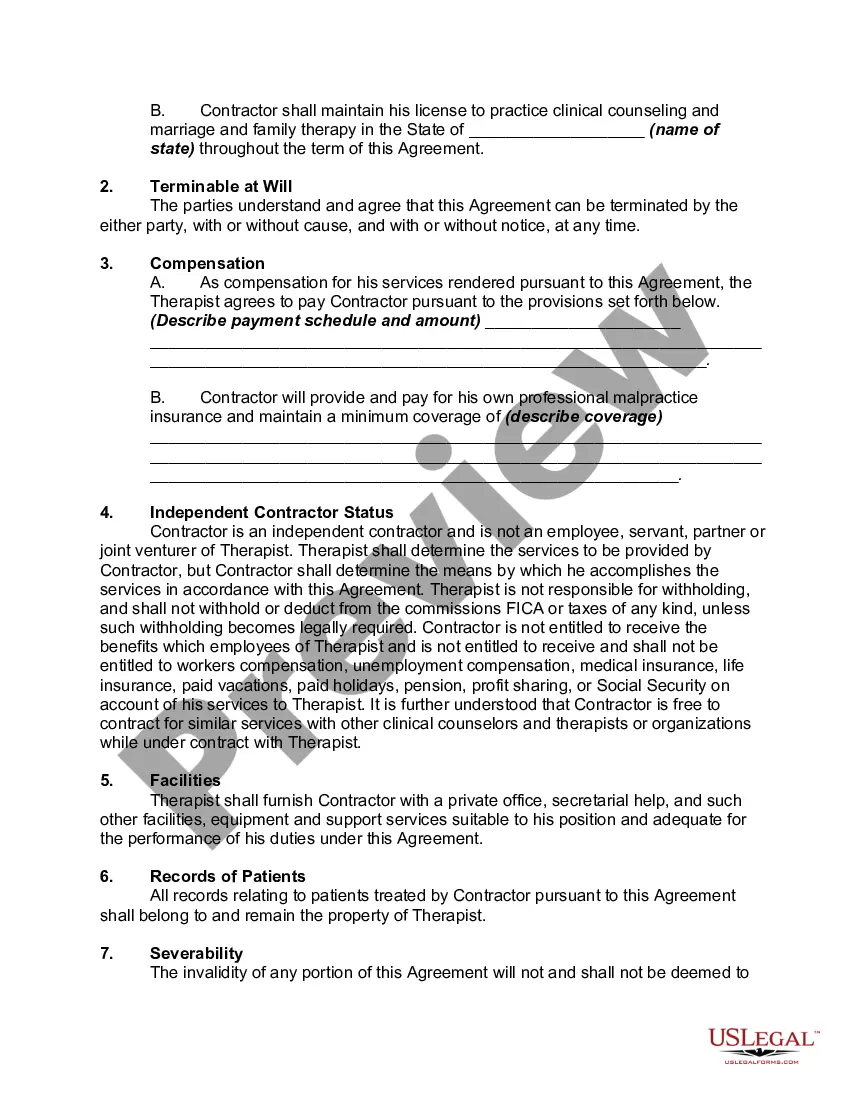
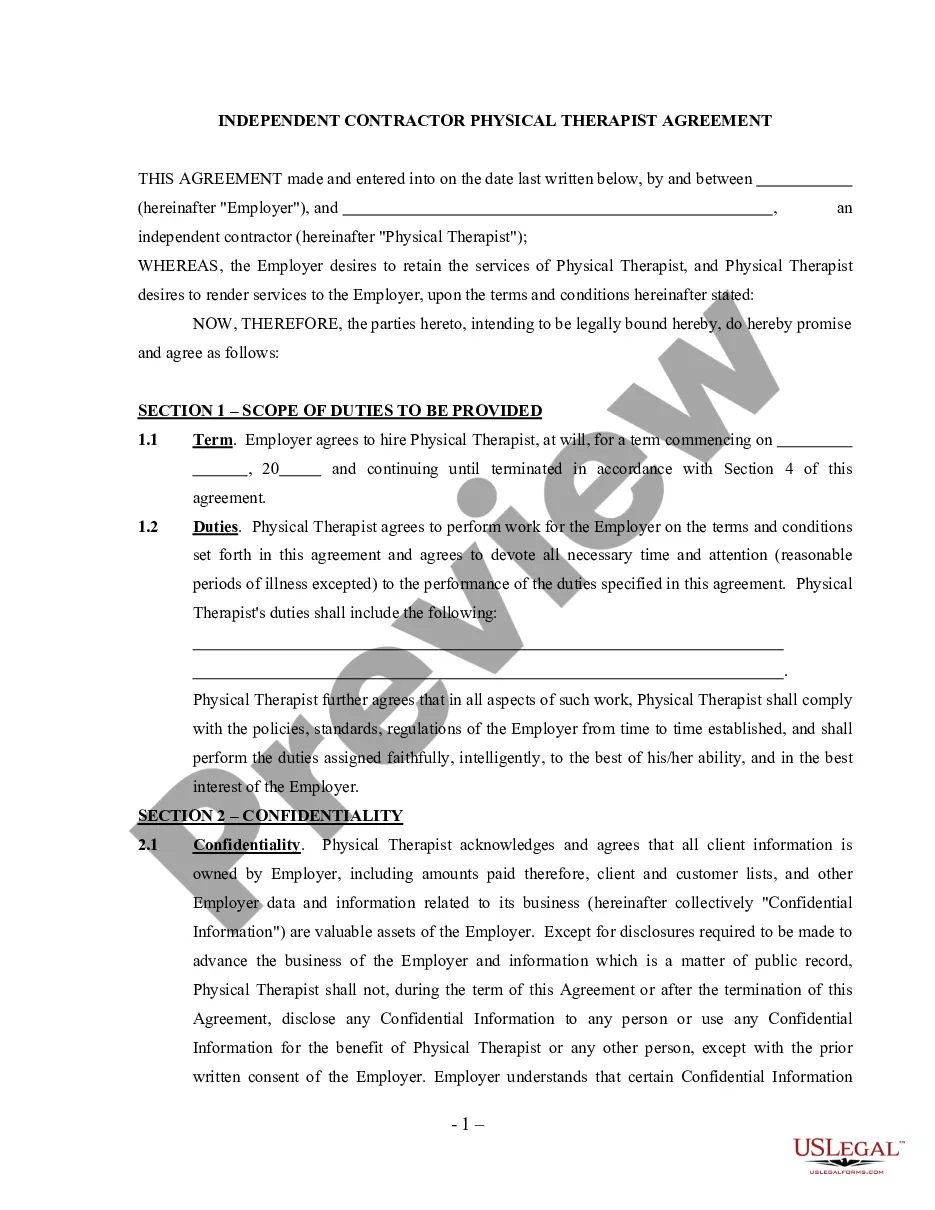
  • Preview Independent Contractor Agreement Between Licensed Counselor and Therapist and Licensed Counselor and Therapist Practicing as a Solo Practitioner
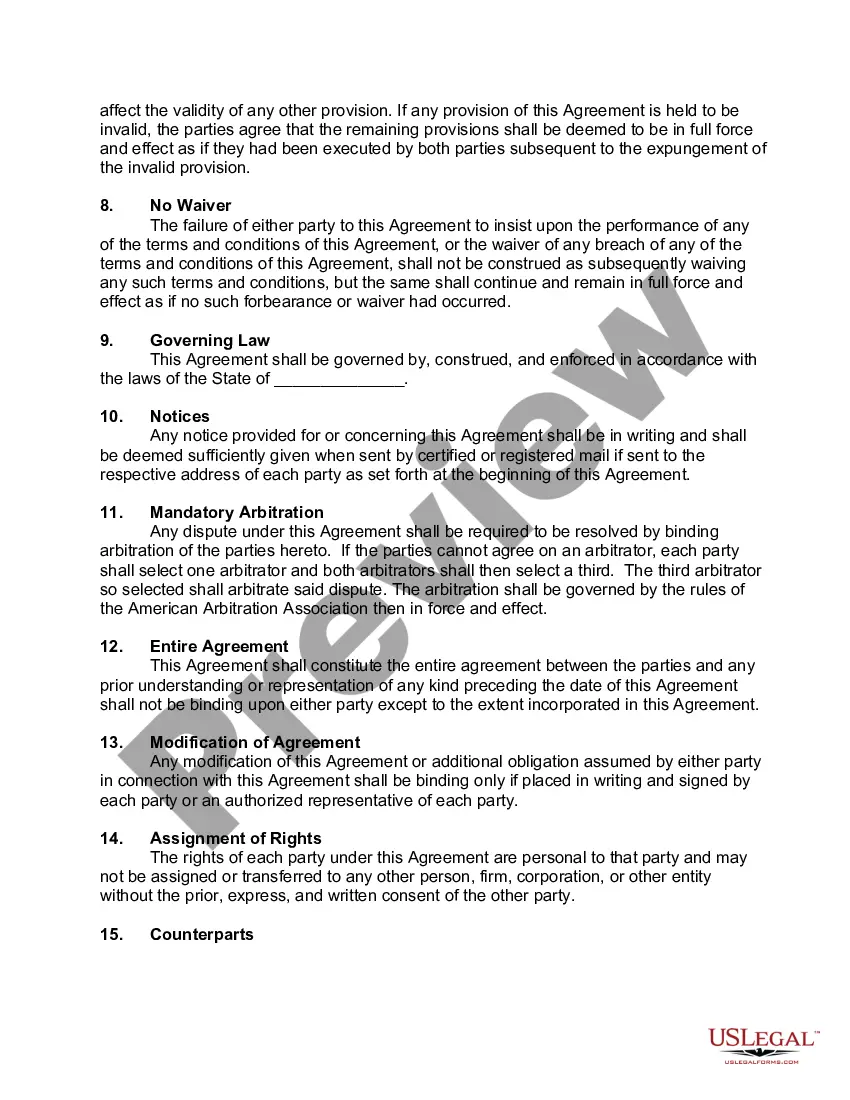
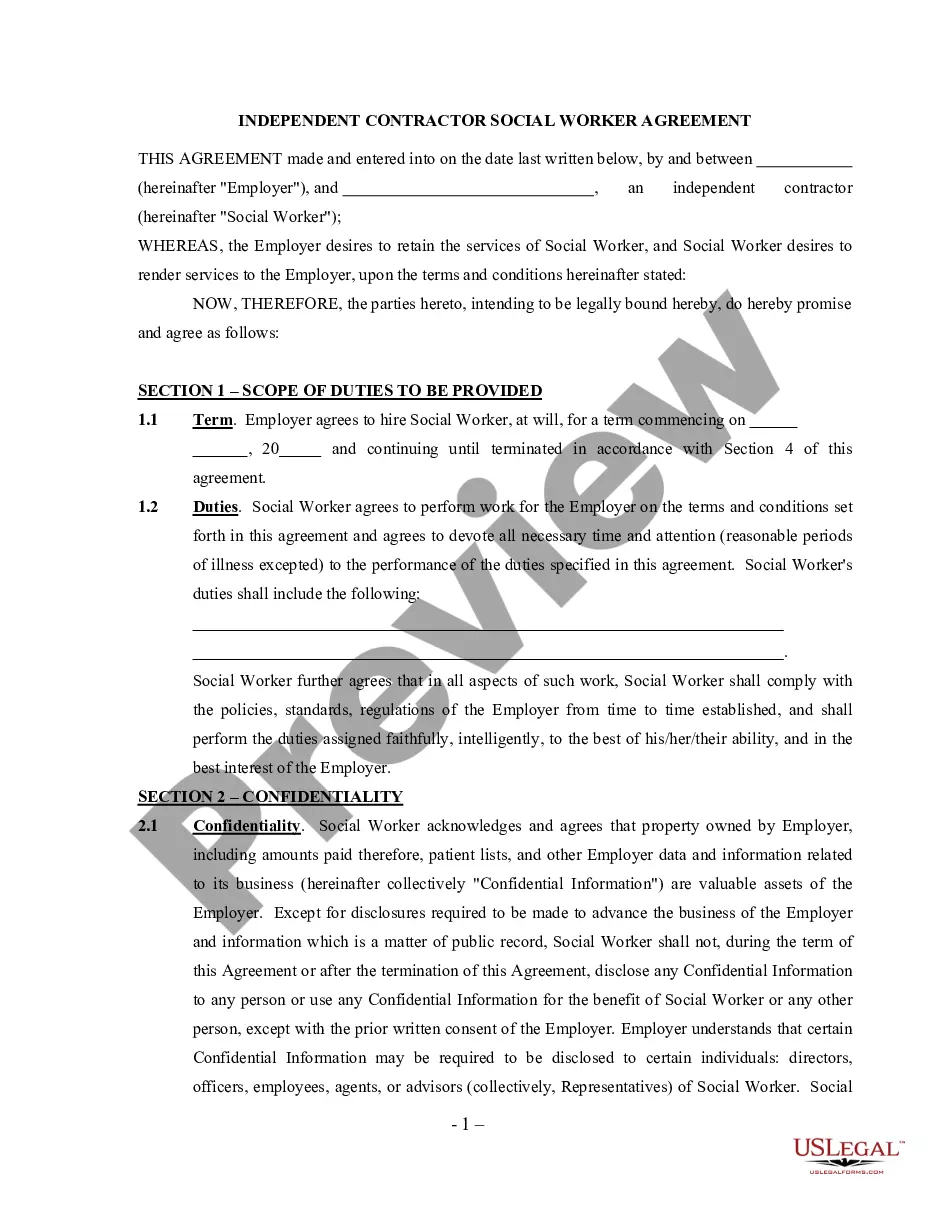
  • Preview Independent Contractor Agreement Between Licensed Counselor and Therapist and Licensed Counselor and Therapist Practicing as a Solo Practitioner
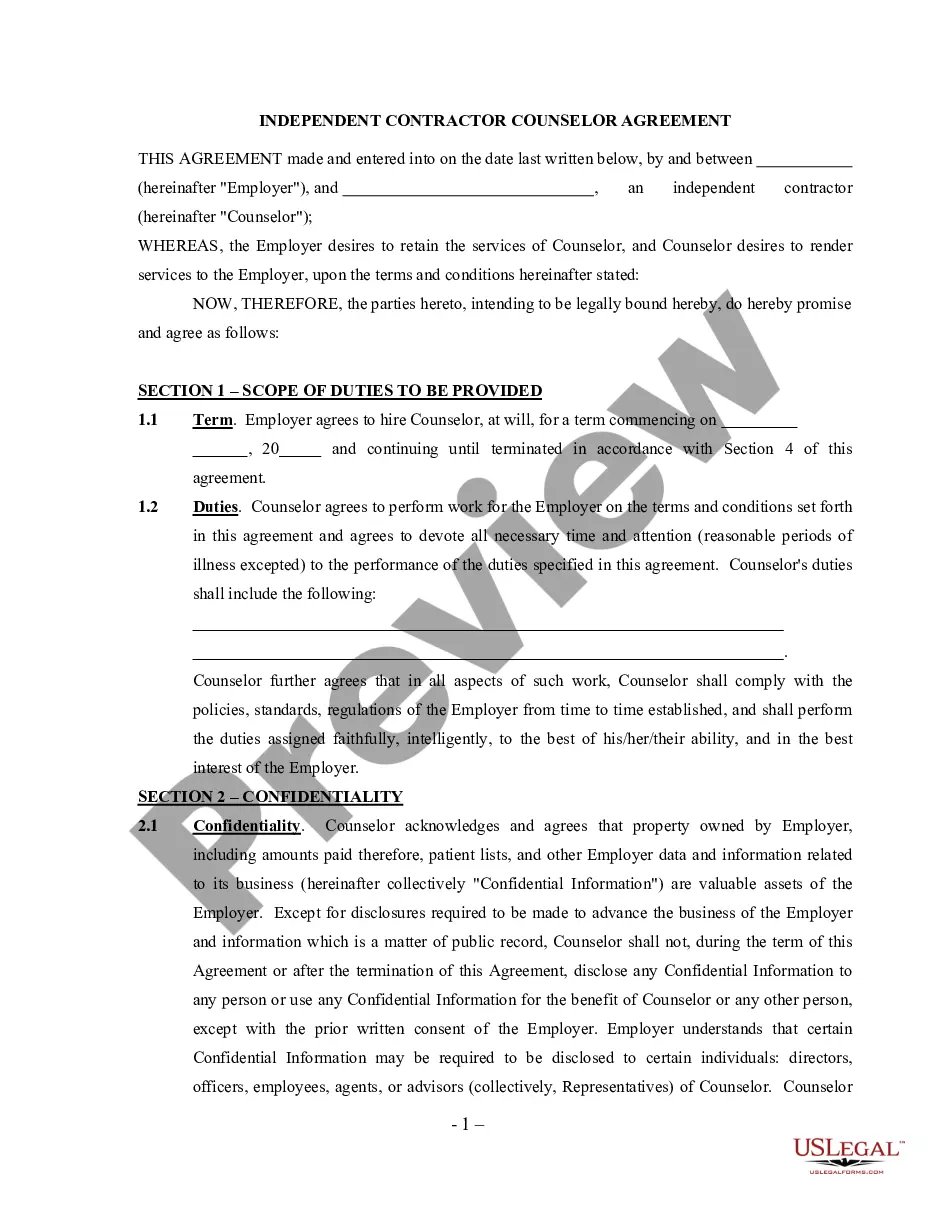
  • Preview Independent Contractor Agreement Between Licensed Counselor and Therapist and Licensed Counselor and Therapist Practicing as a Solo Practitioner
  • Preview Independent Contractor Agreement Between Licensed Counselor and Therapist and Licensed Counselor and Therapist Practicing as a Solo Practitioner

How to fill out Independent Contractor Agreement Between Licensed Counselor And Therapist And Licensed Counselor And Therapist Practicing As A Solo Practitioner?

Locating the appropriate legal document template can be challenging.

Certainly, there are numerous templates accessible online, but how will you obtain the legal form you need.

Make use of the US Legal Forms site.

If you are a new user of US Legal Forms, here are simple steps for you to follow: First, ensure you have chosen the correct form for your city/county. You can preview the template using the Review button and read the form description to confirm it is suitable for you. If the form does not meet your needs, use the Search field to find the right form. Once you are confident that the form is appropriate, click on the Buy now button to get the form. Select the pricing plan you want and provide the necessary information. Create your account and pay for the order using your PayPal account or Visa or MasterCard. Choose the file format and download the legal document template to your device. Complete, modify, print, and sign the acquired Arizona Independent Contractor Agreement Between Licensed Counselor and Therapist and Licensed Counselor and Therapist Practicing as a Solo Practitioner. US Legal Forms is the largest repository of legal forms where you can find a variety of document templates. Utilize the service to download expertly crafted documents that comply with state requirements.

  1. The service provides thousands of templates, including the Arizona Independent Contractor Agreement Between Licensed Counselor and Therapist and Licensed Counselor and Therapist Practicing as a Solo Practitioner, for both business and personal purposes.
  2. All forms are reviewed by experts and meet state and federal requirements.
  3. If you are already registered, Log In to your account and click on the Acquire button to obtain the Arizona Independent Contractor Agreement Between Licensed Counselor and Therapist and Licensed Counselor and Therapist Practicing as a Solo Practitioner.
  4. Use your account to search for the legal forms you may have bought formerly.
  5. Visit the My documents tab on your account to get an additional copy of the document you need.

Form popularity

FAQ

A PLLC in counseling is a legal structure that allows licensed professionals, like counselors and therapists, to operate their practice with limited personal liability. This setup not only enhances credibility but also provides a layer of protection against lawsuits or claims arising from business activities. When licensed counselors and therapists practice as solo practitioners, forming a PLLC is often a strategic choice. It’s important to include PLLC considerations when drafting an Arizona Independent Contractor Agreement Between Licensed Counselor and Therapist and Licensed Counselor and Therapist Practicing as a Solo Practitioner.

While Licensed Professional Counselors (LPC) and therapists often provide similar services, they are not entirely the same. An LPC is a specific credential that denotes a counselor's qualification to practice therapy, whereas 'therapist' is a broader term that can include various mental health professionals. Both LPCs and therapists may work under agreements like the Arizona Independent Contractor Agreement Between Licensed Counselor and Therapist and Licensed Counselor and Therapist Practicing as a Solo Practitioner. Understanding these distinctions can help clients make informed choices and navigate their options effectively.

To write a comprehensive contractor agreement, you must first outline the services provided and any specific duties. Clearly define the terms, payment structure, and duration of the contract to avoid misunderstandings later. It’s essential to include clauses on confidentiality and dispute resolution. Utilizing a reliable platform like uslegalforms can simplify drafting an Arizona Independent Contractor Agreement Between Licensed Counselor and Therapist and Licensed Counselor and Therapist Practicing as a Solo Practitioner, ensuring all key aspects are addressed.

A Professional Limited Liability Company, or PLLC, serves to protect licensed professionals from personal liability for business debts and malpractice claims. This structure allows licensed counselors and therapists to practice as solo practitioners while safeguarding their personal assets. By forming a PLLC, practitioners can comply with state regulations while enjoying the benefits of limited liability. When drafting an Arizona Independent Contractor Agreement Between Licensed Counselor and Therapist and Licensed Counselor and Therapist Practicing as a Solo Practitioner, it's vital to consider the implications of operating under a PLLC.

Not necessarily; while both are qualified professionals, they often have different training and focus areas. A licensed counselor is trained primarily in counseling techniques, whereas a licensed therapist may have a broader scope, including therapeutic approaches for mental health treatment. Clients should consider their personal goals and the specific expertise of the professional they choose. Additionally, the Arizona Independent Contractor Agreement Between Licensed Counselor and Therapist and Licensed Counselor and Therapist Practicing as a Solo Practitioner can clarify the professional guidelines followed by each practitioner.

The main difference lies in education and licensure. A licensed counselor typically holds a master's degree in counseling and focuses on specific issues like grief or addiction. In contrast, a licensed therapist may possess a broader range of qualifications, including degrees in psychology or social work, and may address deeper psychological concerns. Understanding these distinctions can guide you towards the right professional and help you utilize tools like the Arizona Independent Contractor Agreement Between Licensed Counselor and Therapist and Licensed Counselor and Therapist Practicing as a Solo Practitioner for a clear understanding of your provider's expertise.

The title 'therapist' may not be used interchangeably by all counselors, as it often denotes further training or specific clinical skills. In some states, only licensed professionals who meet certain criteria can use the term 'therapist.' Thus, it is crucial for clients to understand the qualifications of the professional they are seeing. The Arizona Independent Contractor Agreement Between Licensed Counselor and Therapist and Licensed Counselor and Therapist Practicing as a Solo Practitioner can help clarify these roles and ensure both parties understand the professional titles used.

Yes, a Licensed Professional Counselor (LPC) can own their own practice, provided they meet state licensing requirements. Establishing an independent practice allows LPCs to provide personalized care while managing their business operations. They must also ensure compliance with legal obligations, including necessary agreements like the Arizona Independent Contractor Agreement Between Licensed Counselor and Therapist and Licensed Counselor and Therapist Practicing as a Solo Practitioner, to protect both themselves and their clients.

Choosing between a counselor and a therapist often depends on your specific needs. Both professionals can help you, but they may have different approaches. A counselor typically focuses on providing guidance for specific issues, while a therapist often dives deeper into emotional and psychological problems. It's essential to understand what you're looking for to make the best choice and, if necessary, consider the Arizona Independent Contractor Agreement Between Licensed Counselor and Therapist and Licensed Counselor and Therapist Practicing as a Solo Practitioner for clarity on their services.

Yes, setting up a business is typically beneficial for independent contractors, as it can provide legal protections and streamline tax processes. Establishing a legal structure can define your work significantly, especially when creating an Arizona Independent Contractor Agreement Between Licensed Counselor and Therapist and Licensed Counselor and Therapist Practicing as a Solo Practitioner. Resources like uslegalforms can assist in guiding you through the setup process, ensuring you have the right foundation for your independent work.

Trusted and secure by over 3 million people of the world’s leading companies

Arizona Independent Contractor Agreement Between Licensed Counselor and Therapist and Licensed Counselor and Therapist Practicing as a Solo Practitioner