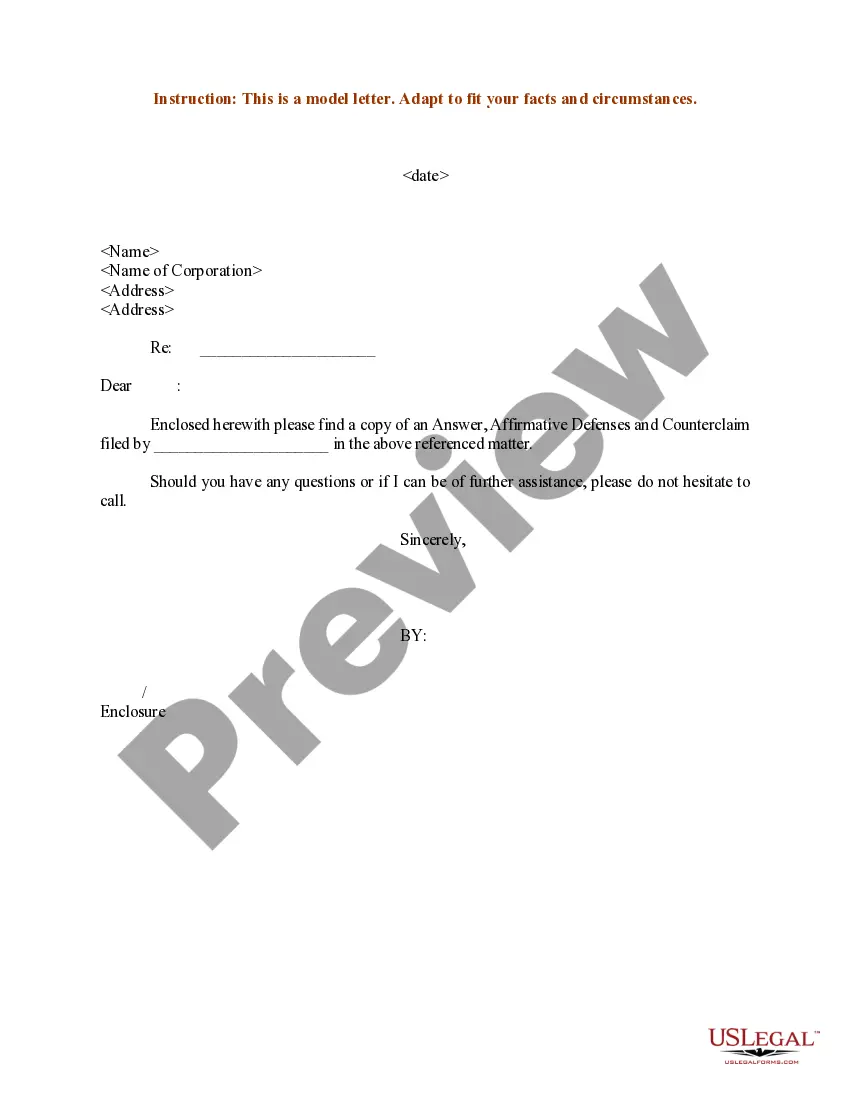
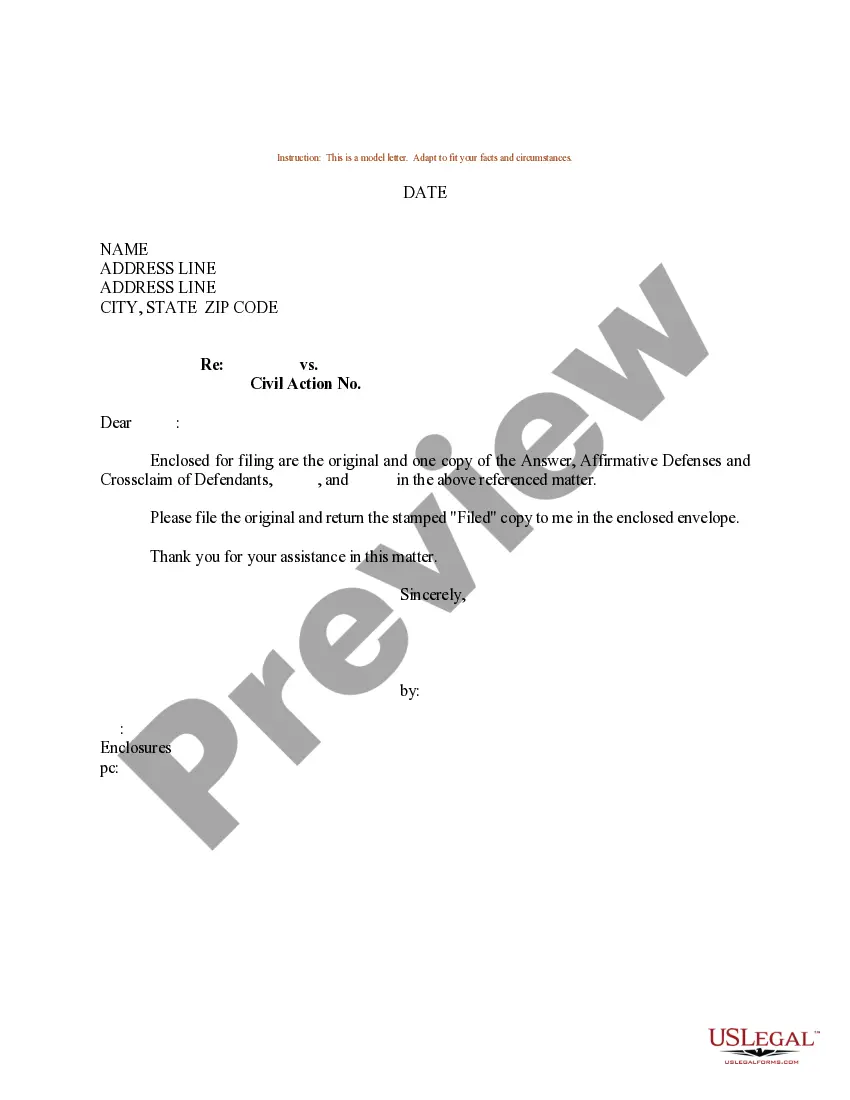
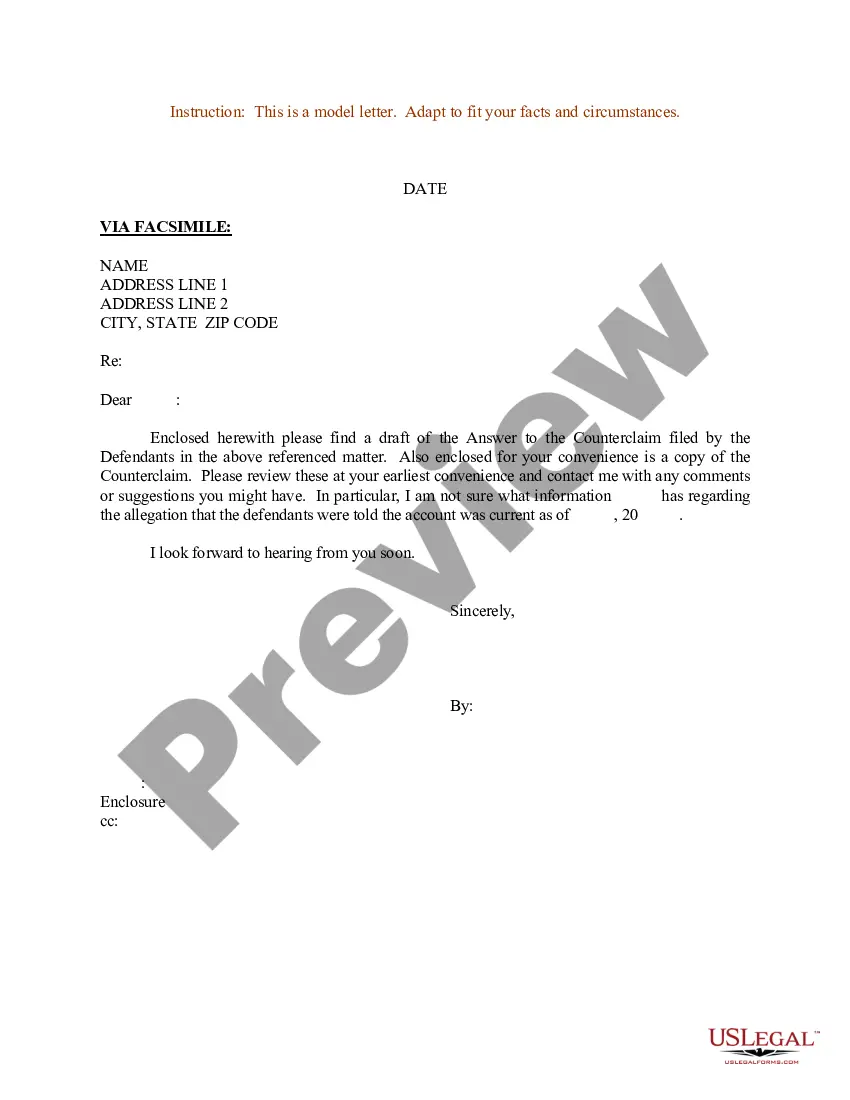
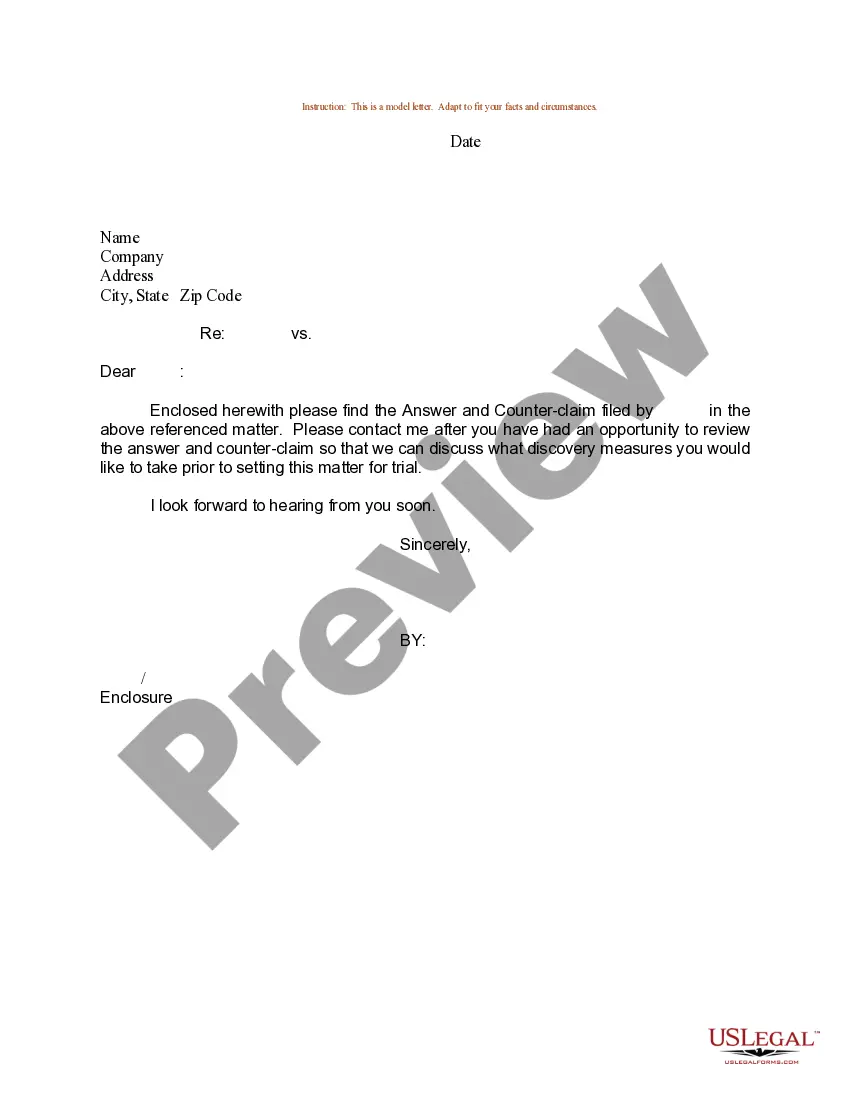
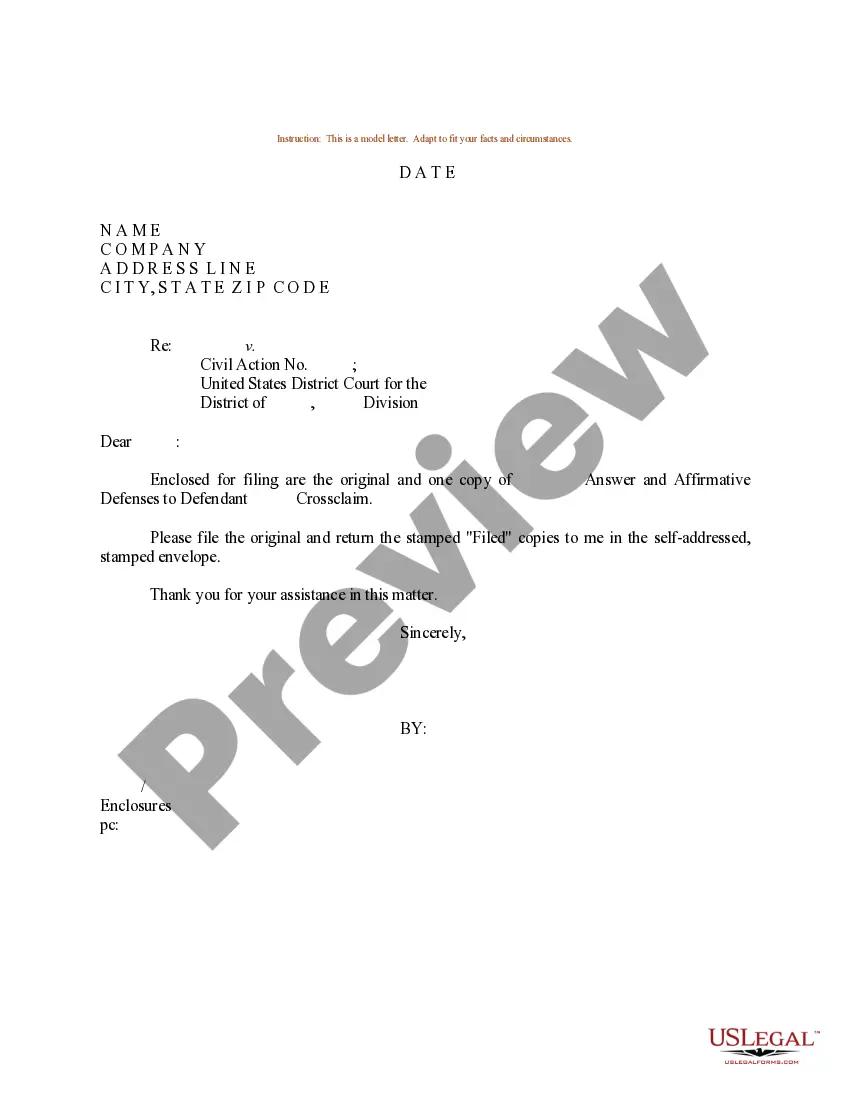
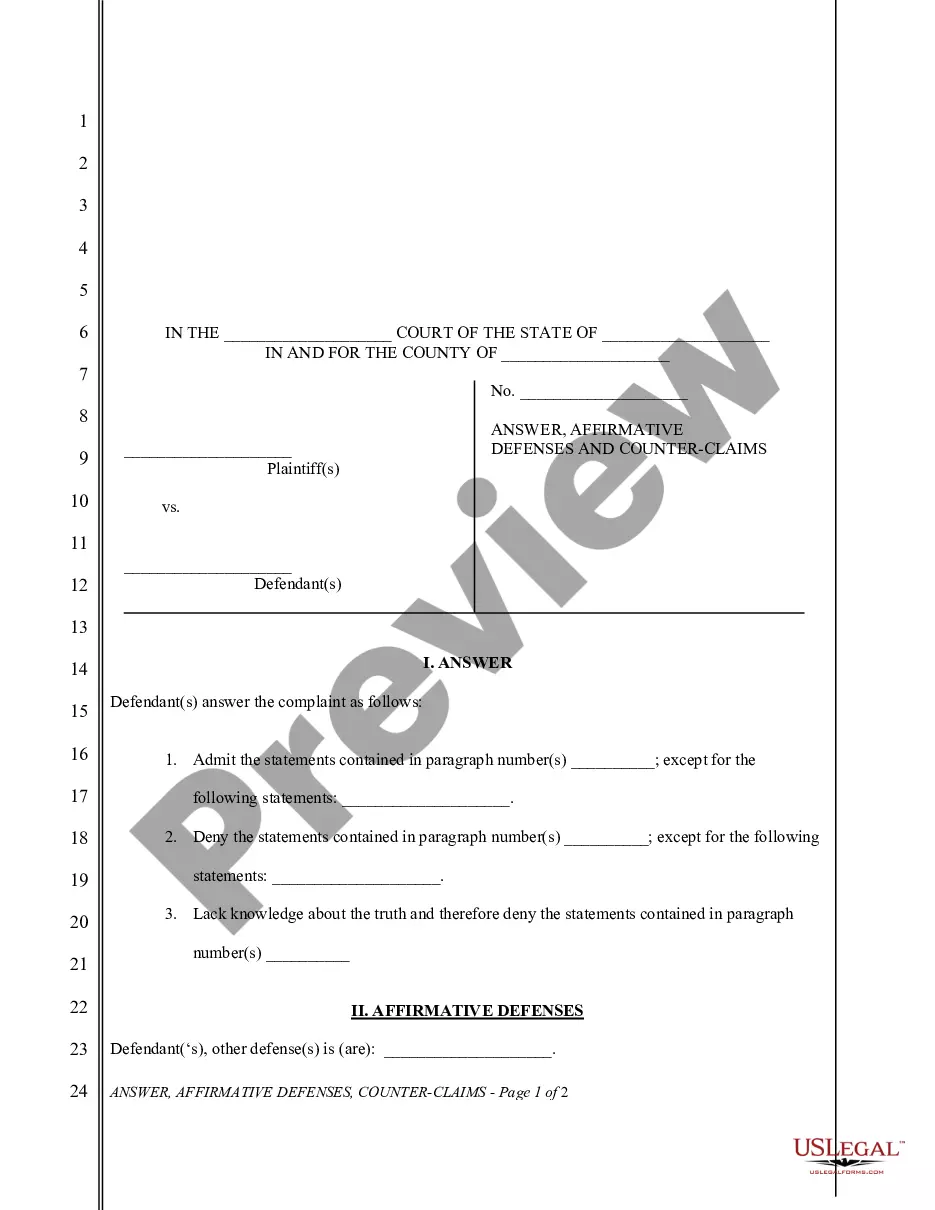
Arizona Sample Letter regarding Answer, Affirmative Defenses, and Counterclaim
Description
Get your form ready online
Our built-in tools help you complete, sign, share, and store your documents in one place.
Make edits, fill in missing information, and update formatting in US Legal Forms—just like you would in MS Word.
Download a copy, print it, send it by email, or mail it via USPS—whatever works best for your next step.
Sign and collect signatures with our SignNow integration. Send to multiple recipients, set reminders, and more. Go Premium to unlock E-Sign.
If this form requires notarization, complete it online through a secure video call—no need to meet a notary in person or wait for an appointment.
We protect your documents and personal data by following strict security and privacy standards.

Make edits, fill in missing information, and update formatting in US Legal Forms—just like you would in MS Word.

Download a copy, print it, send it by email, or mail it via USPS—whatever works best for your next step.

Sign and collect signatures with our SignNow integration. Send to multiple recipients, set reminders, and more. Go Premium to unlock E-Sign.

If this form requires notarization, complete it online through a secure video call—no need to meet a notary in person or wait for an appointment.

We protect your documents and personal data by following strict security and privacy standards.
Looking for another form?




How to fill out Sample Letter Regarding Answer, Affirmative Defenses, And Counterclaim?
You can spend hours online trying to locate the legal document template that meets the state and federal requirements you need. US Legal Forms offers numerous legal forms that are reviewed by professionals.
It is easy to obtain or print the Arizona Sample Letter for Answer, Affirmative Defenses, and Counterclaim from the service. If you already have a US Legal Forms account, you may Log In and click on the Download button.
After that, you can complete, edit, print, or sign the Arizona Sample Letter for Answer, Affirmative Defenses, and Counterclaim. Each legal document template you purchase is yours indefinitely. To obtain another copy of any purchased form, navigate to the My documents section and click on the relevant option.
Choose the format of your document and download it to your device. Make modifications to your document if necessary. You can complete, edit, sign, and print the Arizona Sample Letter for Answer, Affirmative Defenses, and Counterclaim. Download and print numerous document templates using the US Legal Forms website, which provides the largest selection of legal forms. Utilize professional and state-specific templates to address your business or personal needs.
- If you are using the US Legal Forms website for the first time, follow the simple instructions below.
- First, ensure that you have selected the correct document template for your county/city of choice. Check the form description to confirm you have selected the right form.
- If available, use the Preview option to look at the document template as well.
- If you wish to find another version of your form, use the Search field to locate the template that satisfies your requirements.
- Once you have found the template you need, click on Purchase now to proceed.
- Select the pricing plan you prefer, enter your details, and create your account on US Legal Forms.
- Complete the transaction. You can use your Visa or Mastercard or PayPal account to pay for the legal form.
Form popularity
FAQ
The claim is the author's central argument that they are trying to persuade the audience to believe. Counterclaims are arguments of the opposing side which the author will address. Reasoning is the author's logic used to support and prove their claims.
Unlike the reply to a defence, which is not mandatory, where the defendant has filed a counterclaim against the claimant, the claimant must file a defence to counterclaim if they dispute the counterclaim claim.
Example 1: Claim: Some people say that cell phones should be banned from schools, because they distract from learning. Counterclaim: Others say that students should be allowed to carry cell phones for emergency purposes. Rebuttal: There are plenty of other, less-disruptive ways for parents and students to communicate.
An affirmative defense is a defense that brings up new facts or issues not in the Complaint that, if true, would be a legal reason why the plaintiff should not win, or should win less than they're asking for. It is not a denial that you did what the plaintiff says you did.
A Defendant may want to make a new claim of their own against the person that is suing them. This is called a ?counterclaim? or a ?defendant's claim?. Defendants can make a counterclaim if they think that the plaintiff owes them money for something they did.
You should respond to the counterclaim as though it were a Statement of Claim and you were drafting a Defence: respond to every paragraph ? you can do this paragraph by paragraph if necessary; deny any allegations of fact that you do not admit ? you will be deemed to admit facts that you forget to plead to; and.
In responding to a pleading, a party must affirmatively state any avoidance or affirmative defense, including: (A) and satisfaction; (B) arbitration and award; (C) assumption of risk; (D) contributory negligence; (E) duress; (F) estoppel; (G) failure of consideration; (H) fraud; (I) illegality; (J) laches; (K) ...
In conclusion, the main difference between a counterclaim and an affirmative defense is that a counterclaim is a claim made by a defendant against the plaintiff. In contrast, an affirmative defense is a defense raised by the defendant in response to the plaintiff's claim.