Arizona Order for PreJudgment Nonearnings without Notice
What this document covers
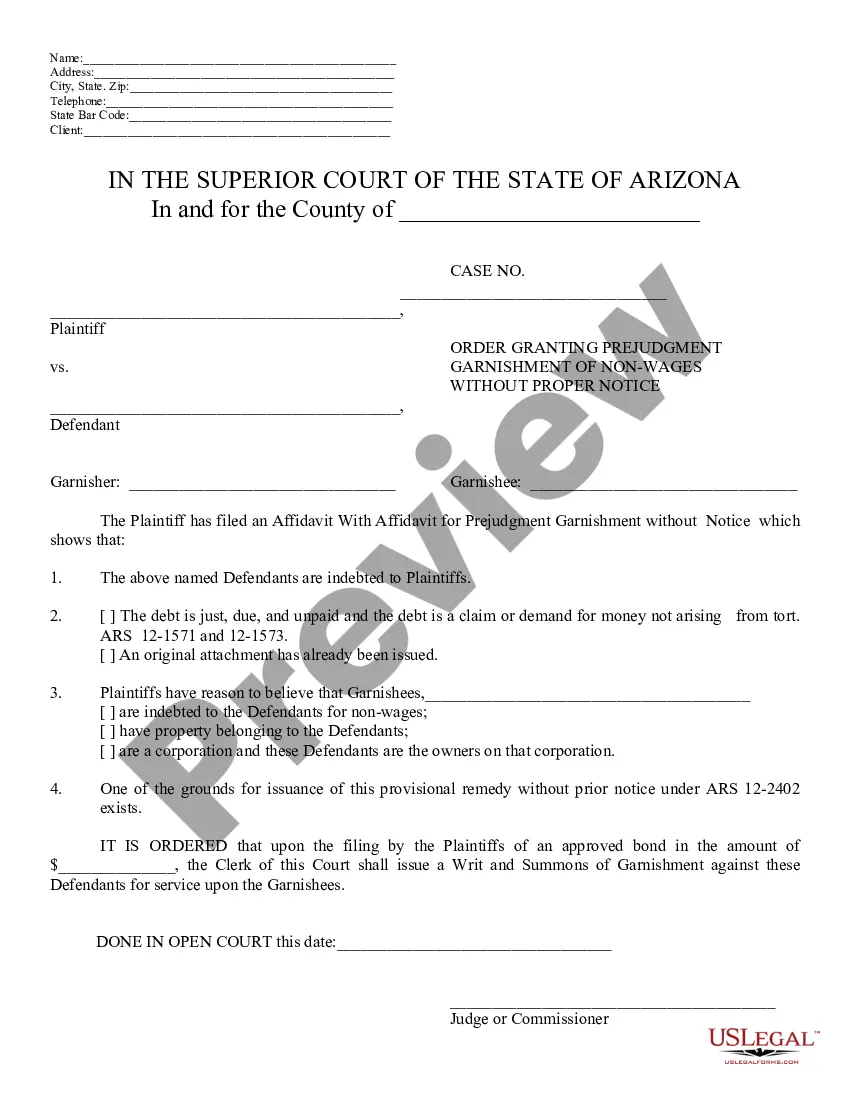
The Order for Pre-Judgment Non-Earnings without Notice is a legal document issued by the court that allows a plaintiff to obtain a garnishment order without giving prior notice to the defendant. This form is used when the creditor believes that notifying the debtor could hinder their ability to recover the debt. It differs from other garnishment orders by not requiring advance notice to the affected parties, making it a critical tool for urgent financial recovery efforts.
Main sections of this form
- Address fields for the plaintiff, defendant, and garnishee.
- Case number to identify the specific court case.
- Declaration of indebtedness, outlining the amount owed by the defendants.
- Details on the bond amount required for the issuance of the garnishment.
- Judicial signatures confirming the order.
When this form is needed
This form is essential in situations where a plaintiff needs to secure a judgment against a defendant for owed debts and seeks to garnish non-wage assets without alerting the defendant in advance. Scenarios may include debts related to personal loans, unpaid services, or other financial agreements where immediate action is necessary to prevent asset dissipation.
Who needs this form
This form is intended for:
- Creditors seeking to recover debts from defendants.
- Individuals or businesses involved in civil litigation regarding unpaid financial obligations.
- Attorneys representing clients in debt recovery processes.
How to prepare this document
- Identify and fill out the addresses of the plaintiff, defendant, and garnishee.
- Enter the case number provided by the court.
- Specify the amount owed in the declaration of indebtedness.
- Determine and input the bond amount that must be filed for the issuance of the garnishment.
- Sign and date the document in the presence of the judge or commissioner.
Notarization requirements for this form
Notarization is required for this form to take effect. Our online notarization service, powered by Notarize, lets you verify and sign documents remotely through an encrypted video session, available 24/7.
Get your form ready online
Our built-in tools help you complete, sign, share, and store your documents in one place.
Make edits, fill in missing information, and update formatting in US Legal Forms—just like you would in MS Word.
Download a copy, print it, send it by email, or mail it via USPS—whatever works best for your next step.
Sign and collect signatures with our SignNow integration. Send to multiple recipients, set reminders, and more. Go Premium to unlock E-Sign.
If this form requires notarization, complete it online through a secure video call—no need to meet a notary in person or wait for an appointment.
We protect your documents and personal data by following strict security and privacy standards.

Make edits, fill in missing information, and update formatting in US Legal Forms—just like you would in MS Word.

Download a copy, print it, send it by email, or mail it via USPS—whatever works best for your next step.

Sign and collect signatures with our SignNow integration. Send to multiple recipients, set reminders, and more. Go Premium to unlock E-Sign.

If this form requires notarization, complete it online through a secure video call—no need to meet a notary in person or wait for an appointment.

We protect your documents and personal data by following strict security and privacy standards.
Common mistakes to avoid
- Failing to include accurate addresses for all parties involved.
- Incorrectly filling out the bond amount required.
- Not signing the document where required by the judge.
- Neglecting to provide the case number.
Advantages of online completion
- Convenience of completing the form from anywhere with internet access.
- Editable templates that save time in filling out the necessary information.
- Access to attorney-drafted forms to ensure legal compliance and accuracy.
Looking for another form?
Form popularity
FAQ
To stop wage garnishment in Arizona, you can take several steps, such as negotiating with the creditor or filing an objection in court. You may also be able to claim exemptions if you can prove financial hardship due to the garnishment. If you are dealing with an Arizona Order for PreJudgment Nonearnings without Notice, understanding your options is key. Legal resources and platforms like uslegalforms can guide you through the process effectively.
In Arizona, the most your check can be garnished is typically 25% of your disposable earnings or the amount by which your disposable earnings exceed 30 times the federal minimum wage, whichever is lower. This regulation helps safeguard a portion of your income for essential living expenses. Understanding this limit is critical if you have an Arizona Order for PreJudgment Nonearnings without Notice. To learn more, consider using platforms like uslegalforms for further assistance.
Yes, in Arizona, creditors can garnish your bank account if they have obtained a judgment against you. They can issue a writ of garnishment to your bank, which requires the bank to freeze a portion of your funds. If you are facing an Arizona Order for PreJudgment Nonearnings without Notice, it is crucial to understand how your financial accounts may be affected. Seeking help from platforms like uslegalforms can help you navigate this situation.
To file a garnishee answer in Arizona, you must complete the appropriate form and submit it to the court where the judgment was entered. It is important to provide accurate information about the debtor’s assets and your status as a garnishee. If you receive an Arizona Order for PreJudgment Nonearnings without Notice, you may find the filing process straightforward. Platforms like uslegalforms can assist you with the necessary forms and procedures.
In Arizona, creditors can garnish up to 25% of your disposable income, depending on your earnings. This percentage applies only after deductions for necessary expenses and taxes. If you have received an Arizona Order for PreJudgment Nonearnings without Notice, it is essential to know your rights and limits regarding wage garnishment. For detailed information, resources like uslegalforms can provide clarity.
In Arizona, certain personal property can be seized under a judgment, such as bank accounts, vehicles, and valuable personal items. However, the law protects some property from seizure, including basic household items. If you are dealing with an Arizona Order for PreJudgment Nonearnings without Notice, knowing which assets can be targeted is crucial. Always consider using trusted legal platforms, like uslegalforms, to understand your rights.
To enforce a judgment in Arizona, you must first obtain a certified copy of the judgment. Next, you can file or serve a writ of execution to seize the debtor's nonexempt property. Additionally, if you are dealing with an Arizona Order for PreJudgment Nonearnings without Notice, you may take steps to collect on the judgment efficiently. It’s often helpful to consult legal resources, or platforms like uslegalforms, for guidance on the process.
Non-earnings garnishment is a legal process that applies to income sources other than wages to satisfy a debt. In Arizona, this can impact your assets and benefits that do not fall within standard earnings categories. Knowing your rights in this area is essential to protect your financial well-being. The Arizona Order for PreJudgment Nonearnings without Notice can provide you with the necessary legal framework to challenge such garnishments effectively.
Non-earnings refer to income that is not derived from wages or traditional employment. This may include benefits like social security, pensions, or reimbursements. Understanding non-earnings is crucial because they can be protected from garnishment in many cases. If you seek to address non-earnings, an Arizona Order for PreJudgment Nonearnings without Notice might be necessary to clarify your situation.
A writ of replevin in Arizona is a legal document that allows a party to regain possession of personal property. This is particularly useful when someone possesses your property without your consent. To obtain this writ, you typically need to show a valid claim to the property. In support of your claim, an Arizona Order for PreJudgment Nonearnings without Notice can help expedite the process.