Arizona Notice of Settlement
What this document covers
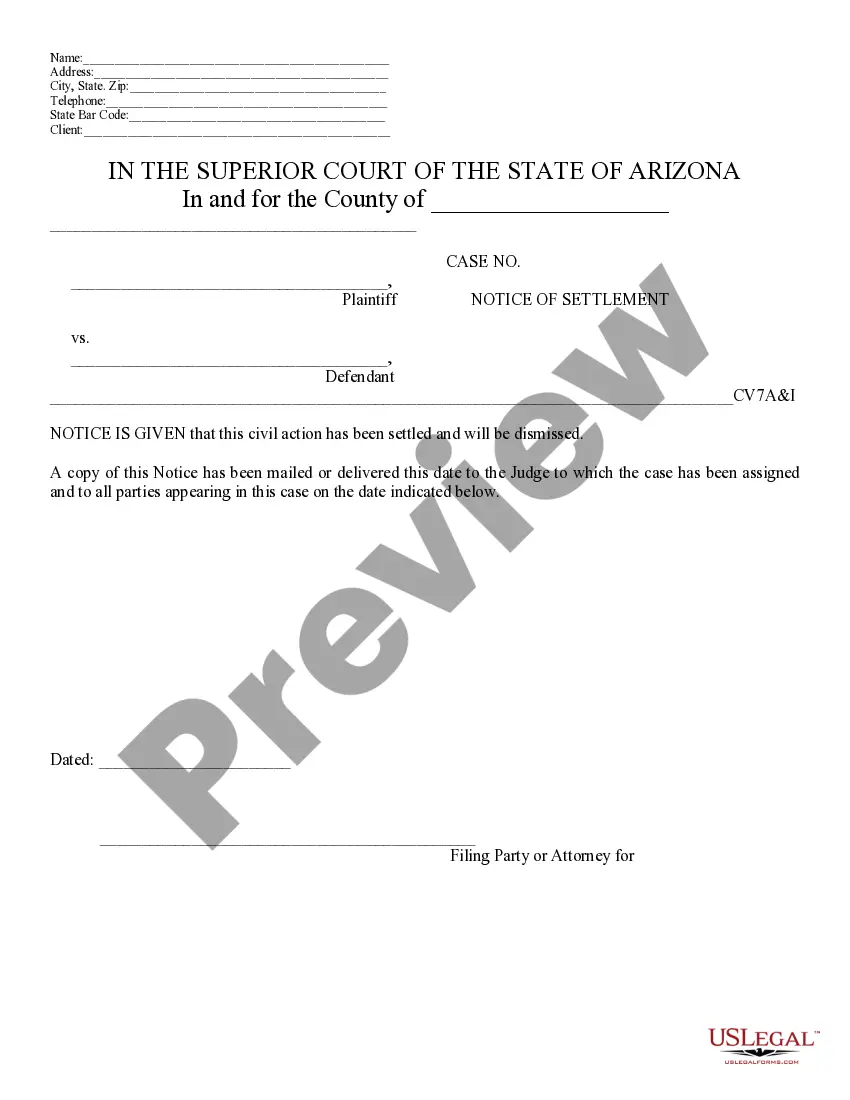
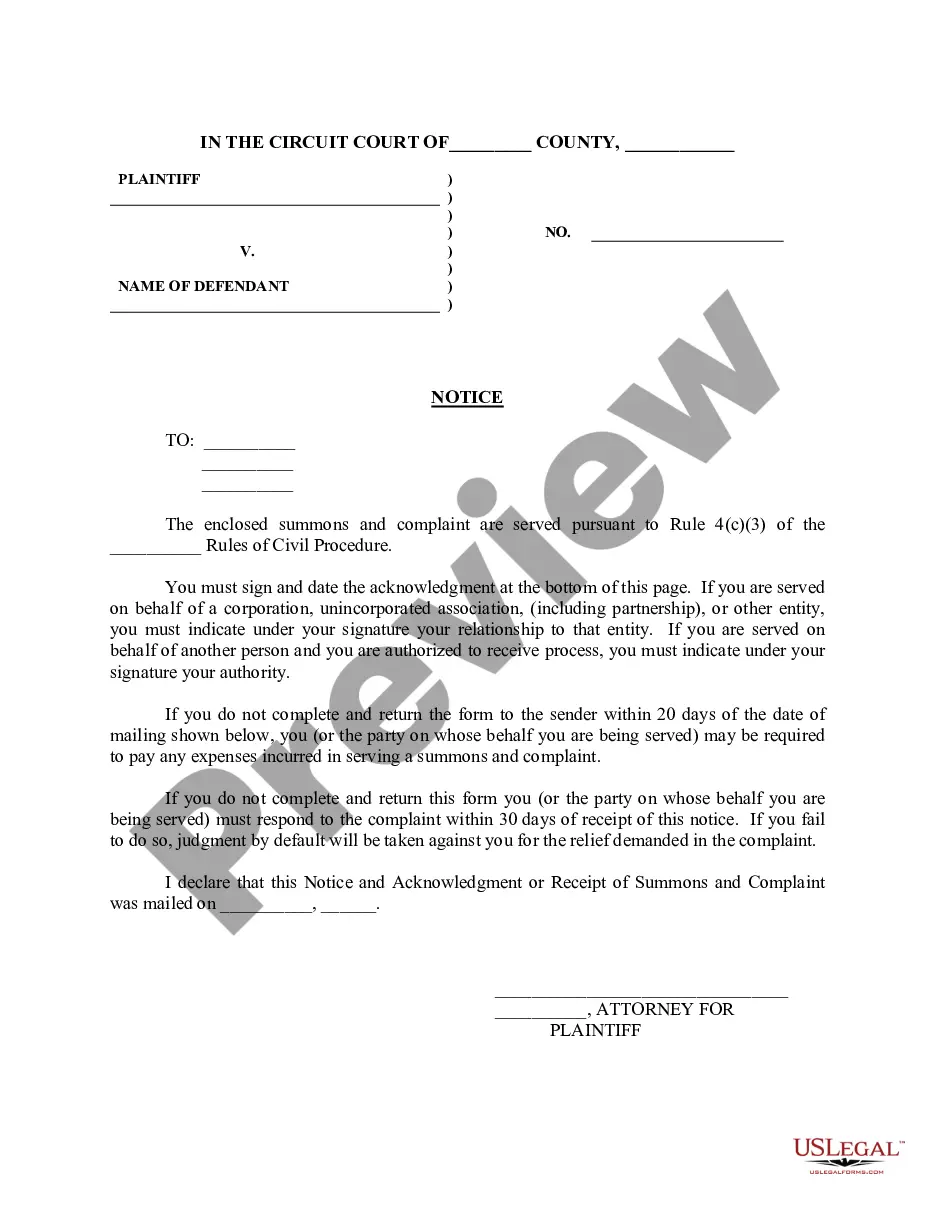
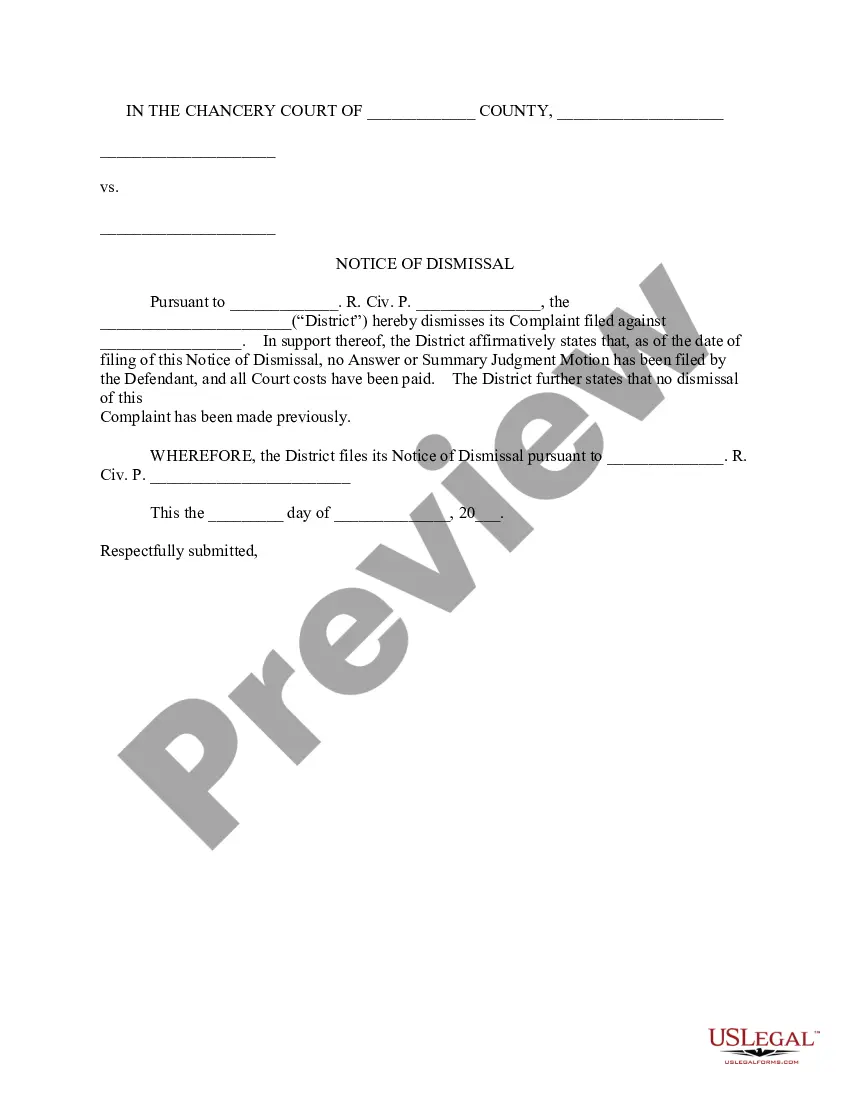
A Notice of Settlement is a legal document that informs relevant parties that a civil action has been settled. This form serves to ensure all involved parties are aware of the resolution and that the case will be dismissed, thus preventing delays in the legal process. Unlike other notification forms, this specific version is tailored for indicating the settlement of a case, making it essential for legal proceedings.
What’s included in this form
- Address and contact information of the filing party or attorney.
- Case title, including plaintiff and defendant names.
- Case number for reference in court records.
- Statement confirming the settlement and intent to dismiss the case.
- Date of the notice and signature of the filing party or attorney.
Common use cases
This form should be used when a lawsuit has reached a settlement agreement. It is typically filed after both parties have come to a mutual understanding regarding the terms of the settlement. Proper use of this form ensures that all necessary notifications are sent to the court and involved parties, facilitating a smooth conclusion to the case.
Who needs this form
This form is intended for:
- Attorneys representing parties in a civil lawsuit.
- Individuals who have settled a legal matter and need to formalize the notification.
- Parties involved in a lawsuit requiring proper legal documentation of a settlement.
Steps to complete this form
- Identify and enter the address and contact details of the filing party or attorney.
- Fill in the case title, including the names of the plaintiff and defendant.
- Enter the correct case number to ensure proper identification in court records.
- Complete the statement of settlement, indicating that the case will be dismissed.
- Date the notice and ensure it is signed by the appropriate party.
Is notarization required?
Notarization is not commonly needed for this form. However, certain documents or local rules may make it necessary. Our notarization service, powered by Notarize, allows you to finalize it securely online anytime, day or night.
Get your form ready online
Our built-in tools help you complete, sign, share, and store your documents in one place.
Make edits, fill in missing information, and update formatting in US Legal Forms—just like you would in MS Word.
Download a copy, print it, send it by email, or mail it via USPS—whatever works best for your next step.
Sign and collect signatures with our SignNow integration. Send to multiple recipients, set reminders, and more. Go Premium to unlock E-Sign.
If this form requires notarization, complete it online through a secure video call—no need to meet a notary in person or wait for an appointment.
We protect your documents and personal data by following strict security and privacy standards.

Make edits, fill in missing information, and update formatting in US Legal Forms—just like you would in MS Word.

Download a copy, print it, send it by email, or mail it via USPS—whatever works best for your next step.

Sign and collect signatures with our SignNow integration. Send to multiple recipients, set reminders, and more. Go Premium to unlock E-Sign.

If this form requires notarization, complete it online through a secure video call—no need to meet a notary in person or wait for an appointment.

We protect your documents and personal data by following strict security and privacy standards.
Common mistakes to avoid
- Forgetting to include all required contact information.
- Not entering the correct case number, which can lead to misfiling.
- Failing to sign and date the notice prior to submission.
- Neglecting to send copies to all parties involved.
Benefits of completing this form online
- Convenience of accessing and downloading the form from anywhere.
- Editability allows users to customize the form for their specific case.
- Reliability of using attorney-drafted templates ensures legal compliance.
Looking for another form?
Form popularity
FAQ
Filing a lawsuit against a company in Arizona involves several clear steps. First, investigate the nature of your claim and prepare your legal documents, stating your allegations and desired outcomes. Next, file your lawsuit with the appropriate court and ensure that the company is properly served with the complaint. Resources like US Legal Forms can assist by providing essential templates and support throughout this process.
To sue a company in Arizona, start by determining the appropriate jurisdiction and filing your complaint with the right court. You will need to gather all necessary evidence and documents that support your case. Once your complaint is filed, serve the business with the legal papers. For accurate templates and guidance, consider using US Legal Forms to assist in preparing your case.
In Arizona, the time limit to file a lawsuit varies depending on the type of claim. Generally, you have one to two years from the date of the incident to bring your case to court. It’s crucial to be aware of these deadlines to ensure your rights are protected. If you have concerns about timelines, US Legal Forms can provide useful information and resources.
The best way to sue a company involves a series of steps, starting with gathering all evidence and understanding your legal rights. You should clearly define your claims and what compensation you seek. File your lawsuit in the appropriate court and be prepared to present your case. Tools like US Legal Forms can help you prepare necessary documents effectively.
To file a complaint against a company in Arizona, you must gather all necessary documentation and evidence of your grievance. Next, you will need to draft a complaint that outlines the specific allegations against the company, citing relevant laws. Afterward, file your complaint with the appropriate court, and serve it to the company. Utilizing resources like US Legal Forms can streamline this process.
The Arizona Notice of Settlement is a formal declaration that parties in a civil case have reached an agreement to resolve their dispute. This notice is typically filed with the court, indicating that the case will no longer proceed to trial due to the settlement. Understanding this notice is essential for anyone involved in a legal process in Arizona, as it plays a crucial role in closing a case amicably.
To file a contempt of court in Arizona, you need to prepare a motion outlining how the other party has disobeyed a court order. This motion should clearly state the pertinent details and the relief you seek from the court. Submit this motion to the court and serve a copy to the other party. Understanding the process can be complex, but platforms like UsLegalForms provide templates that simplify filing.
In Arizona, you typically have 20 days to file an answer to a summons after being served. If you fail to file within this time, the court may issue a default judgment against you. Promptly addressing this requirement protects your rights, so keep track of the deadlines. Utilize resources like the UsLegalForms platform to ensure you meet all necessary timelines.
If you choose to answer a summons without an attorney in Arizona, begin by carefully reading the summons and complaint. You can create your answer by following a simple format that includes your personal information and responses to each claim. Filing your answer with the appropriate court and serving a copy to the plaintiff is crucial. For guidance, consider visiting UsLegalForms, which offers templates and resources to assist you.
Rule 76 in Arizona pertains to the notice of settlement process. This rule allows parties to inform the court and other involved parties of a settlement reached in a case. Essentially, once you submit your Arizona Notice of Settlement, the court can proceed with closing the case. Understanding this rule helps ensure that you follow the appropriate legal steps.