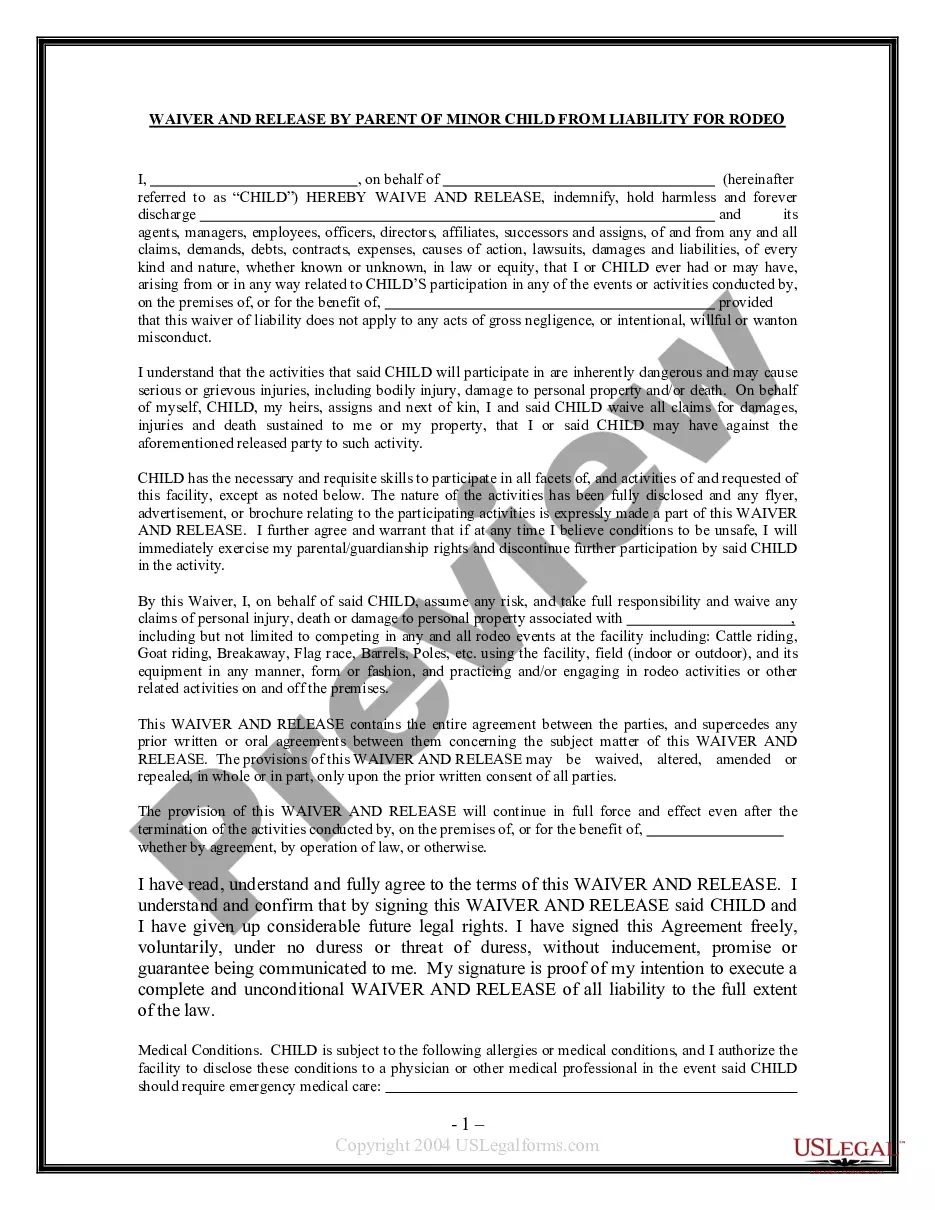
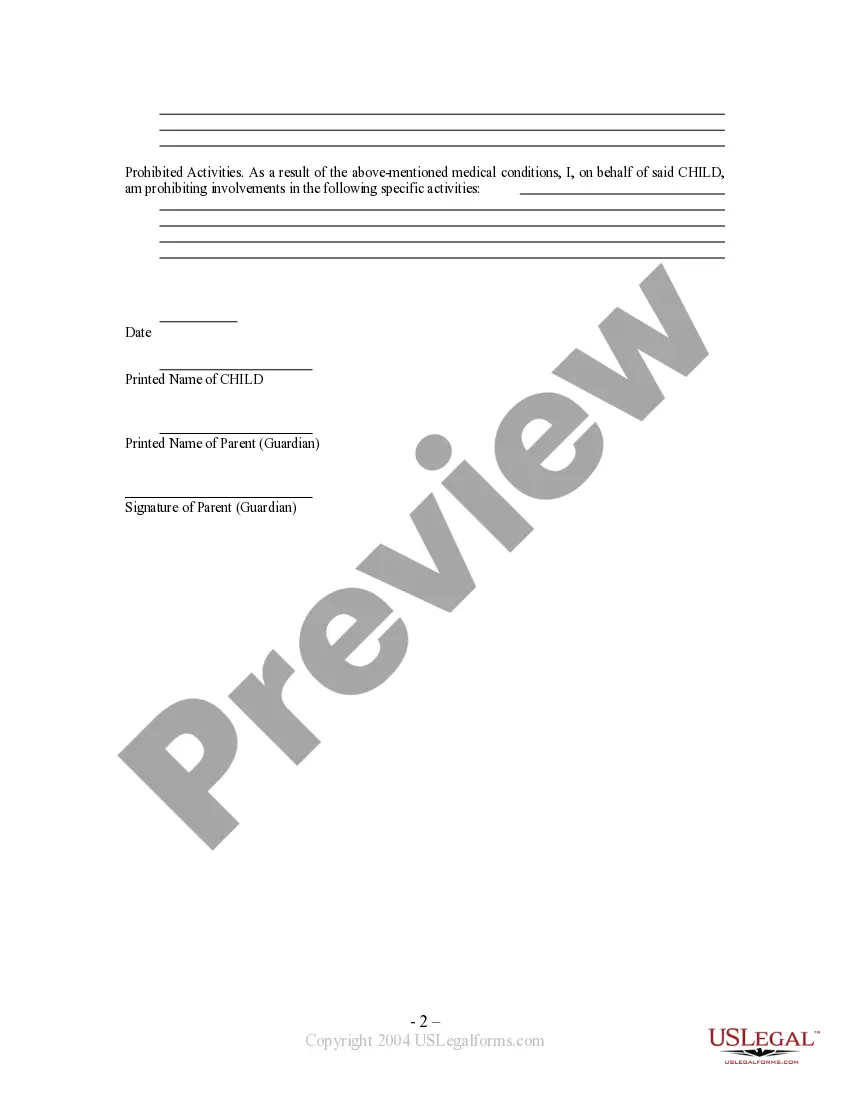
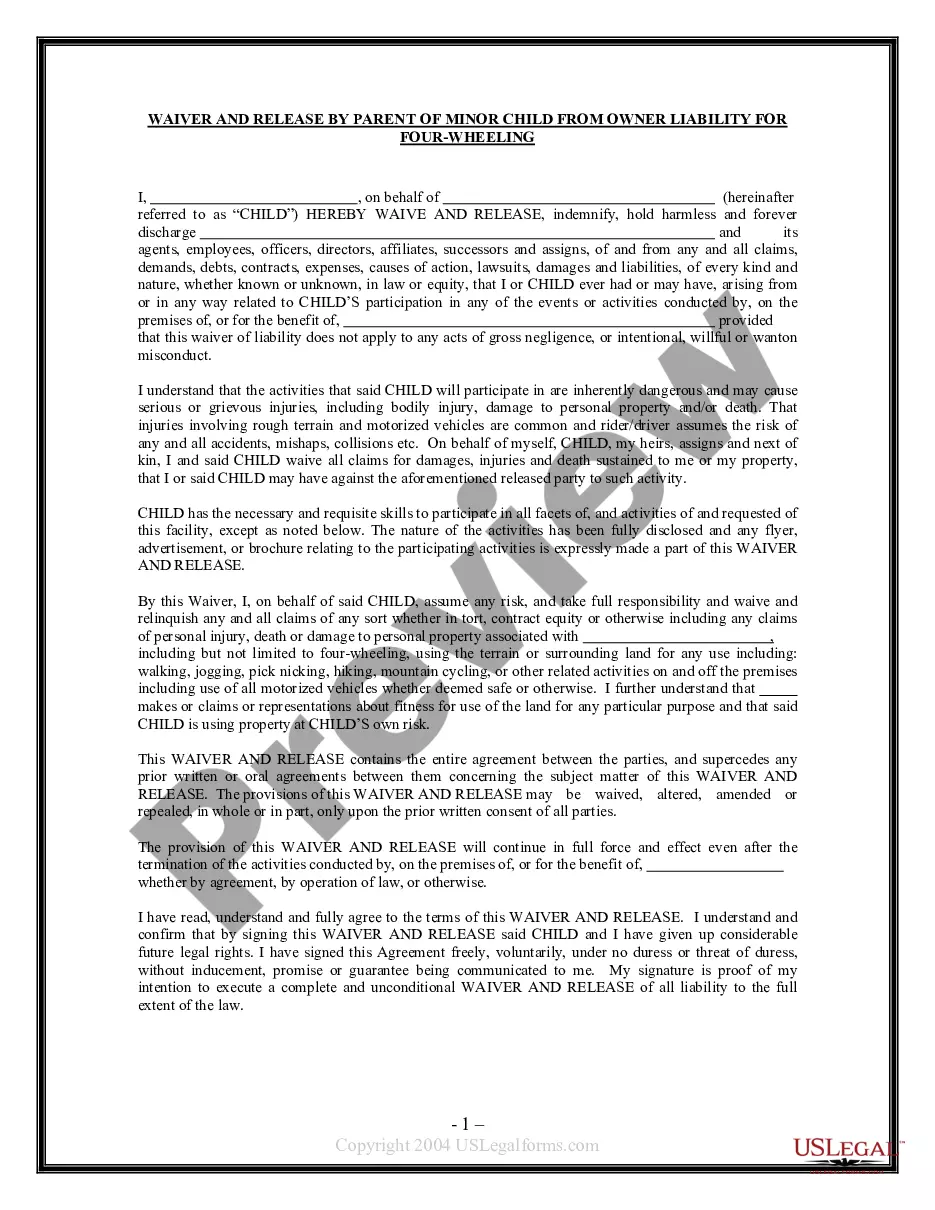
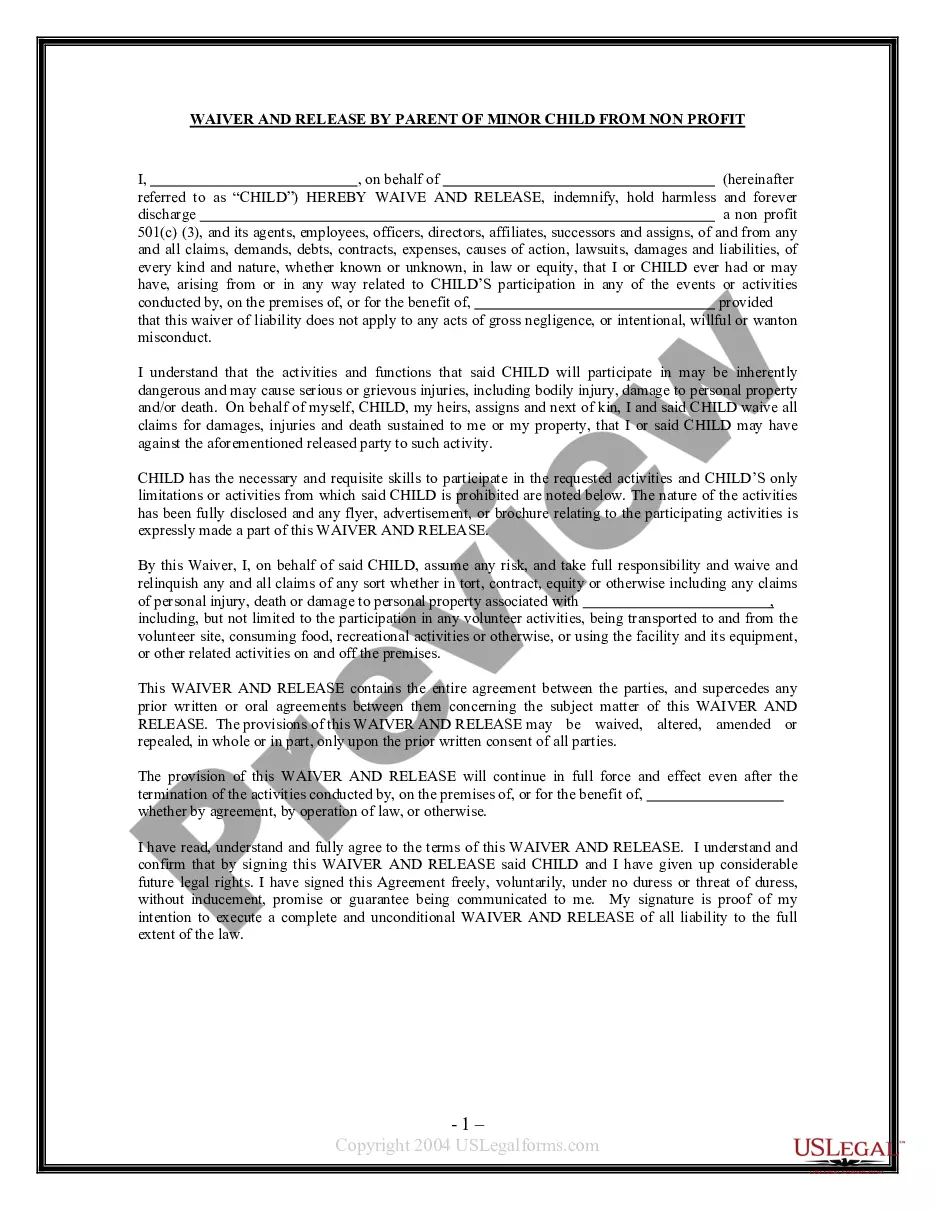
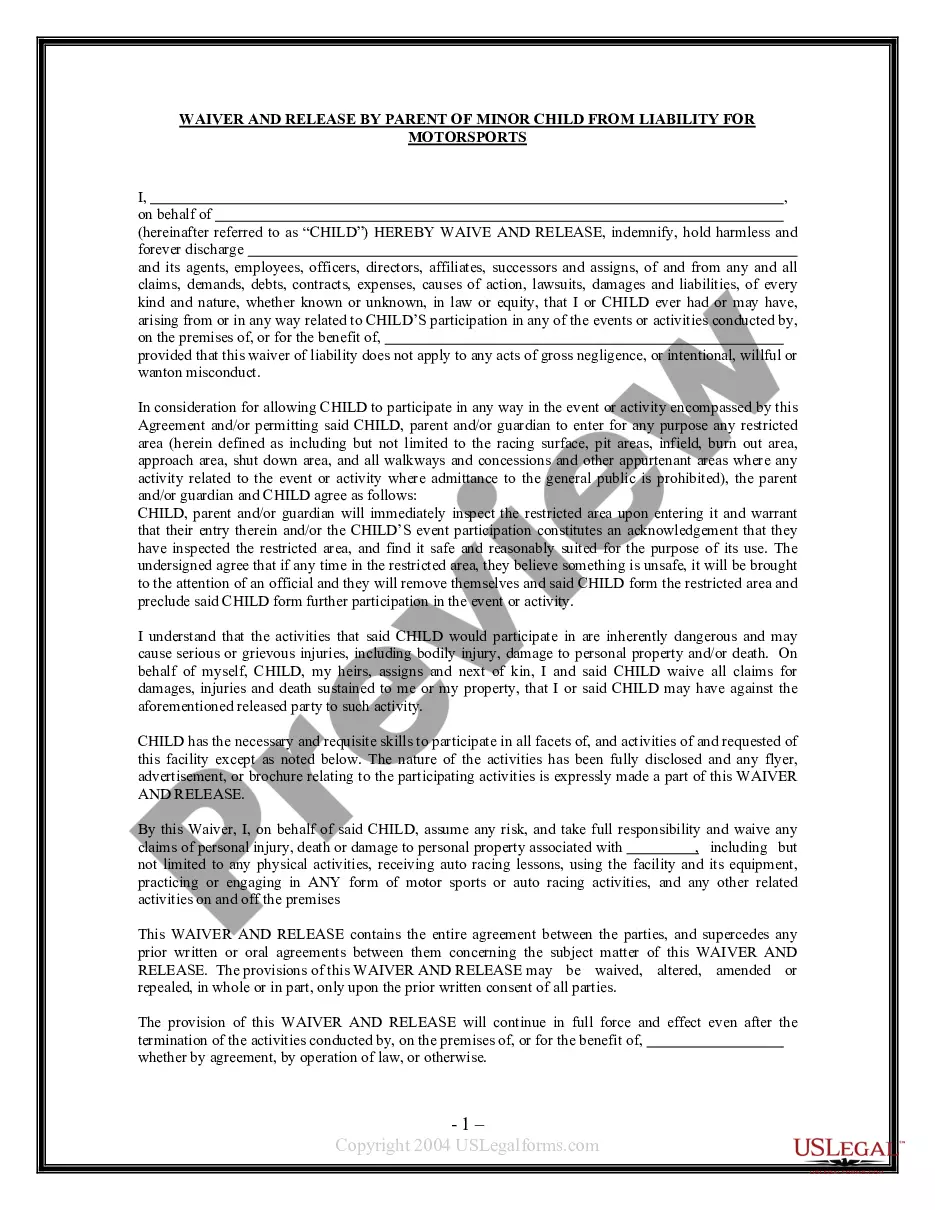
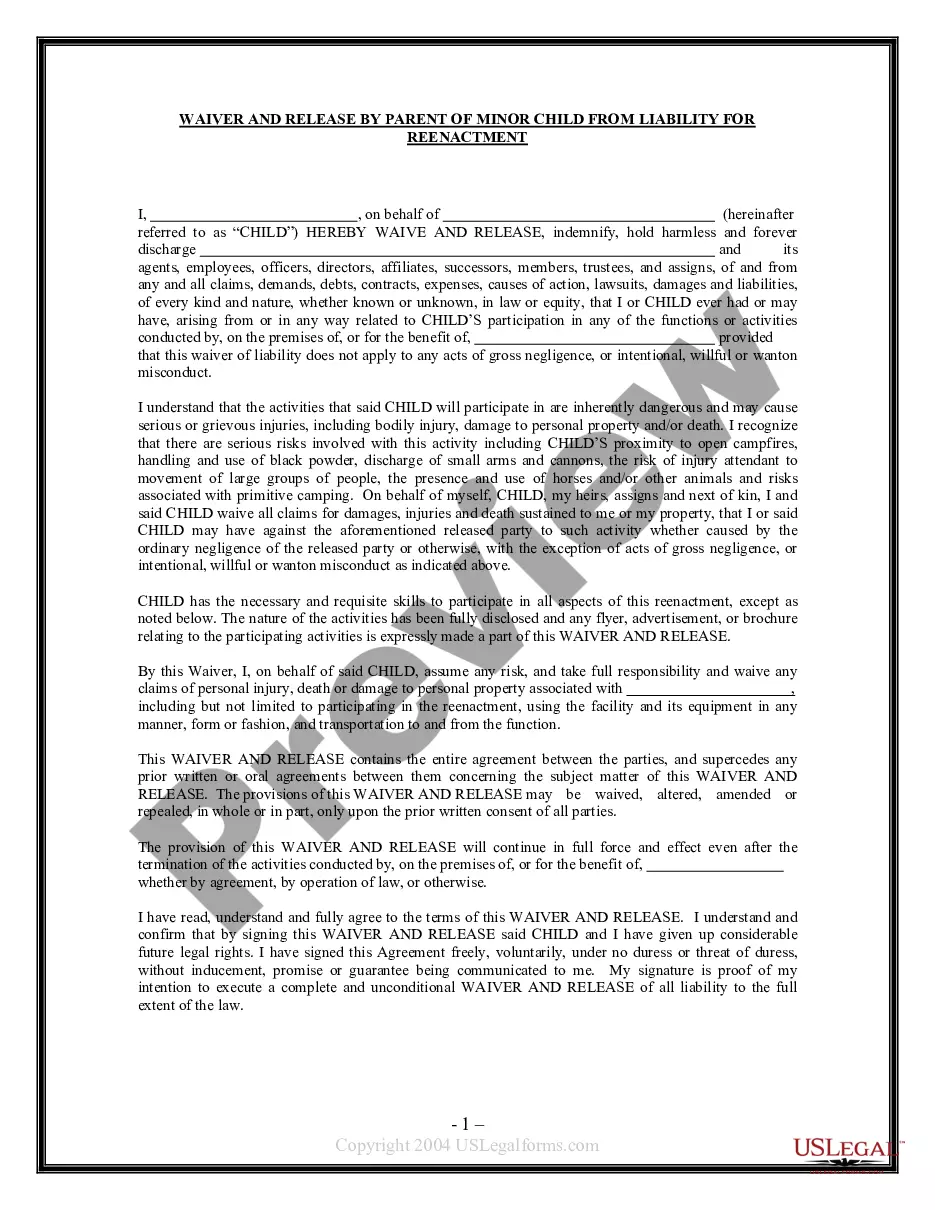
This form allows a parent or guardian to release a rodeo facility from liability for injuries which may be incurred by a minor child while on the premises, taking part in activities, etc.
Arkansas Waiver and Release From Liability For Minor Child for Rodeo
Category:
State:
Multi-State
Control #:
US-WAV-49M
Format:
Word;
Rich Text
Instant download
Description
Free preview


How to fill out Waiver And Release From Liability For Minor Child For Rodeo?
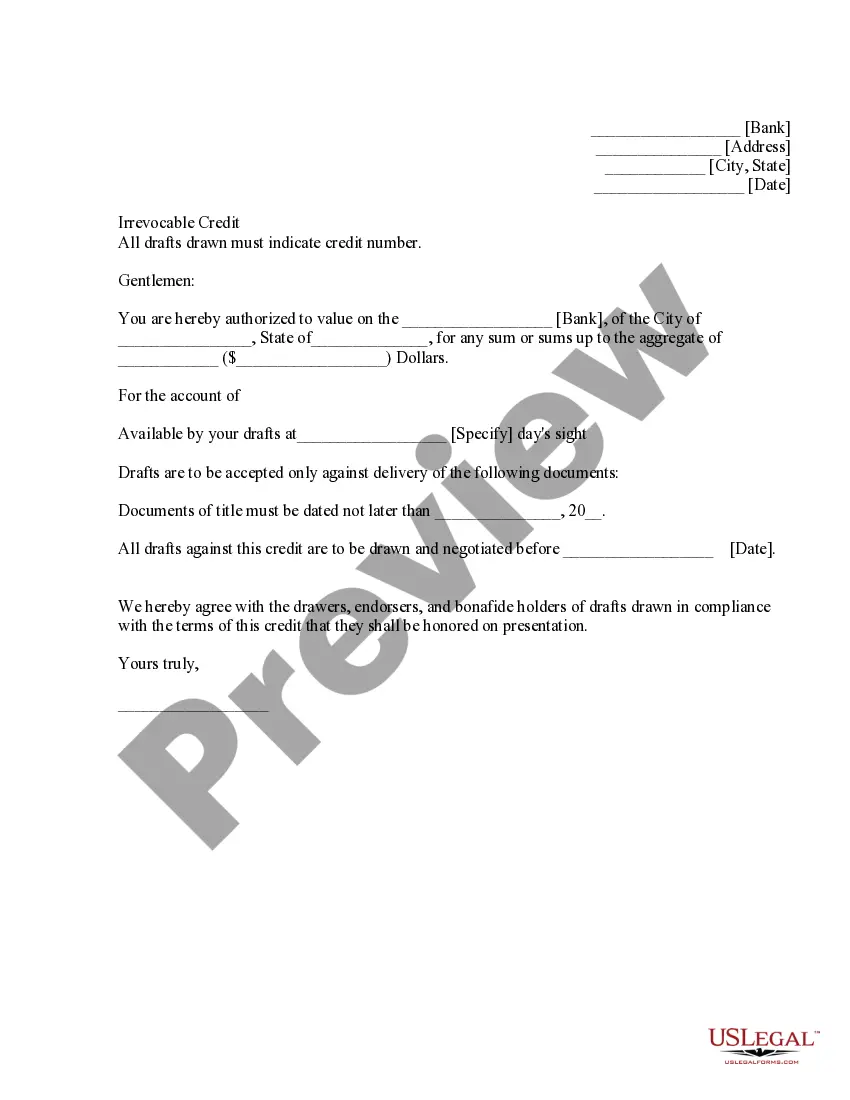
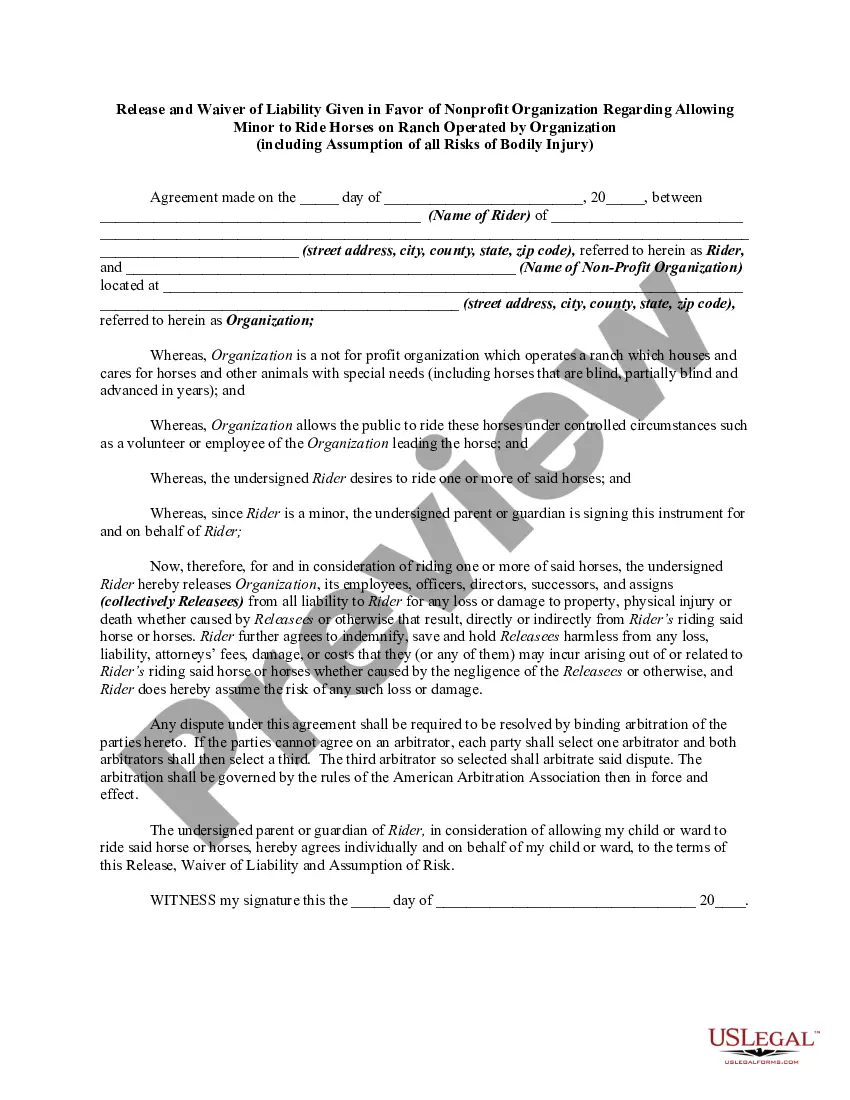
Selecting the appropriate legal document template can be quite a challenge. Obviously, there are numerous designs accessible online, but how do you locate the correct form you require? Utilize the US Legal Forms website. The service provides thousands of templates, including the Arkansas Waiver and Release From Liability For Minor Child for Rodeo, which can be utilized for both business and personal needs. All of the documents are verified by experts and comply with state and federal regulations.
If you are already registered, Log In to your account and click the Download button to acquire the Arkansas Waiver and Release From Liability For Minor Child for Rodeo. Use your account to review the legal documents you have obtained previously. Navigate to the My documents section of your account and retrieve another copy of the document you need.
If you are a new user of US Legal Forms, here are simple instructions for you to follow: First, ensure you have selected the correct form for your city/state. You can view the form using the Review button and read the form description to confirm this is indeed the right one for you. If the form does not meet your requirements, use the Search field to find the appropriate form. Once you are confident the form is suitable, select the Purchase now button to obtain the form. Choose the pricing plan you prefer and enter the necessary information. Create your account and pay for the order using your PayPal account or credit card. Choose the format and download the legal document template to your device. Complete, edit, print, and sign the acquired Arkansas Waiver and Release From Liability For Minor Child for Rodeo.
Make the most of US Legal Forms to ensure you have the proper legal documentation at your fingertips.
- US Legal Forms is the largest collection of legal documents where you can find a variety of paper templates.
- Utilize the service to download professionally crafted documents that comply with state requirements.
- The templates cover various legal needs for individuals and businesses.
- You can easily access past forms and manage them within your account.
- Ensure to read the descriptions carefully to select the correct documents.
- Payment can be made conveniently through PayPal or credit card.
Form popularity
FAQ
The definition of a waiver is the act of voluntarily giving up rights or privileges, usually through a written statement. An example of waiver is a person signing a form releasing the owners of an event location from liability if the person signing the waiver was injured while at the event. noun.
The Waiver must be clearly worded and unambiguous in its intent to relieve any and all legal liability, even liability for negligence. The Waiver should be prominent and not hidden in the fine print of a long contract. The Waiver must be signed by the person who it is being used against.
Components of a waiverGet help. Writing a waiver should not be complicated.Use the correct structure. Waivers should be written in a certain structure.Proper formatting.Include a subject line.Include a caution!Talk about the activity risks.Do not forget an assumption of risk.Hold harmless.More items...?
A waiver is not complete until it includes the signatures of both the event host and business owner and that of the participant. The date should also be included alongside the signatures. You may also include a signature line for a witness if necessary.
4. When is a liability waiver enforceable in California? Liability waivers are enforceable in California solely to the extent they shift to the customer the risk of ordinary negligence. intentionally wrongful act.
So, if an accident happens and injury occurs, is a Waiver effective in protecting the institution from liability and preventing a lawsuit from the injured party? The answer is that, if properly worded and signed, the Waiver is likely valid and will preclude legal claims for injuries.
A liability waiver, or release waiver, is a legal document that a company or organization requires members of the public to sign in order to protect their organization from being sued if you sustain an injury.
In California, a liability waiver must be clear, unambiguous, and explicit. In other words, waivers cannot be printed in faded ink, in small font, on the back of a paper, or in an otherwise ambiguous form. If the waiver that you sign is not represented clearly, it may not hold up in the event of a lawsuit.
A waiver/release is an exculpatory contract that attempts to excuse or relieve a party, for injuries to a participant that arise out of the known and unknown risks in an activity. This includes the inherent risks that arise from the sports organization's ordinary negligence.