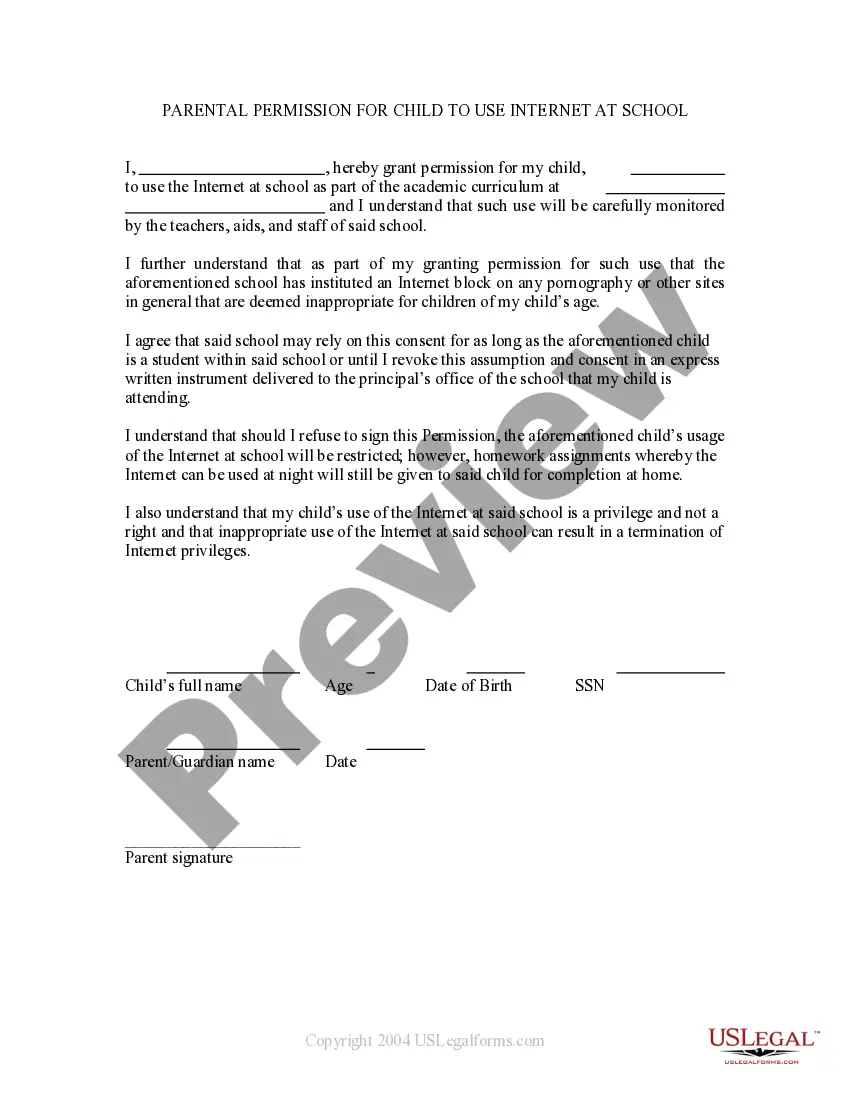
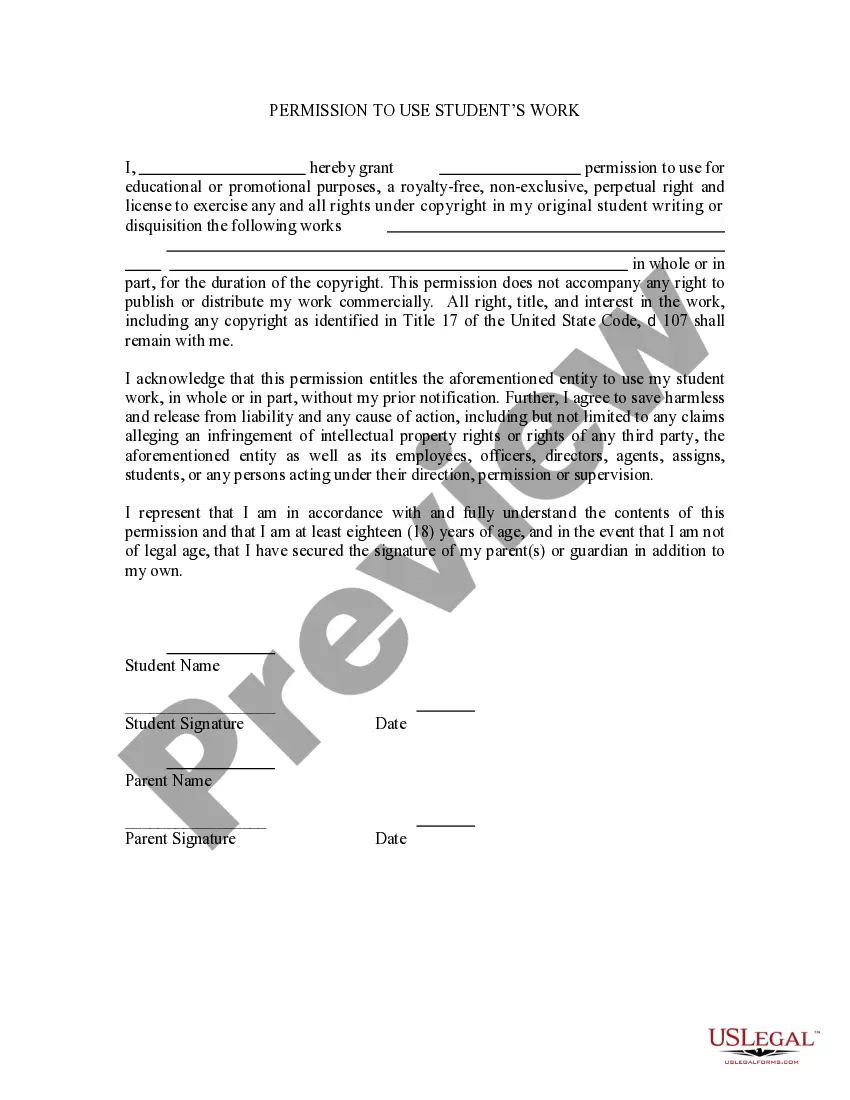
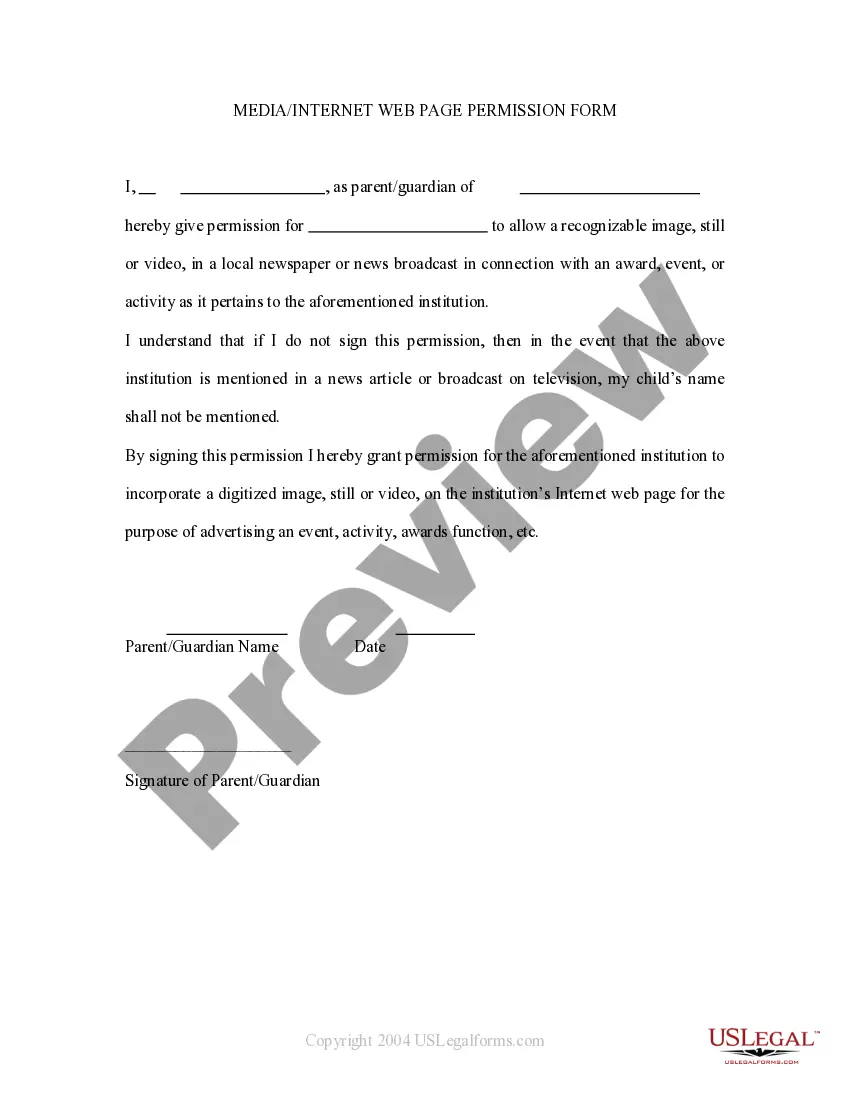
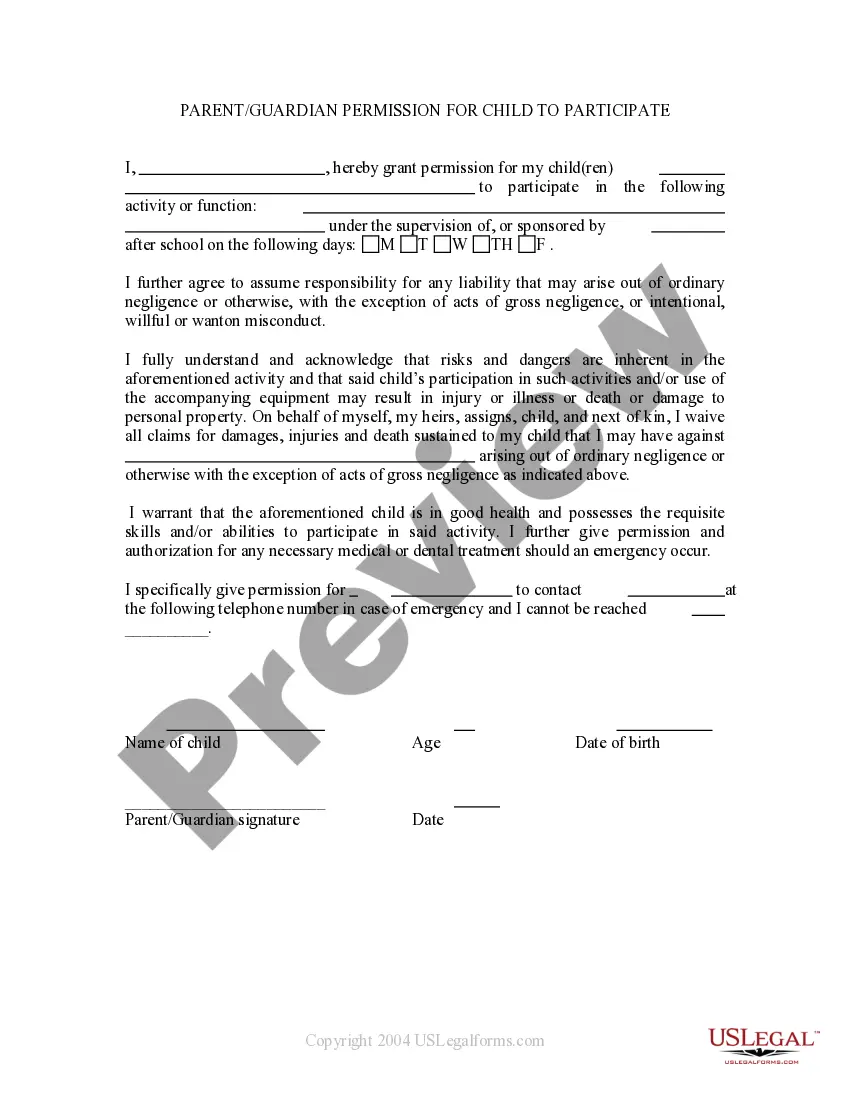
This form is signed by a parent who is granting permission for his/her child to use the Internet at school as part of the academic curriculum, and under the supervision of a teacher, aid, administrator etc.
Alabama Parental Permission For Child To Use Internet At School
Category:
State:
Multi-State
Control #:
US-PRM-28
Format:
Word;
Rich Text
Instant download
Description
How to fill out Parental Permission For Child To Use Internet At School?
Selecting the optimal legitimate document format can be a challenge. Of course, there are numerous templates accessible online, but how do you find the correct legal form you require? Utilize the US Legal Forms website. The platform offers an extensive array of templates, including the Alabama Parental Consent For Child To Access Internet At School, which can be utilized for business and personal purposes. All of the forms are reviewed by experts and adhere to state and federal regulations.
If you are already registered, Log In to your account and click the Download button to obtain the Alabama Parental Consent For Child To Access Internet At School. Use your account to browse the legal forms you have previously acquired. Navigate to the My documents section of your account and retrieve another copy of the document you need.
If you are a new user of US Legal Forms, here are straightforward instructions that you can follow: First, ensure you have selected the correct form for your city/region. You may examine the document using the Review button and read the form description to confirm this is suitable for you. If the form does not meet your requirements, utilize the Search field to find the appropriate form. Once you are confident that the form is suitable, click the Get now button to obtain the form. Choose the pricing plan you prefer and enter the necessary information. Create your account and pay for your order using your PayPal account or credit card. Select the file format and download the legal document format for your device. Complete, modify, and print and sign the acquired Alabama Parental Consent For Child To Access Internet At School.
Make the most of this service to access a vast selection of legal forms tailored to meet your needs.
- US Legal Forms is the largest repository of legal forms that you will find various document templates.
- Utilize the service to download properly-crafted paperwork that comply with state requirements.
- The templates are user-friendly and designed for convenience.
- All documents are verified to ensure compliance with legal standards.
- The platform supports various payment methods for ease of transaction.
- Users can easily navigate their accounts to manage documents.
Form popularity
FAQ
Additional COPPA resources The FTC's website below states: The Rule requires that the link to your privacy policy be placed in a clear and prominent place and manner on the home page of the website or online service, and at each area where children provide, or are asked to provide, personal information.
For a company to become COPPA-compliant, it must ensure that personal information collected from minors isn't stored for longer than necessary. When getting rid of the data, measures should be put in place to avoid exposure or loss. Parents are allowed to review data collected from their kids.
Over a year ago. Verifiable parental consent is required under COPPA to make sure parents know what information is shared with who. If a company is covered by COPPA, they must get parents' verifiable consent before collecting, using or disclosing personal information (PI) from their kids.
A school is perfectly within its rights to refuse to release a child to a parent during school hours. Once school hours are over it is another matter. At that point they must release the child to anyone who has PR unless there is a court order stating otherwise.
COPPA rules that site operators allow parents to review children's personal information. In practice, this means that any relevant site has to provide full access to all user records, profiles and login information when a parent requests it.
The Children's Online Privacy Protection Act (COPPA) specifically aims to protect the privacy of children under the age of 13 by requesting parental consent for the collection or use of any personal information of the users. The Act took effect in April 2000 and was revised in 2013.
Parents, consumer groups, industry members, and others that believe an operator is violating COPPA may report that to the FTC online or call our toll free telephone number at (877) FTC-HELP.
COPPA imposes certain requirements on operators of websites or online services directed to children under 13 years of age, and on operators of other websites or online services that have actual knowledge that they are collecting personal information online from a child under 13 years of age.
Currently, COPPA protects children below 13 years. For COPPA compliance purposes, operators only need to label their websites as 13+ to start collecting minors' personal information. Today, children below 13 years can still access such sites and provide their information to operators, knowingly or unknowingly.
The Children's Online Privacy Protection Act (COPPA) specifically aims to protect the privacy of children under the age of 13 by requesting parental consent for the collection or use of any personal information of the users. The Act took effect in April 2000 and was revised in 2013.