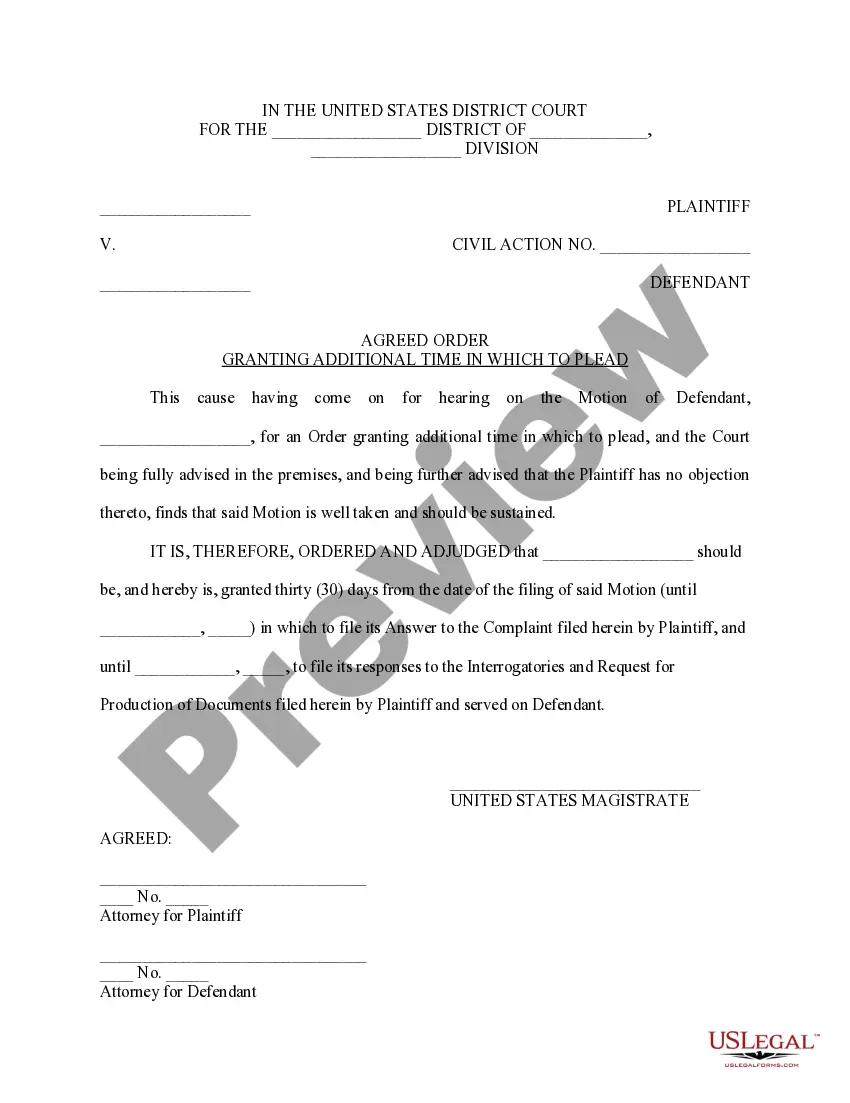
Alabama Agreed Order Granting Additional Time to Plead and Respond to Interrogatories and Requests for Production
Description
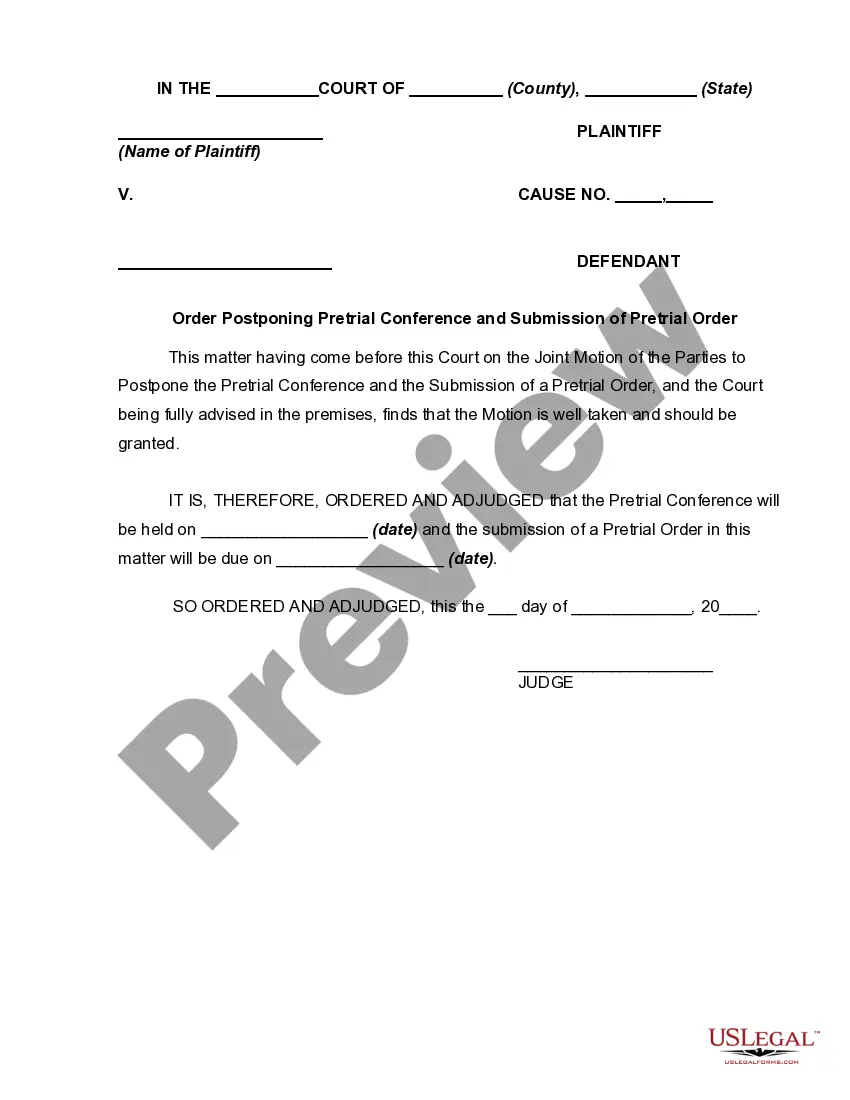



How to fill out Agreed Order Granting Additional Time To Plead And Respond To Interrogatories And Requests For Production?
You can spend numerous hours online trying to locate the legal document template that satisfies the federal and state requirements you need. US Legal Forms offers a multitude of legal forms that can be assessed by professionals.
You can actually obtain or print the Alabama Agreed Order Granting Additional Time to Plead and Respond to Interrogatories and Requests for Production through my service.
If you already possess a US Legal Forms account, you can Log In and click the Download button. Afterwards, you can complete, modify, print, or sign the Alabama Agreed Order Granting Additional Time to Plead and Respond to Interrogatories and Requests for Production. Each legal document template you acquire is yours indefinitely. To obtain another copy of the purchased form, navigate to the My documents section and select the appropriate option.
- If you are visiting the US Legal Forms website for the first time, follow the simple instructions below.
- First, ensure you have selected the correct document template for the county/region of your choice.
- Read the form description to confirm you have chosen the suitable document.
- If available, use the Review option to examine the document template as well.
- If you wish to find another version of your document, use the Search box to find the template that meets your needs and requirements.
- Once you have found the template you need, click Buy now to proceed.
- Choose the pricing plan you want, enter your details, and register for your account on US Legal Forms.
- Complete the transaction. You can use your credit card or PayPal account to pay for the legal document.
- Select the format of your document and download it to your device.
- Make adjustments to your document if necessary. You can complete, modify, sign, and print the Alabama Agreed Order Granting Additional Time to Plead and Respond to Interrogatories and Requests for Production.
- Download and print numerous document templates using the US Legal Forms website, which provides the largest collection of legal forms.
- Utilize professional and state-specific templates to address your business or personal needs.
Form popularity
FAQ
In Alabama, the standard time frame to respond to interrogatories is typically 30 days from the date of service. However, if you have an Alabama Agreed Order Granting Additional Time to Plead and Respond to Interrogatories and Requests for Production, this timeline may be extended. It’s important to keep track of deadlines to ensure compliance with court rules. If you need assistance, uslegalforms can help you with the necessary documentation and guidance.
Interrogatories and requests for production are both discovery tools used in legal cases, but they serve different purposes. Interrogatories are written questions that one party sends to another, requiring a written response under oath. On the other hand, requests for production involve asking the other party to provide specific documents or evidence relevant to the case. Understanding these differences is essential when navigating the Alabama Agreed Order Granting Additional Time to Plead and Respond to Interrogatories and Requests for Production.
Rule 59 in Alabama addresses the grounds for a motion for a new trial. It allows a party to request a new trial based on specific reasons, such as errors in the trial process or newly discovered evidence. Understanding this rule is essential for effective legal strategy, especially if you face challenges after a judgment. The Alabama Agreed Order Granting Additional Time to Plead and Respond to Interrogatories and Requests for Production can also play a role in ensuring you have ample time to file these motions.
In Alabama, you generally have 30 days to respond to interrogatories after receiving them. This timeframe is crucial for gathering accurate information and preparing your answers. If you find yourself needing more time, the Alabama Agreed Order Granting Additional Time to Plead and Respond to Interrogatories and Requests for Production can provide the necessary extension. Utilizing resources like US Legal Forms can guide you through this process.
In Alabama, Rule 26 pertains to the disclosure of expert witnesses and their testimonies. It requires parties to provide a report from any expert they plan to call in court. This ensures transparency and allows both sides to prepare adequately. The Alabama Agreed Order Granting Additional Time to Plead and Respond to Interrogatories and Requests for Production can be beneficial if you need extra time to gather expert opinions.
33(c)] states that a party electing to respond to an interrogatory by providing electronically stored information must ensure that the interrogating party can locate and identify it 'as readily as can the party served,' and that the responding party must give the interrogating party a 'reasonable opportunity to examine ...
Rule 33 of the Federal Rules of Civil Procedure limits the number of interrogatories a party may propound to twenty-five. Parties must obtain leave of court before serving more than twenty- five interrogatories.
Interrogatories allow the parties to ask who, what, when, where and why questions, making them a good method for obtaining new information in a case. There are two types of interrogatories: form interrogatories and special interrogatories.
Rule 37(a) provides recourse for compulsion of discovery and applies to all discovery devices. Generally comparable provisions existed in Tit. 7, § 474(17), Code of Ala. Rule 37(a)(1) states which court is the appropriate court for determination of problems arising in discovery.
A request for production is a discovery device used to gain access to documents, electronic data, and physical items held by an opposing party in a legal matter. The aim is to gain insight into any relevant evidence that the opposing party holds.