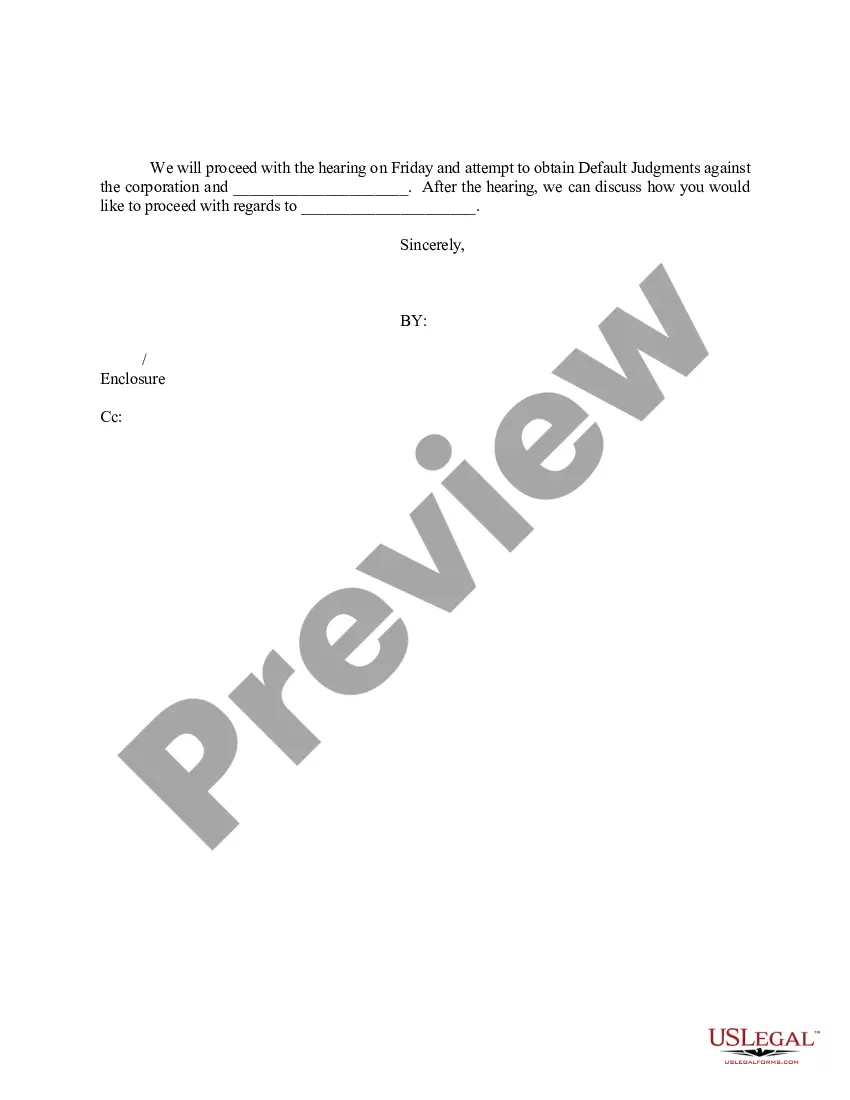
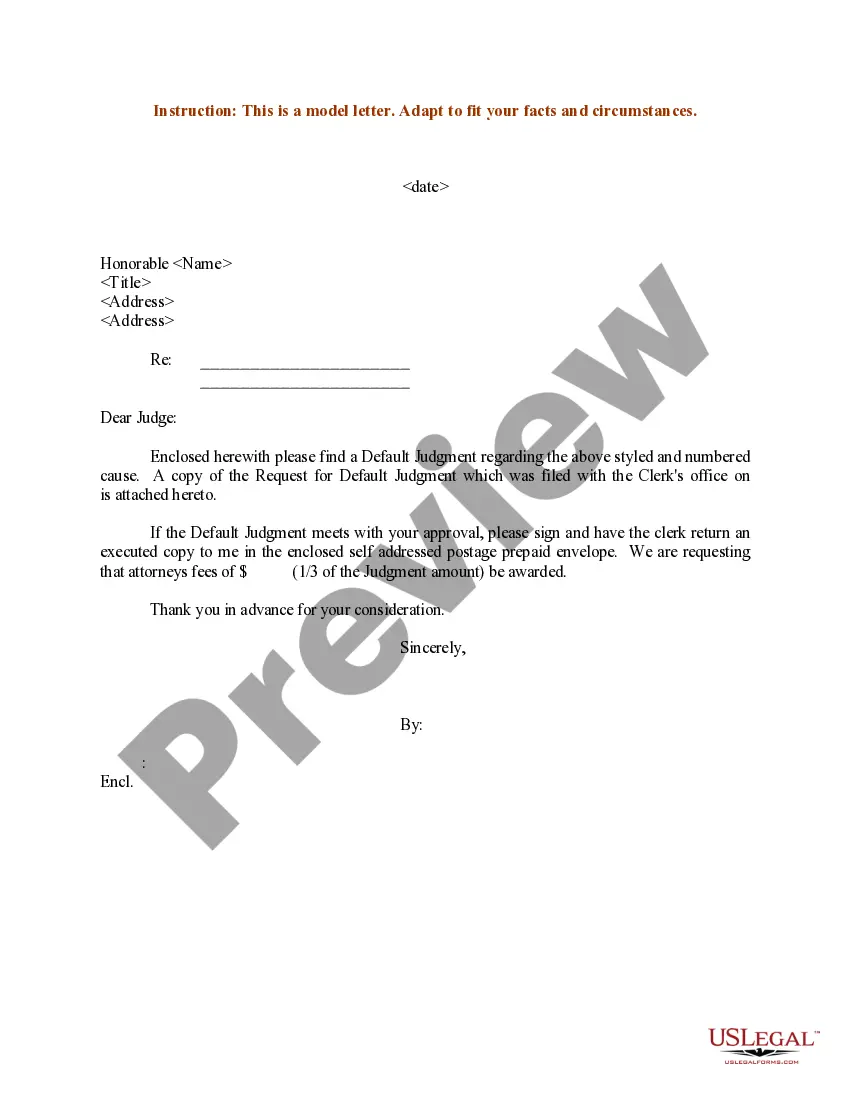
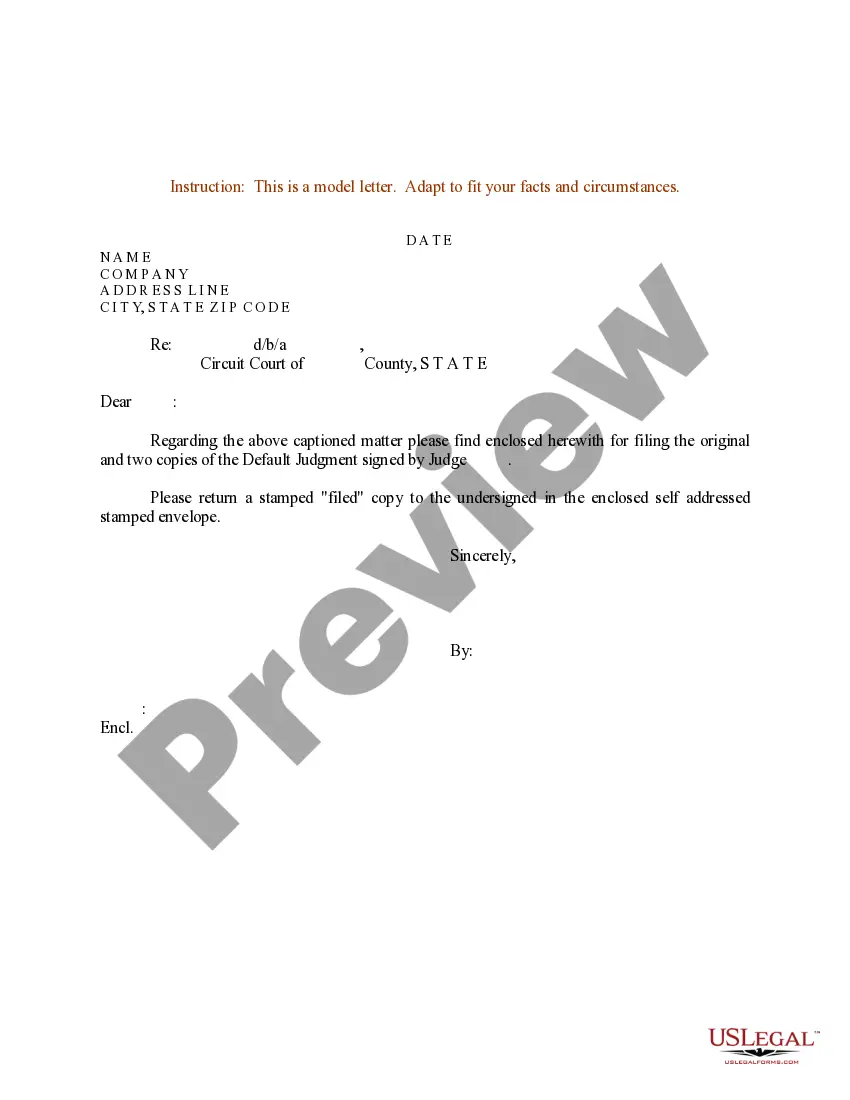
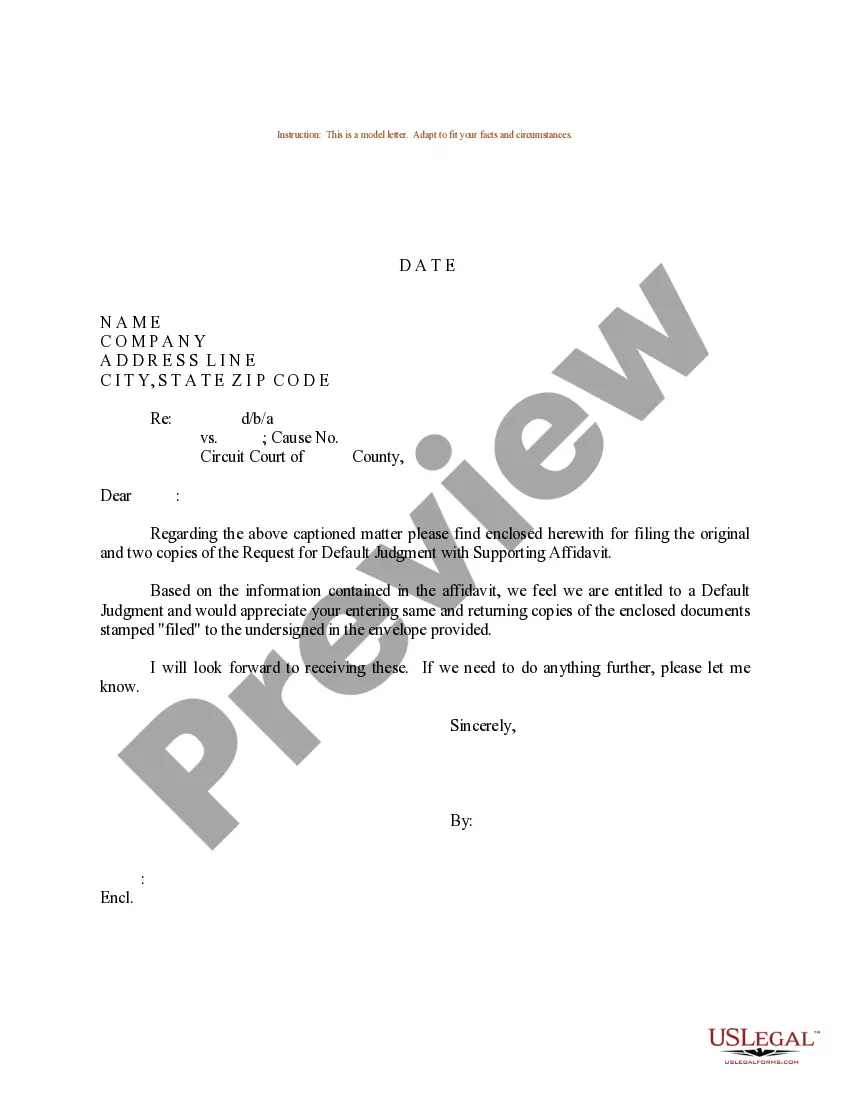
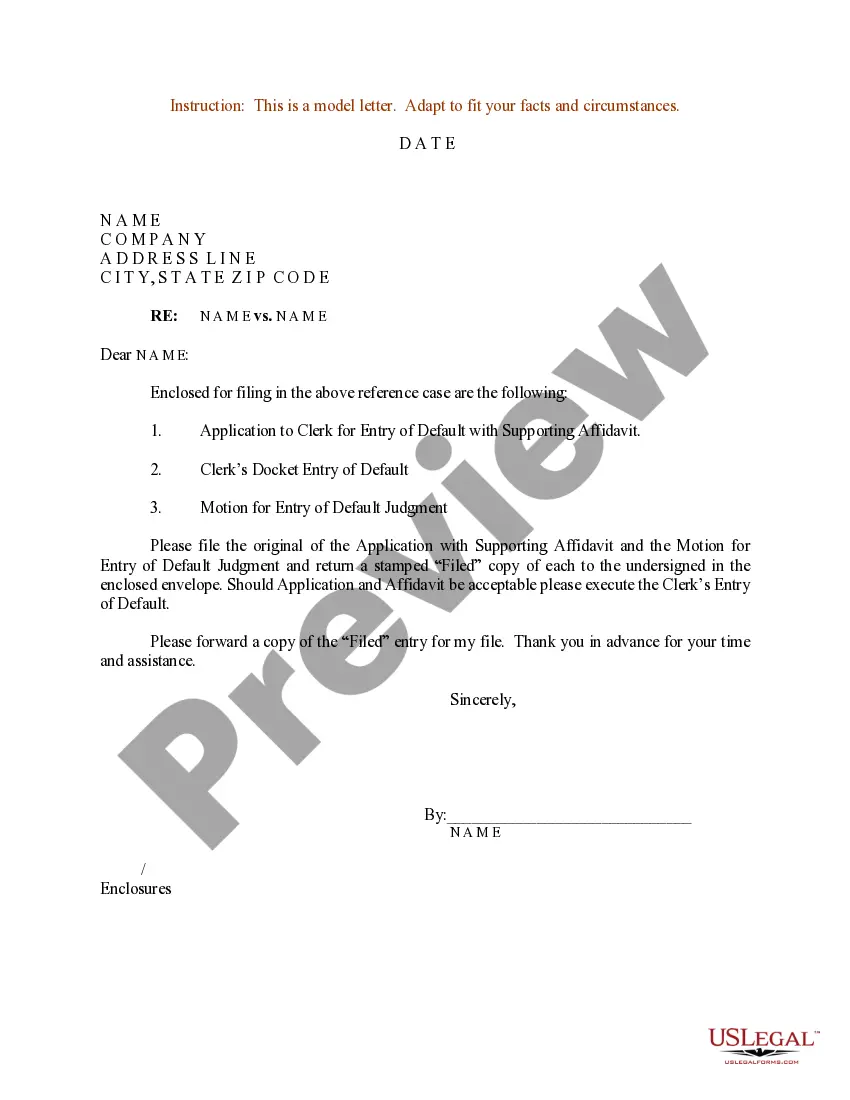
This form is a sample letter in Word format covering the subject matter of the title of the form.
Alabama Sample Letter for Entrance of Default Judgments
State:
Multi-State
Category:
Control #:
US-0020LTR
Format:
Word;
Rich Text
121 downloads
Description
Free preview

Get your form ready online
Our built-in tools help you complete, sign, share, and store your documents in one place.
Built-in online Word editor
Make edits, fill in missing information, and update formatting in US Legal Forms—just like you would in MS Word.
Export easily
Download a copy, print it, send it by email, or mail it via USPS—whatever works best for your next step.
E-sign your document
Sign and collect signatures with our SignNow integration. Send to multiple recipients, set reminders, and more. Go Premium to unlock E-Sign.
Notarize online 24/7
If this form requires notarization, complete it online through a secure video call—no need to meet a notary in person or wait for an appointment.
Store your document securely
We protect your documents and personal data by following strict security and privacy standards.

Make edits, fill in missing information, and update formatting in US Legal Forms—just like you would in MS Word.

Download a copy, print it, send it by email, or mail it via USPS—whatever works best for your next step.

Sign and collect signatures with our SignNow integration. Send to multiple recipients, set reminders, and more. Go Premium to unlock E-Sign.

If this form requires notarization, complete it online through a secure video call—no need to meet a notary in person or wait for an appointment.

We protect your documents and personal data by following strict security and privacy standards.
Looking for another form?
How to fill out Sample Letter For Entrance Of Default Judgments?
If you wish to acquire, download, or print legal document templates, utilize US Legal Forms, the largest repository of legal forms available online.
Take advantage of the site’s straightforward and user-friendly search feature to find the documents you need.
Different templates for business and personal purposes are organized by categories and states, or keywords.
Step 4. After finding the form you need, click the Buy now button. Select your preferred payment plan and provide your details to register for an account.
Step 5. Complete the payment process. You can use your Visa or MasterCard or PayPal account to finalize the transaction. Step 6. Choose the format of the legal document and download it to your device.
- Employ US Legal Forms to locate the Alabama Sample Letter for Entrance of Default Judgments in just a few clicks.
- If you are already a US Legal Forms user, sign in to your account and click the Download button to retrieve the Alabama Sample Letter for Entrance of Default Judgments.
- You can also access forms you previously obtained in the My documents section of your account.
- If you are using US Legal Forms for the first time, follow these steps.
- Step 1. Ensure you have chosen the form for the correct city/state.
- Step 2. Use the Preview option to review the content of the form. Don’t forget to read the information thoroughly.
- Step 3. If you are not satisfied with the form, utilize the Search box at the top of the screen to find alternative versions of the legal form template.
Form popularity
FAQ
To make an application for default judgment in Alabama, you first need to file a complaint with the court. After the defendant fails to respond, you can use the Alabama Sample Letter for Entrance of Default Judgments to formally request the court to issue a judgment against the defendant. This letter should include relevant details, such as the case number and the reason for the default. Utilizing the right resources can simplify this process, and US Legal Forms provides templates to help you create the necessary documents efficiently.
Entry of default judgment occurs when the court grants a judgment in favor of the plaintiff due to the defendant's failure to respond. This judgment can have significant legal implications, as it typically allows the plaintiff to collect damages without further litigation. To facilitate this process, an Alabama Sample Letter for Entrance of Default Judgments can provide you with the necessary structure and content to present your case effectively.
A declaration for entry of default is a formal statement submitted to the court when a defendant fails to respond to a lawsuit. This declaration initiates the process for obtaining a default judgment in favor of the plaintiff. By utilizing an Alabama Sample Letter for Entrance of Default Judgments, you can effectively communicate your request and improve your chances of a favorable outcome.
Rule 59e in Alabama allows parties to file motions to alter or amend a judgment within a specific timeframe. This rule provides an avenue for correcting errors or reconsidering decisions made by the court. As you navigate the legal system, having an Alabama Sample Letter for Entrance of Default Judgments can help streamline your process and ensure your motions are correctly formatted.
In Alabama, a creditor can place a judgment lien on your real property (or your personal property or vehicle) in order to collect the judgment, and it will remain attached to your real property for 10 years, even if you sell the property.
Default. (a) Entry. When a party against whom a judgment for affirmative relief is sought has failed to plead or otherwise defend as provided by these rules and that fact is made to appear by affidavit or otherwise, the clerk shall enter the party's default. The clerk's entry of default may be made electronically.
In Alabama, a creditor can place a judgment lien on your real property (or your personal property or vehicle) in order to collect the judgment, and it will remain attached to your real property for 10 years, even if you sell the property.
The best way to get a judgment vacated is to be able to prove that you never received notice of the lawsuit in the first place. This is not easy, though. You can't just stand in court and say you were never served: you have to present persuasive evidence contradicting the plaintiff's proof of service.
Default. (a) Entry. When a party against whom a judgment for affirmative relief is sought has failed to plead or otherwise defend as provided by these rules and that fact is made to appear by affidavit or otherwise, the clerk shall enter the party's default.
Default judgment is a binding judgment in favor of either party based on some failure to take action by the other party. Most often, it is a judgment in favor of a plaintiff when the defendant has not responded to a summons or has failed to appear before a court of law.