Alabama Complaint - Federal Truth-in-Lending Act
Understanding this form
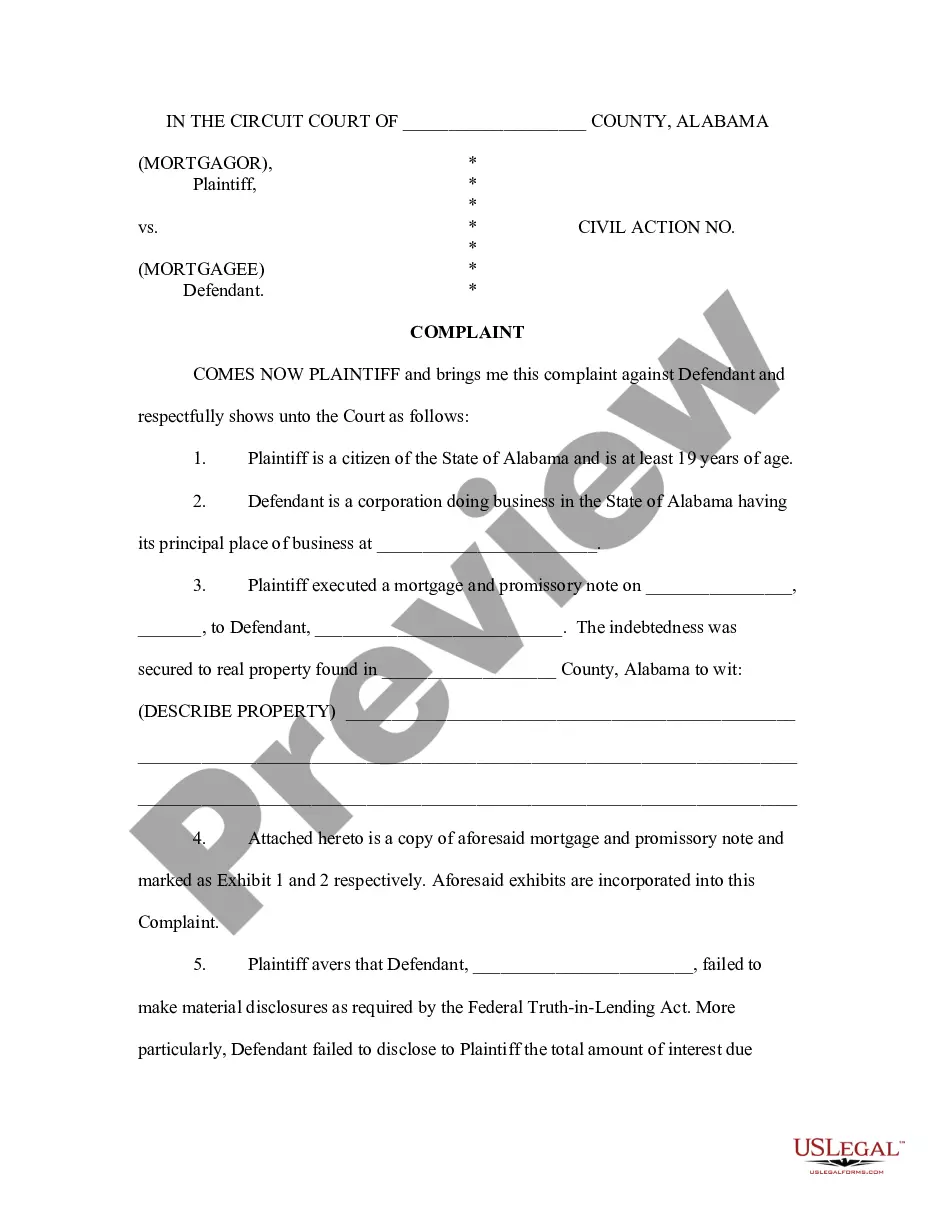
The Complaint under the Federal Truth-in-Lending Act is a legal document used by borrowers to file a complaint against lenders for failing to provide required material disclosures related to loan terms. This form is essential for consumers seeking to protect their rights and can lead to the rescission of promissory notes or mortgages that violate federal lending laws. Unlike other complaints, this form specifically targets disclosure violations as mandated by the Truth-in-Lending Act.
Key parts of this document
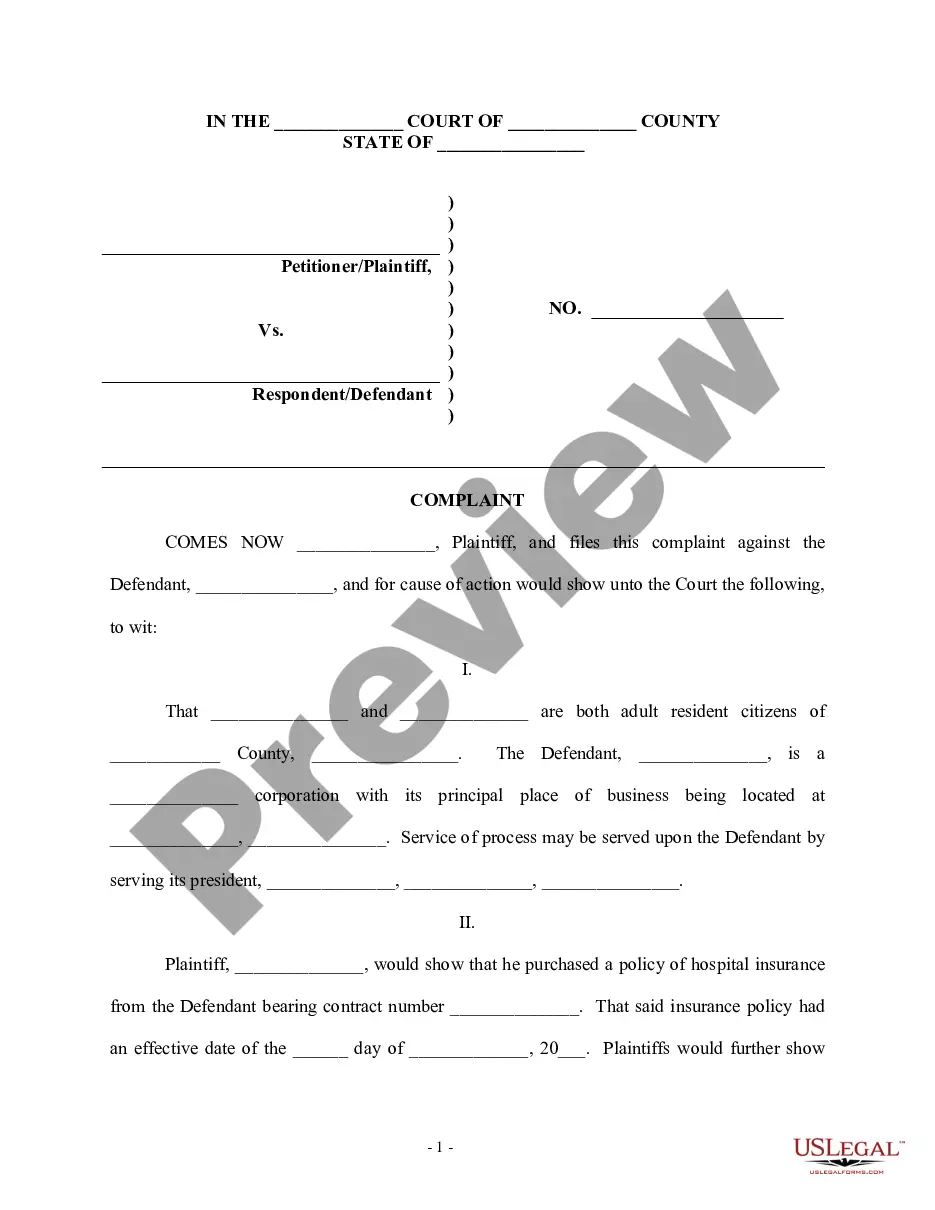
- Identification of the plaintiff and defendant, including their addresses.
- Details about the mortgage and promissory note, including execution date and property description.
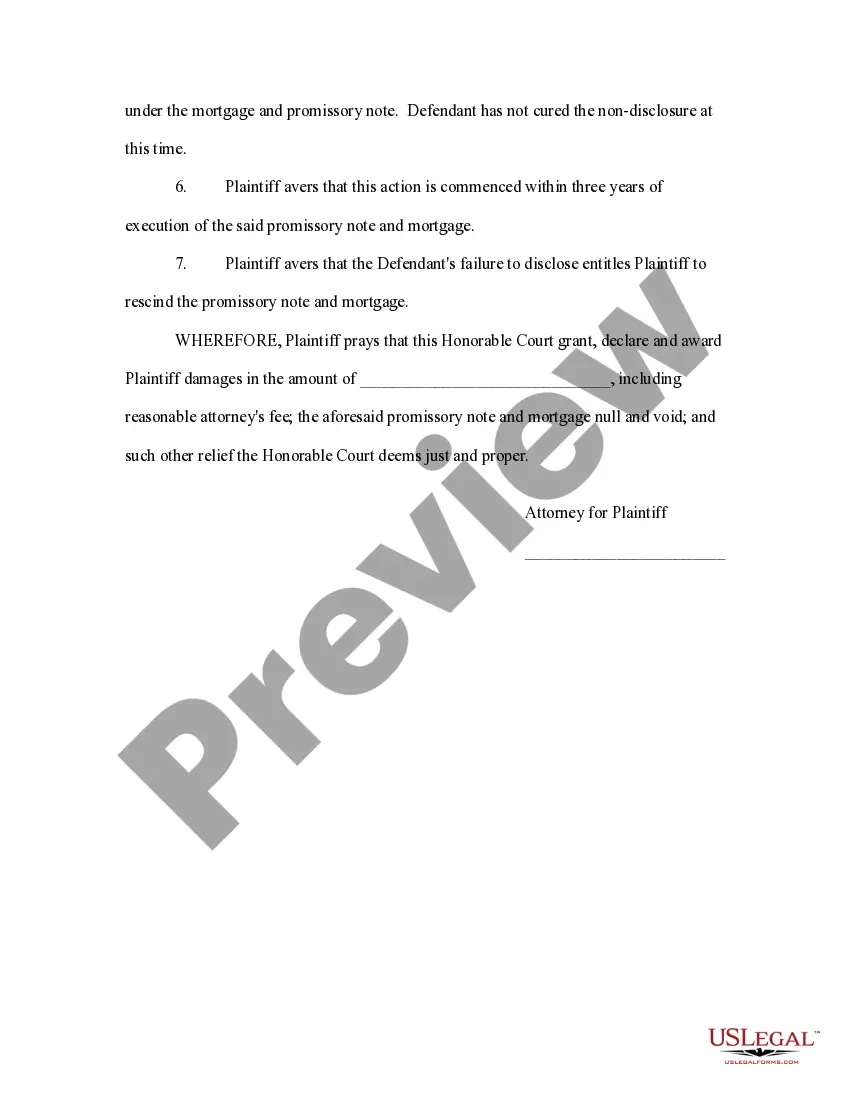
- Plaintiff's assertion of the defendant's failure to make necessary disclosures.
- Request for damages and for the promissory note to be declared null and void.
- Inclusion of copies of the mortgage and promissory note as exhibits.
When this form is needed
This Complaint should be utilized when a borrower believes that their lender has failed to disclose important information regarding a loan under the Federal Truth-in-Lending Act. Common scenarios include situations where the total interest cost or other key loan terms were not properly communicated to the borrower, leading to potential financial harm.
Who this form is for
- Consumers who have taken out a mortgage or signed a promissory note.
- Individuals who suspect that their lender has not made required disclosures.
- Borrowers seeking to protect their rights under federal lending laws.
- Legal representatives filing on behalf of consumers dealing with such issues.
Completing this form step by step
- Identify the parties involved by filling in the names and addresses of the plaintiff and defendant.
- Specify the details of the mortgage and promissory note, including the execution date and property description.
- Describe the alleged failures of the defendant to make required disclosures under the Truth-in-Lending Act.
- Include the amount of damages being sought and state the request for the promissory note to be declared null and void.
- Attach copies of the mortgage and promissory note as exhibits to the complaint.
Is notarization required?
This document requires notarization to meet legal standards. US Legal Forms provides secure online notarization powered by Notarize, allowing you to complete the process through a verified video call, available 24/7.
Get your form ready online
Our built-in tools help you complete, sign, share, and store your documents in one place.
Make edits, fill in missing information, and update formatting in US Legal Forms—just like you would in MS Word.
Download a copy, print it, send it by email, or mail it via USPS—whatever works best for your next step.
Sign and collect signatures with our SignNow integration. Send to multiple recipients, set reminders, and more. Go Premium to unlock E-Sign.
If this form requires notarization, complete it online through a secure video call—no need to meet a notary in person or wait for an appointment.
We protect your documents and personal data by following strict security and privacy standards.

Make edits, fill in missing information, and update formatting in US Legal Forms—just like you would in MS Word.

Download a copy, print it, send it by email, or mail it via USPS—whatever works best for your next step.

Sign and collect signatures with our SignNow integration. Send to multiple recipients, set reminders, and more. Go Premium to unlock E-Sign.

If this form requires notarization, complete it online through a secure video call—no need to meet a notary in person or wait for an appointment.

We protect your documents and personal data by following strict security and privacy standards.
Common mistakes to avoid
- Failing to complete all sections of the form thoroughly.
- Not attaching necessary exhibits like copies of the mortgage and promissory note.
- Missing the statute of limitations for filing the complaint (three years from execution).
- Using vague or unclear language regarding the failure to disclose information.
Benefits of completing this form online
- Convenient access to legal forms any time from your device.
- Editable templates tailored to incorporate personal information.
- Assurance that forms are drafted by licensed attorneys, reflecting current laws.
Key takeaways
- This Complaint is essential for borrowers claiming violations of disclosure requirements under the Federal Truth-in-Lending Act.
- Ensuring accuracy and completeness in the form is crucial for a successful filing.
- The form is specifically designed for use in Alabama, reflecting state-specific legal considerations.
Looking for another form?
Form popularity
FAQ
The Alabama Complaint - Federal Truth-in-Lending Act does not address every possible lending issue. Specifically, it does not cover home mortgages in most cases, nor does it include loans with an established repayment period of less than a year. Understanding these limitations can empower consumers to navigate their financial agreements more effectively.
If you believe you are a victim of predatory lending, it is crucial to take immediate action. You can file a complaint through the Alabama Complaint - Federal Truth-in-Lending Act or consult with legal professionals specializing in consumer rights. Platforms like USLegalForms provide valuable resources to help you report such offenses and seek justice.
The enforcement of the Alabama Complaint - Federal Truth-in-Lending Act falls under the authority of the Consumer Financial Protection Bureau (CFPB). This federal agency ensures compliance with the law, promoting fair lending practices. Consumers can report violations to the CFPB for thorough investigation.
The Alabama Complaint - Federal Truth-in-Lending Act does not apply to all financial transactions. For example, it generally does not cover loans secured by real estate and certain credit transactions like those made under an open-end credit plan. Knowing this can assist borrowers in identifying situations where they may lack protection under the Act.
Certain loans are specifically excluded from the Alabama Complaint - Federal Truth-in-Lending Act. These include loans made primarily for business purposes, loans with a principal amount less than $54,000, and certain student loans. Recognizing these exclusions can help borrowers understand their rights under the law.
The Alabama Complaint - Federal Truth-in-Lending Act does not cover all types of loans. For instance, it excludes business or commercial loans, loans secured by real estate, and certain types of student loans. By understanding what is not included, you can better assess your rights and seek assistance if necessary.
The enforcement of the Truth in Lending Act, or TILA, is primarily carried out by the Consumer Financial Protection Bureau (CFPB). Additionally, other federal and state agencies may also play a role in overseeing compliance. If you suspect a breach of TILA, you can initiate an Alabama Complaint - Federal Truth-in-Lending Act through platforms like uslegalforms, simplifying the process for consumers seeking justice. Awareness and action are key to protecting your rights.
Oversight of the Truth in Lending Act (TILA) is managed by the Consumer Financial Protection Bureau (CFPB) and other federal agencies. These agencies ensure that lenders provide clear and truthful information about credit terms. If you believe a lender has been non-compliant, consider filing an Alabama Complaint - Federal Truth-in-Lending Act. Speaking up helps maintain the integrity of lending practices.
The Consumer Financial Protection Bureau (CFPB) holds the primary responsibility for enforcing the truth in lending law. This agency supervises financial institutions to ensure they adhere to regulations that protect consumers. If you face issues with deceptive lending practices, an Alabama Complaint - Federal Truth-in-Lending Act is a powerful tool to seek resolution. Knowing your rights strengthens your position as a consumer.
The enforcement of TILA requirements falls under the jurisdiction of multiple federal and state regulators, with the CFPB taking the lead. They monitor compliance and investigate complaints related to lending practices. If you believe a lender has violated TILA, consider submitting an Alabama Complaint - Federal Truth-in-Lending Act. Such actions are vital in promoting transparency and fairness in lending.