Alabama Acknowledgment of Probate of Conveyance
Understanding this form
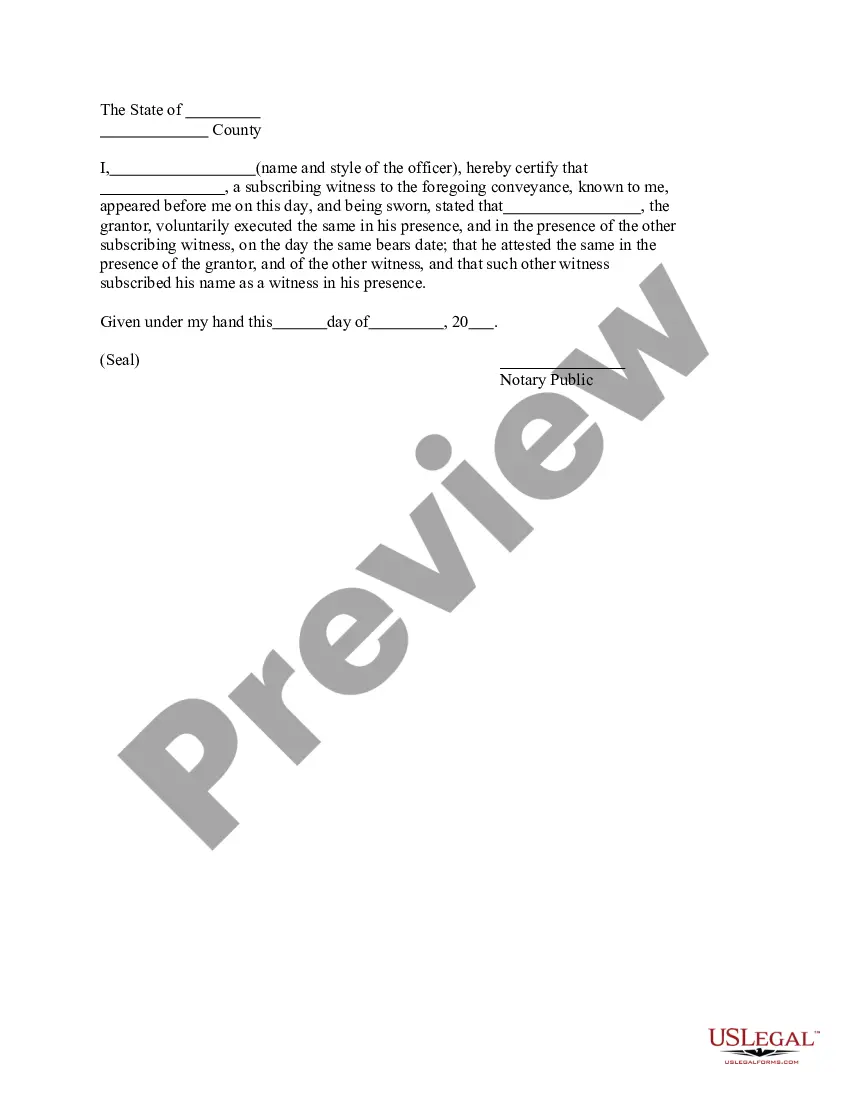
The Acknowledgment of Probate of Conveyance is a legal document used to confirm that a property transfer has been properly executed and is recognized by the probate court. This form serves as proof that the grantor executed the conveyance and that the deed was witnessed appropriately, distinguishing it from simpler forms of property transfer documentation. It is essential in confirming the validity of the property transfer in legal proceedings.
Main sections of this form
- Identification of the notary public certifying the document.
- Name and details of the grantor and witnesses involved in the conveyance.
- Certification statement affirming the execution of the document by the grantor.
- Date of the notarization to ensure the timeliness of the document.
- Seal of the notary public to authenticate the acknowledgment.

Common use cases
This form should be used when you need to formalize the probate of a property conveyance, especially after a property owner has passed away or when a trust is involved. It is commonly utilized in estate planning or during the settlement of a deceased person's estate, ensuring that all property transfers are legally recognized and documented as part of the probate process.
Who should use this form
This form is intended for:
- Executors of estates responsible for managing property transfers.
- Trustees handling real estate within a trust.
- Attorneys or legal representatives overseeing property conveyances.
- Individuals involved in the sale or transfer of inherited property.
How to prepare this document
- Identify the name and address of the grantor in the first section of the form.
- Enter the names and addresses of all subscribing witnesses to the conveyance.
- Ensure the notary public includes their name, signature, and seal where indicated.
- Fill in the date of notarization accurately to reflect when the document was executed.
- Review the completed form for accuracy before submitting it for recording.
Does this form need to be notarized?
To make this form legally binding, it must be notarized. Our online notarization service, powered by Notarize, lets you verify and sign documents remotely through an encrypted video session.
Get your form ready online
Our built-in tools help you complete, sign, share, and store your documents in one place.
Make edits, fill in missing information, and update formatting in US Legal Forms—just like you would in MS Word.
Download a copy, print it, send it by email, or mail it via USPS—whatever works best for your next step.
Sign and collect signatures with our SignNow integration. Send to multiple recipients, set reminders, and more. Go Premium to unlock E-Sign.
If this form requires notarization, complete it online through a secure video call—no need to meet a notary in person or wait for an appointment.
We protect your documents and personal data by following strict security and privacy standards.

Make edits, fill in missing information, and update formatting in US Legal Forms—just like you would in MS Word.

Download a copy, print it, send it by email, or mail it via USPS—whatever works best for your next step.

Sign and collect signatures with our SignNow integration. Send to multiple recipients, set reminders, and more. Go Premium to unlock E-Sign.

If this form requires notarization, complete it online through a secure video call—no need to meet a notary in person or wait for an appointment.

We protect your documents and personal data by following strict security and privacy standards.
Mistakes to watch out for
- Failing to have all required signatures, which can invalidate the form.
- Omitting the notary's seal or signature, leading to issues with acceptance.
- Leaving out important details about the grantor or witnesses.
- Incorrectly dating the document, which can create confusion about its validity.
Why use this form online
- Convenience of downloading and printing the form at your own pace.
- Editability allows you to fill in your information accurately.
- Access to templates created by licensed attorneys, ensuring legal compliance.
- Quick and efficient way to complete necessary legal forms without extensive legal fees.
Looking for another form?
Form popularity
FAQ
Filling out a certificate of acknowledgment requires careful attention to detail. Begin by clearly identifying the parties involved and the document being acknowledged. Include the date and location of the acknowledgment, as well as your signature as the person who is acknowledging the document. Utilizing US Legal Forms can provide you with templates and guidance to ensure that you complete the Alabama Acknowledgment of Probate of Conveyance correctly.
An Alabama probate judge oversees the probate process and ensures its proper execution. The judge determines the validity of the will, authorizes the Alabama Acknowledgment of Probate of Conveyance, and oversees the distribution of assets according to state law. Their role includes resolving any disputes among heirs and ensuring that all legal proceedings comply with established guidelines.
Filing a petition for probate in Alabama is a straightforward process. Start by completing the petition form and include the original will, if available. You must also submit the Alabama Acknowledgment of Probate of Conveyance to confirm the authenticity of the will. Filing these documents at the local probate court initiates the process, allowing the court to recognize the will.
You can probate a will in Alabama without a lawyer by following the state’s probate process. First, gather necessary documents, including the original will, death certificate, and the Alabama Acknowledgment of Probate of Conveyance form. Next, file these documents with the probate court in your county. While the process can seem daunting, using resources like US Legal Forms can simplify your experience.
Transferring a deed of a house after death in Alabama requires going through the probate process, where the estate is properly settled. You'll need to provide the court with various documents to obtain an Alabama acknowledgment of probate of conveyance. Once the probate court validates the will, you can then execute a new deed that reflects the rightful owner. Utilizing tools from platforms like USLegalForms can help streamline this process, ensuring all necessary information is accurately documented.
In Alabama, you have five years from the date of death to file for probate, although it is advisable to file as soon as possible. Delaying this process may lead to difficulties in managing the estate and distributing assets. Beginning the probate early also ensures that you can secure the necessary Alabama acknowledgment of probate of conveyance without unnecessary complications. Timely filing promotes smoother transitions for loved ones involved.
If you choose not to probate a will in Alabama, the estate may not be distributed according to the deceased's wishes. This could lead to unintended consequences, such as disputes among heirs or state laws dictating how assets are divided. By filing for the Alabama acknowledgment of probate of conveyance, you ensure a legal and orderly distribution of the estate. It is always best to adhere to legal processes to avoid complications in the future.
Filing a petition for probate in Alabama involves submitting a request to the probate court in your county. You typically need to provide various documents, including the will and any necessary forms. Once the petition is filed, the court will verify the will and issue an Alabama acknowledgment of probate of conveyance. It is advisable to seek assistance from a legal expert or a platform like USLegalForms to simplify this process.
In Alabama, an estate typically must exceed $25,000 in value to require probate. However, certain assets may not count toward this threshold. If the estate's value meets or surpasses this amount, you will need to acknowledge the probate of conveyance formally. Filing for probate ensures proper distribution of the estate according to the wishes stated in the will.