Alabama Certification of Pro Se Judgment
What this document covers
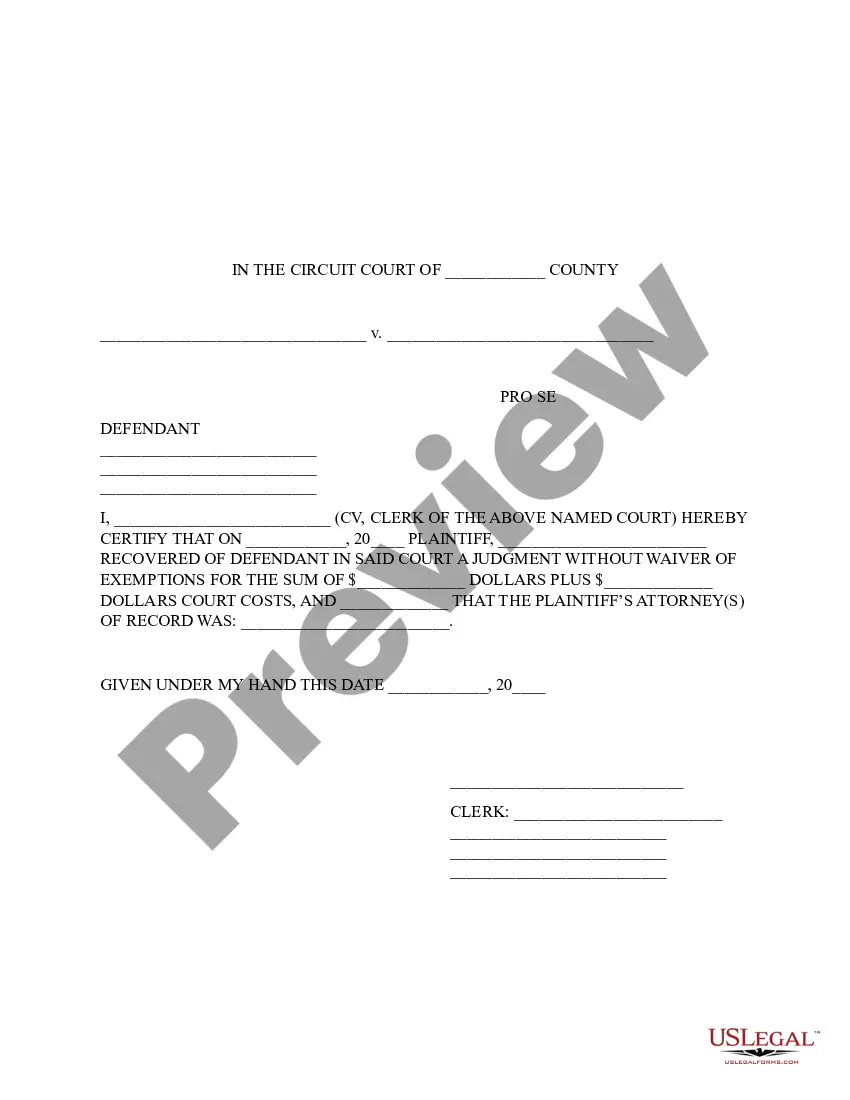
The Certification of Pro Se Judgment is a legal document used by individuals representing themselves in court, known as pro se litigants. This form records a court judgment against a defendant when the plaintiff does not have legal representation. It serves a unique purpose by enabling those without attorneys to formalize their case outcomes, ensuring that their victories are documented correctly and recognized by the court systems.
Key components of this form
- Names of the parties involved: Plaintiff and Defendant.
- Date of the judgment issued by the court.
- Amount of judgment awarded to the Plaintiff, including any court costs.
- Certification statement by the court clerk documenting the judgment.
- Signatures of the court clerk to validate the document.
When this form is needed
This form is needed when a person who is representing themselves in a court case has received a judgment in their favor against another party. It is typically used to ensure the judgment is formally recognized and can be enforced, particularly in cases related to small claims, civil disputes, or other legal matters where one party chooses to navigate the legal process without an attorney.
Who this form is for
This form is intended for:
- Individuals involved in a court case who are representing themselves (pro se litigants).
- Parties who have successfully obtained a judgment against another party in court.
- Individuals seeking to document their judgment formally for future legal processes or enforcement.
How to prepare this document
- Fill in the names of the Plaintiff and Defendant in the appropriate spaces on the form.
- Provide the date when the judgment was issued by the court.
- Enter the total judgment amount awarded, including any additional court costs.
- Complete the certification statement, including the clerk's name and details.
- Obtain the required signature from the court clerk to finalize the document.
Notarization guidance
This form typically does not require notarization unless specified by local law. It is crucial to check with your jurisdiction's rules regarding notarization requirements for court filings.
Get your form ready online
Our built-in tools help you complete, sign, share, and store your documents in one place.
Make edits, fill in missing information, and update formatting in US Legal Forms—just like you would in MS Word.
Download a copy, print it, send it by email, or mail it via USPS—whatever works best for your next step.
Sign and collect signatures with our SignNow integration. Send to multiple recipients, set reminders, and more. Go Premium to unlock E-Sign.
If this form requires notarization, complete it online through a secure video call—no need to meet a notary in person or wait for an appointment.
We protect your documents and personal data by following strict security and privacy standards.

Make edits, fill in missing information, and update formatting in US Legal Forms—just like you would in MS Word.

Download a copy, print it, send it by email, or mail it via USPS—whatever works best for your next step.

Sign and collect signatures with our SignNow integration. Send to multiple recipients, set reminders, and more. Go Premium to unlock E-Sign.

If this form requires notarization, complete it online through a secure video call—no need to meet a notary in person or wait for an appointment.

We protect your documents and personal data by following strict security and privacy standards.
Mistakes to watch out for
- Failing to provide the correct names of the parties involved.
- Leaving the judgment amount blank or incorrectly calculated.
- Not obtaining the court clerk's signature, which invalidates the form.
- Using an outdated version of the form not compliant with current laws.
Advantages of online completion
- Convenient access to a professionally drafted, legally sound document.
- Editable format allows for customization to fit specific case details.
- Instant download option ensures you have the form readily available.
- Secure storage of your legal forms for future reference.
Legal use & context
- This form is legally binding once completed and signed by the authorized court personnel.
- The Certification of Pro Se Judgment ensures that a court's decision is documented correctly for enforcement purposes.
- It serves as evidence of the court's ruling if disputes arise regarding the judgment in the future.
What to keep in mind
- The Certification of Pro Se Judgment legitimizes court decisions for self-represented litigants.
- Completing the form accurately is essential to avoid disputes or legal complications.
- It is important to verify state-specific rules that may affect the form's usage and submission process.
Looking for another form?
Form popularity
FAQ
AlaFile is an online platform that allows Alabama residents to file court documents electronically. This service simplifies the filing process and enhances access to court services, making it especially beneficial for individuals managing their cases, including matters related to Alabama Certification of Pro Se Judgment. Using AlaFile can save you time and streamline your legal experience.
A judge in Alabama is encouraged to rule on motions as expeditiously as possible, often within 30 days. However, the actual time may vary based on case complexity and the judge's caseload. For those involved in Alabama Certification of Pro Se Judgment, understanding these timelines can aid in managing expectations and planning your next steps in the legal process.
In Alabama, you typically have 30 days to respond to a motion filed against you. This timeframe ensures you have enough opportunity to prepare your response and gather necessary documentation. If you are dealing with matters related to Alabama Certification of Pro Se Judgment, timely responses are vital to ensure your voice is heard in court.
Rule 59 in Alabama governs the process of requesting a new trial or amending a judgment. Under this rule, a party has a specific timeframe to file a motion for reconsideration after a judgment has been entered. This can be particularly relevant in the context of Alabama Certification of Pro Se Judgment, as understanding Rule 59 can help you identify your options for challenging a court's decision.
In Alabama, the time it takes for a judge to rule on motions can vary significantly based on the case and the court's schedule. Typically, judges aim to make decisions on motions within a few weeks, but more complex cases might require additional time. If you're navigating a situation involving Alabama Certification of Pro Se Judgment, staying patient is essential, as timely rulings contribute to efficient case management.
A motion for summary judgment in Alabama is a request made to the court to decide a case or a specific issue without proceeding to trial. This motion is based on the argument that there are no material facts in dispute, allowing the judge to rule based solely on the evidence presented. Understanding this process is crucial when dealing with Alabama Certification of Pro Se Judgment, as it can expedite the resolution of your case.
Rule 37 of the Alabama Rules of Civil Procedure deals with the consequences of failing to comply with discovery rules during litigation. Specifically, it provides for sanctions that the court can impose on parties who do not respond to discovery requests and outlines the process for resolving these disputes. Understanding Rule 37 is essential for both attorneys and pro se litigants who want to ensure compliance while pursuing an Alabama Certification of Pro Se Judgment.
The term 'pro se judge' typically describes a judge that deals with cases where at least one party is self-represented. Judges in such cases must balance their role as impartial arbiters while also guiding pro se litigants through the complexities of the legal process. This often involves clarifying procedural rules and ensuring that individuals seeking an Alabama Certification of Pro Se Judgment understand what is required.
A pro se judge is not a formal title but refers to a judge presiding over cases involving pro se litigants. These judges often encounter individuals representing themselves and may provide guidance on court procedures without offering legal advice. Understanding how to effectively communicate in a pro se setting is essential for ensuring a fair hearing.
An example of pro se representation could be a person filing a divorce petition without hiring a lawyer. They would gather the necessary documents, complete the required forms, and appear in court to present their case. While this approach is common in family law, individuals must ensure they meet all legal requirements, such as obtaining an Alabama Certification of Pro Se Judgment when necessary.