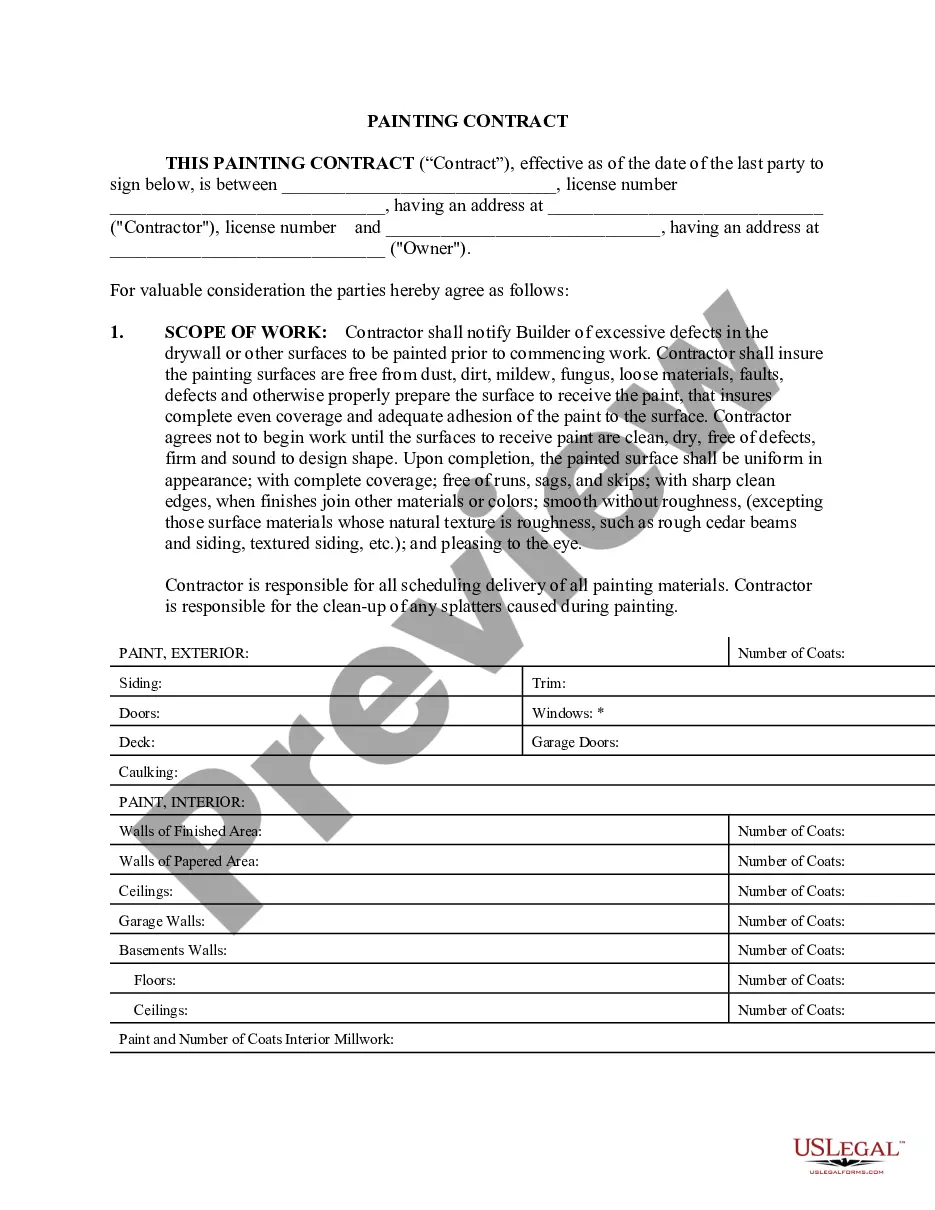
Alabama Request for Mediation
What is this form?
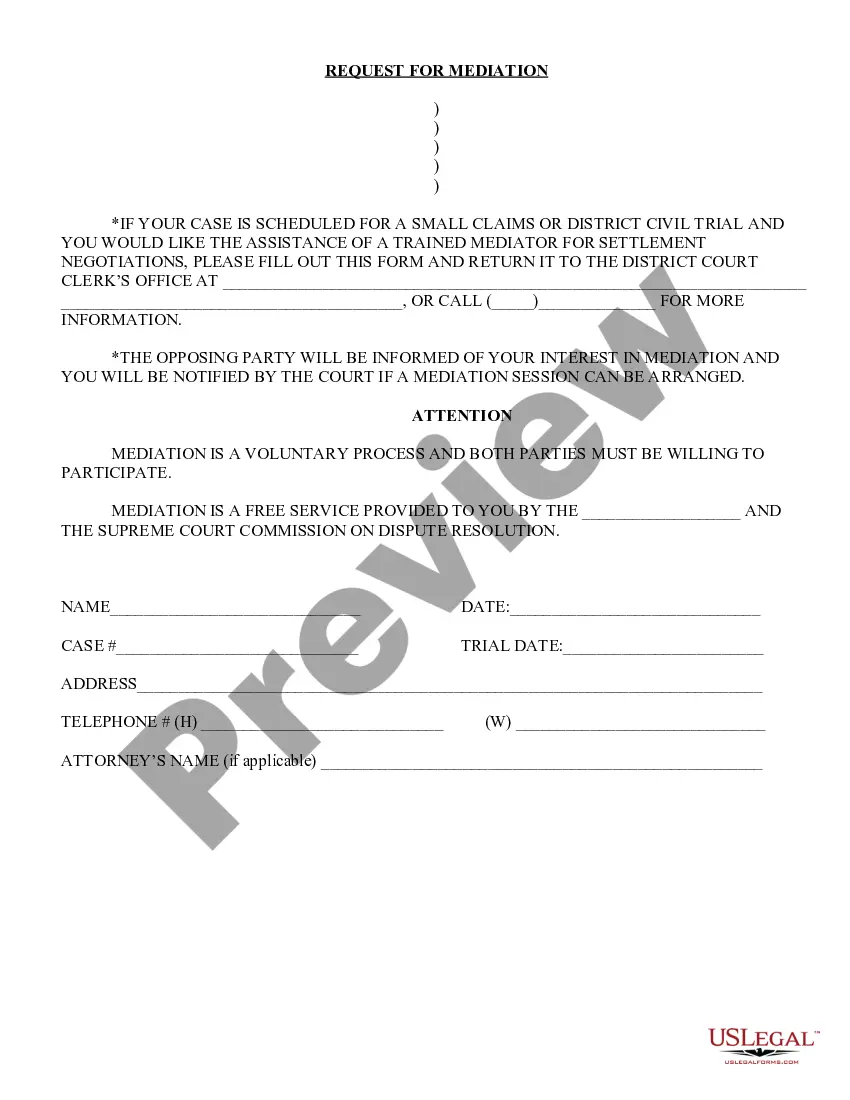
The Request for Mediation is a legal document used by a party involved in a civil trial to formally request mediation services. This process is designed to help parties reach a settlement through negotiation with the assistance of a trained mediator. Mediation is voluntary and requires the willingness of both parties to participate. This form distinguishes itself from other forms by focusing specifically on requesting mediation, which is provided free of charge.
What’s included in this form
- Request for mediation services
- Notification of the opposing party's interest in mediation
- Confirmation of the voluntary nature of mediation
- Contact information for court inquiries
- Your details: name, case number, trial date, address, and phone numbers
- Attorney's name (if applicable)

Situations where this form applies
This form should be used when a participant in a small claims or district civil trial desires to seek mediation assistance to resolve the conflict before the trial date. It is an effective way to collaborate with the opposing party and potentially avoid the time and expense of a trial.
Who can use this document
The following individuals should consider using this form:
- Anyone involved in a civil trial seeking mediation services
- Parties in disputes willing to negotiate a settlement
- Individuals looking to utilize free court-provided mediation services
Instructions for completing this form
- Fill in your name and the date of the request.
- Provide your case number and the trial date.
- Enter your contact information, including both home and work phone numbers.
- Include your attorney's name if you have legal representation.
- Submit the completed form to the district court clerk's office as instructed.
Notarization requirements for this form
This form does not typically require notarization to be legally valid. However, some jurisdictions or document types may still require it. US Legal Forms provides secure online notarization powered by Notarize, available 24/7 for added convenience.
Get your form ready online
Our built-in tools help you complete, sign, share, and store your documents in one place.
Make edits, fill in missing information, and update formatting in US Legal Forms—just like you would in MS Word.
Download a copy, print it, send it by email, or mail it via USPS—whatever works best for your next step.
Sign and collect signatures with our SignNow integration. Send to multiple recipients, set reminders, and more. Go Premium to unlock E-Sign.
If this form requires notarization, complete it online through a secure video call—no need to meet a notary in person or wait for an appointment.
We protect your documents and personal data by following strict security and privacy standards.

Make edits, fill in missing information, and update formatting in US Legal Forms—just like you would in MS Word.

Download a copy, print it, send it by email, or mail it via USPS—whatever works best for your next step.

Sign and collect signatures with our SignNow integration. Send to multiple recipients, set reminders, and more. Go Premium to unlock E-Sign.

If this form requires notarization, complete it online through a secure video call—no need to meet a notary in person or wait for an appointment.

We protect your documents and personal data by following strict security and privacy standards.
Common mistakes
- Forgetting to include all required contact information.
- Neglecting to specify your case number or trial date.
- Assuming mediation is mandatory when it is voluntary for both parties.
Benefits of completing this form online
- Convenient access and download from anywhere.
- Editable form to customize the details easily.
- Reliable templates drafted by licensed attorneys.
Looking for another form?
Form popularity
FAQ
Typically, each party involved in an Alabama Request for Mediation contributes to the payment of mediation fees. However, in some cases, one party may agree to cover the costs to encourage participation. It’s essential to reach an agreement beforehand about who will be responsible for payment to prevent any misunderstandings later.
In an Alabama Request for Mediation, the costs can be shared between the parties involved or may be allocated by the court in certain cases. Often, both parties agree on how to manage the fees upfront, which fosters cooperation. It’s crucial to openly discuss and clarify these costs during initial mediation sessions to ensure there are no surprises.
The average settlement offer during an Alabama Request for Mediation can vary significantly based on the specifics of each case. Typically, parties may expect offers that reflect realistic compensation for damages, taking into account evidence and circumstances surrounding the dispute. Mediation helps parties communicate openly, which can lead to better settlement figures that are mutually beneficial.
When writing a letter requesting mediation, be concise and direct. Clearly state the reason for your request, provide context about the dispute, and express your willingness to cooperate. Incorporating this information in your Alabama Request for Mediation will help set the stage for productive discussions.
To write a mediation proposal, start by identifying the issues at hand and propose possible solutions. Clearly state your willingness to engage in mediation and outline the benefits of resolving the conflict through this process. Making such a proposal is vital in the context of an Alabama Request for Mediation, which encourages amicable resolutions.
A good example of mediation involves a workplace dispute where two employees disagree on project responsibilities. In this scenario, a mediator facilitates a discussion where both can share their views and work towards a compromise. This is similar to the Alabama Request for Mediation, emphasizing mutual understanding and collaborative solutions.
A good mediation statement should clearly outline your position while remaining respectful of the other party’s perspective. Begin by summarizing the key issues, followed by your interests and desired outcomes. This approach works well in the Alabama Request for Mediation process, helping all parties understand each other better.
In mediation, it is crucial to focus on facts and express your feelings constructively. Avoid blame, anger, or accusations, as these can escalate tensions. Instead, emphasize your goals and the importance of finding common ground, particularly in the context of an Alabama Request for Mediation, which focuses on peaceful resolutions.
A strong opening statement for mediation sets a collaborative tone for the discussion. It should include an acknowledgment of the situation and express a genuine desire to reach a resolution. For an effective Alabama Request for Mediation, consider starting with a brief explanation of your viewpoint, followed by an invitation for open dialogue.
Getting your way in mediation involves presenting a compelling case. Focus on the interests behind your positions rather than just the positions themselves. By demonstrating flexibility and considering the other party's perspective, you can foster an environment conducive to compromise. Using tools like the Alabama Request for Mediation ensures that you remain organized and informed throughout the process.