Alabama Order Appointing a GAL
Understanding this form
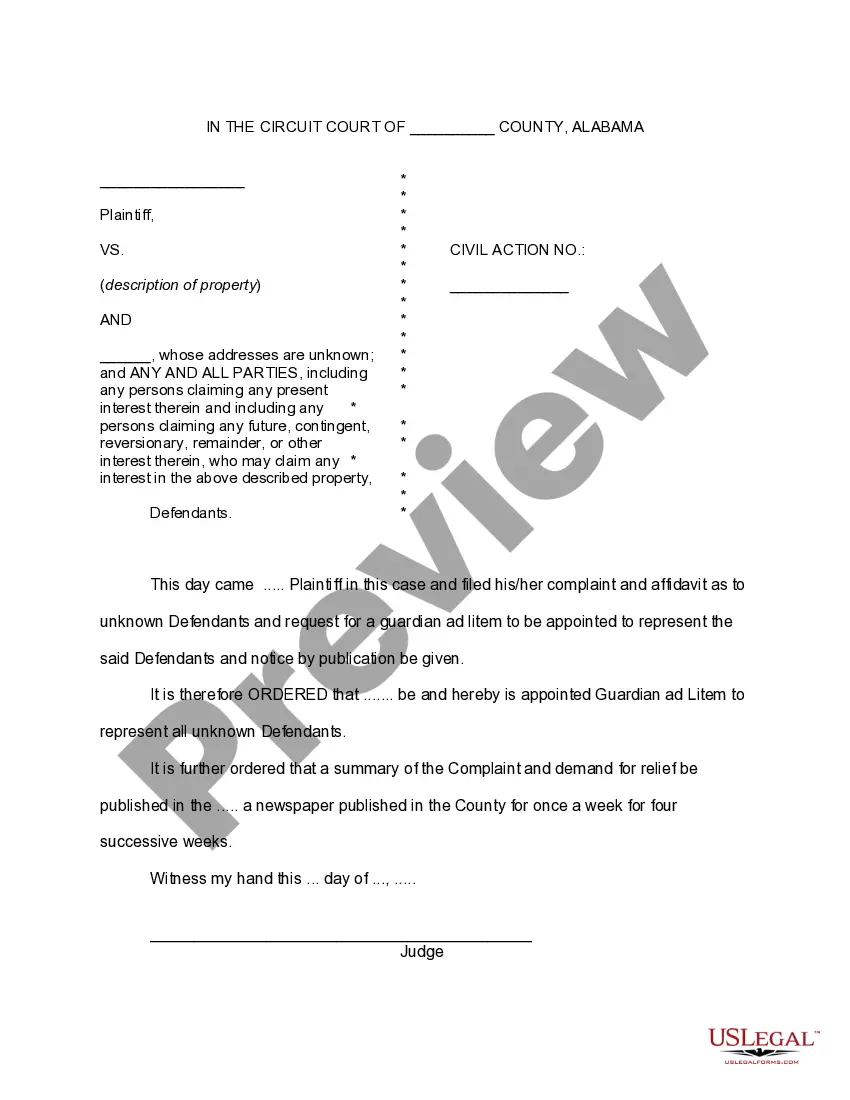
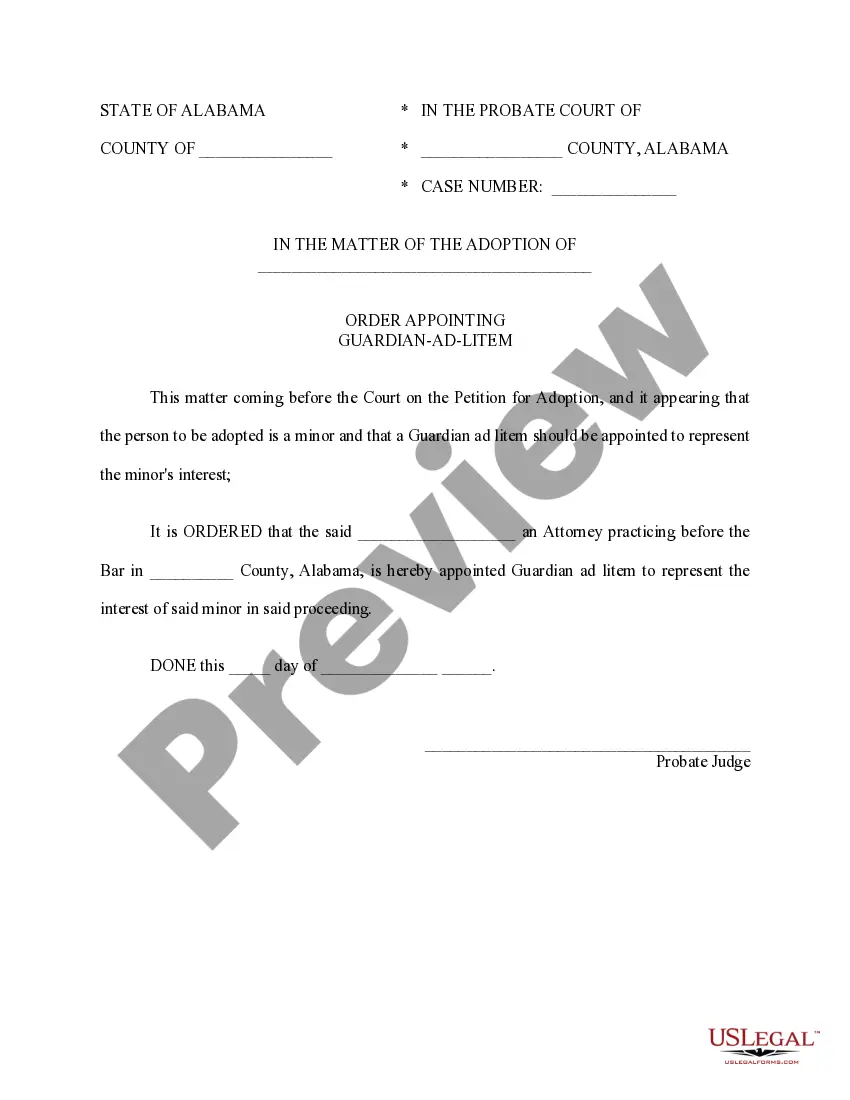
The Order Appointing a Guardian Ad Litem (GAL) is a legal document used in Circuit Court to appoint a representative for unknown defendants in a civil case. This form ensures that all parties, especially those whose identities or whereabouts are not known, are adequately represented during legal proceedings. It serves a specific function distinct from other guardian appointments, focusing solely on defendants who cannot be identified.
Main sections of this form
- Identification of the Circuit Court and the relevant county.
- The names of the plaintiff and defendants involved in the case.
- A description of the property in dispute.
- Details regarding the appointment of a Guardian ad Litem.
- Instructions for publishing a notice in a local newspaper.
- Signature line for the presiding judge.

Situations where this form applies
This form is used when a plaintiff needs to file a civil action involving defendants whose identities or addresses are unknown. It is particularly relevant in cases of real property disputes, where potential interests may exist that have not been disclosed or identified. By appointing a Guardian ad Litem, the court can ensure that all parties, even those who are unidentified, are given a fair opportunity to respond to the legal action.
Who should use this form
- Plaintiffs in civil actions involving unknown defendants.
- Attorneys representing clients in property disputes.
- Individuals filing lawsuits where the identity of some defendants is uncertain.
Instructions for completing this form
- Enter the name of the Circuit Court and the county at the top of the form.
- Identify the plaintiff and list all defendants, specifically noting that some addresses are unknown.
- Provide a detailed description of the property involved in the dispute.
- Fill in the name of the individual to be appointed as Guardian ad Litem.
- Specify the local newspaper where the notice will be published.
- Sign and date the form where indicated by the judge.
Does this form need to be notarized?
To make this form legally binding, it must be notarized. Our online notarization service, powered by Notarize, lets you verify and sign documents remotely through an encrypted video session.
Get your form ready online
Our built-in tools help you complete, sign, share, and store your documents in one place.
Make edits, fill in missing information, and update formatting in US Legal Forms—just like you would in MS Word.
Download a copy, print it, send it by email, or mail it via USPS—whatever works best for your next step.
Sign and collect signatures with our SignNow integration. Send to multiple recipients, set reminders, and more. Go Premium to unlock E-Sign.
If this form requires notarization, complete it online through a secure video call—no need to meet a notary in person or wait for an appointment.
We protect your documents and personal data by following strict security and privacy standards.

Make edits, fill in missing information, and update formatting in US Legal Forms—just like you would in MS Word.

Download a copy, print it, send it by email, or mail it via USPS—whatever works best for your next step.

Sign and collect signatures with our SignNow integration. Send to multiple recipients, set reminders, and more. Go Premium to unlock E-Sign.

If this form requires notarization, complete it online through a secure video call—no need to meet a notary in person or wait for an appointment.

We protect your documents and personal data by following strict security and privacy standards.
Typical mistakes to avoid
- Failing to accurately describe the parties involved may lead to complications.
- Not including sufficient details for the property can cause delays.
- Missing signatures or dates can invalidate the order.
- Overlooking local publication requirements may result in noncompliance with court rules.
Benefits of using this form online
- Immediate access to professionally drafted legal documents.
- Convenient downloading and printing options, allowing you to complete your necessary filings quickly.
- Editable templates ensure that you can customize your form to meet specific case requirements.
- Reliability and accuracy, as the forms are developed by licensed attorneys familiar with the law.
Key takeaways
- The Order Appointing a Guardian Ad Litem is essential for representing unknown defendants in civil cases.
- Proper completion of the form is crucial to avoid legal complications and delays.
- This form is specific to Alabama laws and procedures concerning the appointment of a GAL.
Looking for another form?

Form popularity
FAQ
The compensation for a guardian ad litem in Alabama can vary depending on the case and location. Generally, they earn hourly rates that range from $50 to $150, depending on their experience and the complexity of the situation. It is important to review the Alabama Order Appointing a GAL, as the court may provide specific guidelines regarding payment. If you are looking for a seamless process to understand this and other related topics, consider using US Legal Forms to access the necessary documents and guidance.
In Alabama, the court typically decides who pays for the guardian ad litem (GAL) as part of the Alabama Order Appointing a GAL. Often, the costs can be covered by the parties involved in the case or, in some situations, by the county or state. It's essential to understand that the financial responsibility may vary depending on the specific circumstances of your case. By leveraging platforms like USLegalForms, you can easily navigate the process and understand the financial aspects tied to appointing a guardian ad litem in Alabama.
Preparing for a GAL visit starts with organizing relevant documentation and creating an overview of your child’s daily routine. Make an effort to maintain an orderly and welcoming environment, as this reflects your commitment to the child’s well-being. Additionally, utilizing the resources available on US Legal Forms can simplify navigating the Alabama Order Appointing a GAL, thereby easing your preparation process.
To impress a GAL, present yourself as knowledgeable and responsible. Share relevant achievements and actions you have taken that prioritize the child’s interests. Clarity and transparency are key when discussing an Alabama Order Appointing a GAL; exhibiting reliability can enhance the GAL's confidence in you.
Building a positive relationship with a GAL involves demonstrating your commitment to the child's well-being. Be honest, consistent, and cooperative throughout the process, as these attributes foster trust. Engaging with an Alabama Order Appointing a GAL in a respectful manner can greatly influence their perception and recommendations.
When speaking with a GAL, avoid sharing biased opinions or personal grievances that do not pertain to the child's welfare. It is essential to focus on facts and observations rather than emotional stories or hearsay. Instead, stay factual and relevant to the Alabama Order Appointing a GAL to facilitate a clearer understanding of the situation.
A guardian ad litem (GAL) primarily looks for the best interests of the child involved in a legal situation. They assess the child’s home environment, relationships with family, and overall welfare. When handling an Alabama Order Appointing a GAL, it's important for them to gather information that reflects the child's needs and preferences in order to make informed recommendations to the court.
To get a guardian appointed in Alabama, you must file a petition in court stating the reasons for guardianship. This includes providing detailed information about the individual's needs and circumstances. The court will evaluate your petition and, upon finding it valid, will issue the Alabama Order Appointing a GAL. Consult a legal professional to help you navigate this process effectively and ensure compliance with state laws.
In Alabama, you cannot hire a guardian ad litem without a court order. Their primary role is to act in the best interests of the child during legal proceedings initiated by the court. Therefore, formally requesting an Alabama Order Appointing a GAL is essential before expecting their involvement. It is crucial to follow legal protocols to ensure that the child's welfare is prioritized.
To become a guardian ad litem in Alabama, individuals must meet certain qualifications set by the state. This often involves completing training programs and background checks. Once you prepare, you can apply through local courts or legal aid organizations. Engaging with platforms like US Legal Forms can provide valuable resources and guidance on the application process, ensuring you meet all necessary criteria.