Alabama Life Insurance Fraud - Requests for Production of Documents to Defendant Agent
What this document covers
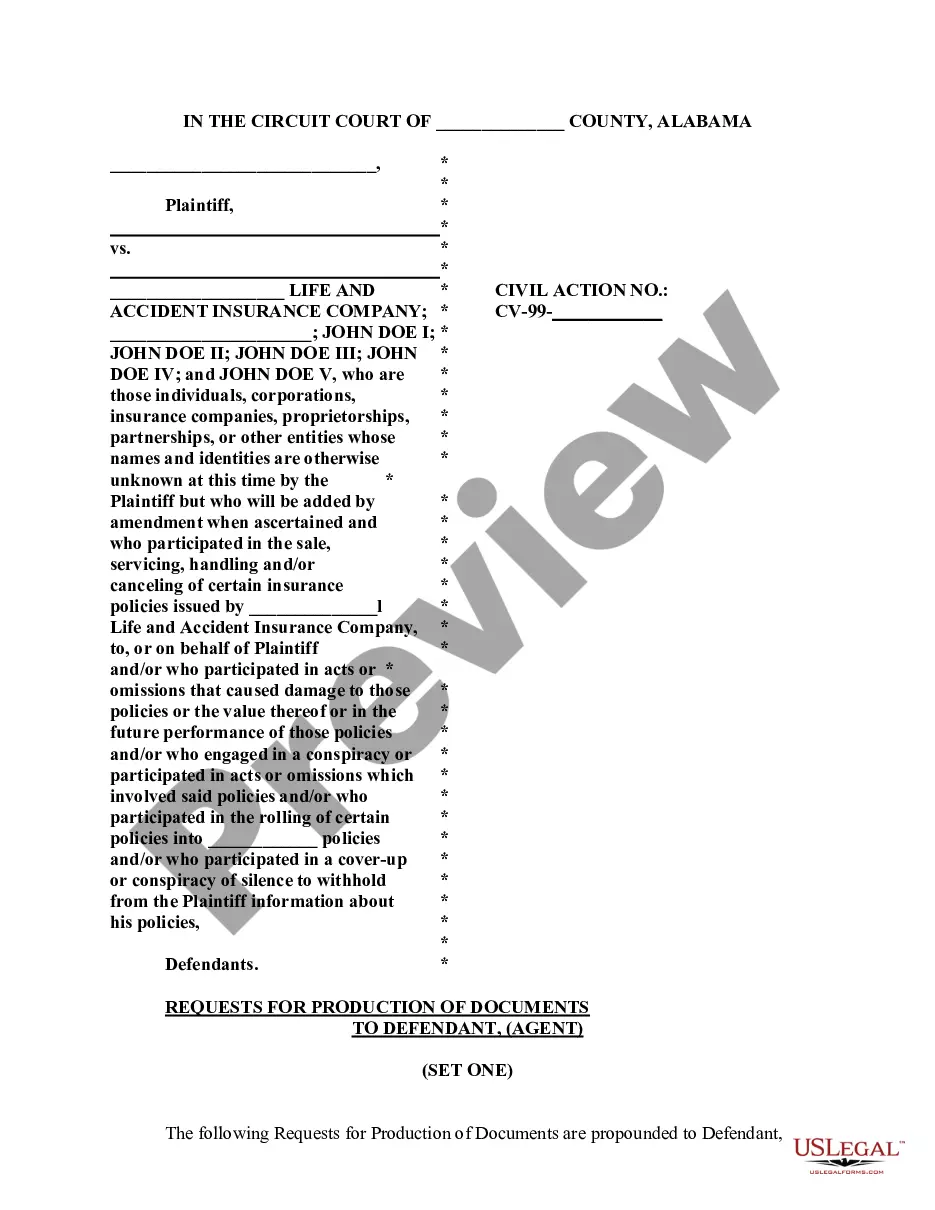
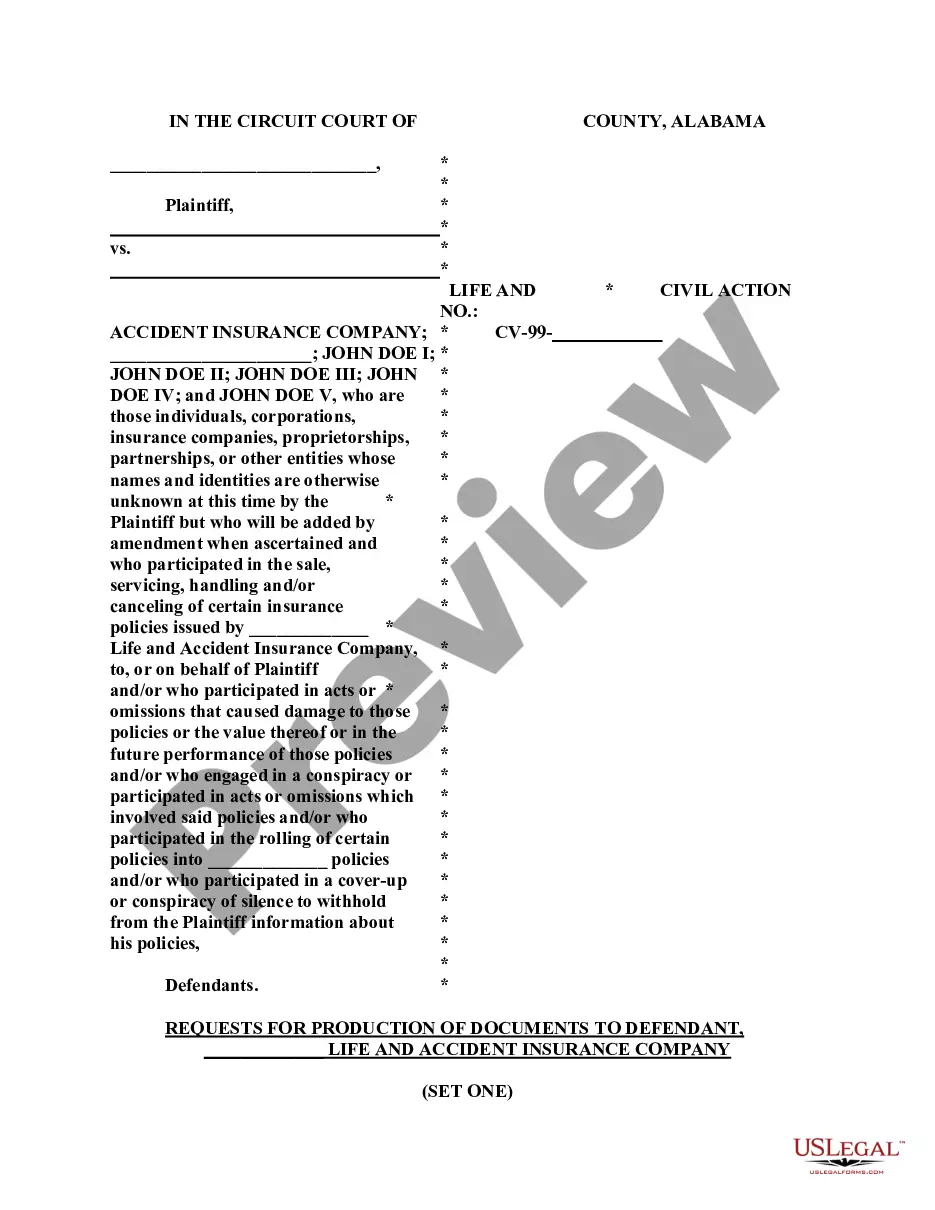
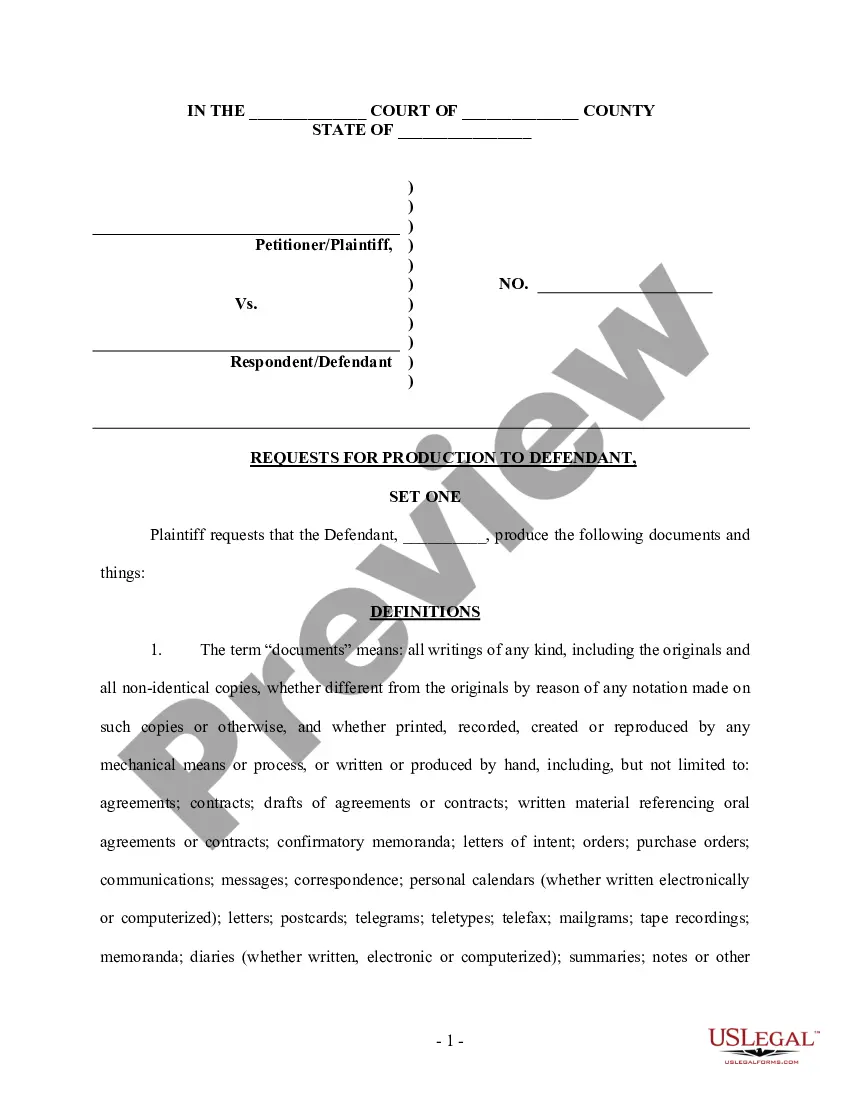
This form is known as the Life Insurance Fraud - Requests for Production of Documents to Defendant Agent. It is used in civil actions related to alleged life insurance fraud, specifically for requesting relevant documents from the defendant insurance agent. This form helps establish a legal basis for disclosure of materials that may influence the outcome of a case, setting it apart from other discovery forms that may not specifically target insurance-related disputes.
Key components of this form
- Identification of parties involved in the case.
- Defined terms for key components, such as "documents" and "Agent."
- Requests for specific documents related to insurance policies and correspondence.
- Instructions on completing the document production requests.
- Response requirements and timeframe for the defendant.



Situations where this form applies
This form should be used when there are allegations of life insurance fraud, and you need to gather evidence from the defendant agent. It is essential in the discovery phase of litigation to collect documents that could substantiate claims or defenses regarding insurance policies, communication between parties, and any related transactions.
Who should use this form
- Plaintiffs involved in a civil lawsuit regarding life insurance fraud.
- Attorneys representing clients in insurance fraud cases.
- Individuals seeking to obtain evidence from insurance agents to support their claims.
Completing this form step by step
- Identify the parties by filling in the names of the Plaintiff and Defendant Agent.
- Review and define all key terms as specified in the form.
- List specific requests for documents related to the policies and communications with the Plaintiff.
- Provide a response section for the Defendant to fill in their answers or objections.
- Sign and date the form in the appropriate section.
Is notarization required?
This form does not typically require notarization unless specified by local law. Ensure to check your state's regulations to verify necessary procedures.
Get your form ready online
Our built-in tools help you complete, sign, share, and store your documents in one place.
Make edits, fill in missing information, and update formatting in US Legal Forms—just like you would in MS Word.
Download a copy, print it, send it by email, or mail it via USPS—whatever works best for your next step.
Sign and collect signatures with our SignNow integration. Send to multiple recipients, set reminders, and more. Go Premium to unlock E-Sign.
If this form requires notarization, complete it online through a secure video call—no need to meet a notary in person or wait for an appointment.
We protect your documents and personal data by following strict security and privacy standards.

Make edits, fill in missing information, and update formatting in US Legal Forms—just like you would in MS Word.

Download a copy, print it, send it by email, or mail it via USPS—whatever works best for your next step.

Sign and collect signatures with our SignNow integration. Send to multiple recipients, set reminders, and more. Go Premium to unlock E-Sign.

If this form requires notarization, complete it online through a secure video call—no need to meet a notary in person or wait for an appointment.

We protect your documents and personal data by following strict security and privacy standards.
Avoid these common issues
- Failing to properly identify all parties involved in the action.
- Not specifying enough detail in requests, leading to vague responses.
- Missing the deadline for response, which can affect the case's progress.
- Overlooking state-specific submission requirements that may apply.
Why complete this form online
- Convenient access to a legally drafted document that can be tailored to specific needs.
- Easy editing options allow users to customize the form quickly.
- Secure storage and access to your completed forms when needed later.
Legal use & context
- This form is legally enforceable as part of the discovery process in civil litigation.
- It helps establish a foundation for a fraud claim by collecting pertinent evidence.
- Compliance with local laws and deadlines is necessary for the form to be effective.
What to keep in mind
- The form is essential in cases of alleged life insurance fraud for requesting documents.
- Clear identification of all parties and requests enhances the effectiveness of the form.
- It provides a structured approach to gathering evidence in legal disputes involving insurance claims.
Looking for another form?

Form popularity
FAQ
In certain cases, you might be able to write a letter to the other side and request the documents that you need. However, in more formal cases, you will likely have to draft more formal discovery demands. There are usually forms available for this in local law libraries, from the court clerk's office, or online.
The issues discussed above in connection with interrogatories are also the issues which you need to cover in your requests for production. However, because requests for production do not yield a written answer, you can ask both for specific documents and for general categories of documents.
You can object to an interrogatory if the information sought is known by the requesting party or available to both parties equally. For example, you should raise this objection if the answers are publicly available or in a third-party's custody or control.
Have a strategy. Adjust the scope of your requests to the questions at issue. Send clear requests. Always consider how your client would be prepared to respond to similar requests. Make your objections clear and specific.
A Request for Production of Documents (often referred to as a Notice to Produce) requires a spouse to provide the other spouse with certain documents for review.depositions (proceedings in which a spouse testifies under oath about various aspects of the marriage, usually at one of the attorney's offices).
You must answer each interrogatory separately and fully in writing under oath, unless you object to it. You must explain why you object. You must sign your answers and objections.
Anything a witness or party saw, heard, or did in connection with the dispute. anything anyone said at a particular time and place (for example, in a business meeting related to the dispute or after a car accident that turned into a lawsuit)
A discovery draft is essentially a brainstorming method that writers use. They sit down to tell a story and just wing it (or pants it) from page one to the last page. When they are done, the draft is a mess, but they know their story and their characters much better and have a grasp of what they are writing about.
Interrogatories, which are written questions about things that are relevant or important to the case. (NRCP 33; JCRCP 33) Requests for production of documents or things, which are written requests that demand the other side provide particular documents or items.