Alabama Consent or Relinquishment of Minor For Adoption - Release of Parental Rights
Overview of this form
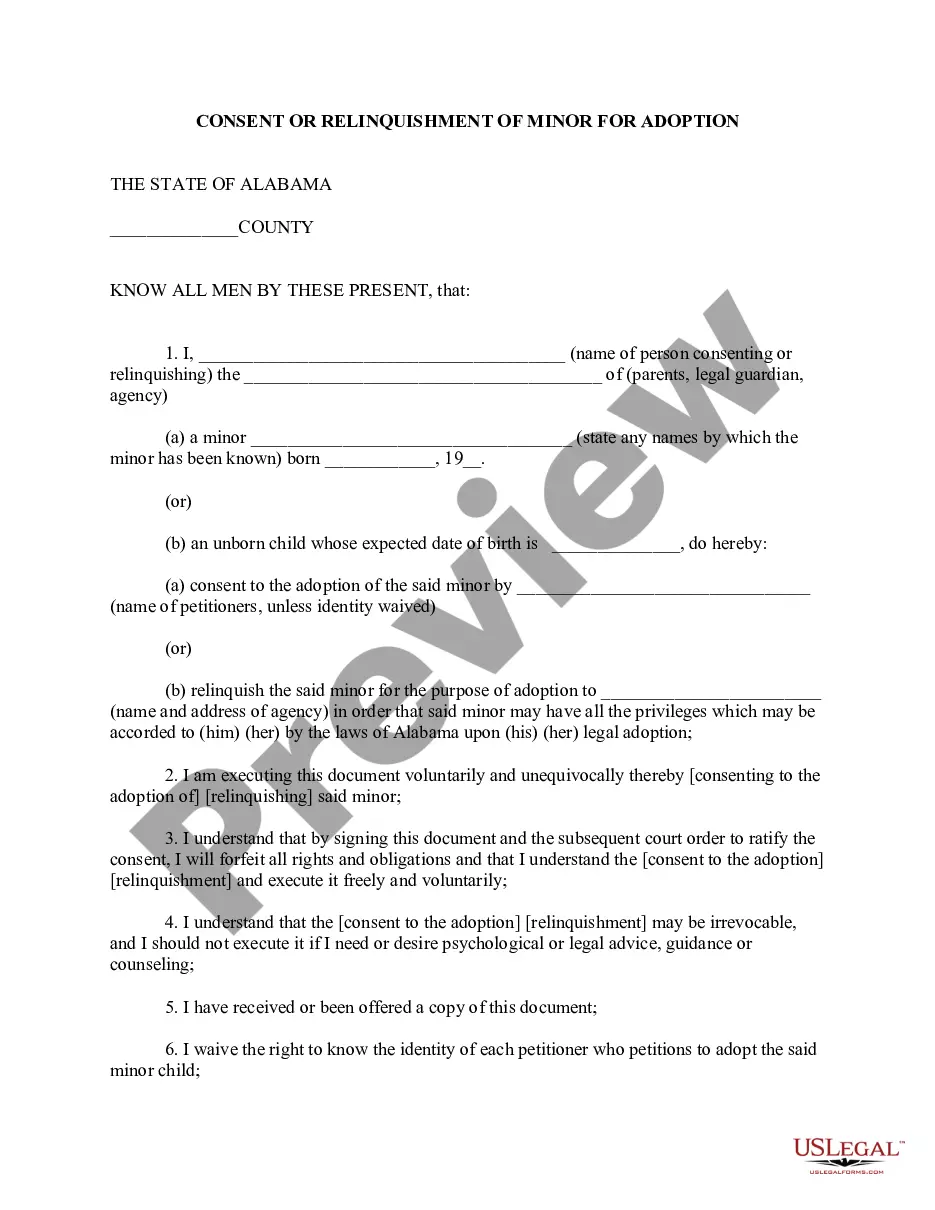
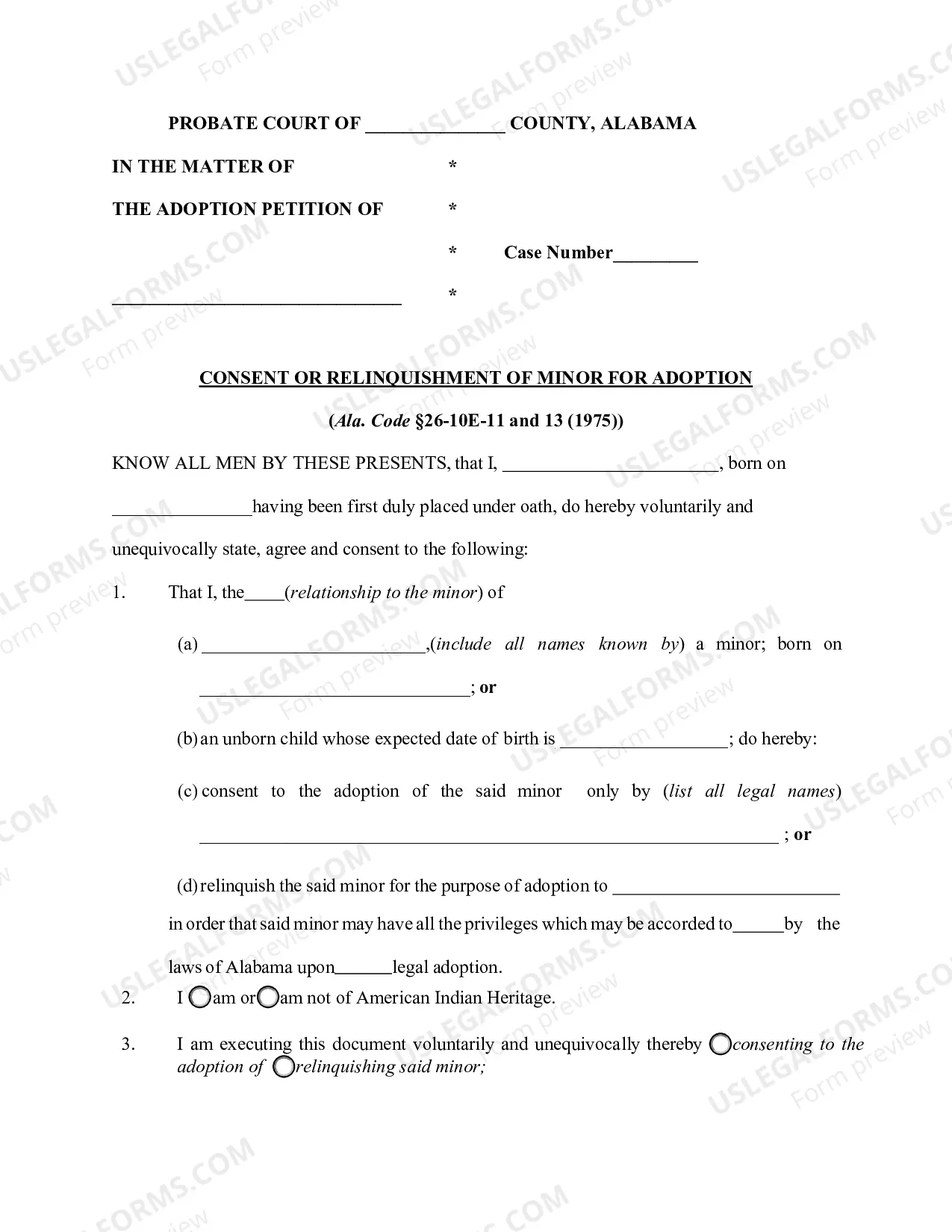
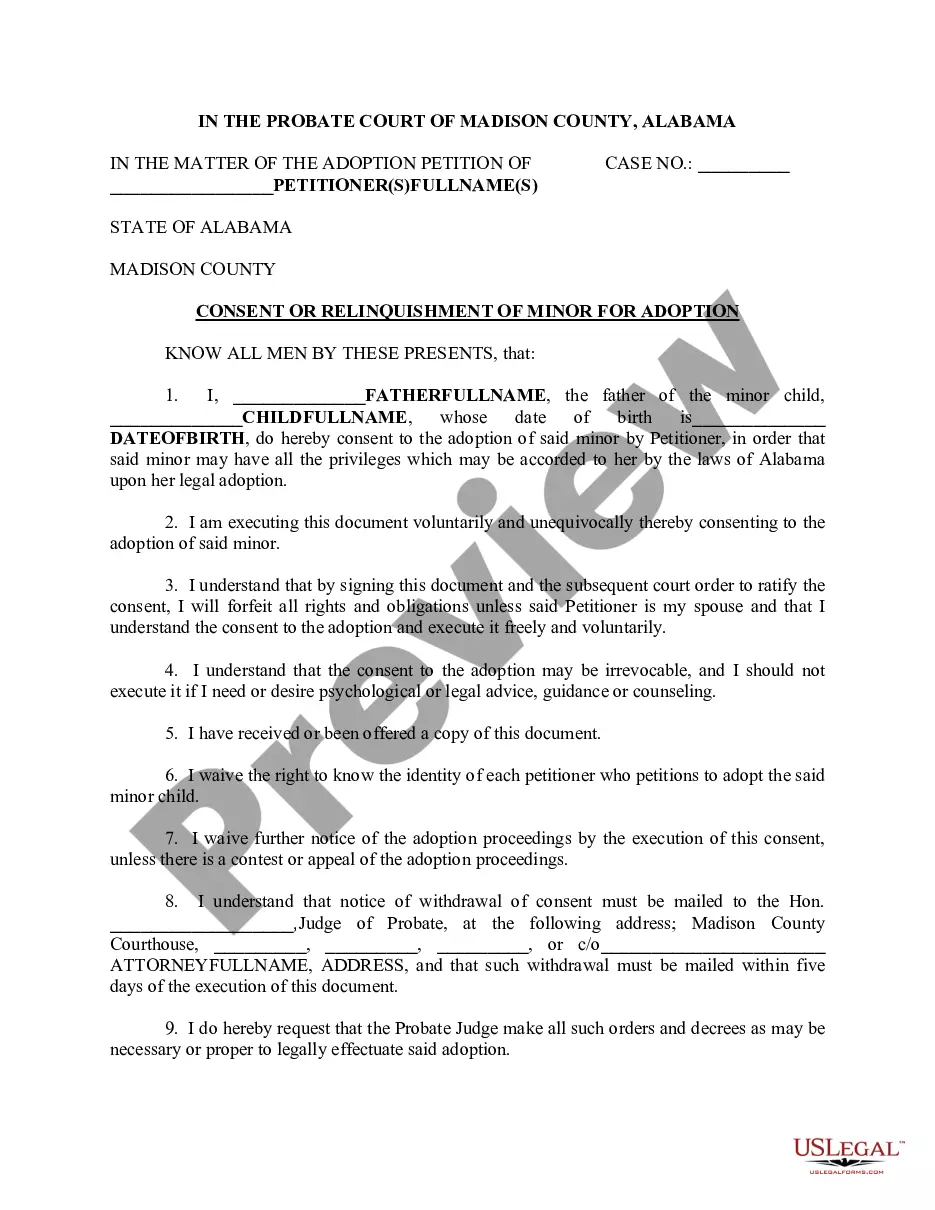
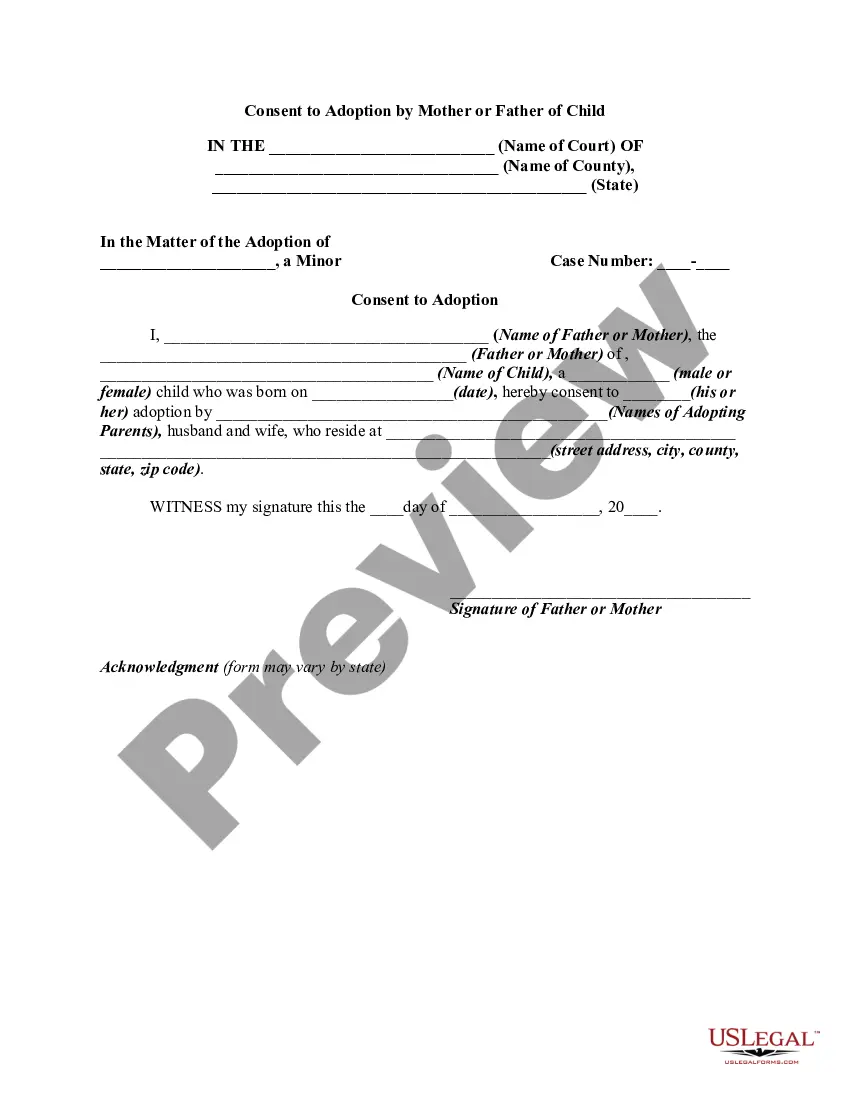
The Consent or Relinquishment of Minor for Adoption - Release of Parental Rights form is a legal document that allows a parent or guardian to voluntarily relinquish their rights to a minor child for adoption purposes. This form ensures that the rights of the biological parent or guardian are formally waived, allowing the child to be adopted by another individual or agency. It is important to note that this consent is irrevocable and must be signed in the presence of a notary, distinguishing it from other documents related to adoption or parental rights.
What’s included in this form
- Parties involved: Identifies the person relinquishing rights and the minor child being adopted.
- Consent declaration: States the voluntary nature of the consent and its irrevocable status.
- Waiver of notification: The signer waives the right to be informed about adoption proceedings.
- Legal implications: Acknowledges the forfeiture of parental rights and obligations upon signing.
- Notary acknowledgment: Requires notarization to validate the document legally.




When this form is needed
This form should be used when a parent or legal guardian decides to relinquish their rights and consent to the adoption of a minor child. It is applicable in cases where the parent feels it is in the best interest of the child to be adopted by another family or individual. This form is crucial when the biological parent wishes to place the child with adoptive parents while ensuring that the legal formalities are followed.
Who should use this form
- Biological parents or legal guardians who wish to voluntarily give up their parental rights.
- Individuals or agencies preparing for the adoption of a minor child.
- Any person involved in the adoption process who needs to formalize the relinquishment of parental rights.
How to complete this form
- Identify yourself: Fill in your name as the person consenting or relinquishing rights.
- Provide details of the minor: Enter the child's name and any known aliases.
- Specify the adopting party: Name the individual(s) or agency seeking to adopt the minor.
- Sign the document: Ensure your signature is witnessed and notarized.
- Receive a copy: Keep a copy of the signed document for your records.
Does this document require notarization?
Yes, this form must be notarized to be legally valid. Notarization ensures that the consent is genuine and helps prevent any future disputes regarding the relinquishment of parental rights. US Legal Forms offers integrated online notarization, allowing you to securely notarize documents through a video call at your convenience.
Get your form ready online
Our built-in tools help you complete, sign, share, and store your documents in one place.
Make edits, fill in missing information, and update formatting in US Legal Forms—just like you would in MS Word.
Download a copy, print it, send it by email, or mail it via USPS—whatever works best for your next step.
Sign and collect signatures with our SignNow integration. Send to multiple recipients, set reminders, and more. Go Premium to unlock E-Sign.
If this form requires notarization, complete it online through a secure video call—no need to meet a notary in person or wait for an appointment.
We protect your documents and personal data by following strict security and privacy standards.

Make edits, fill in missing information, and update formatting in US Legal Forms—just like you would in MS Word.

Download a copy, print it, send it by email, or mail it via USPS—whatever works best for your next step.

Sign and collect signatures with our SignNow integration. Send to multiple recipients, set reminders, and more. Go Premium to unlock E-Sign.

If this form requires notarization, complete it online through a secure video call—no need to meet a notary in person or wait for an appointment.

We protect your documents and personal data by following strict security and privacy standards.
Common mistakes to avoid
- Failing to have the document notarized, which invalidates the relinquishment.
- Not fully understanding the implications of irreversibility before signing.
- Leaving fields blank or incorrectly identifying the minor or adopting party.
- Not retaining a copy of the signed form for personal records.
Advantages of online completion
- Convenience of immediate access and download to complete at your own pace.
- Editability to ensure that all information is correct before finalizing.
- Reliability of professionally drafted forms reviewed by licensed attorneys.
Quick recap
- The consent form is essential for relinquishing parental rights for the purpose of adoption.
- It requires notarization and carries significant legal implications.
- Understanding the form thoroughly before signing is crucial to avoid mistakes.
Looking for another form?
Form popularity
FAQ
The cost for court document preparation can range from $500 to $2,000, while the cost for legal representation may range from $2,500 to $12,000 or more in some states.
You don't need to mention how 'different' your adopted child looks from the rest of the family. Don't try to hide the fact that your child is adopted. Don't keep secrets. Don't wait to tell them they are adopted when they are older. Don't tell them 'you wouldn't understand because you're different than us'.
If the child is 12 or older, he or she must agree (consent) to the adoption before the judge will order the adoption final. Children under 12 do not have to agree.
There isn't a right time to tell your child that they are adopted but its best to tell them as early as possible.Adopted children should be made to feel very positive about their adoption and reassured that they are accepted and loved by their parents and family.
Under California law, a noncustodial parent's consent isn't necessary for adoption if the parent willfully fails to communicate with and to pay for the care, support, and education of the child (when they were able to do so) for a period of at least one year.
Check out your state adoption laws. Contact the court in your county that handles adoptions. Obtain required legal forms. Submit required legal paperwork. Await notification of a court hearing date. Appear at the hearing. Finalize the adoption. Apply for amended birth certificates.
Because many teenagers and minors live with their parents, it's normal to wonder whether the baby's grandparents will play a role in the adoption process. The answer is no not unless the prospective birth mother wants them to. Your parents cannot force you into a certain unplanned pregnancy option.
What's your story? Take time to explain to your child Do not try to make this a hasty procedure. Answer all their questions Your child is bound to ask you a lot of questions; be ready to answer each one of them.
The short answer is sometimes. Legally the father has the same rights to a child as the mother.It is possible to put a child up for adoption without the father's consent. In the future, however, if the father decides that he wants his child, then this may place an already established adoption in jeopardy.