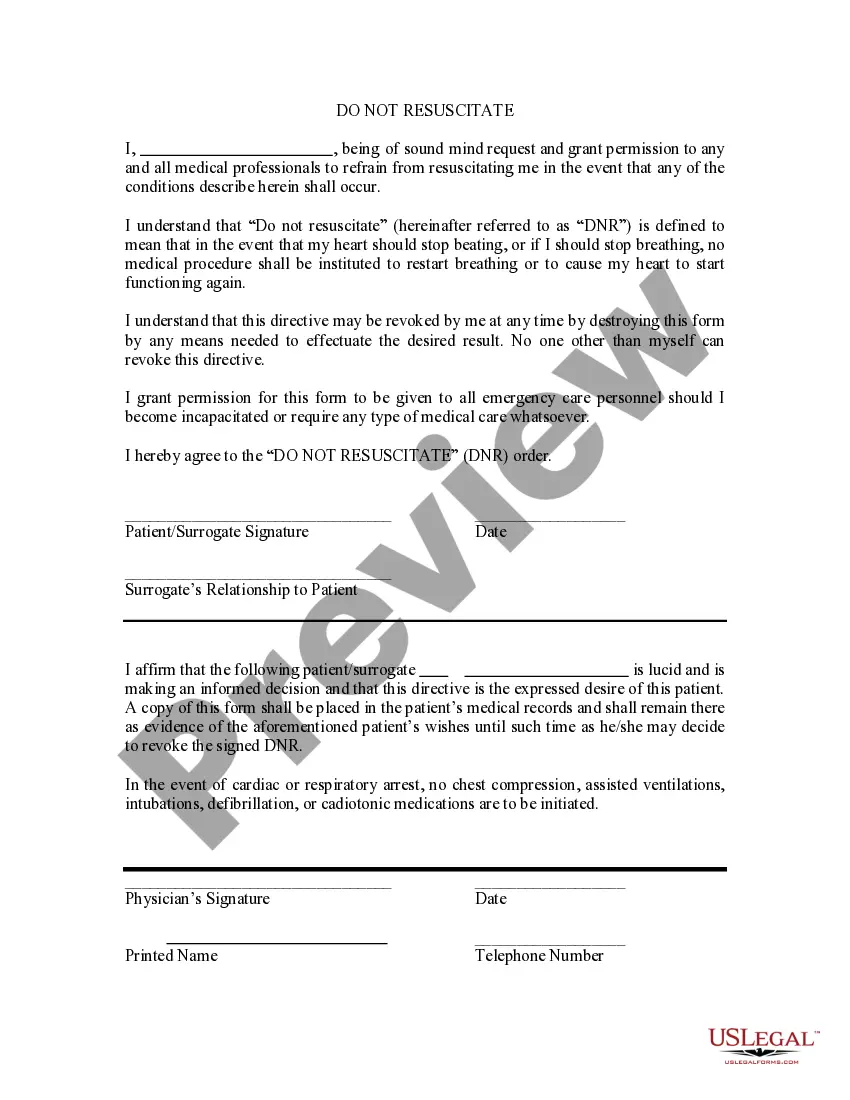
This is a form initiated by a patient requesting that he/she not be resuscitated should he/she stop breathing or should his/her heart stop beating. This form is also to be signed by a physician attesting to patient's wishes and to be placed in the patient's file.
Alaska Do Not Resuscitate Request - DNR
State:
Multi-State
Control #:
US-PRM-12
Format:
Word;
Rich Text
Instant download
Description
Free preview

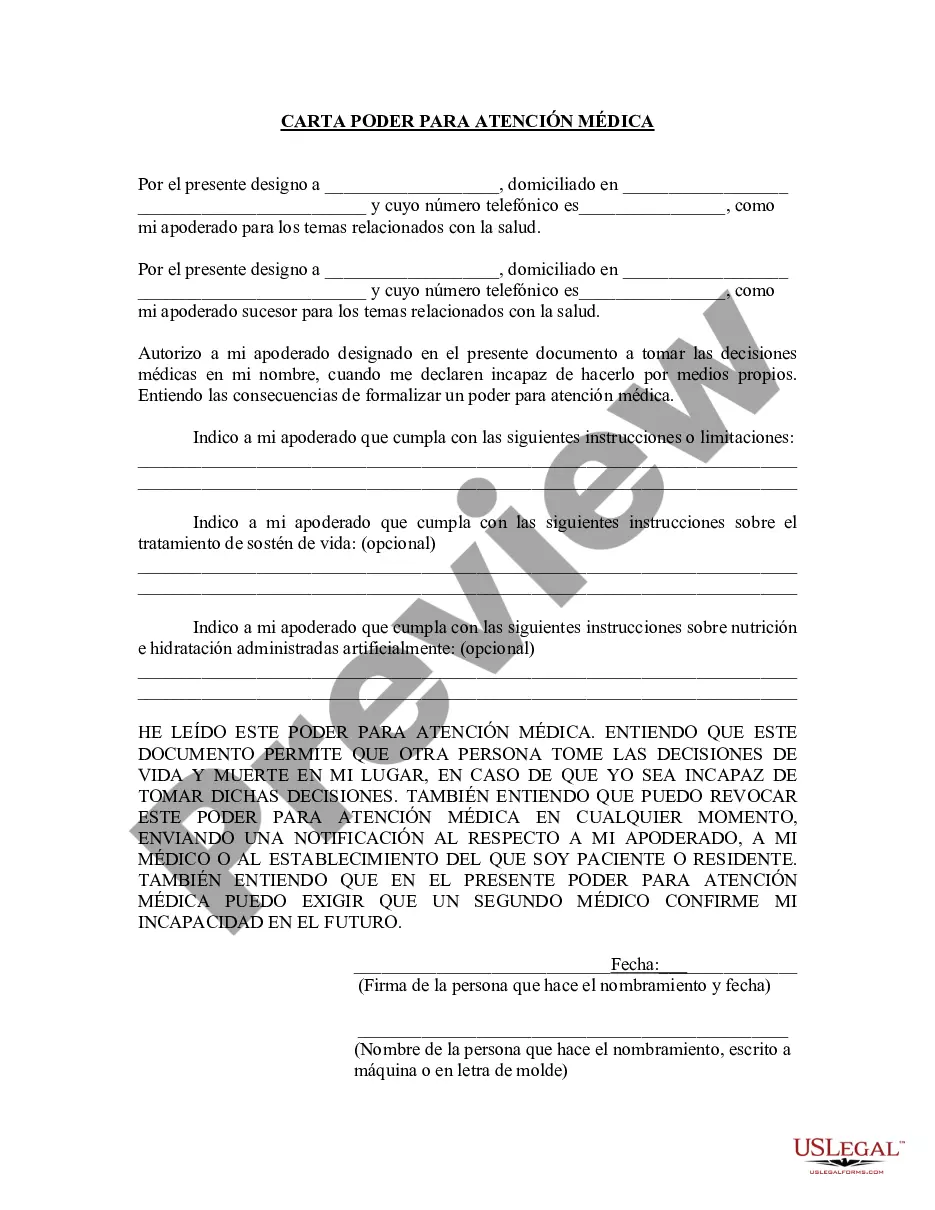
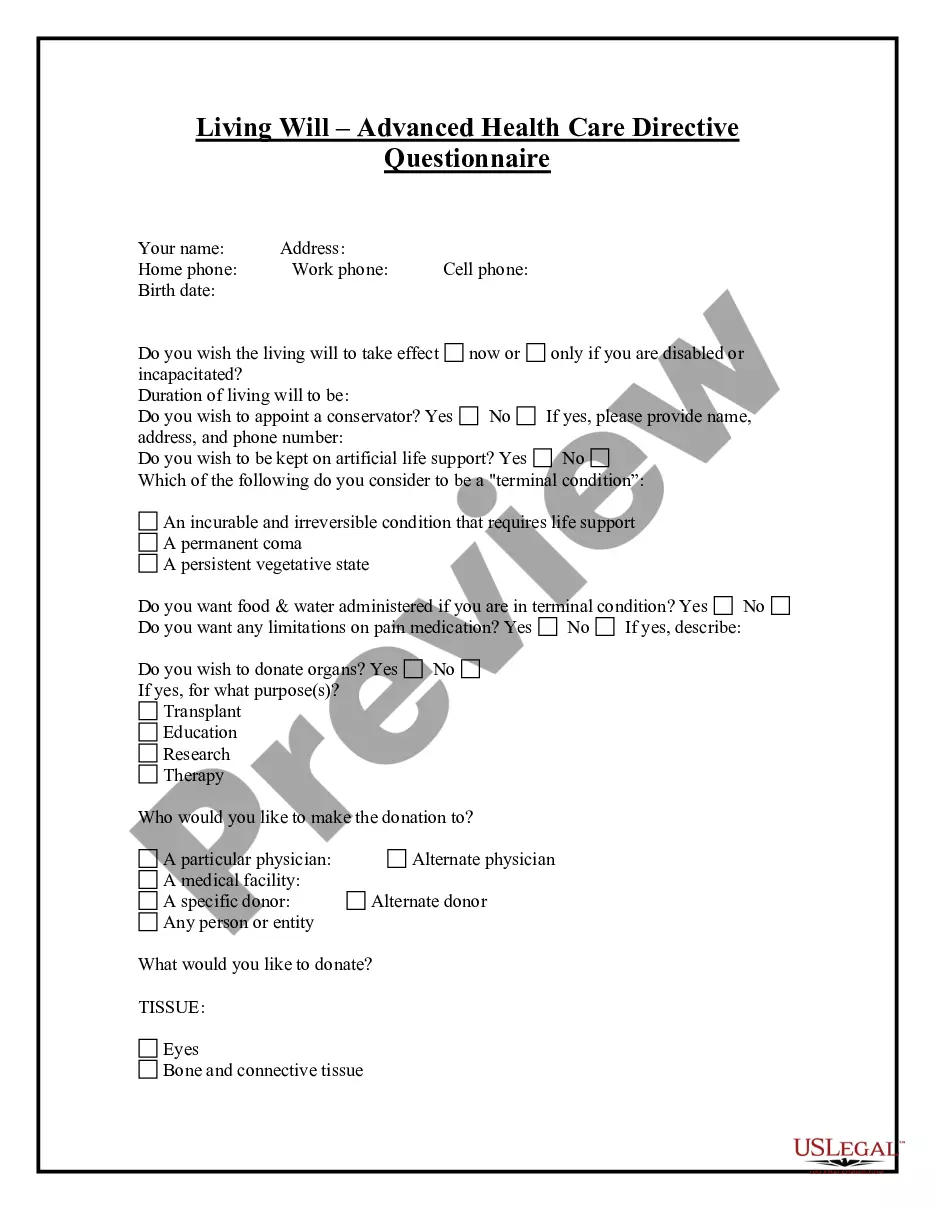
Get your form ready online
Our built-in tools help you complete, sign, share, and store your documents in one place.
Built-in online Word editor
Make edits, fill in missing information, and update formatting in US Legal Forms—just like you would in MS Word.
Export easily
Download a copy, print it, send it by email, or mail it via USPS—whatever works best for your next step.
E-sign your document
Sign and collect signatures with our SignNow integration. Send to multiple recipients, set reminders, and more. Go Premium to unlock E-Sign.
Notarize online 24/7
If this form requires notarization, complete it online through a secure video call—no need to meet a notary in person or wait for an appointment.
Store your document securely
We protect your documents and personal data by following strict security and privacy standards.

Make edits, fill in missing information, and update formatting in US Legal Forms—just like you would in MS Word.

Download a copy, print it, send it by email, or mail it via USPS—whatever works best for your next step.

Sign and collect signatures with our SignNow integration. Send to multiple recipients, set reminders, and more. Go Premium to unlock E-Sign.

If this form requires notarization, complete it online through a secure video call—no need to meet a notary in person or wait for an appointment.

We protect your documents and personal data by following strict security and privacy standards.
Looking for another form?


How to fill out Do Not Resuscitate Request - DNR?
Are you in a circumstance that requires documents for potential business or personal reasons almost all the time.
There is a multitude of legal document templates available online, but finding ones you can trust is not straightforward.
US Legal Forms offers thousands of form templates, including the Alaska Do Not Resuscitate Request - DNR, which can be printed to meet state and federal regulations.
Once you find the appropriate form, click on Purchase now.
Choose the pricing plan you desire, complete the necessary information to create your account, and pay for your order using PayPal or a credit card.
- If you are already familiar with the US Legal Forms website and have an account, simply Log In.
- Then, you can download the Alaska Do Not Resuscitate Request - DNR template.
- If you do not have an account and want to start using US Legal Forms, follow these steps.
- Locate the form you need and ensure it is for your correct city/state.
- Use the Preview button to view the document.
- Review the details to ensure you have selected the correct form.
- If the form isn’t what you’re looking for, use the Search field to find the document that meets your needs.
Form popularity
FAQ
To initiate a do-not-resuscitate request - DNR in Alaska, start by discussing your wishes with your healthcare provider. They will guide you through the necessary steps and help you complete the required documentation. After completing the forms, ensure they are accessible to all healthcare professionals involved in your care. For a smooth process, you can utilize UsLegalForms, which offers comprehensive resources and templates for your Alaska Do Not Resuscitate Request - DNR needs.
In Alaska, a do-not-resuscitate request - DNR can be made by the patient themselves or by a legally authorized representative. This typically includes a family member, guardian, or healthcare proxy designated by the patient. It is essential that the individual requesting the DNR understands the implications of this decision. If you need assistance with the process, consider using the UsLegalForms platform, which provides reliable resources and forms to help you navigate your Alaska Do Not Resuscitate Request - DNR.
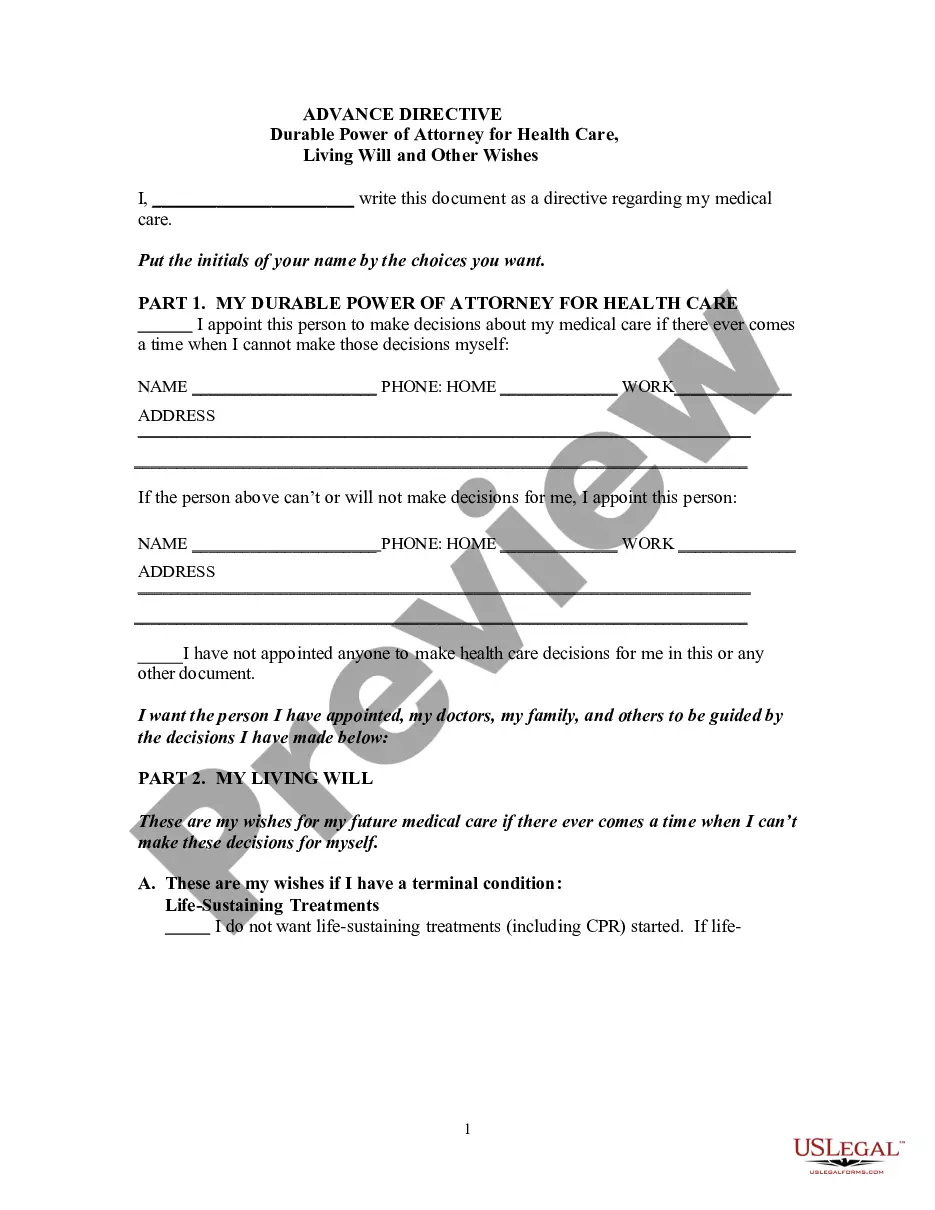
Yes, you can specify your end-of-life wishes through an advance directive, which includes the option for an Alaska Do Not Resuscitate Request - DNR. This document allows you to communicate your preferences regarding medical treatment and life support in clear terms. By using a reliable platform like uslegalforms, you can easily create, customize, and ensure your advance directive meets all legal requirements, giving you peace of mind about your healthcare choices.
To submit claims to Alaska Medicaid, you need to follow specific guidelines set by the state. Start by collecting all necessary documentation, including any advance directives like an Alaska Do Not Resuscitate Request - DNR, if applicable. You can submit claims electronically or by mail, ensuring you provide accurate information to avoid delays in processing your claims.
Generally, a doctor must respect your advance directive, including your Alaska Do Not Resuscitate Request - DNR, as long as it is valid and complies with state laws. However, if your doctor believes that your directive does not align with your current medical condition or treatment options, they may discuss alternatives with you or your family. It's crucial to have open conversations with your healthcare provider about your wishes to ensure they are understood and honored.
Anyone who wants to ensure their healthcare preferences are honored should consider an advance directive. This is particularly important for individuals with serious medical conditions or those who wish to specify their wishes regarding life-sustaining treatments, including an Alaska Do Not Resuscitate Request - DNR. By having an advance directive, you communicate your healthcare decisions clearly to your family and medical team.
DNR means "Do Not Resuscitate." DNR orders are written instructions from a physician telling health care providers not to perform Cardiopulmonary Resuscitation (CPR).
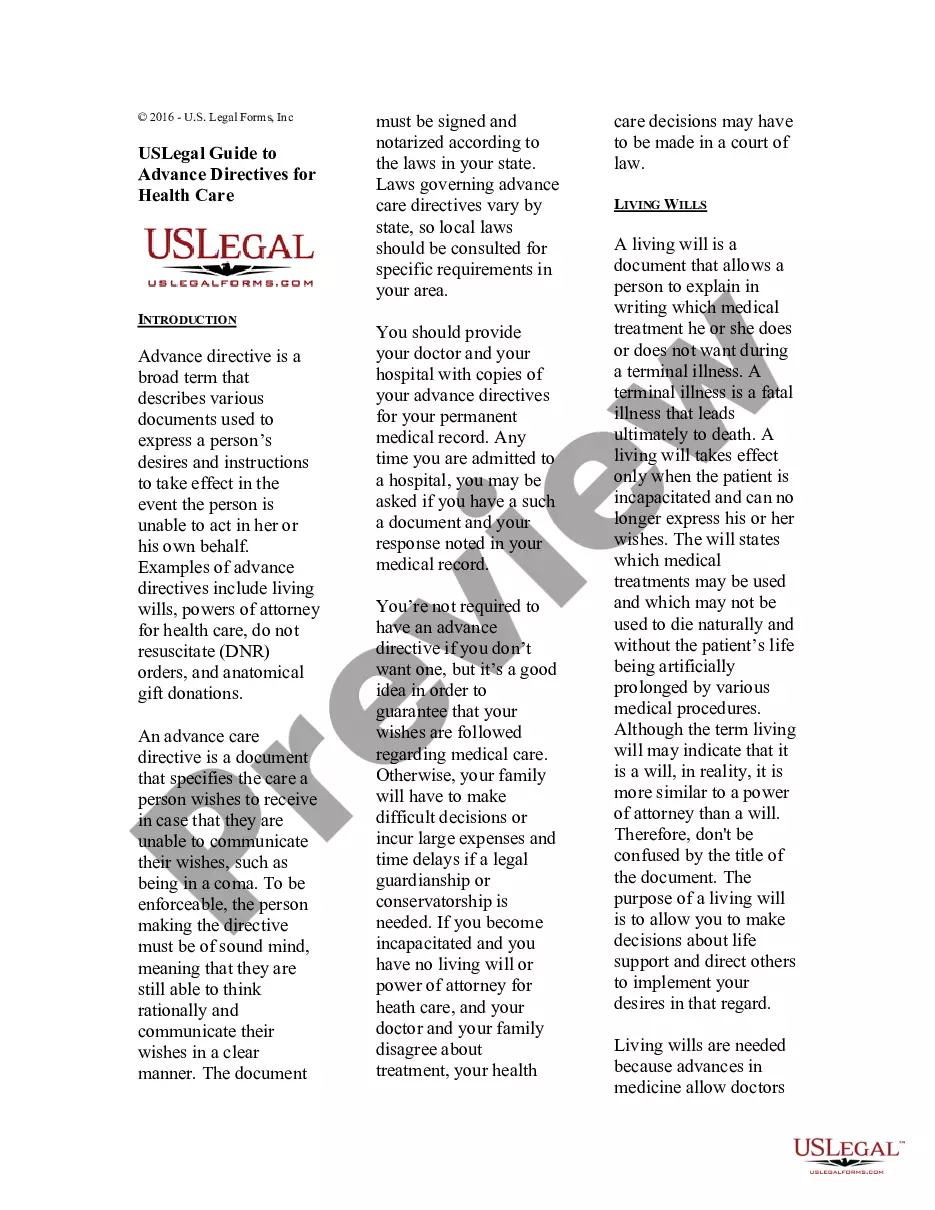
Most hospitals and GPs will be able to provide you with an advance care directive form to fill out, to get you started. Once you have created an advance care directive it is a good idea to give a copy to your doctor, a copy to your family and to keep a copy with you.
You can use an advance directive form or tell your doctor that you don't want to be resuscitated. Your doctor will put the DNR order in your medical chart. Doctors and hospitals in all states accept DNR orders.
What is a 'do not resuscitate order'? A DNR order is a medical order to withhold cardiopulmonary resuscitation (CPR). Such an order lets the healthcare team know that, in the event of a cardiac arrest, CPR must not be conducted. Instead, healthcare staff should promote comfort and prepare for end-of-life care.