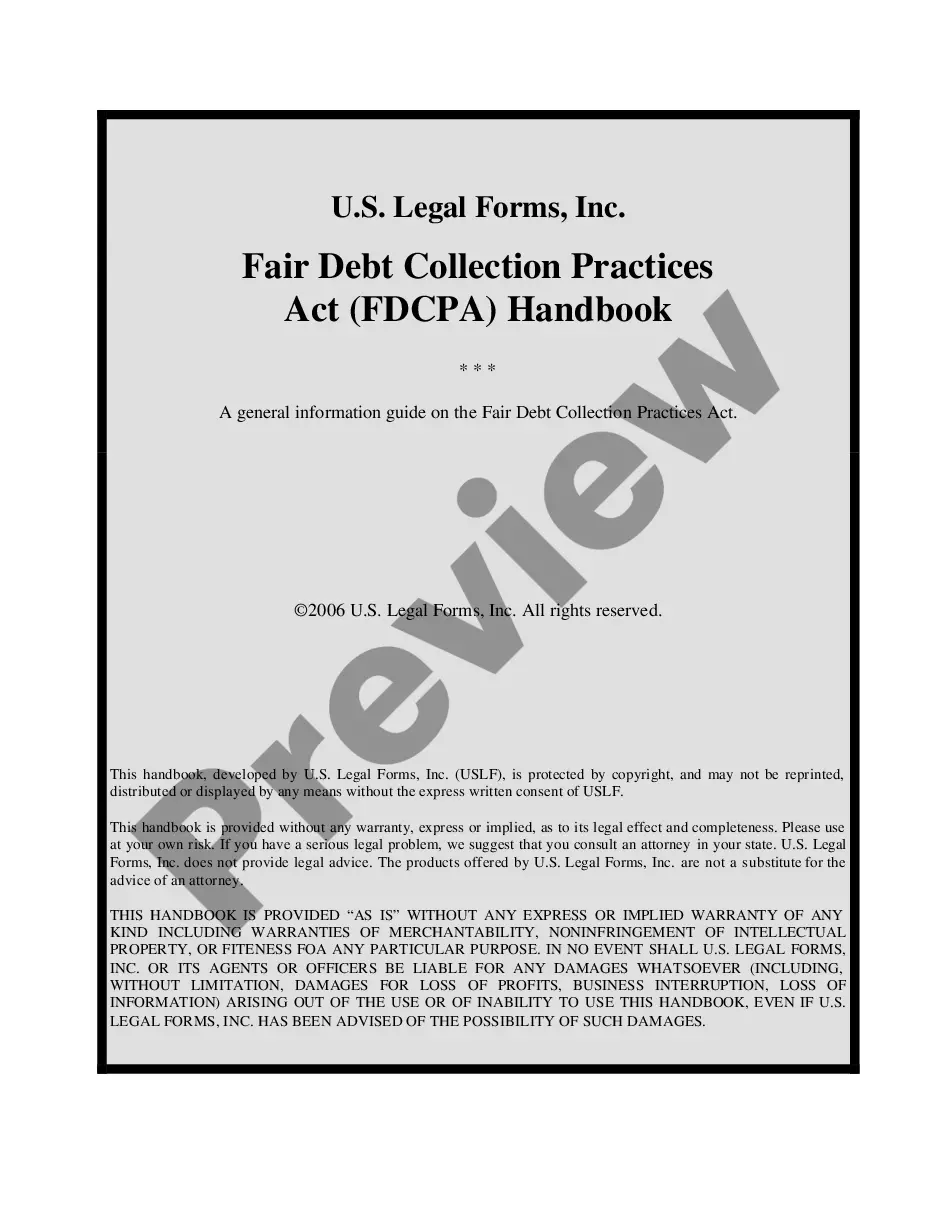
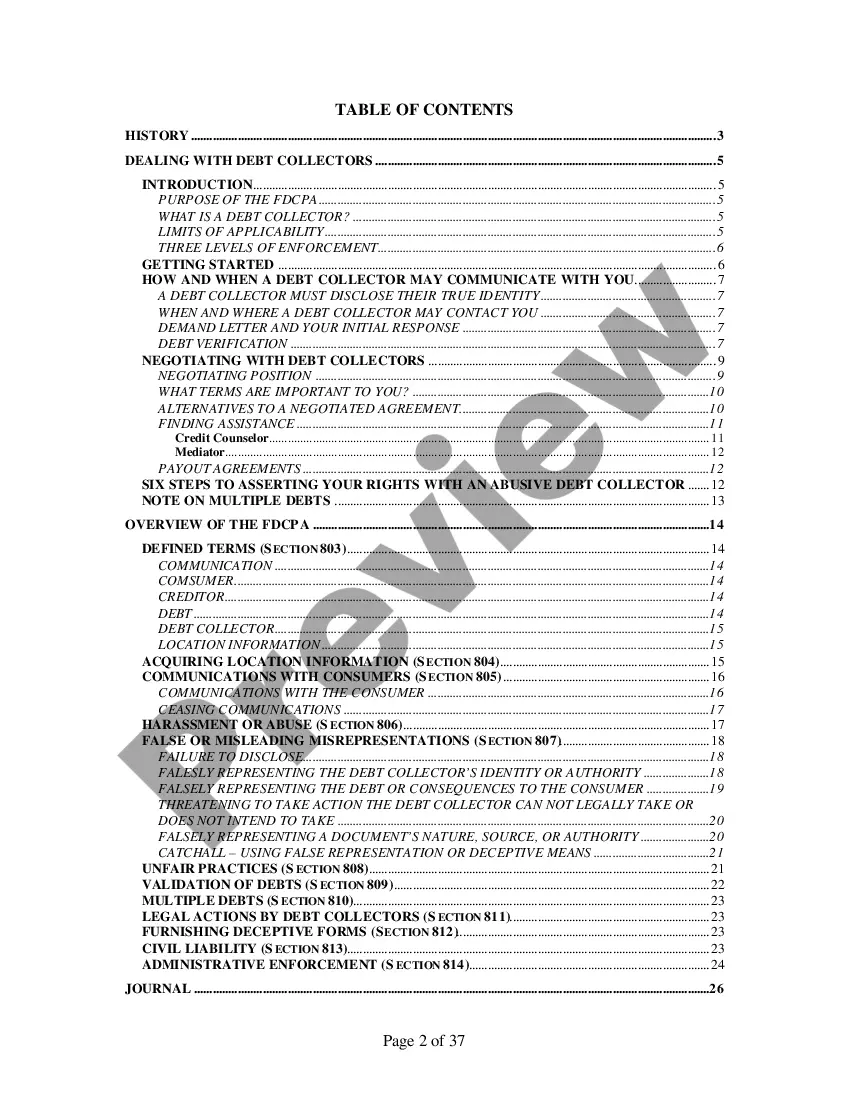
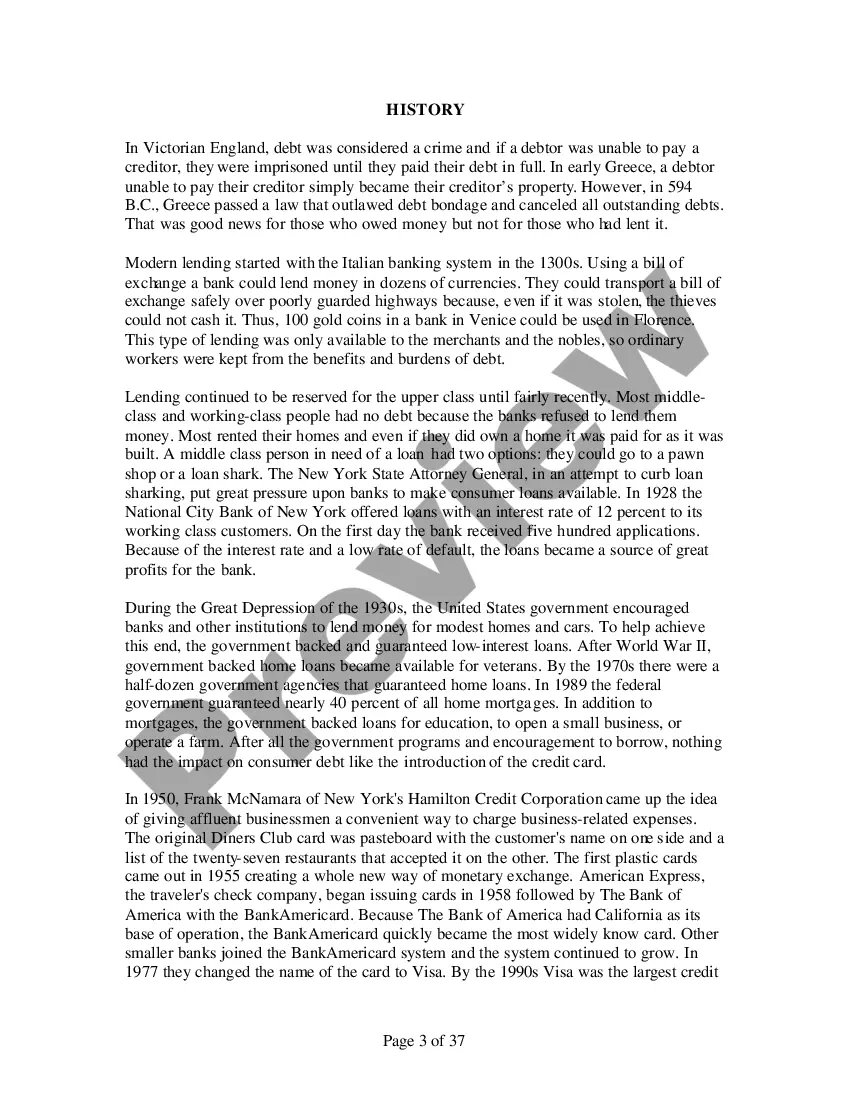
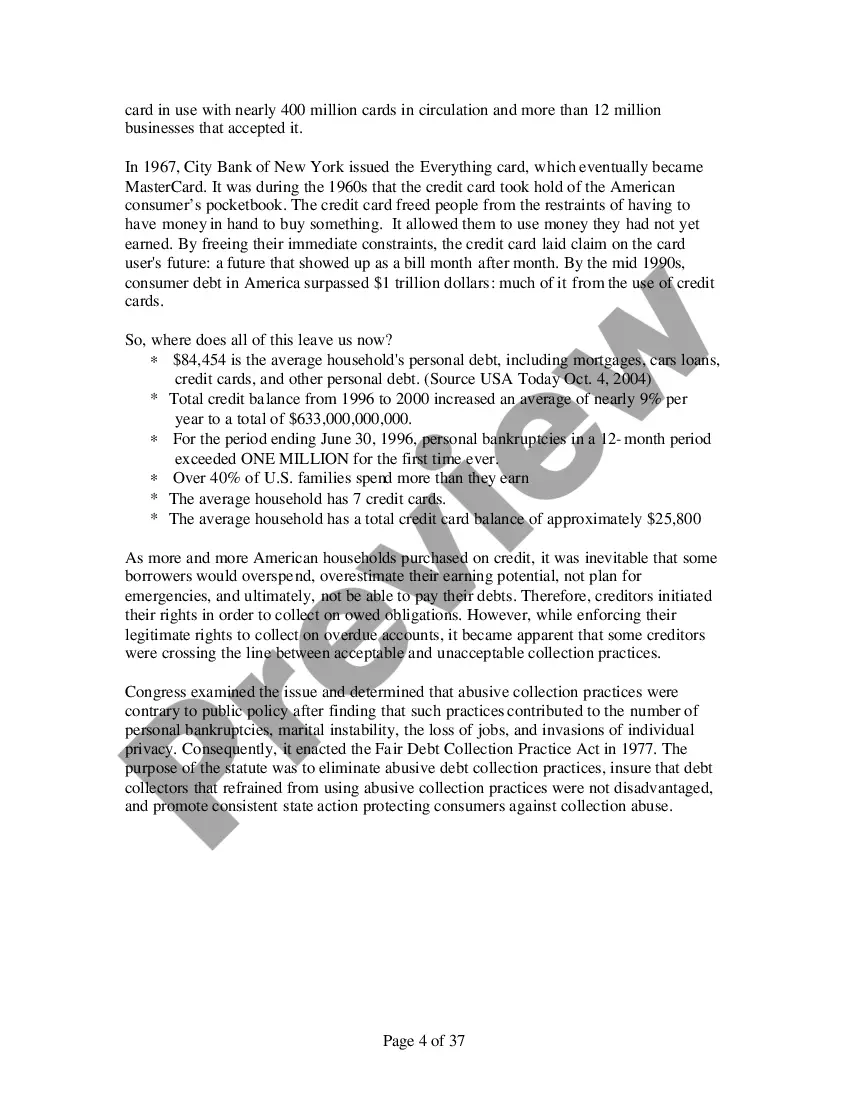
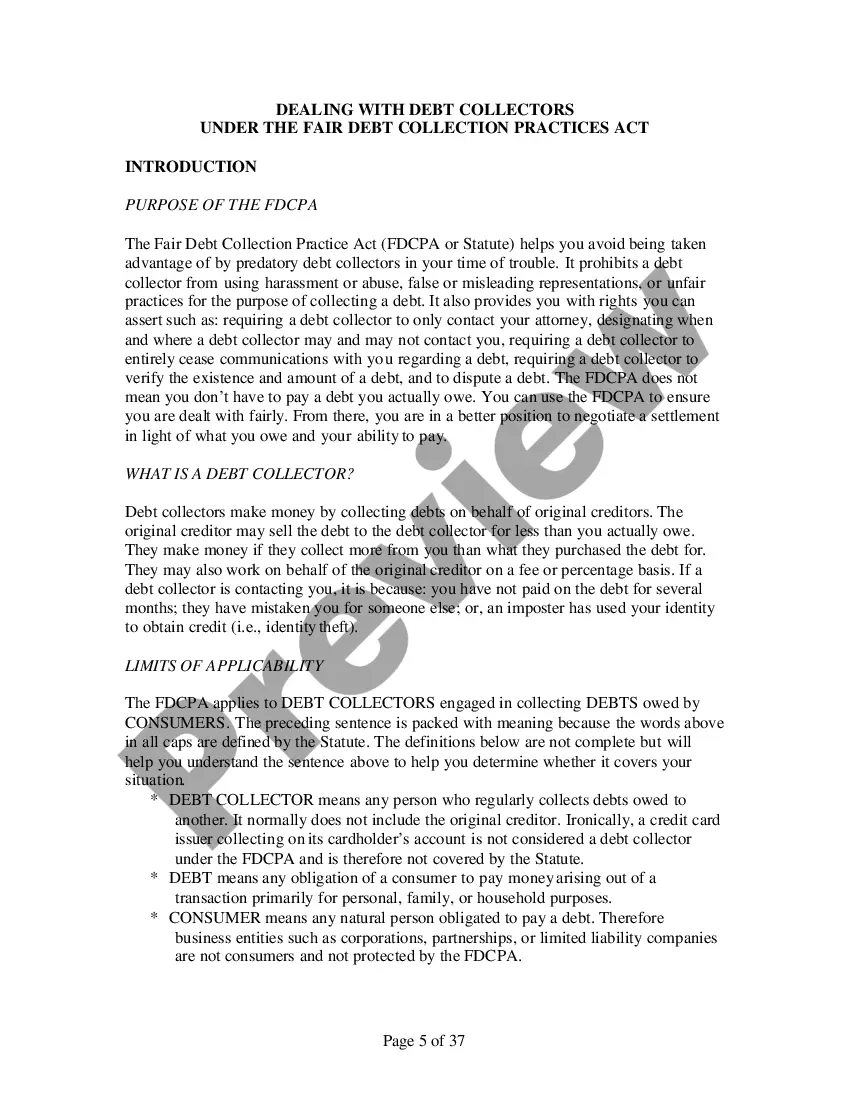
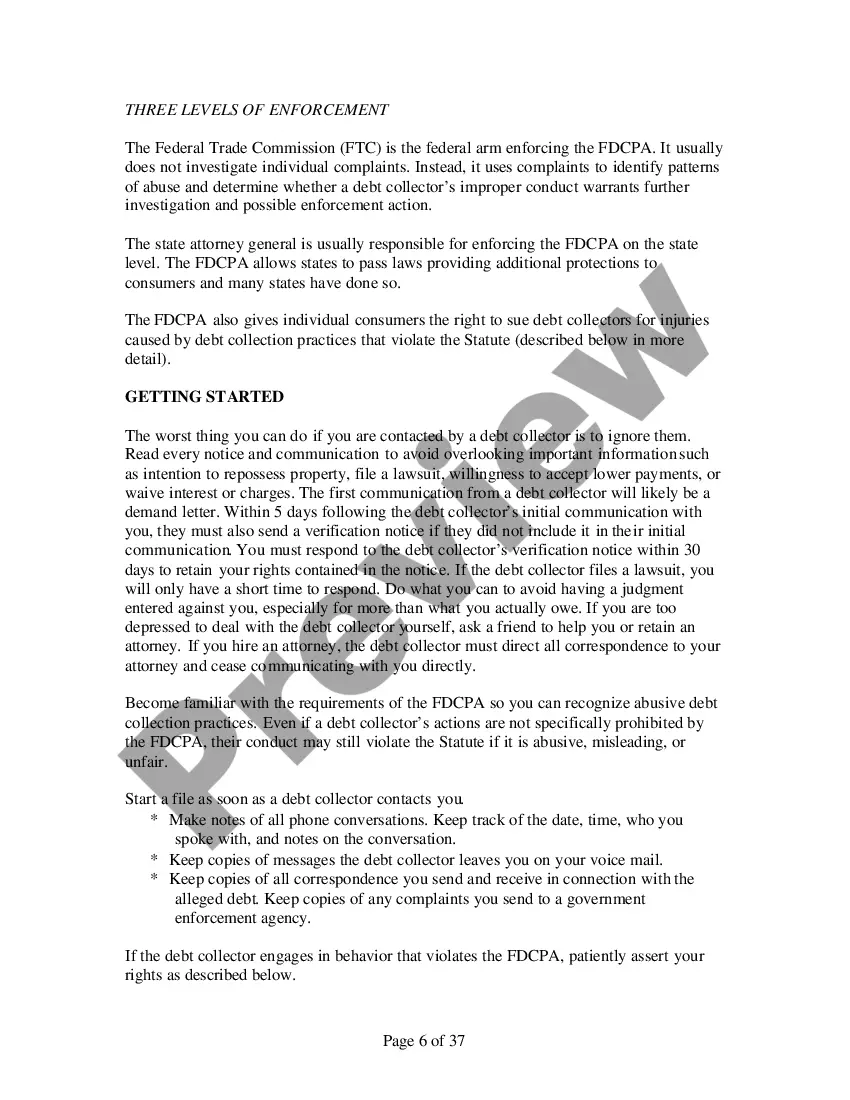
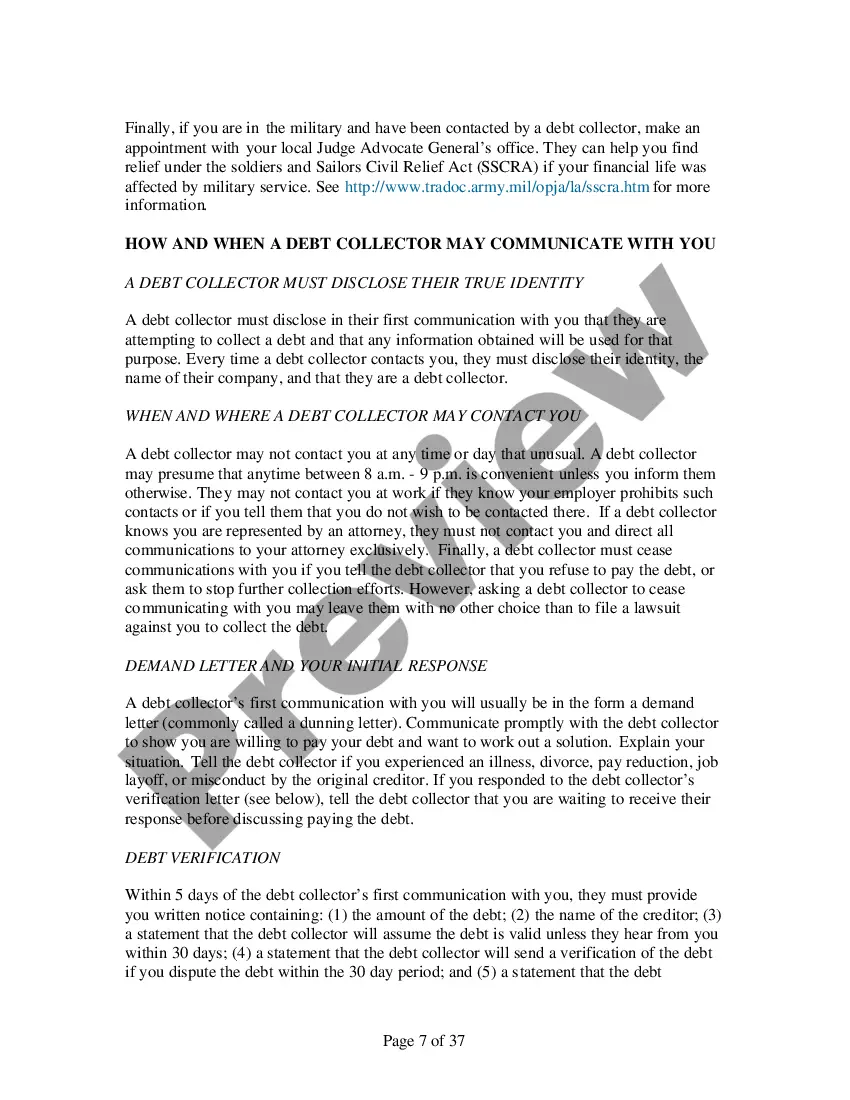
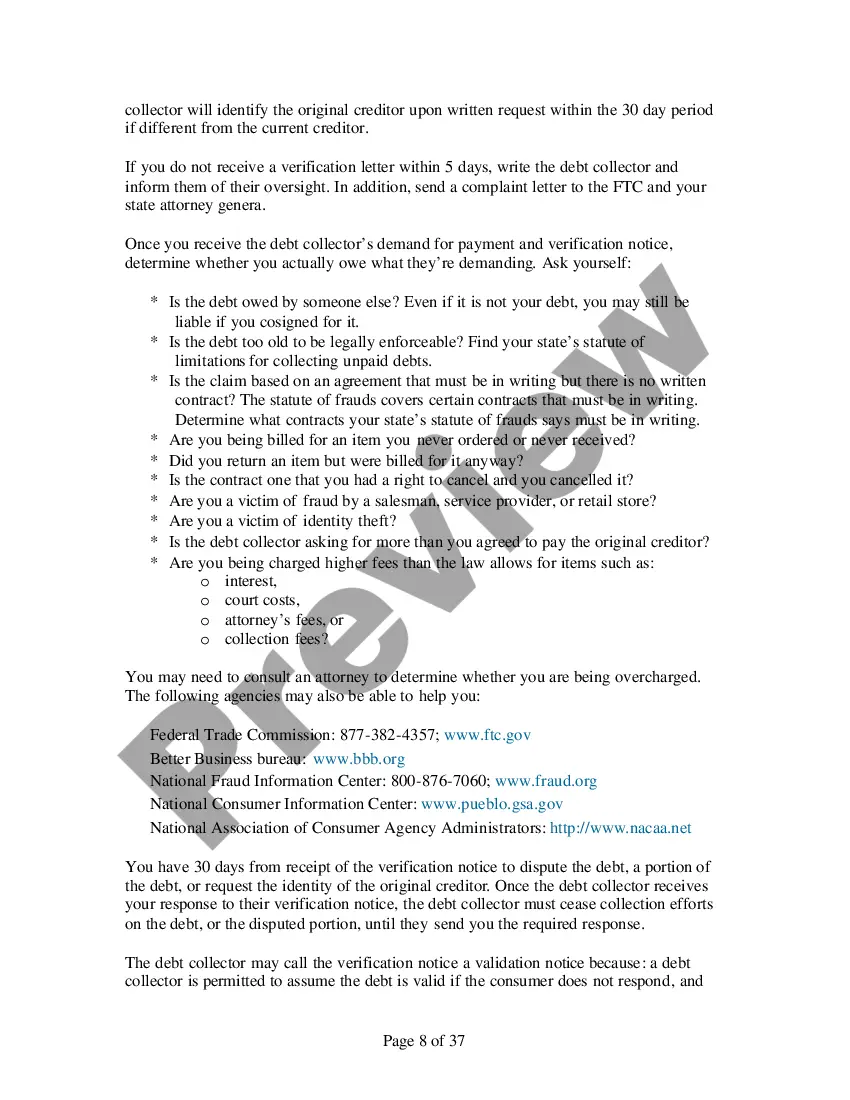
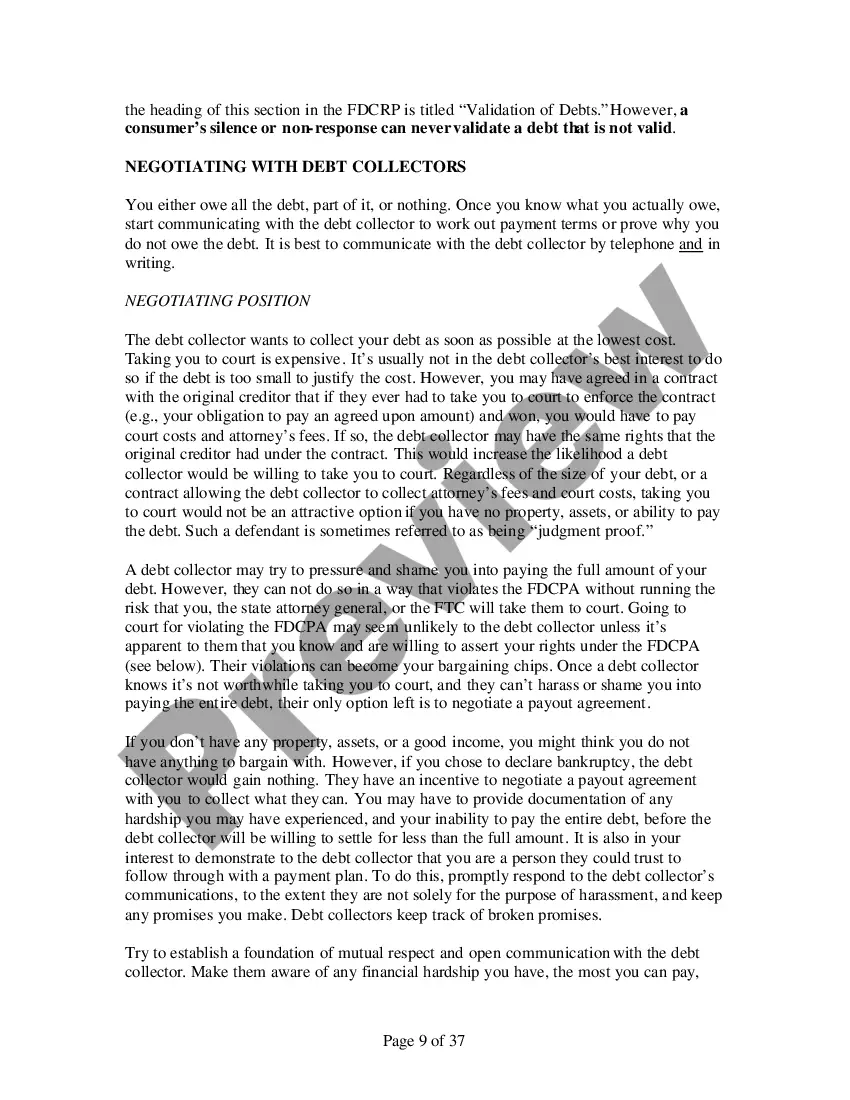
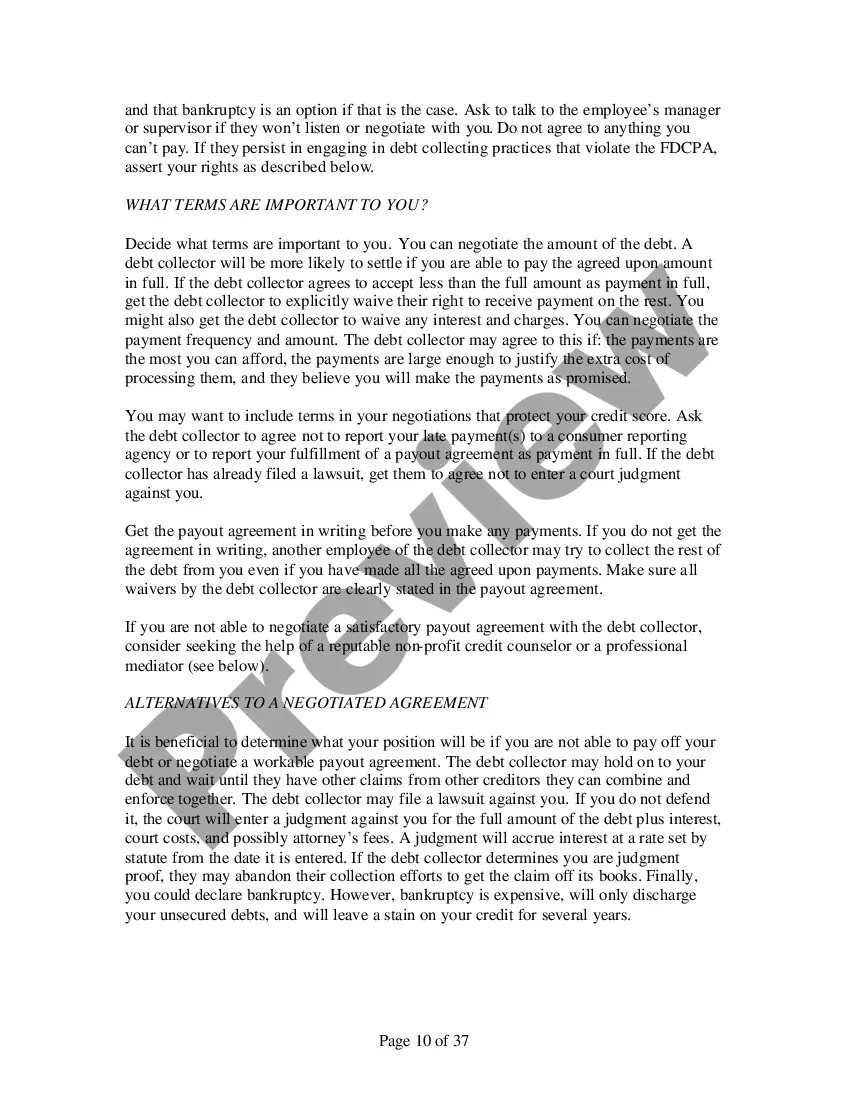
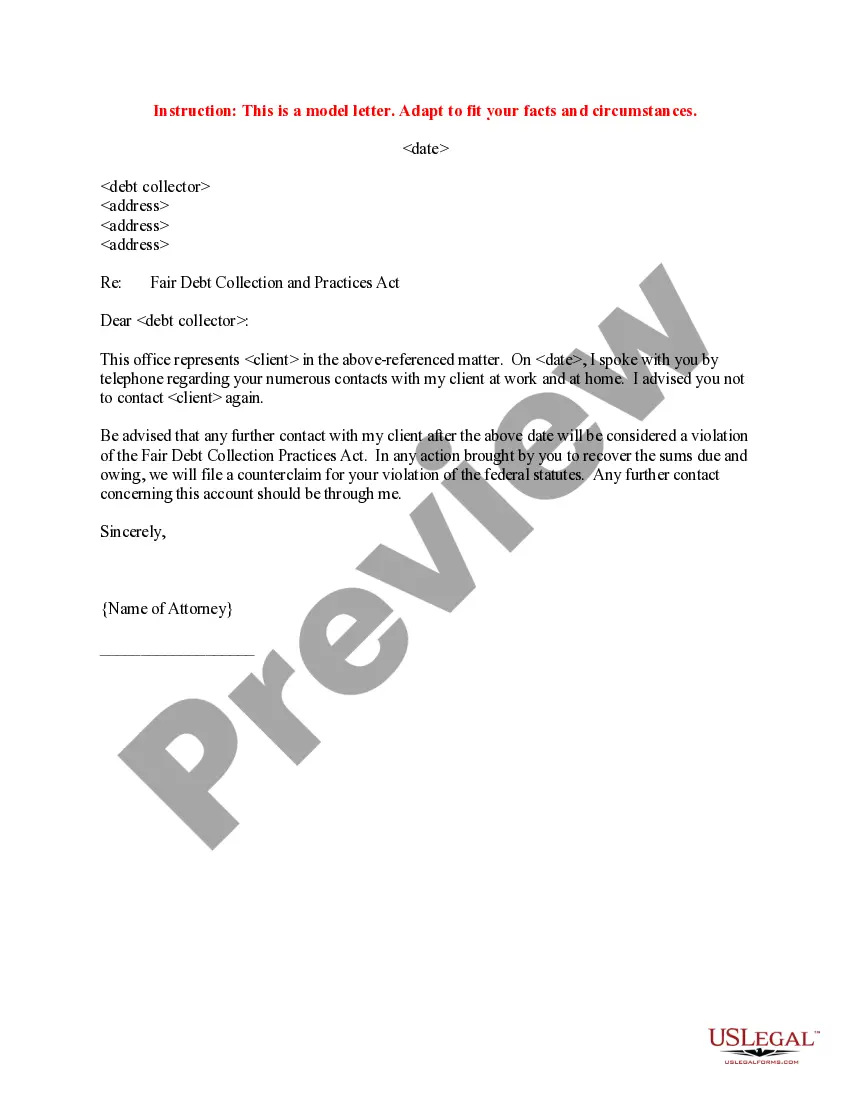
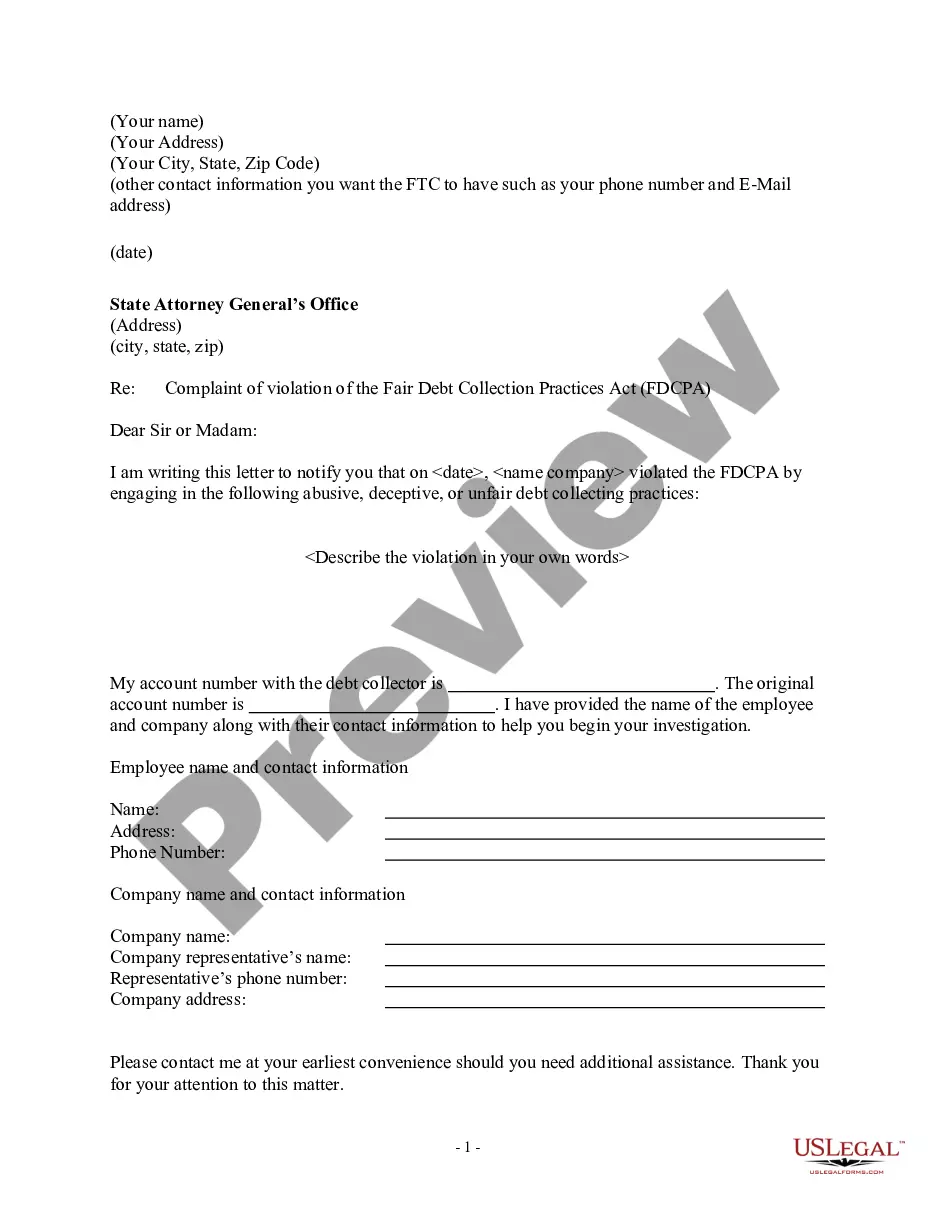
This handbook describes the Fair Debt Collection Practices Act (FDCPA) and discusses how to negotiate with debt collectors and creditors. The handbook is divided into 4 sections. Section 1 briefly describes how consumer credit got started. Section 2 describes how to deal with debt collectors. Section 3 provides a detailed overview of the FDCPA. Finally, Section 4 is a journal for you to use to document your communicatioins with debt collectors.
Alaska Fair Debt Collection Practices Act Handbook
State:
Multi-State
Category:
Control #:
US-DCPA-23
Format:
PDF
124 downloads
Description
Free preview

Get your form ready online
Our built-in tools help you complete, sign, share, and store your documents in one place.
Built-in online Word editor
Make edits, fill in missing information, and update formatting in US Legal Forms—just like you would in MS Word.
Export easily
Download a copy, print it, send it by email, or mail it via USPS—whatever works best for your next step.
E-sign your document
Sign and collect signatures with our SignNow integration. Send to multiple recipients, set reminders, and more. Go Premium to unlock E-Sign.
Notarize online 24/7
If this form requires notarization, complete it online through a secure video call—no need to meet a notary in person or wait for an appointment.
Store your document securely
We protect your documents and personal data by following strict security and privacy standards.

Make edits, fill in missing information, and update formatting in US Legal Forms—just like you would in MS Word.

Download a copy, print it, send it by email, or mail it via USPS—whatever works best for your next step.

Sign and collect signatures with our SignNow integration. Send to multiple recipients, set reminders, and more. Go Premium to unlock E-Sign.

If this form requires notarization, complete it online through a secure video call—no need to meet a notary in person or wait for an appointment.

We protect your documents and personal data by following strict security and privacy standards.
Looking for another form?



How to fill out Fair Debt Collection Practices Act Handbook?
You might spend time online attempting to locate the valid document template that meets the state and federal stipulations you require.
US Legal Forms offers a vast array of valid templates that can be reviewed by experts.
You can easily download or print the Alaska Fair Debt Collection Practices Act Handbook from their service.
If available, utilize the Preview button to check the document template as well.
- If you already possess a US Legal Forms account, you can sign in and click the Obtain button.
- After that, you can complete, modify, print, or sign the Alaska Fair Debt Collection Practices Act Handbook.
- Every valid document template you obtain is yours permanently.
- To retrieve another copy of a purchased form, head to the My documents section and select the corresponding button.
- If you are using the US Legal Forms website for the first time, follow the straightforward directions below.
- First, confirm that you have selected the right document template for your desired county/town.
- Review the form description to ensure you have chosen the correct form.
Form popularity
FAQ
The Fair Debt Collection Practices Act (FDCPA) is a federal law that limits the actions of third-party debt collectors who are attempting to collect debts on behalf of another person or entity.
Repeated calls. Threats of violence. Publishing information about you. Abusive or obscene language.
What are the provisions of the FDCPA?Call Time Restrictions.Honoring Workplace Opt-Outs.Honoring Home Phone Opt-Outs.Restrictions Against Harassment.Restrictions Against Unfair Practices.Restrictions Against False Lawsuit Threats.
7 Most Common FDCPA ViolationsContinued attempts to collect debt not owed.Illegal or unethical communication tactics.Disclosure verification of debt.Taking or threatening illegal action.False statements or false representation.Improper contact or sharing of info.Excessive phone calls.
Judgments are valid until satisfied or discharged; however, when a period of five years lapses, the judgment holder must file a motion with the court and prove sufficient cause for failure to obtain a writ of execution. Alaska Stat. § 09.35. 020.
A judgment remains on your credit record for 5 years or until it is paid in full or a rescission is granted by the courts. Although not always the case, in general a consumer is listed as defaulting before a credit provider applies for a judgment.
7 Most Common FDCPA ViolationsContinued attempts to collect debt not owed.Illegal or unethical communication tactics.Disclosure verification of debt.Taking or threatening illegal action.False statements or false representation.Improper contact or sharing of info.Excessive phone calls.16-Sept-2020
Debt collectors cannot harass or abuse you. They cannot swear, threaten to illegally harm you or your property, threaten you with illegal actions, or falsely threaten you with actions they do not intend to take. They also cannot make repeated calls over a short period to annoy or harass you.
Regulation F requires debt collectors to provide notice in any electronic communication to a consumer of the right to opt out of a specific medium of electronic communication, and must disclose to the consumer a reasonable, simple, and free method to opt out of a specific mode of electronic communication.
Debt collectors cannot harass or abuse you. They cannot swear, threaten to illegally harm you or your property, threaten you with illegal actions, or falsely threaten you with actions they do not intend to take. They also cannot make repeated calls over a short period to annoy or harass you.