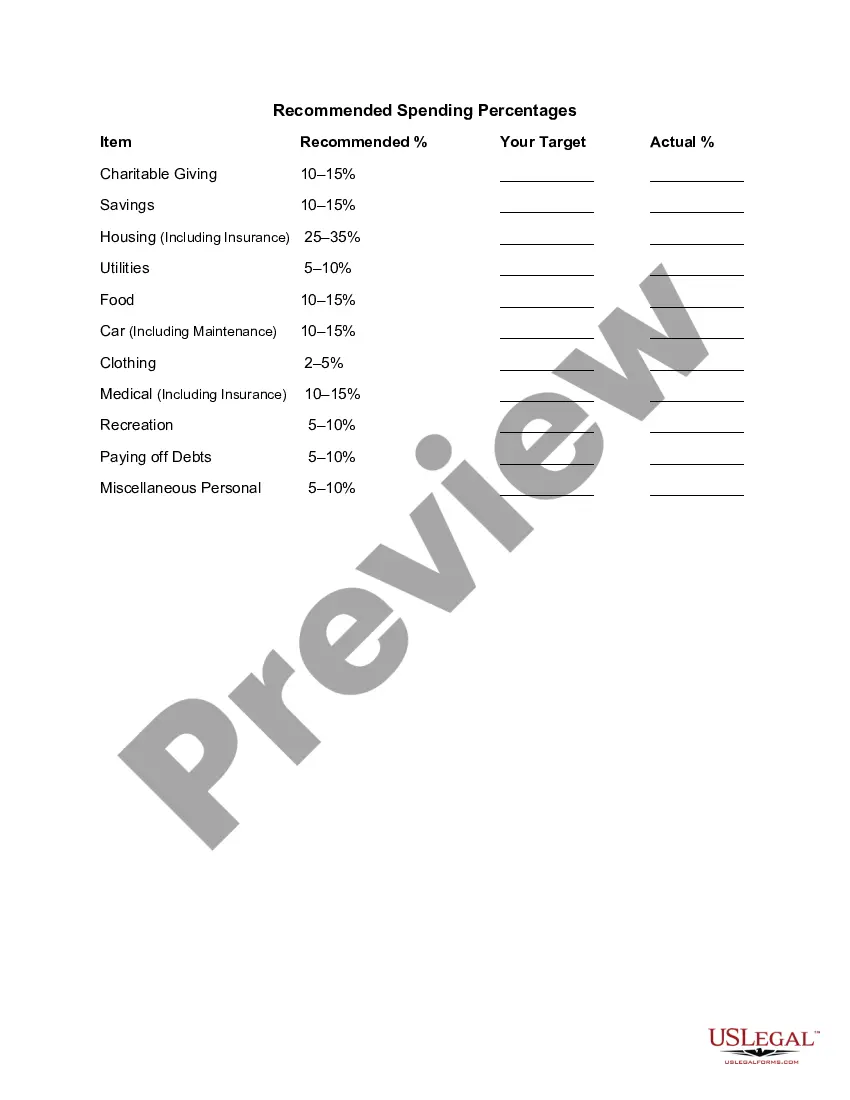
Alaska Recommended Spending Percentages
Description

How to fill out Recommended Spending Percentages?
It is feasible to spend hours online trying to locate the valid document template that meets the state and federal criteria you require.
US Legal Forms provides thousands of valid forms that have been reviewed by professionals.
You can easily retrieve or generate the Alaska Recommended Spending Percentages from my service.
If you wish to find another version of the form, use the Search field to locate the template that fits your needs and requirements.
- If you have a US Legal Forms account, you can Log In and click the Acquire button.
- Following that, you can complete, edit, print, or sign the Alaska Recommended Spending Percentages.
- Every valid document template you purchase belongs to you permanently.
- To obtain an additional copy of the purchased document, visit the My documents tab and click the relevant button.
- If you are using the US Legal Forms website for the first time, follow the simple instructions below.
- First, ensure that you have selected the correct document template for your chosen state/city.
- Review the form details to confirm you have selected the correct template.
Form popularity
FAQ
Military (Discretionary)Social Security, Unemployment, and Labor (Mandatory)Medicare and Health (Mandatory)Government (Discretionary)Education (Discretionary) Whether you owe money to the IRS or you have a State tax debt, our staff of Enrolled Agents and Tax Professionals can help you!
This category includes entitlement programs such as Social Security, Medicare, and unemployment compensation. It also includes welfare programs such as Medicaid. Social Security will be the biggest expense, budgeted at $1.196 trillion. It's followed by Medicare at $766 billion and Medicaid at $571 billion.
Most of local government spending is on services like water, electricity, sewage, waste removal, roads and facilities.
The oil and gas industry is the largest component of Alaska's economy. Nearly 85 percent of the state budget is supplied by oil revenues. The fortunes of Alaska's oil industry, and therefore many sectors of the economy, are dependent upon world oil prices.
Alaska spends its money in four main ways: providing services to Alaskans (the operations budget); building and maintaining statewide infrastructure (the capital budget); saving for the future; and paying Permanent Fund dividends to Alaska residents.
The table below notes what share of Alaska's general revenues came from the federal government in 2014. That year, Alaska received approximately $2.8 billion in federal aid, 26.9 percent of the state's general revenues.
As Figure A suggests, Social Security is the single largest mandatory spending item, taking up 38% or nearly $1,050 billion of the $2,736 billion total. The next largest expenditures are Medicare and Income Security, with the remaining amount going to Medicaid, Veterans Benefits, and other programs.
The oil and gas industry is the largest component of Alaska's economy. Nearly 85 percent of the state budget is supplied by oil revenues. The fortunes of Alaska's oil industry, and therefore many sectors of the economy, are dependent upon world oil prices.
The table below notes what share of Alaska's general revenues came from the federal government in 2014. That year, Alaska received approximately $2.8 billion in federal aid, 26.9 percent of the state's general revenues.
Instead of collecting sales taxes and personal income taxes, the Alaska state government relies on other types of taxes (including excise and severance taxes) to fund its operations. Most of its revenue comes from gas production and oil drilling.