Alaska Warranty Deed to convert Community Property to Joint Tenancy
Overview of this form
The Warranty Deed to convert Community Property to Joint Tenancy is a legal document that allows property owners to change the title of their property from community property, typically owned jointly by married couples, to a joint tenancy. This change provides the benefits of survivorship rights, ensuring that upon the death of one owner, their share automatically transfers to the surviving owner. This form is particularly valuable for couples who wish to simplify the transfer of ownership after the death of one partner, distinguishing it from standard warranty deeds that do not specify the type of joint ownership.
Main sections of this form
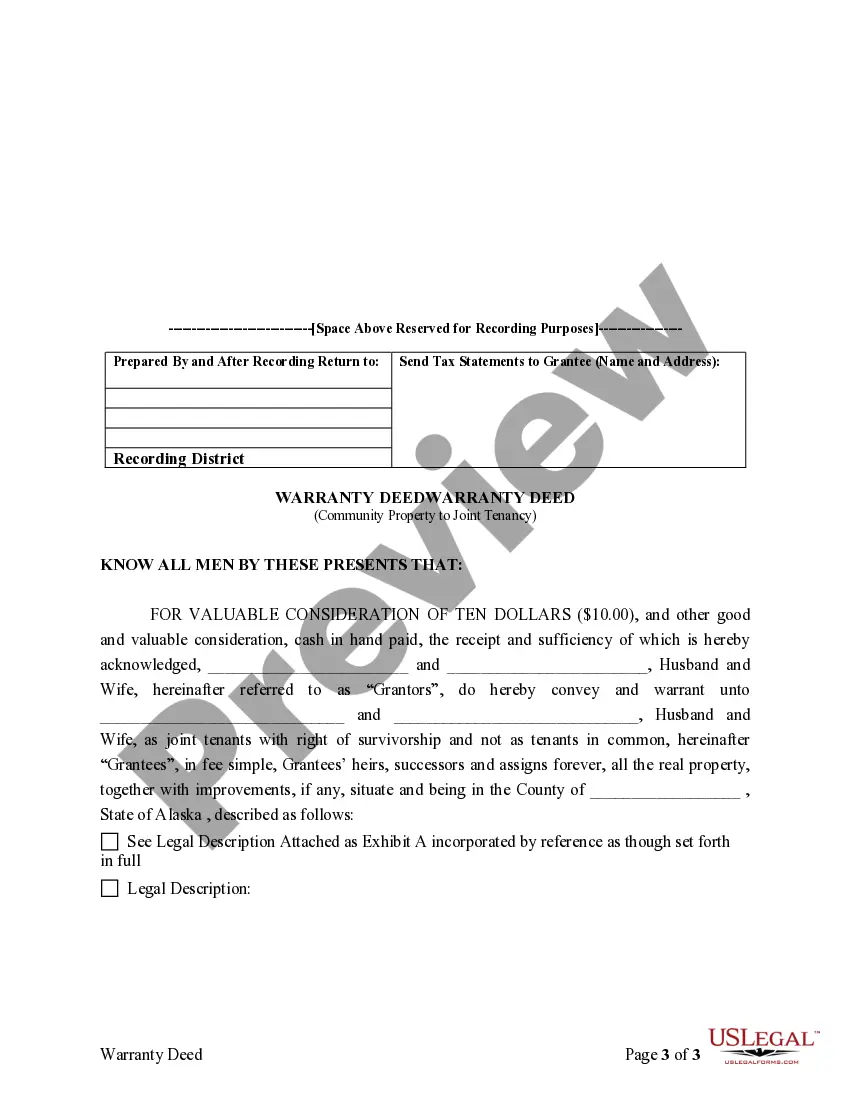
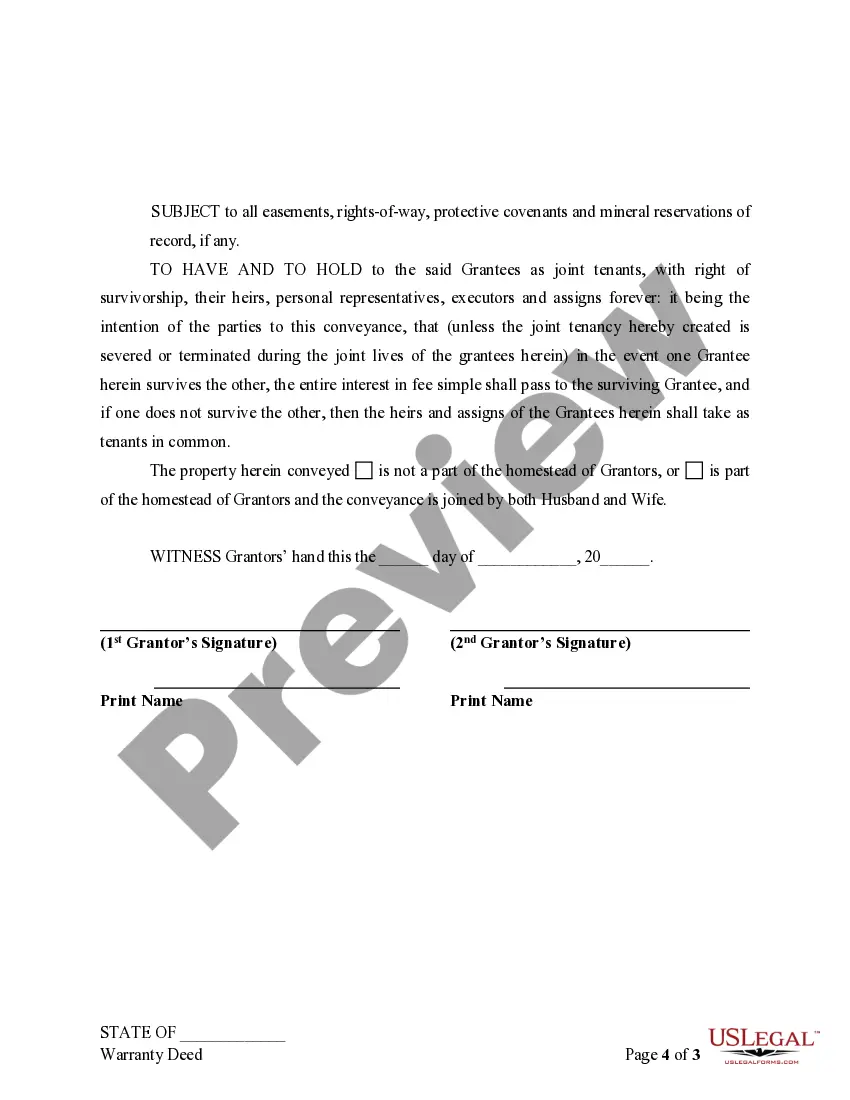
- Identification of Grantors: Names of the current property owners (Husband and Wife).
- Identification of Grantees: Names of the new joint tenants who will own the property.
- Property Description: Complete legal description of the property being conveyed.
- Homestead Declaration: Confirmation if the property is part of the homestead.
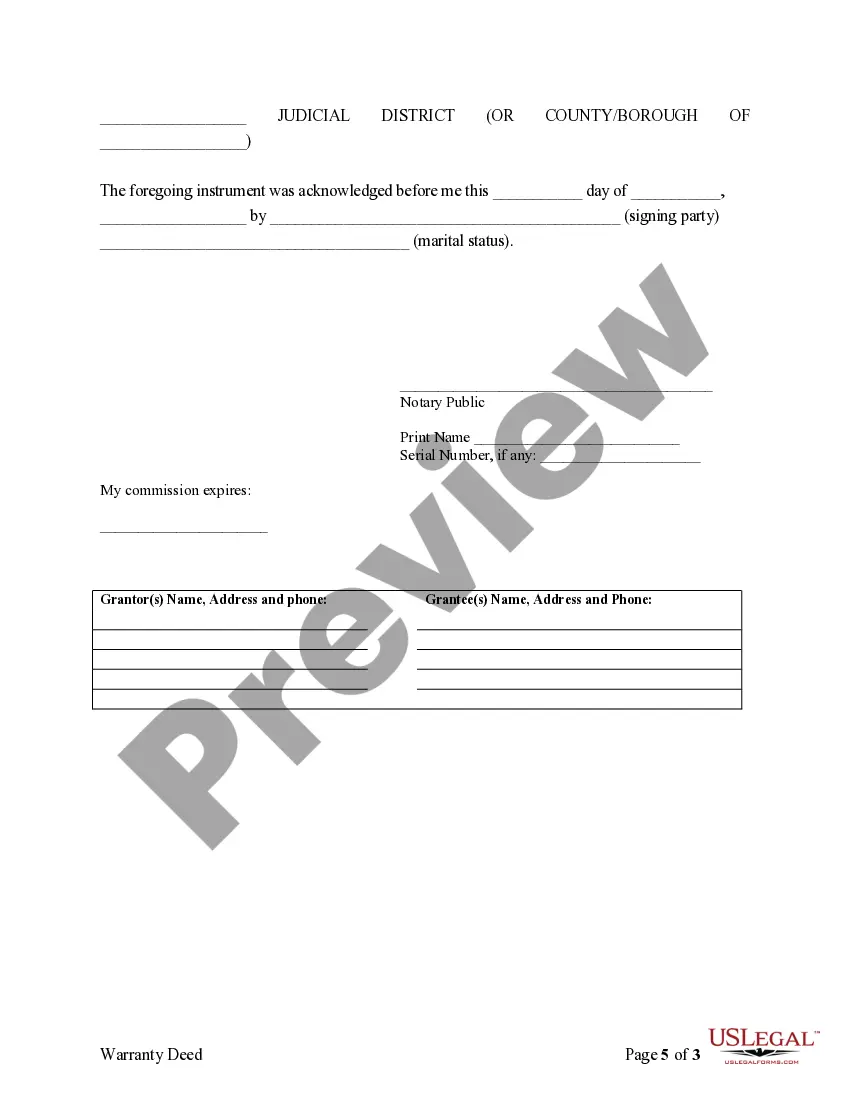
- Signature Fields: Areas for the signatures of the Grantors and a Notary Public.





When this form is needed
This form should be used when married couples who own property as community property wish to convert it to joint tenancy. This can occur for various reasons, including estate planning, ensuring transfer of property automatically upon death, or simplifying legal processes regarding property ownership. It is particularly relevant during discussions of estate management or when one spouse desires to ensure continuity of ownership for the other after passing away.
Intended users of this form
- Married couples who own property and want to convert community property to joint tenancy.
- Individuals involved in estate planning who want to ensure property transfers without probate.
- Those seeking clear definitions of ownership rights post-death of a spouse.
Instructions for completing this form
- Identify the Grantors: Fill in the names of both husband and wife.
- Specify the Grantees: Enter the names of the individuals who will hold the property in joint tenancy.
- Detail the Property: Include a full legal description of the property as attached in Exhibit A.
- Determine Homestead Status: Indicate whether the property is part of the Grantors' homestead.
- Obtain Signatures: Both Grantors must sign the deed in the designated spaces.
- Get Notarization: Have the document notarized to validate the transfer.
Notarization guidance
Yes, this form must be notarized to be legally valid. Notarization ensures that the signatures are authentic and the parties involved are who they claim to be. U.S. Legal Forms offers integrated online notarization services to facilitate this process, providing a secure video call for notarization at any time.
Get your form ready online
Our built-in tools help you complete, sign, share, and store your documents in one place.
Make edits, fill in missing information, and update formatting in US Legal Forms—just like you would in MS Word.
Download a copy, print it, send it by email, or mail it via USPS—whatever works best for your next step.
Sign and collect signatures with our SignNow integration. Send to multiple recipients, set reminders, and more. Go Premium to unlock E-Sign.
If this form requires notarization, complete it online through a secure video call—no need to meet a notary in person or wait for an appointment.
We protect your documents and personal data by following strict security and privacy standards.

Make edits, fill in missing information, and update formatting in US Legal Forms—just like you would in MS Word.

Download a copy, print it, send it by email, or mail it via USPS—whatever works best for your next step.

Sign and collect signatures with our SignNow integration. Send to multiple recipients, set reminders, and more. Go Premium to unlock E-Sign.

If this form requires notarization, complete it online through a secure video call—no need to meet a notary in person or wait for an appointment.

We protect your documents and personal data by following strict security and privacy standards.
Mistakes to watch out for
- Failing to include the complete legal description of the property.
- Omitting to specify whether the property is part of the homestead.
- Insufficient signatures or lack of notarization, which can invalidate the deed.
Why use this form online
- Convenience: Easily fill out and download the form from home at your convenience.
- Editability: Customize the form to meet your specific property and ownership details.
- Reliability: Developed by licensed attorneys, ensuring the form complies with Alaska law.
Looking for another form?
Form popularity
FAQ
It would be simple for us to say that you can simply record a new document putting both of you onto title to the home as joint tenants with rights of survivorship. Usually, when you make a simple change in the title from tenants in common to joint tenants, the taxing authorities will ignore that change.
The term joint tenants in common (JTIC) refers to a legal relationship in which two or more people own a piece of property or another asset where no rights of survivorship are afforded to any of the account holders. If one owner dies, the surviving owner doesn't necessarily acquire the rights of the deceased owner.
Generally, property held as community property with right of survivorship has tax advantages over a joint tenancy. In a joint tenancy, when one spouse sells property that was held jointly prior to the death of the other spouse, a portion of the profit is subject to capital gains tax.
Change from joint tenants to tenants in common You can make this change without the other owners' agreement. A solicitor, conveyancer or legal executive can also make the application for you.
The name and address of the seller (called the grantor) The name and address of the buyer (called the grantee) A legal description of the property (found on the previous deed) A statement that the grantor is transferring the property to the grantee.
The term joint tenancy refers to a legal arrangement in which two or more people own a property together, each with equal rights and obligations. Joint tenancies can be created by married and non-married couples, friends, relatives, and business associates.
Change from tenants in common to joint tenantsYou need the agreement of all the other joint owners to change from being tenants in common to joint tenants. A solicitor, conveyancer or legal executive can also make the application for you.
The name and address of the seller (called the grantor) The name and address of the buyer (called the grantee) A legal description of the property (found on the previous deed) A statement that the grantor is transferring the property to the grantee.
You may agree with your other co-tenant(s) to sever it. If you cannot agree on how to divide the property, you may terminate your tenancy in common by seeking judicial partition of the property.