Alaska Release of Lis Pendens
Overview of this form
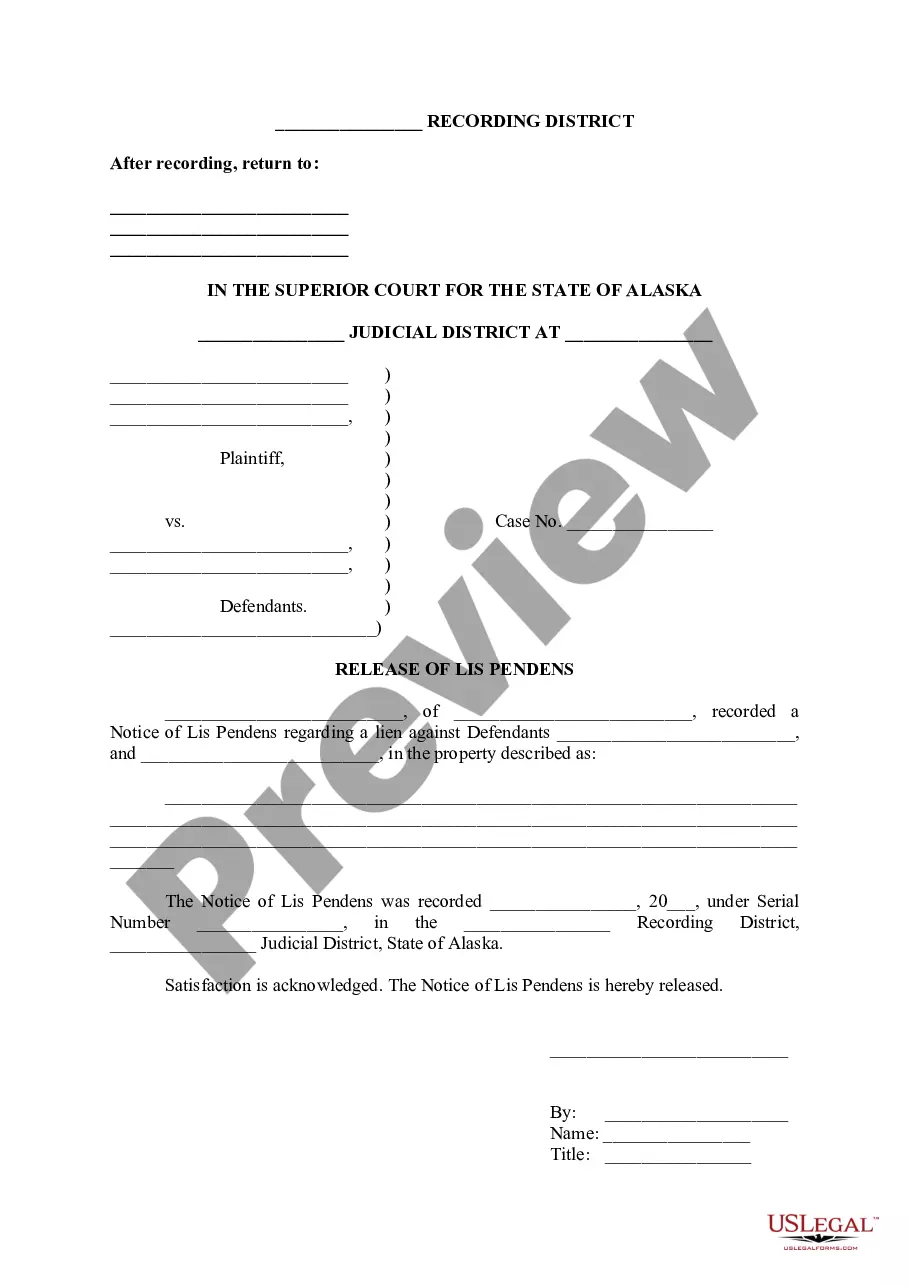
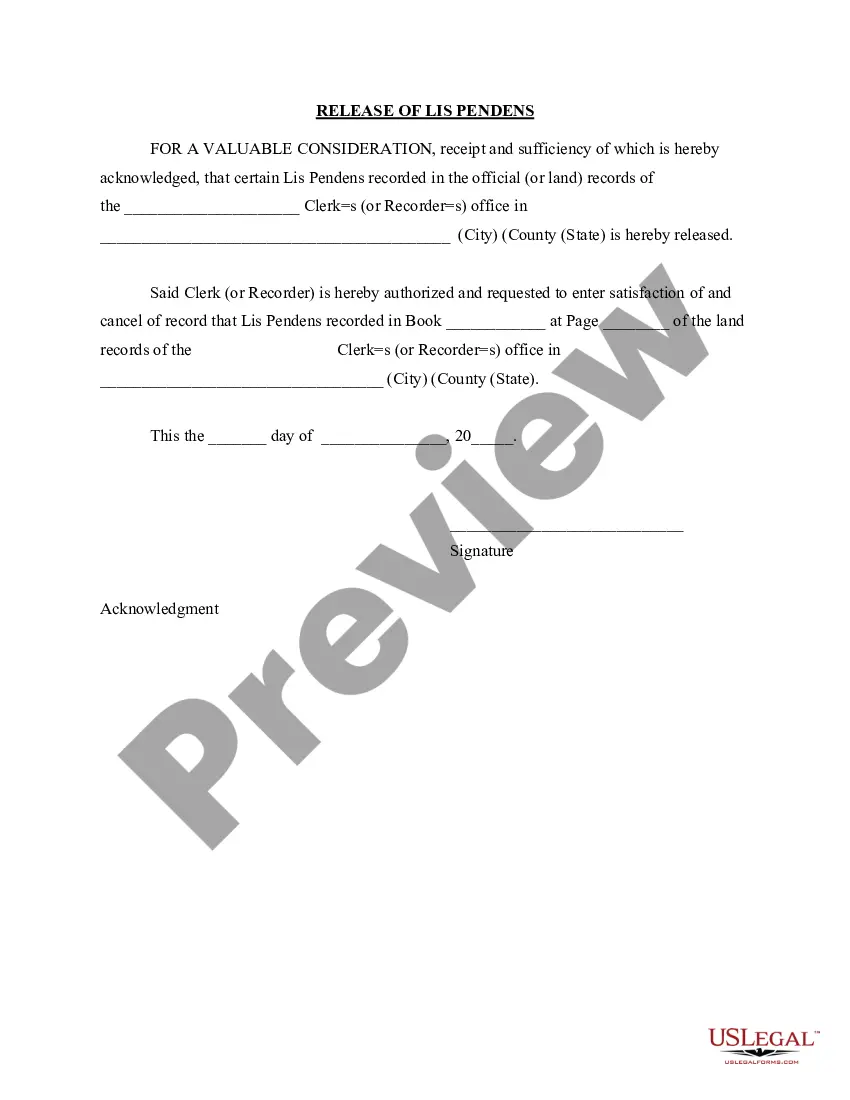
The Release of Lis Pendens is a legal document that cancels a previously recorded Lis Pendens, which is a notice that indicates a pending lawsuit concerning a property. By issuing this release, property owners or representatives can facilitate the sale of the property or secure loans against it, allowing for normal transactions to proceed without the encumbrance of the pending legal claim. This document is crucial when parties wish to move forward with financial dealings involving the property after resolving the underlying legal issues.
What’s included in this form
- Recording district information for proper documentation.
- Identification of the plaintiff and defendants involved in the original case.
- Description of the property tied to the Lis Pendens.
- Details of the original notice, including recording date and serial number.
- Signature of the party releasing the Lis Pendens, along with their title.
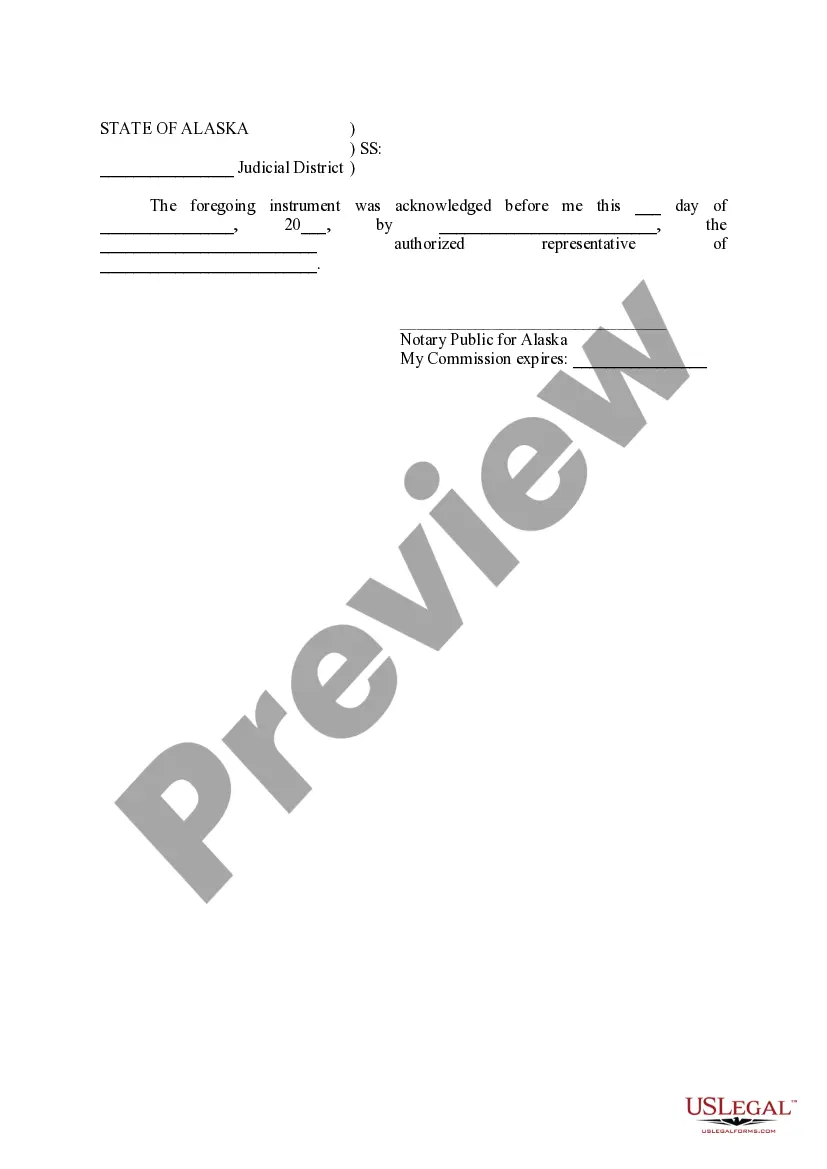
- Notary acknowledgment to confirm the validity of the signatures.
When this form is needed
This form should be used when a plaintiff has resolved the issues related to a Lis Pendens and needs to cancel that notice. It is commonly necessary when the property is about to be sold, refinanced, or otherwise transferred, allowing the property owner to clarify that there are no legal impediments affecting the property. Additionally, this form is helpful to lenders when assessing the property for financing purposes.
Who should use this form
The following parties should consider using this form:
- Property owners who have had a Lis Pendens filed against their property.
- Attorneys representing clients wanting to remove a Lis Pendens.
- Real estate professionals involved in the sale or financing of the property.
- Lenders requiring confirmation that any legal claims against a property have been lifted.
Instructions for completing this form
- Identify the recording district where the form will be filed.
- Fill in the names of the plaintiff and the defendants involved in the original case.
- Clearly describe the property affected by the Lis Pendens.
- Provide details regarding the original notice, including the recording date and serial number.
- Sign and date the form as the authorized representative releasing the Lis Pendens.
- Have the signature notarized to ensure the document's validity.
Notarization requirements for this form
Yes, this form must be notarized to be legally valid. The signatures of the parties involved must be witnessed by a notary public, ensuring the authenticity of the document. US Legal Forms offers integrated online notarization services that are available 24/7, making it easy and secure to complete this step without the need to travel.
Get your form ready online
Our built-in tools help you complete, sign, share, and store your documents in one place.
Make edits, fill in missing information, and update formatting in US Legal Forms—just like you would in MS Word.
Download a copy, print it, send it by email, or mail it via USPS—whatever works best for your next step.
Sign and collect signatures with our SignNow integration. Send to multiple recipients, set reminders, and more. Go Premium to unlock E-Sign.
If this form requires notarization, complete it online through a secure video call—no need to meet a notary in person or wait for an appointment.
We protect your documents and personal data by following strict security and privacy standards.

Make edits, fill in missing information, and update formatting in US Legal Forms—just like you would in MS Word.

Download a copy, print it, send it by email, or mail it via USPS—whatever works best for your next step.

Sign and collect signatures with our SignNow integration. Send to multiple recipients, set reminders, and more. Go Premium to unlock E-Sign.

If this form requires notarization, complete it online through a secure video call—no need to meet a notary in person or wait for an appointment.

We protect your documents and personal data by following strict security and privacy standards.
Common mistakes
- Failing to include accurate property descriptions.
- Not providing the original notice details, such as the recording date or serial number.
- Skipping the notarization step, which may invalidate the release.
- Not checking local jurisdiction requirements that may vary.
Why use this form online
- Easy access to professionally drafted templates, ensuring accuracy and compliance with legal standards.
- Editable formats that allow users to customize information before printing.
- Convenience of completing forms at any time without the need for in-person visits.
- Prompt downloads mean users can quickly move forward with property transactions.
Looking for another form?

Form popularity
FAQ
The most common types of encumbrance apply to real estate; these include mortgages, easements, and property tax liens. Not all forms of encumbrance are financial, easements being an example of non-financial encumbrances. An encumbrance can also apply to personal as opposed to real property.
A lien is a legal right or interest of a creditor in the property of another, usually lasting until a debt or duty is satisfied. An encumbrance is a claim or liability attached to property. It includes any property right that is not an ownership interest. A lien is a type of encumbrance.
The lis pendens can be removed once the lawsuit is settled and the court has ruled on an outcome. It might also be resolved on its own if an agreement is reached between the title owner and whoever filed the complaint. If the claim was wrongfully filed, the lis pendens will be expunged.
Because lis pendens are typically recorded in the real property records, the effect of lis pendens is that it puts others on notice that there is a dispute concerning the real property.
Similarly, a lis pendens constitutes an encumbrance against the owner's title to the property.Thus, the recordation of a lis pendens has a chilling effect on any resale or refinancing of the property pending the conclusion of the litigation.
Both a lis pendens and a lien against property represent claims against it. Yet, the lis pendens is not the same thing as a lien. Instead, it is a notification of a potential lien.
A lis pendens may be removed through a motion to expunge. A motion to expunge may be granted if the underlying lawsuit or other court action does not contain a real property claim that has probable validity. The motion will be granted it if is more likely than not that the underlying lawsuit or claim will fail.
A lis pendens may be withdrawn by recording a notice of withdrawal executed by the party who recorded the notice. The notice of withdrawal shall be acknowledged.
The homeowner can enter into a contract to sell the property, but the claim of the person who has filed the lis pendens has to be paid or settled before title can pass free and clear to the buyer. If the house closes, the buyer would ultimately have to accept the outcome of the pending litigation.