Alaska Corrective Lease
What this document covers
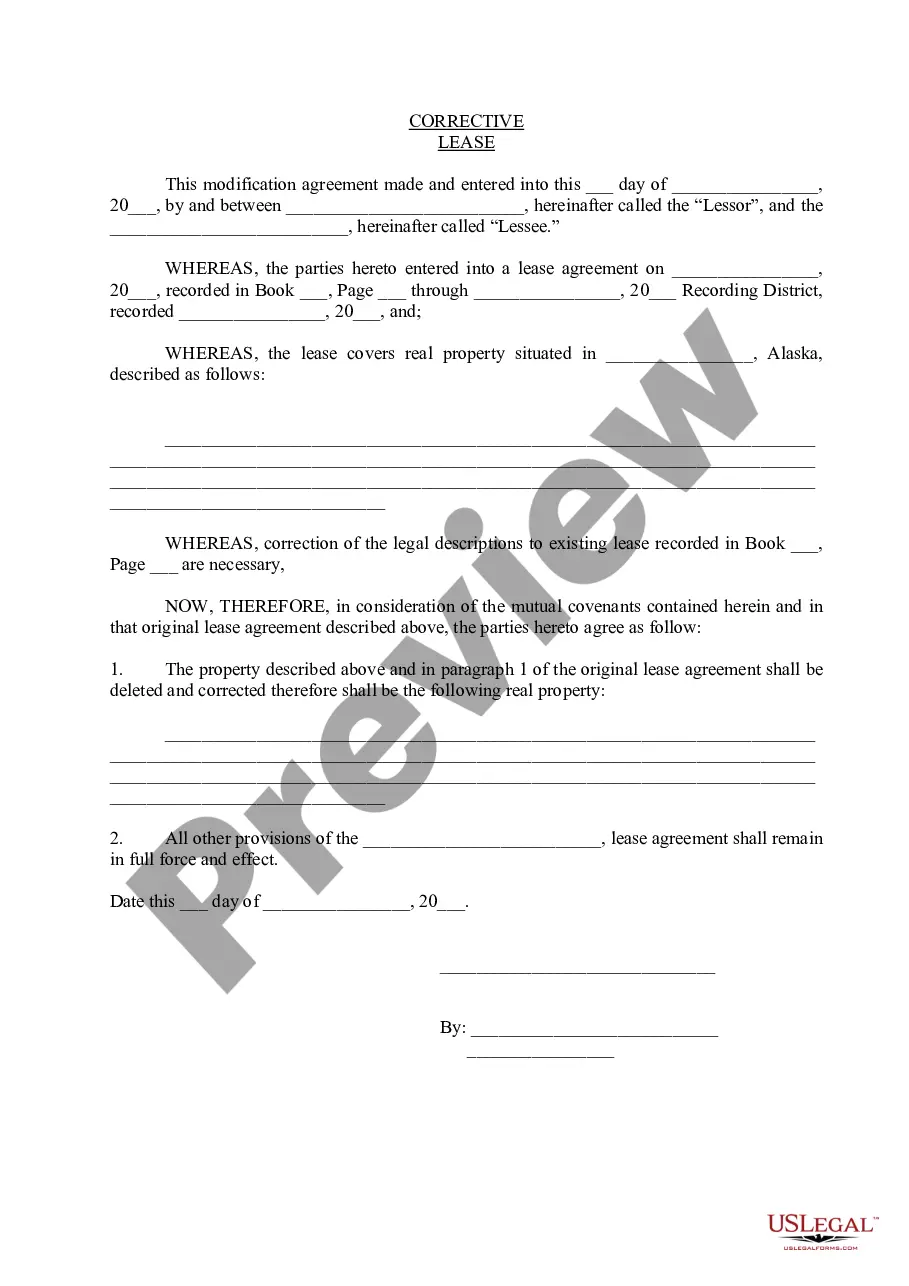
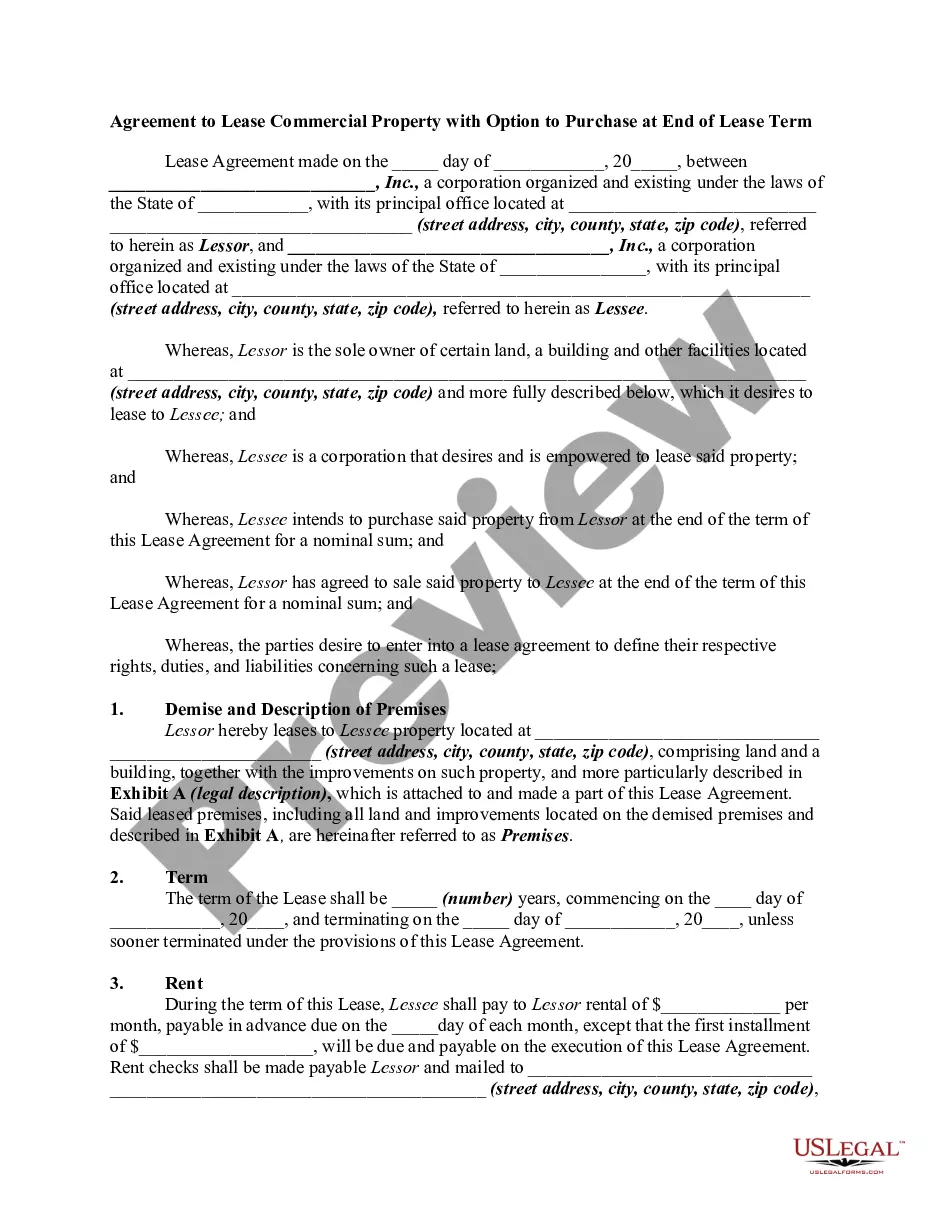
A corrective lease is a legal document used to modify an existing lease agreement between a tenant and a landlord. This form allows the parties to add, remove, or change clauses in the lease. It serves as a crucial tool for ensuring that both parties have an accurate and up-to-date agreement, differentiating it from a standard lease, which is primarily used for initial agreements without any modifications.
Key parts of this document
- Identification of the lessor (landlord) and lessee (tenant).
- Reference to the original lease agreement, including recording details.
- Description of the property being leased.
- Specific clauses to be corrected or modified.
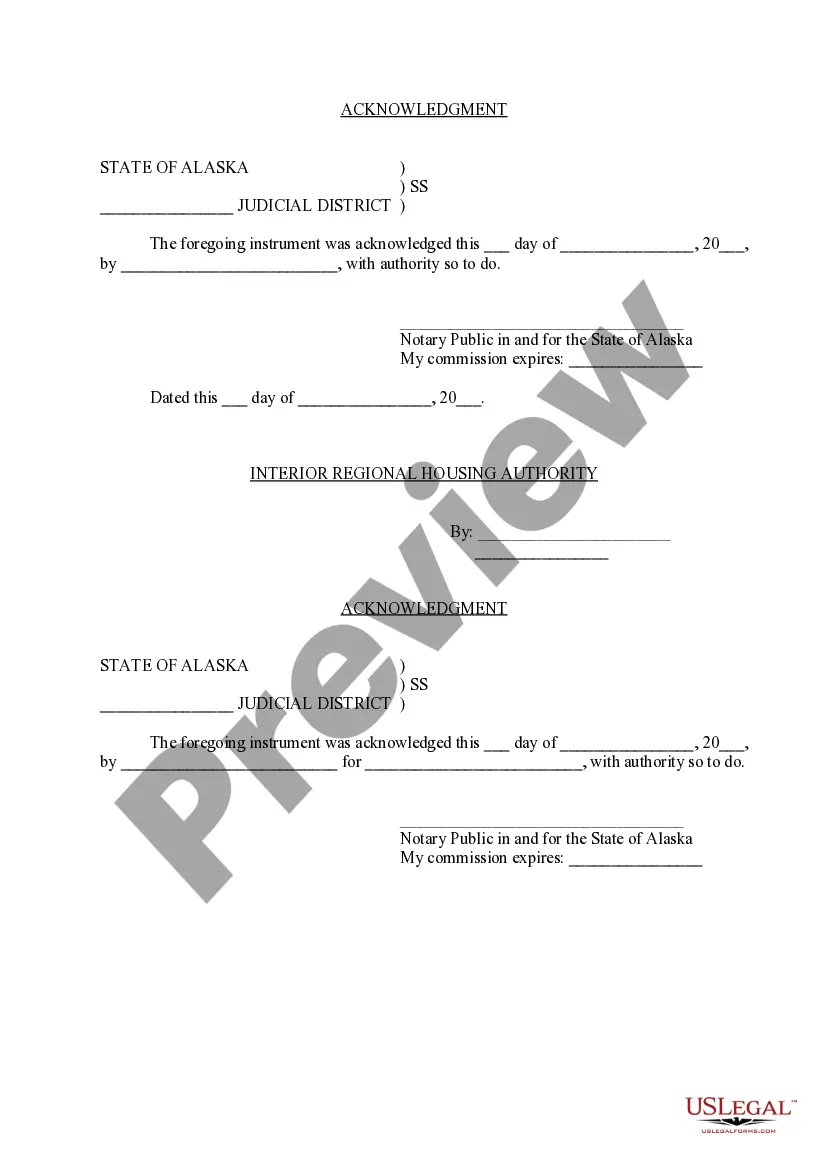
- Signatures from both parties, along with dates and notary acknowledgment.
When to use this form
This form is appropriate in scenarios where the parties wish to amend specific conditions of their existing lease. For example, if the property description has changed, or if either party intends to add or remove provisions due to changing circumstances, a corrective lease is necessary to maintain an accurate and enforceable legal agreement.
Who needs this form
This form is suitable for:
- Landlords wanting to clarify terms in a lease.
- Tenants seeking to update or correct their lease agreements.
- Property managers needing to make adjustments to existing contracts.
Steps to complete this form
- Identify both parties by entering the names of the lessor and lessee.
- Specify the date of modification and the date of the original lease.
- Provide a detailed description of the property referenced in both the original lease and the corrective lease.
- Clearly outline the modifications being made to the lease terms.
- Both parties should sign and date the document in the designated areas.
- Have the document notarized to ensure its legal validity.
Does this form need to be notarized?
Yes, this form must be notarized to be legally valid. Notarization helps to verify the identities of the parties involved and provides an additional layer of legal security. US Legal Forms offers integrated online notarization services, ensuring that you can complete this process quickly and securely through a video call with a licensed notary.
Get your form ready online
Our built-in tools help you complete, sign, share, and store your documents in one place.
Make edits, fill in missing information, and update formatting in US Legal Forms—just like you would in MS Word.
Download a copy, print it, send it by email, or mail it via USPS—whatever works best for your next step.
Sign and collect signatures with our SignNow integration. Send to multiple recipients, set reminders, and more. Go Premium to unlock E-Sign.
If this form requires notarization, complete it online through a secure video call—no need to meet a notary in person or wait for an appointment.
We protect your documents and personal data by following strict security and privacy standards.

Make edits, fill in missing information, and update formatting in US Legal Forms—just like you would in MS Word.

Download a copy, print it, send it by email, or mail it via USPS—whatever works best for your next step.

Sign and collect signatures with our SignNow integration. Send to multiple recipients, set reminders, and more. Go Premium to unlock E-Sign.

If this form requires notarization, complete it online through a secure video call—no need to meet a notary in person or wait for an appointment.

We protect your documents and personal data by following strict security and privacy standards.
Mistakes to watch out for
- Failing to provide accurate property descriptions, which can invalidate the corrections.
- Not signing the document, leaving it unenforceable.
- Overlooking the necessity of notarization, if applicable.
- Making changes without mutual consent from both parties.
Benefits of completing this form online
- Convenient and quick access to professionally drafted templates.
- Editable form that allows for customization based on specific needs.
- Reliability ensuring compliance with legal standards.
Looking for another form?
Form popularity
FAQ
When there is no lease agreement (like in the case of weekly rentals), you can instead use the Alaska Notice to Vacate to inform the other party in advance that you wish to end the tenancy agreement and vacate the premises.
Concisely review the main facts and lay out the reasons your landlord owes you money. Include copies of relevant letters and agreements, such as your notice to move out. Ask for exactly what you want, such as the full amount of your deposit within ten days. Cite state security deposit law.
Watson. If the landlord does not return your security deposit, you can take the landlord to the special court in your city to get your funds back. Check out your city's housing authority website to determine if your landlord is breaking any laws.
5 Times a Landlord Does Not Have to Return a Tenant's Security Deposit. Breaking or Terminating a Lease Early. Nonpayment of Rent. Damage to the Property. Cleaning Costs. Unpaid Utilities.
In some circumstances, a tenant can break a fixed-term agreement early without penalty. A tenant can give 14 days' written notice to end an agreement early without penalty if: they have accepted an offer of social housing (e.g. from DCJ Housing)
Alaska state law limits how much a landlord can charge for a security deposit (two months' rent, unless the monthly rent exceeds $2,000), when it must be returned (within 14 days after a tenant moves if the tenant has given proper notice to end the tenancy or 30 days if the tenant has not), and sets other restrictions
Give the landlord/agent a written termination notice and vacate move out and return the keys according to your notice, and/or. apply to the NSW Civil & Administrative Tribunal (NCAT) for a termination order.
Fails to pay rent; Violates a clause in the lease or rental agreement; Violates a responsibility imposed by law.