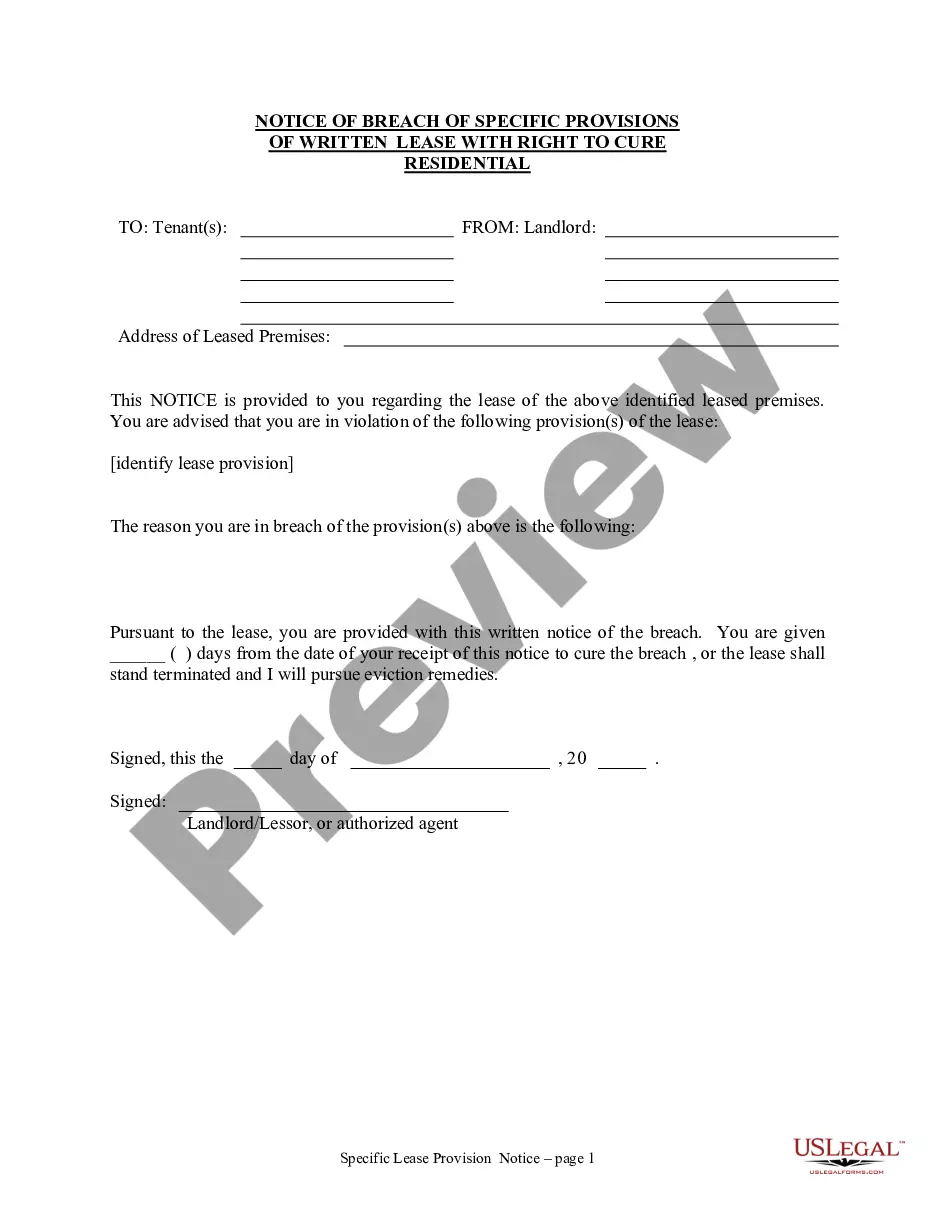
This Notice of Breach of Written Lease for Violating Specific Provisions of Lease with Right to Cure for Residential Property from Landlord to Tenant form is for a Landlord to provide notice of breach of a Written Lease for violating a specific provision of the lease with the right to cure. It is for a Residential lease. You insert the specific breach in the form. The lease should contain the specific provision which has been violated and provide the deadline to cure the breach. This form is for use when a form for your specific situation is not available.
Alaska Notice of Breach of Written Lease for Violating Specific Provisions of Lease with Right to Cure for Residential Property from Landlord to Tenant
State:
Alaska
Control #:
AK-1500LT
Format:
Word;
Rich Text
Instant download
Description
Free preview
How to fill out Alaska Notice Of Breach Of Written Lease For Violating Specific Provisions Of Lease With Right To Cure For Residential Property From Landlord To Tenant?
Utilizing Alaska Notice of Breach of Written Lease for Breaching Specific Lease Terms with Right to Cure for Residential Property templates designed by qualified lawyers provides you the chance to avoid complications when completing documents.
Simply download the example from our site, complete it, and seek legal advice to verify it.
This approach can save you significantly more time and expenses than hiring legal assistance to draft a document entirely from the beginning tailored to your requirements.
Remember to verify all entered information for accuracy before sending or posting it. Save time spent on document preparation with US Legal Forms!
- If you have already purchased a US Legal Forms subscription, simply Log In to your account and go back to the sample page.
- Locate the Download button next to the template you are reviewing.
- Once you download a document, your saved samples can be found in the My documents section.
- If you do not have a subscription, that's okay.
- Just adhere to the steps below to create your account online, obtain, and complete your Alaska Notice of Breach of Written Lease for Breaching Specific Lease Terms with Right to Cure for Residential Property template.
- Check again to ensure you are downloading the correct state-specific form.
Form popularity
FAQ
A lease is automatically void when it is against the law, such as a lease for an illegal purpose. In other circumstances, like fraud or duress, a lease can be declared void at the request of one party but not the other.
Your name, and the landlord's name and address. The date you're writing the letter. Informing the landlord you're breaking your lease early. The reason why you're breaking your lease. The building and apartment you're vacating. The date by which you're vacating.
If a tenant breaches a tenancy agreement it is possible that their landlord will try and evict them from the property. The sort of breaches of tenancy which result in a landlord seeking a court order for possession include:Damage to the property (eg broken windows)
The rental property address, including unit number (if applicable) The names of all tenants on the lease agreement. The date the lease violation notice was written. The specific reason for the notice. The time and date the violation occurred (if applicable)
Fails to pay rent; Violates a clause in the lease or rental agreement; Violates a responsibility imposed by law.
Give the landlord/agent a written termination notice and vacate move out and return the keys according to your notice, and/or. apply to the NSW Civil & Administrative Tribunal (NCAT) for a termination order.
Sue the landlord and whoever for up to $10,000 in small claims court for trespassing, breach of contract, invasion of privacy, and breach of quiet enjoyment; if you are two or more tenants, each can separately sue them for up to $10,000, and a joint action is not required.
When there is no lease agreement (like in the case of weekly rentals), you can instead use the Alaska Notice to Vacate to inform the other party in advance that you wish to end the tenancy agreement and vacate the premises.
In some circumstances, a tenant can break a fixed-term agreement early without penalty. A tenant can give 14 days' written notice to end an agreement early without penalty if: they have accepted an offer of social housing (e.g. from DCJ Housing)