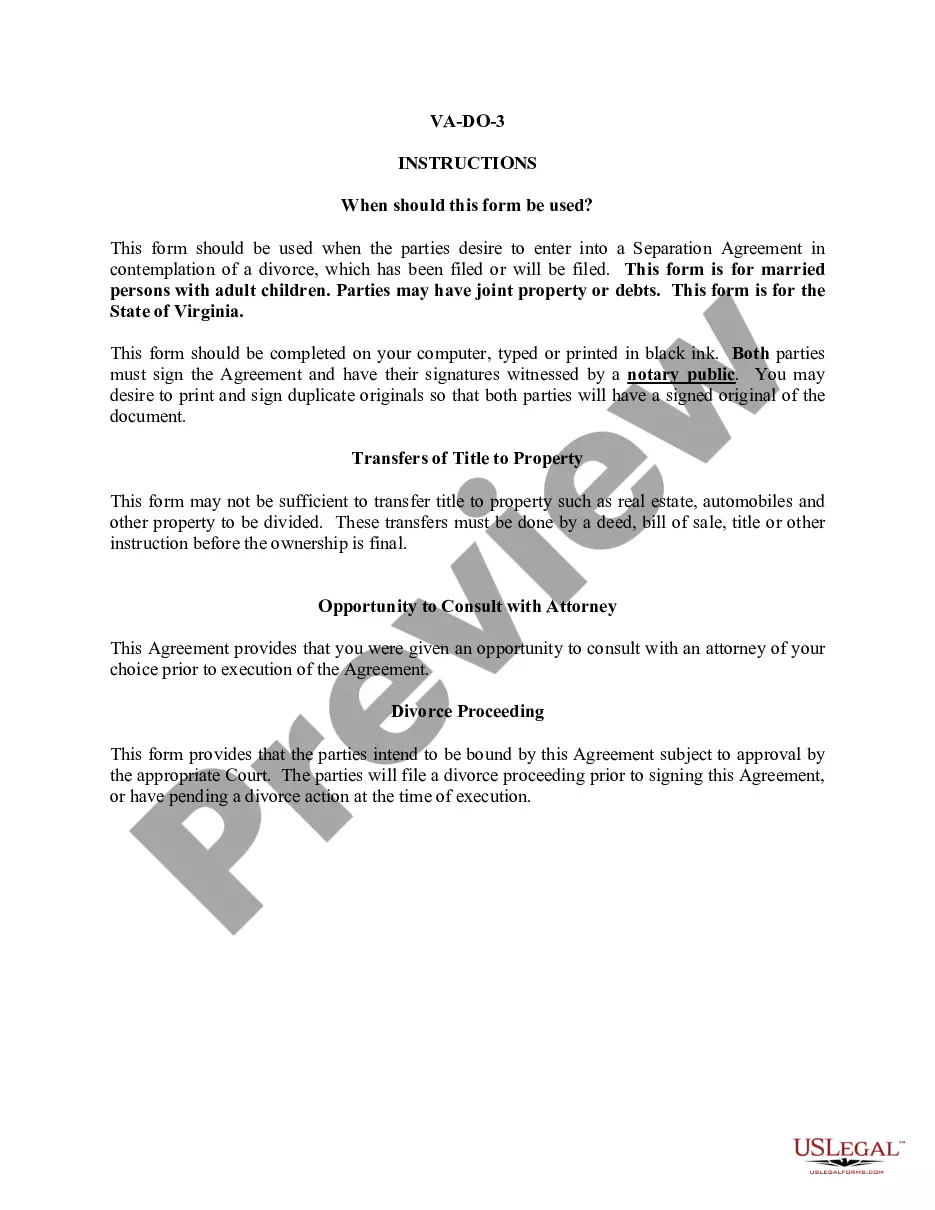
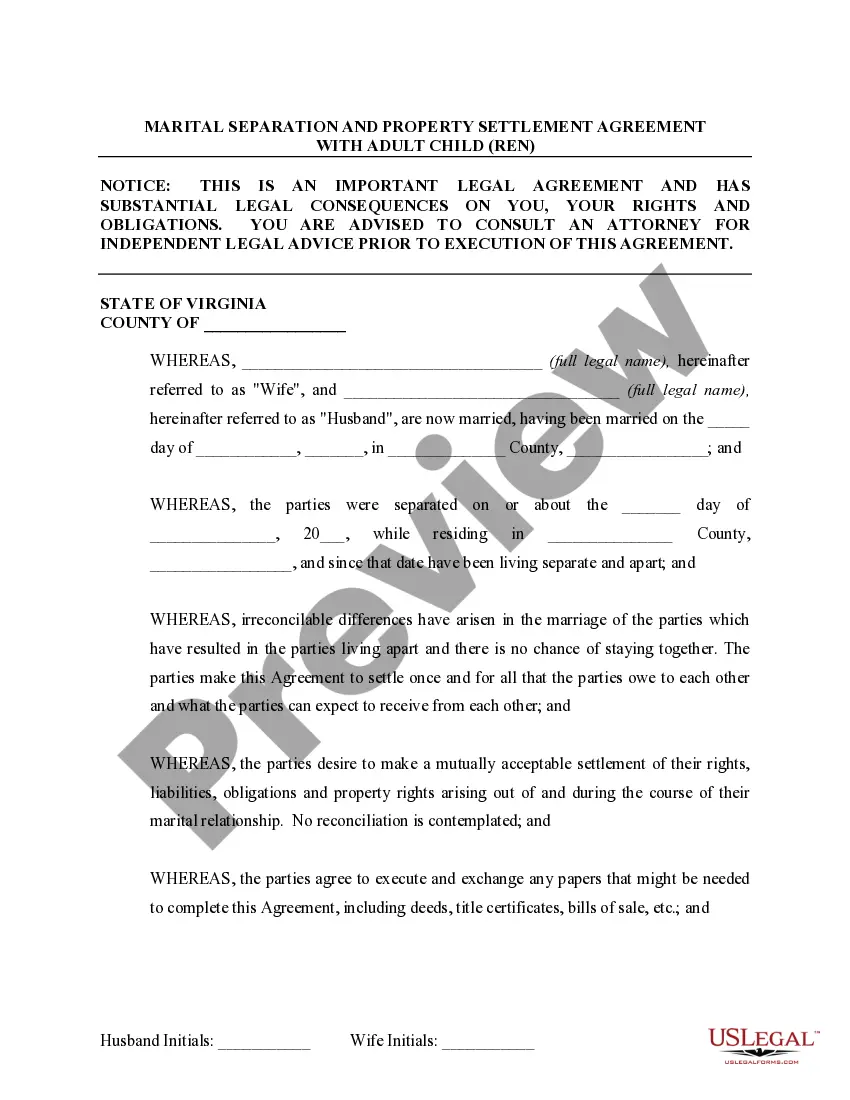
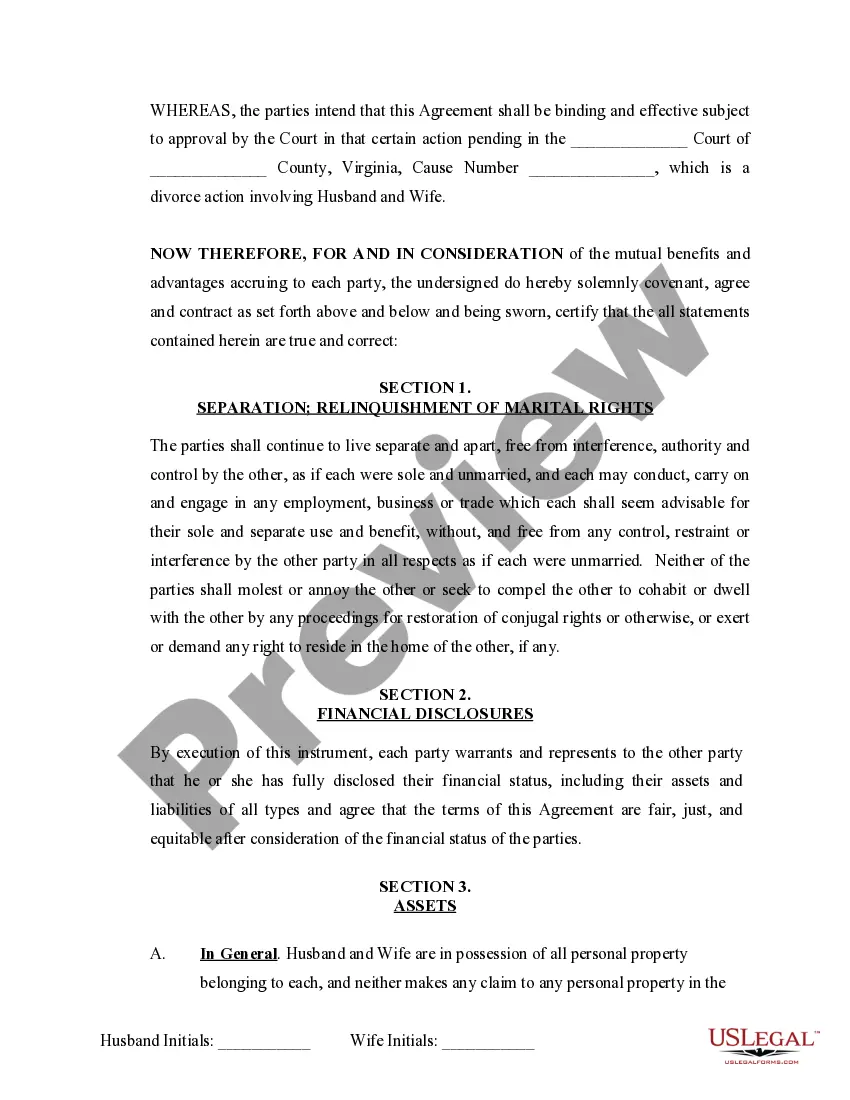
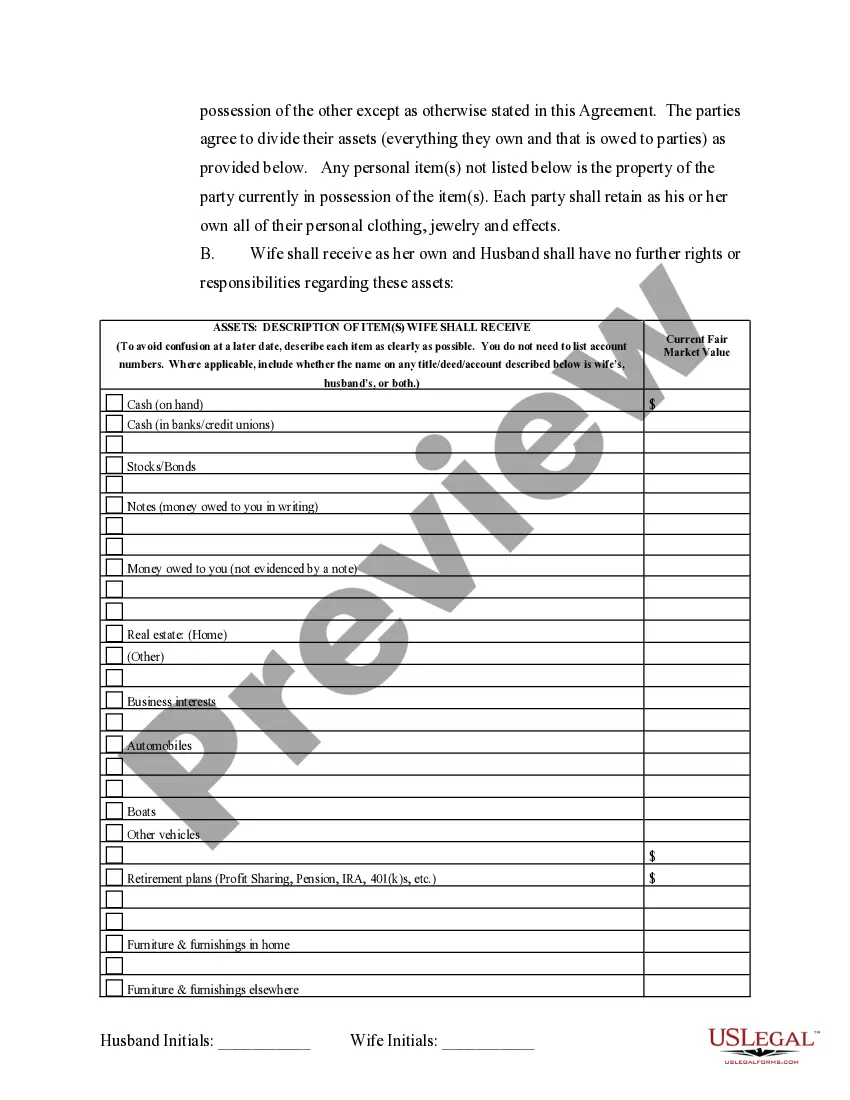
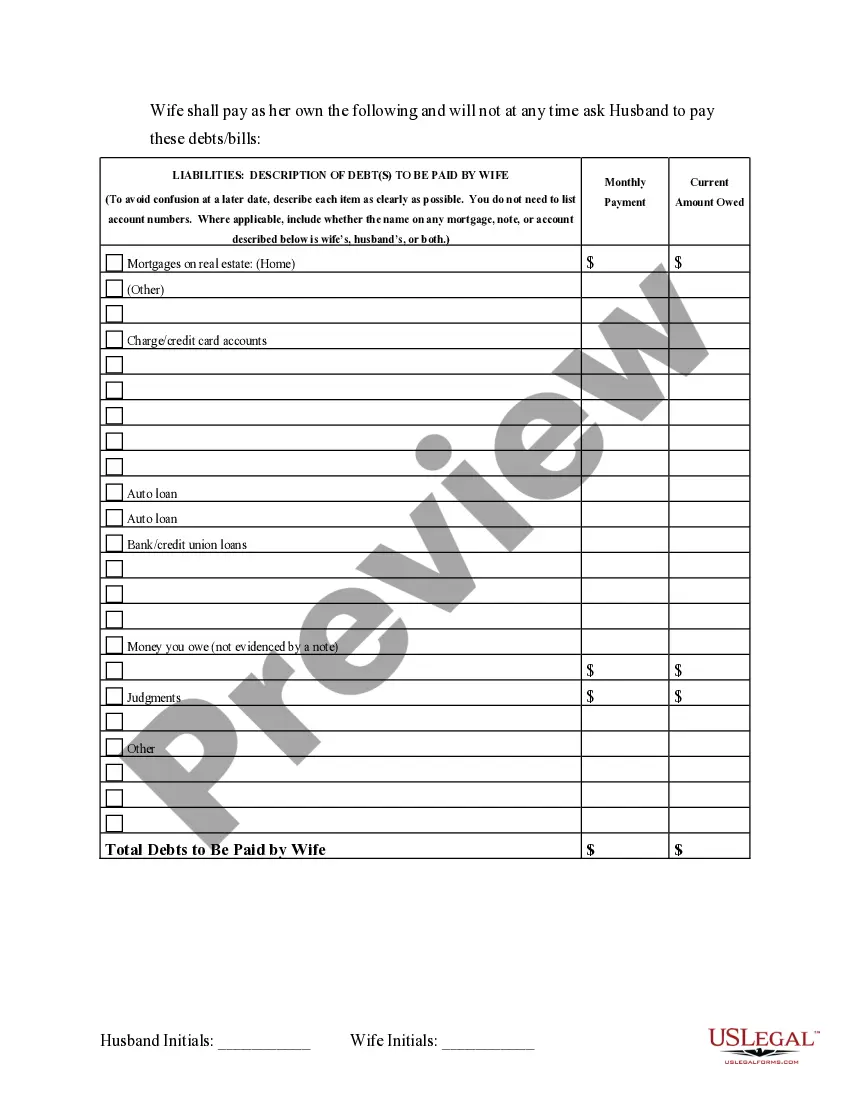
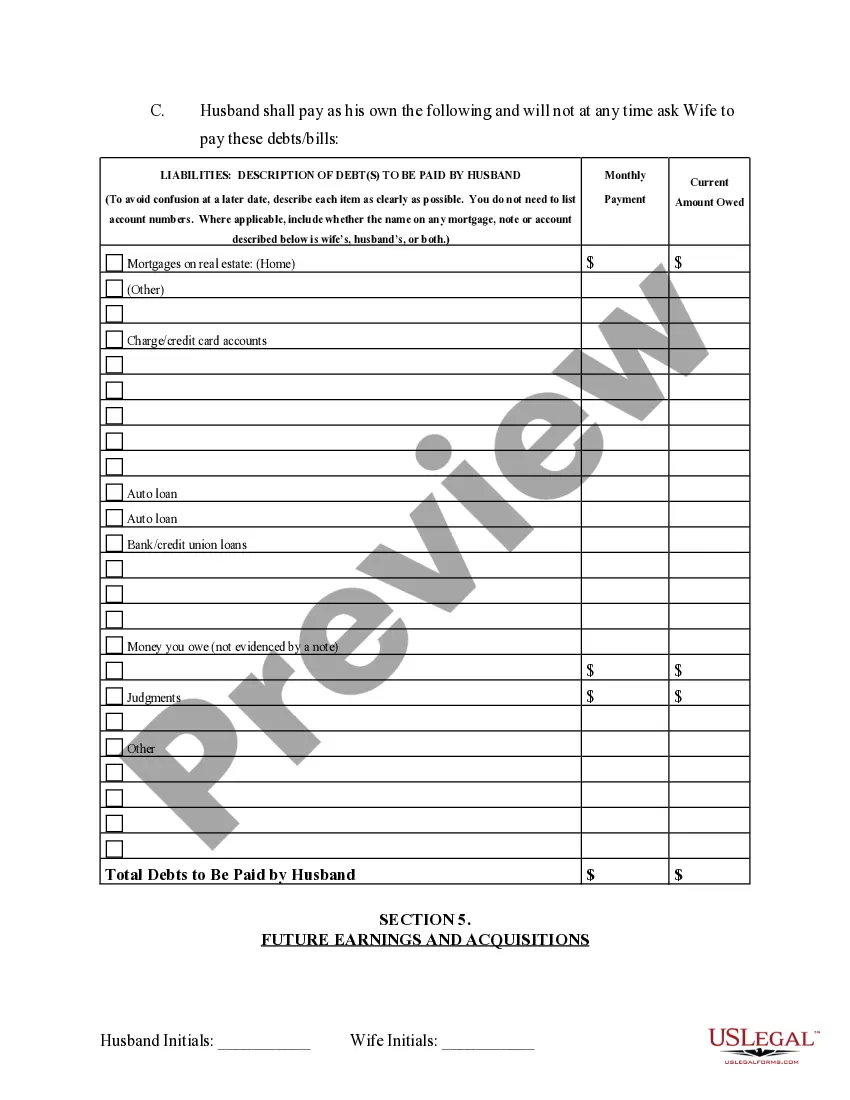
Marital Domestic Separation and Property Settlement Agreement Adult Children Parties May have Joint Property or Debts where Divorce Action Filed
Note: This summary is not intended to be an all inclusive
discussion of the law of separation agreements in Virginia, but does include
basic and other provisions.
General Summary:
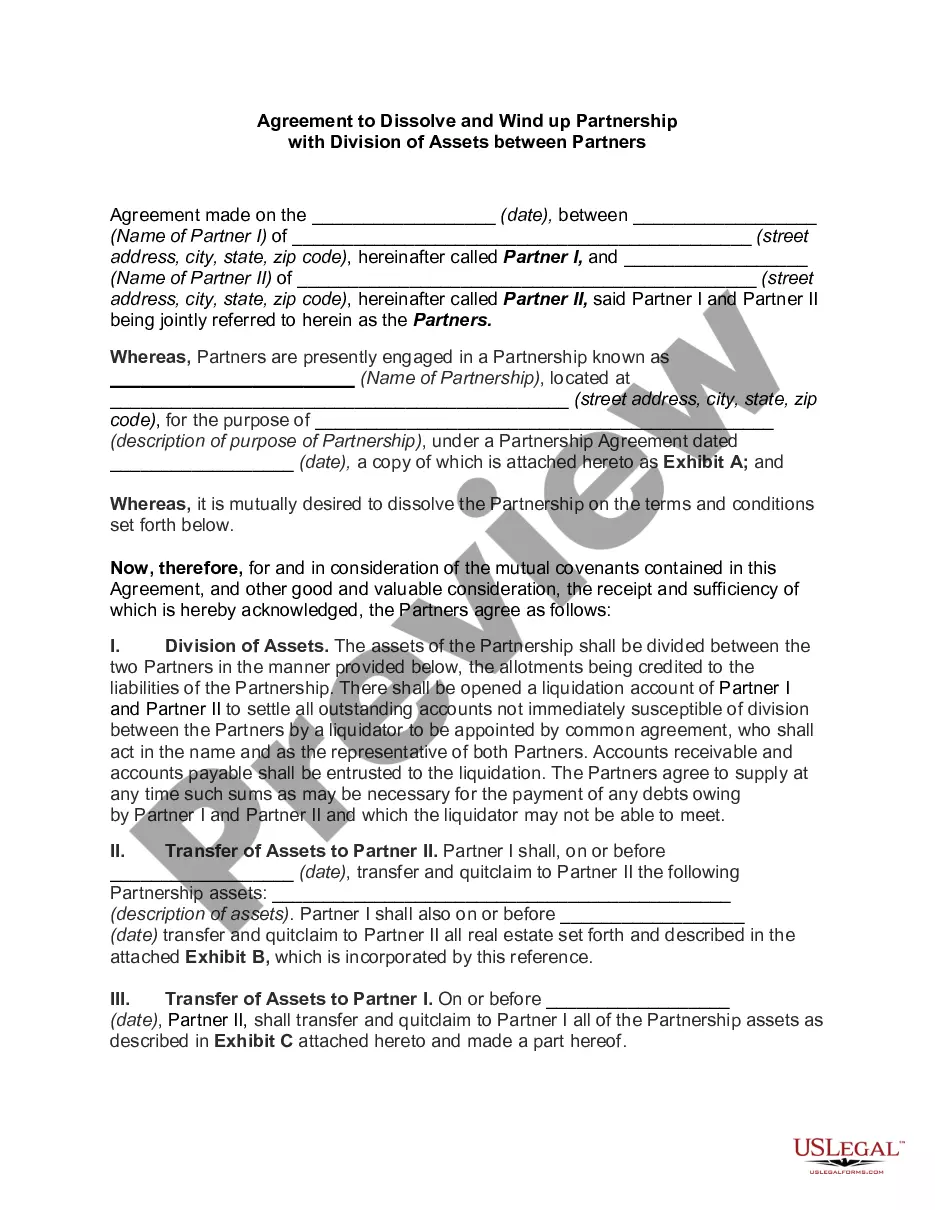
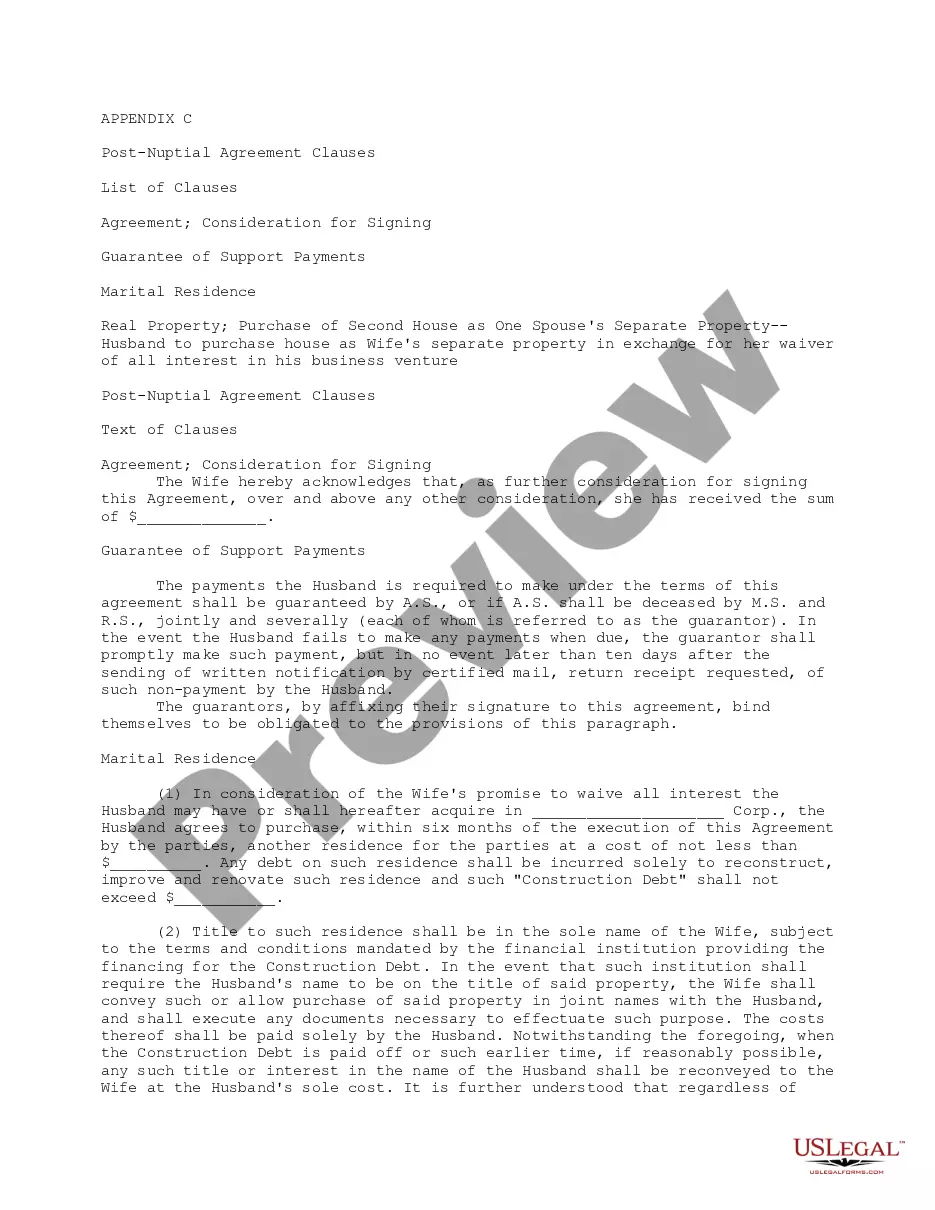
Separation and Property Agreements may be entered into before a divorce is filed to be effective immediately.
The Court may incorporate, ratify or affirm, the marital agreement in the
decree of divorce.
Virginia also provides that marital agreements, defined as a contract
between parties that are already married, may also be made under the terms
and conditions of the Premarital Agreement Act, Title 20, Ch. 8 of the
Virginia Code. Thus a marital agreement, as a contract, may be revoked
only by a written agreement signed by the parties.
The marital agreement is thus a part of the decree when it is incorporated
by the Court and a valid contract between the parties and may be enforced
as such.
Statutes:
Code of Virginia
Title 20 - DOMESTIC RELATIONS.
Chapter 6 - Divorce, Affirmation and Annulment
Grounds for divorce from bond of matrimony; contents of decree:
A. A divorce from the bond of matrimony may be decreed:
(3) Where either of the parties subsequent to the marriage has
been convicted of a felony, sentenced to confinement for more than one
year and confined for such felony subsequent to such conviction, and cohabitation
has not been resumed after knowledge of such confinement (in which case
no pardon granted to the party so sentenced shall restore such party to
his or her conjugal rights);
(6) Where either party has been guilty of cruelty, caused reasonable
apprehension of bodily hurt, or willfully deserted or abandoned the other,
such divorce may be decreed to the innocent party after a period of one
year from the date of such act; or
(9) (a) On the application of either party if and when the husband
and wife have lived separate and apart without any cohabitation and without
interruption for one year. In any case where the parties have entered into
a separation agreement and there are no minor children either born of the
parties, born of either party and adopted by the other or adopted by both
parties, a divorce may be decreed on application if and when the husband
and wife have lived separately and apart without cohabitation and without
interruption for six months. A plea of res adjudicata or of recrimination
with respect to any other provision of this section shall not be a bar
to either party obtaining a divorce on this ground; nor shall it be a bar
that either party has been adjudged insane, either before or after such
separation has commenced, but at the expiration of one year or six months,
whichever is applicable, from the commencement of such separation, the
grounds for divorce shall be deemed to be complete, and the committee of
the insane defendant, if there be one, shall be made a party to the cause,
or if there be no committee, then the court shall appoint a guardian ad
litem to represent the insane defendant.
(b) This subdivision (9) shall apply whether the separation
commenced prior to its enactment or shall commence thereafter. Where otherwise
valid, any decree of divorce hereinbefore entered by any court having equity
jurisdiction pursuant to this subdivision (9), not appealed to the Supreme
Court of Virginia, is hereby declared valid according to the terms of said
decree notwithstanding the insanity of a party thereto.
B. A decree of divorce shall include each party's social security number,
or other control number issued by the Department of Motor Vehicles pursuant
to § 46.2-342. § 20-91.
Court may decree as to property of the parties:
A. Upon decreeing the dissolution of a marriage, and also
upon decreeing a divorce from the bond of matrimony, or upon the filing
with the court as provided in subsection J of a certified copy of a final
divorce decree obtained without the Commonwealth, the court, upon request of either party, shall determine
the legal title as between the parties, and the ownership and value of
all property, real or personal, tangible or intangible, of the parties
and shall consider which of such property is separate property, which is marital property, and which
is part separate and part marital property in accordance with subdivision
A 3. The court shall determine the value of any such property as of the
date of the evidentiary hearing on the evaluation issue. Upon motion of
either party made no less than twenty-one days before the evidentiary hearing
the court may, for good cause shown, in order to attain the ends of justice,
order that a different valuation date be used. The court, on the motion
of either party, may retain jurisdiction in the final decree of divorce
to adjudicate the remedy provided by this section when the court determines
that such action is clearly necessary, and all decrees heretofore entered
retaining such jurisdiction are validated.
1. Separate property is (i) all property, real and personal,
acquired by either party before the marriage; (ii) all property acquired
during the marriage by bequest, devise, descent, survivorship or gift from
a source other than the other party; (iii) all property acquired during
the marriage in exchange for or from the proceeds of sale of separate property,
provided that such property acquired during the marriage is maintained
as separate property; and (iv) that part of any property classified as
separate pursuant to subdivision A 3. Income received from separate property
during the marriage is separate property if not attributable to the personal
effort of either party. The increase in value of separate property during
the marriage is separate property, unless marital property or the personal
efforts of either party have contributed to such increases and then only
to the extent of the increases in value attributable to such contributions.
The personal efforts of either party must be significant and result in
substantial appreciation of the separate property if any increase in value
attributable thereto is to be considered marital property.
2. Marital property is (i) all property titled in the names of
both parties, whether as joint tenants, tenants by the entirety or otherwise,
except as provided by subdivision A 3, (ii) that part of any property classified
as marital pursuant to subdivision A 3, or (iii) all other property acquired
by each party during the marriage which is not separate property as defined
above. All property including that portion of pensions, profit-sharing
or deferred compensation or retirement plans of whatever nature, acquired
by either spouse during the marriage, and before the last separation of
the parties, if at such time or thereafter at least one of the parties
intends that the separation be permanent, is presumed to be marital property
in the absence of satisfactory evidence that it is separate property. For
purposes of this section marital property is presumed to be jointly owned unless there is a deed, title or other clear indicia
that it is not jointly owned.
3. The court shall classify property as part marital property and
part separate property as follows:
a. In the case of income received from separate property
during the marriage, such income shall be marital property only to the
extent it is attributable to the personal efforts of either party. In the
case of the increase in value of separate property during the marriage,
such increase in value shall be marital property only to the extent that
marital property or the personal efforts of either party have contributed
to such increases, provided that any such personal efforts must be significant
and result in substantial appreciation of the separate property.
For purposes of this subdivision, the nonowning spouse shall bear
the burden of proving that (i) contributions of marital property or personal
effort were made and (ii) the separate property increased in value. Once
this burden of proof is met, the owning spouse shall bear the burden of
proving that the increase in value or some portion thereof was not caused
by contributions of marital property or personal effort.
"Personal effort" of a party shall be deemed to be labor, effort,
inventiveness, physical or intellectual skill, creativity, or managerial,
promotional or marketing activity applied directly to the separate property
of either party.
b. In the case of any pension, profit-sharing, or deferred compensation
plan or retirement benefit, the marital share as defined in subsection
G shall be marital property.
d. When marital property and separate property are commingled by
contributing one category of property to another, resulting in the loss
of identity of the contributed property, the classification of the contributed
property shall be transmuted to the category of property receiving the
contribution. However, to the extent the contributed property is retraceable
by a preponderance of the evidence and was not a gift, such contributed
property shall retain its original classification.
e. When marital property and separate property are commingled into
newly acquired property resulting in the loss of identity of the contributing
properties, the commingled property shall be deemed transmuted to marital
property. However, to the extent the contributed property is retraceable
by a preponderance of the evidence and was not a gift, the contributed
property shall retain its original classification.
f. When separate property is retitled in the joint names of the
parties, the retitled property shall be deemed transmuted to marital property.
However, to the extent the property is retraceable by a preponderance of
the evidence and was not a gift, the retitled property shall retain its
original classification.
g. Subdivisions A 3 d, e and f of this section shall apply to jointly
owned property. No presumption of gift shall arise under this section where
(i) separate property is commingled with jointly owned property; (ii) newly
acquired property is conveyed into joint ownership; or (iii) existing property
is conveyed or retitled into joint ownership. For purposes of this subdivision
A 3, property is jointly owned when it is titled in the name of both parties,
whether as joint tenants, tenants by the entireties, or otherwise.
B. For the purposes of this section only, both parties shall be deemed
to have rights and interests in the marital property. However, such interests
and rights shall not attach to the legal title of such property and are
only to be used as a consideration in determining a monetary award, if
any, as provided in this section.
C. Except as provided in subsection G, the court shall have no
authority to order the division or transfer of separate property or marital
property which is not jointly owned. The court may, based upon the factors
listed in subsection E, divide or transfer or order the division or transfer,
or both, of jointly owned marital property, or any part thereof. The court
shall also have the authority to apportion and order the payment of the
debts of the parties, or either of them, that are incurred prior to the
dissolution of the marriage, based upon the factors listed in subsection
E.
As a means of dividing or transferring the jointly owned marital
property, the court may transfer or order the transfer of real or personal
property or any interest therein to one of the parties, permit either party
to purchase the interest of the other and direct the allocation of the
proceeds, provided the party purchasing the interest of the other agrees
to assume any indebtedness secured by the property, or order its sale by
private sale by the parties, through such agent as the court shall direct,
or by public sale as the court shall direct without the necessity for partition.
All decrees entered prior to July 1, 1991, which are final and not subject to further proceedings on appeal
as of that date, which divide or transfer or order the division or transfer
of property directly between the parties are hereby validated and deemed
self-executing. All orders or decrees which divide or transfer or order
division or transfer of real property between the parties shall be recorded
and indexed in the names of the parties in the appropriate grantor and
grantee indexes in the land records in the clerk's office of the circuit
court of the county or city in which the property is located.
D. In addition, based upon (i) the equities and the rights and interests
of each party in the marital property, and (ii) the factors listed in subsection
E, the court has the power to grant a monetary award, payable either in
a lump sum or over a period of time in fixed amounts, to either party.
The party against whom a monetary award is made may satisfy the award,
in whole or in part, by conveyance of property, subject to the approval
of the court. An award entered pursuant to this subsection shall constitute
a judgment within the meaning of § 8.01-426 and shall not be docketed
by the clerk unless the decree so directs. The provisions of § 8.01-382,
relating to interest on judgments, shall apply unless the court orders
otherwise.
Any marital property, which has been considered or ordered transferred
in granting the monetary award under this section, shall not thereafter
be the subject of a suit between the same parties to transfer title or
possession of such property.
E. The amount of any division or transfer of jointly owned marital
property, and the amount of any monetary award, the apportionment of marital
debts, and the method of payment shall be determined by the court after
consideration of the following factors:
1. The contributions, monetary and nonmonetary, of each
party to the well-being of the family;
2. The contributions, monetary and nonmonetary, of each party in
the acquisition and care and maintenance of such marital property of the
parties;
5. The circumstances and factors which contributed to the dissolution
of the marriage, specifically including any ground for divorce under the
provisions of subdivisions (1), (3) or (6) of § 20-91 or § 20-95;
7. The debts and liabilities of each spouse, the basis for such
debts and liabilities, and the property which may serve as security for
such debts and liabilities;
10. Such other factors as the court deems necessary or appropriate
to consider in order to arrive at a fair and equitable monetary award.
F. The court shall determine the amount of any such monetary award
without regard to maintenance and support awarded for either party or support
for the minor children of both parties and shall, after or at the time
of such determination and upon motion of either party, consider whether
an order for support and maintenance of a spouse or children shall be entered
or, if previously entered, whether such order shall be modified or vacated.
G. In addition to the monetary award made pursuant to subsection
D, and upon consideration of the factors set forth in Subsection E:
1. The court may direct payment of a percentage of the
marital share of any pension, profit-sharing or deferred compensation plan
or retirement benefits, whether vested or nonvested, which constitutes
marital property and whether payable in a lump sum or over a period of
time. The court may order direct payment of such percentage of the marital
share by direct assignment to a party from the employer trustee, plan administrator
or other holder of the benefits. However, the court shall only direct that
payment be made as such benefits are payable. No such payment shall exceed
fifty percent of the marital share of the cash benefits actually received
by the party against whom such award is made. "Marital share" means that
portion of the total interest, the right to which was earned during the
marriage and before the last separation of the parties, if at such time
or thereafter at least one of the parties intended that the separation
be permanent.
2. To the extent permitted by federal or other applicable law,
the court may order a party to designate a spouse or former spouse as irrevocable
beneficiary during the lifetime of the beneficiary of all or a portion
of any survivor benefit or annuity plan of whatsoever nature, but not to
include a life insurance policy. The court, in its discretion, shall determine
as between the parties, who shall bear the costs of maintaining such plan.
H. In addition to the monetary award made pursuant to subsection D,
and upon consideration of the factors set forth in subsection E, the court
may direct payment of a percentage of the marital share of any personal
injury or workers' compensation recovery of either party, whether such
recovery is payable in a lump sum or over a period of time. However, the
court shall only direct that payment be made as such recovery is payable,
whether by settlement, jury award, court award, or otherwise. "Marital
share" means that part of the total personal injury or workers' compensation
recovery attributable to lost wages or medical expenses to the extent not
covered by health insurance accruing during the marriage and before the last separation of the parties, if at such time or thereafter
at least one of the parties intended that the separation be permanent.
I. Nothing in this section shall be construed to prevent the affirmation,
ratification and incorporation in a decree of an agreement between the
parties pursuant to §§ 20-109 and 20-109.1. Agreements, otherwise
valid as contracts, entered into between spouses prior to the marriage
shall be recognized and enforceable.
J. A court of proper jurisdiction under § 20-96 may exercise
the powers conferred by this section after a court of a foreign jurisdiction
has decreed a dissolution of a marriage or a divorce from the bond of matrimony,
if (i) one of the parties was domiciled in this Commonwealth when the foreign
proceedings were commenced, (ii) the foreign court did not have personal
jurisdiction over the party domiciled in the Commonwealth, (iii) the proceeding
is initiated within two years of receipt of notice of the foreign decree
by the party domiciled in the Commonwealth, and (iv) the court obtains
personal jurisdiction over the parties pursuant to subdivision A 9 of §
8.01-328.1, or in any other manner permitted by law.
K. The court shall have the continuing authority and jurisdiction
to make any additional orders necessary to effectuate and enforce any order
entered pursuant to this section, including the authority to:
1. Order a date certain for transfer or division of any
jointly owned property under subsection C or payment of any monetary award
under subsection D;
2. Punish as contempt of court any willful failure of a party to
comply with the provisions of any order made by the court under this section;
3. Appoint a special commissioner to transfer any property under
subsection C where a party refuses to comply with the order of the court
to transfer such property; and
4. Modify any order entered in a case filed on or after July 1,
1982, intended to affect or divide any pension, profit-sharing or deferred
compensation plan or retirement benefits pursuant to the United States
Internal Revenue Code or other applicable federal laws, only for the purpose
of establishing or maintaining the order as a qualified domestic relations
order or to revise or conform its terms so as to effectuate the expressed
intent of the order. § 20-107.3.
§ 20-108. Revision and alteration of such decrees.
The court may, from time to time after decreeing as provided in
§ 20-107.2, on petition of either of the parents, or on its own motion
or upon petition of any probation officer or superintendent of public welfare,
which petition shall set forth the reasons for the relief sought, revise
and alter such decree concerning the care, custody, and maintenance of
the children and make a new decree concerning the same, as the circumstances
of the parents and the benefit of the children may require. The intentional
withholding of visitation of a child from the other parent without just
cause may constitute a material change of circumstances justifying a change of custody in the discretion
of the court.
No support order may be retroactively modified, but may be modified
with respect to any period during which there is a pending petition for
modification, but only from the date that notice of such petition has been
given to the responding party.
Affirmation, ratification and incorporation by reference in decree
of agreement between parties:
Any court may affirm, ratify and incorporate by reference in its
decree dissolving a marriage or decree of divorce whether from the bond
of matrimony or from bed and board, or by a separate decree prior to or
subsequent to such decree, or in a decree entered in a suit for annulment
or separate maintenance, and in a proceeding arising under subsection A
3 or L of § 16.1-241, any valid agreement between the parties, or
provisions thereof, concerning the conditions of the maintenance of the
parties, or either of them and the care, custody and maintenance of their
minor children, or establishing or imposing any other condition or consideration,
monetary or nonmonetary. Where the court affirms, ratifies and incorporates
by reference in its decree such agreement or provision thereof, it shall
be deemed for all purposes to be a term of the decree, and enforceable
in the same manner as any provision of such decree. The provisions of this
section shall apply to any decree hereinbefore or hereinafter entered affirming,
ratifying and incorporating an agreement as provided herein. Upon the death
or remarriage of the spouse receiving support, spousal support shall terminate
unless otherwise provided by stipulation or contract. In any case where
jurisdiction is obtained over a nonresident defendant by order of publication
or by acceptance of service pursuant to § 20-99.1:1, any properly
acknowledged and otherwise valid agreement entered into between the parties
may be affirmed, ratified and incorporated as provided in this section.
§ 20-109.1.
Chapter 8 - Premarital Agreement Act
Application:
This chapter shall apply to any premarital agreement executed on
or after July 1, 1986. § 20-147.
Definitions:
As used in this chapter:
"Premarital agreement" means an agreement between prospective spouses
made in contemplation of marriage and to be effective upon marriage.
"Property" means an interest, present or future, legal or equitable,
vested or contingent, in real or personal property, including income and
earnings. § 20-148.
Formalities of premarital agreement:
A premarital agreement shall be in writing and signed by both parties.
Such agreement shall be enforceable without consideration and shall become
effective upon marriage. § 20-149.
Content of agreement:
Parties to a premarital agreement may contract with respect to:
1. The rights and obligations of each of the parties in
any of the property of either or both of them whenever and wherever acquired
or located;
2. The right to buy, sell, use, transfer, exchange, abandon, lease,
consume, expend, assign, create a security interest in, mortgage, encumber,
dispose of, or otherwise manage and control property;
3. The disposition of property upon separation, marital dissolution,
death, or the occurrence or nonoccurrence of any other event;
4. Spousal support;
5. The making of a will, trust, or other arrangement to carry out
the provisions of the agreement;
6. The ownership rights in and disposition of the death benefit
from a life insurance policy;
7. The choice of law governing the construction of the agreement;
and
8. Any other matter, including their personal rights and obligations,
not in violation of public policy or a statute imposing a criminal penalty.
§ 20-150.
Enforcement; void marriage:
A. A premarital agreement is not enforceable if the person
against whom enforcement is sought proves that:
2. The agreement was unconscionable when it was executed and, before
execution of the agreement, that person (i) was not provided a fair and
reasonable disclosure of the property or financial obligations of the other
party; and (ii) did not voluntarily and expressly waive, in writing, any right to disclosure of the
property or financial obligations of the other party beyond the disclosure
provided.
B. Any issue of unconscionability of a premarital agreement shall be
decided by the court as a matter of law. Recitations in the agreement shall
create a prima facie presumption that they are factually correct.
C. If a marriage is determined to be void, an agreement that would
otherwise have been a premarital agreement shall be enforceable only to
the extent necessary to avoid an inequitable result. § 20-151.
Limitation of actions:
Any statute of limitations applicable to an action asserting a
claim for relief under a premarital agreement is tolled during the marriage
of the parties to the agreement. However, equitable defenses limiting the
time for enforcement, including laches and estoppel, are available to either party. § 20-152.
Amendment or revocation of agreement:
After marriage, a premarital agreement may be amended or revoked
only by a written agreement signed by the parties. The amended agreement
or the revocation is enforceable without consideration. § 20-153.
Prior agreements:
All written agreements entered into prior to the enactment of this
chapter between prospective spouses for the purpose affecting any of the
subjects specified in § 20-150 shall be valid and enforceable if otherwise
valid as contracts. § 20-154.
Marital agreements:
Married persons may enter into agreements with each other for the
purpose of settling the rights and obligations of either or both of them,
to the same extent, with the same effect, and subject to the same conditions,
as provided in §§ 20-147 through 20-154 for agreements between prospective spouses, except that
such marital agreements shall become effective immediately upon their execution.
However, a reconciliation of the parties after the signing of a separation
or property settlement agreement shall abrogate such agreement unless otherwise
expressly set forth in the agreement. § 20-155.
Caselaw:
Incorporation of the [property settlement] agreement into the decree
renders the terms of the agreement so incorporated enforceable as a decree
of the court." Fry v. Schwarting, 4 Va. App. 173, 179, 355 S.E.2d
342, 345 (1987). However, a decree that incorporates an agreement permitting
automatic, unilateral, or agreed upon modification of support without prior
court approval is a legal nullity and void. Kelley v. Kelley, 248
Va. 295, 298-99, 449 S.E.2d 55, 56-57 (1994). Parents cannot contract
away their children's rights to support and any provision which impinges
upon the right of children to support is void, and a decree which incorporates
such provision is likewise void. Riggins v. O'Brien, 34 Va.
App. 82, 538 S.E.2d 320
In order to challenge the validity of a separation agreement that
has been incorporated into a divorce decree, the challenge must be brought
within twenty-one days after the entry of the divorce decree. Rook v.
Rook, 233 Va. 92, 94-95, 353 S.E.2d 756, 757-58 (1987). After the passage
of twenty-one days from the entry of a judgment, the judgment becomes final
and conclusive, absent a perfected appeal. Golderos v. Golderos,
169 Va. 496, 501-02, 194 S.E. 706, 707-08 (1938). Accordingly, any challenge
to the agreement may be made only upon grounds sufficient to sustain a
challenge to the divorce decree itself. Higgins v. McFarlan,
196 Va. 889, 896-97, 86 S.E.2d 168, 173 (1955).
Both parents owe a duty of support to their minor children. Code
Sec. 20-61. A divorce court retains continuing jurisdiction to change
or modify its decree relating to the maintenance and support of minor children.
Code Sec. 20-108; Featherstone v. Brooks, 220 Va. 443, 448, 258
S.E.2d 513, 516 (1979). Consequently, parents cannot contract away
their children's rights to support nor can a court be precluded by agreement
from exercising its power to decree child support. Carter v. Carter,
215 Va. 475, 481, 211 S.E.2d 253, 258 (1975).