Tennessee Owner's Notice of Transfer by Corporation
What this document covers
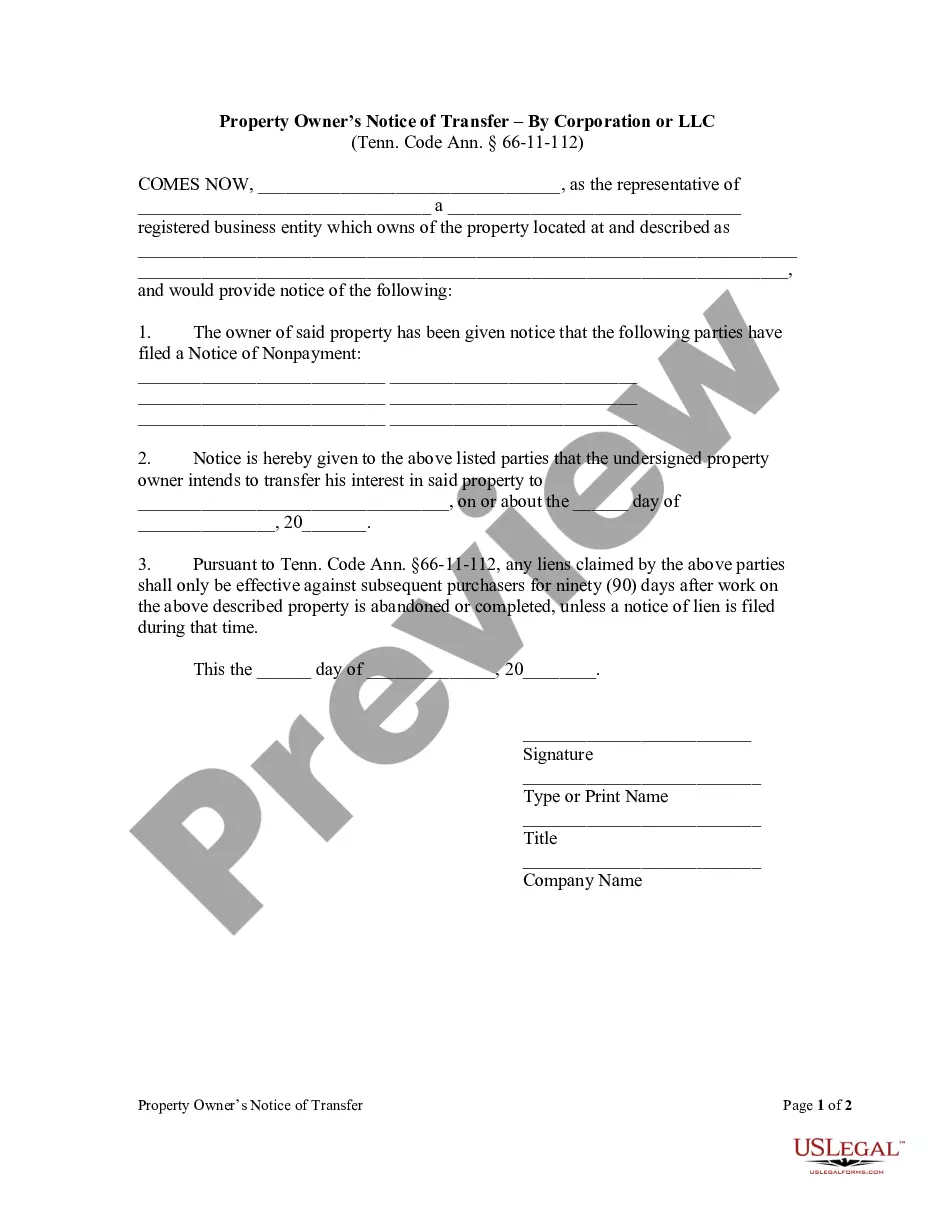
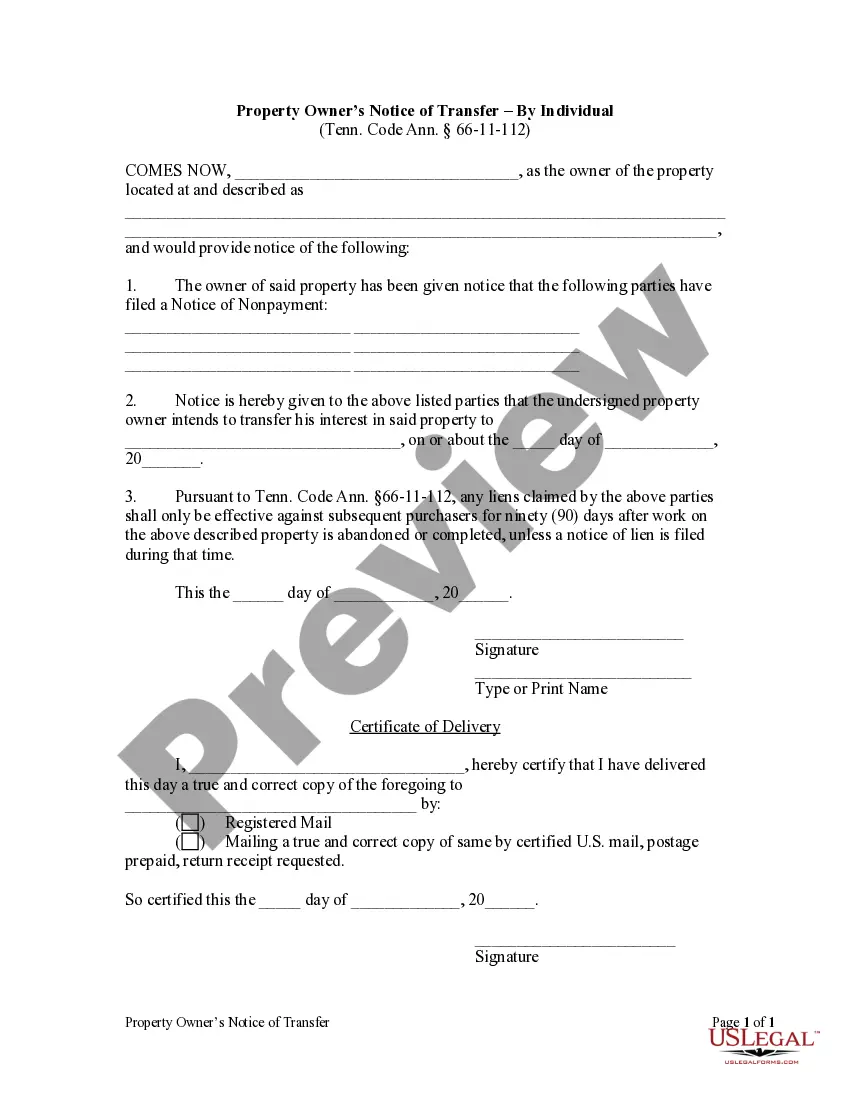
The Owner's Notice of Transfer by Corporation is a legal document used by corporations to inform involved parties that an interest in a property is being transferred. This form is essential for protecting the interests of lienors by providing them with advance notice of any impending transfer. It also outlines the rules governing the validity of any liens against the property after such transfer, distinguishing it from other property transfer forms by its focus on lien notifications.
What’s included in this form
- Identification of the property owner and corporation.
- List of parties that have filed a Notice of Nonpayment.
- Details of the intended property transfer, including dates.
- Statement regarding the effectiveness of any liens against subsequent purchasers for ninety days.
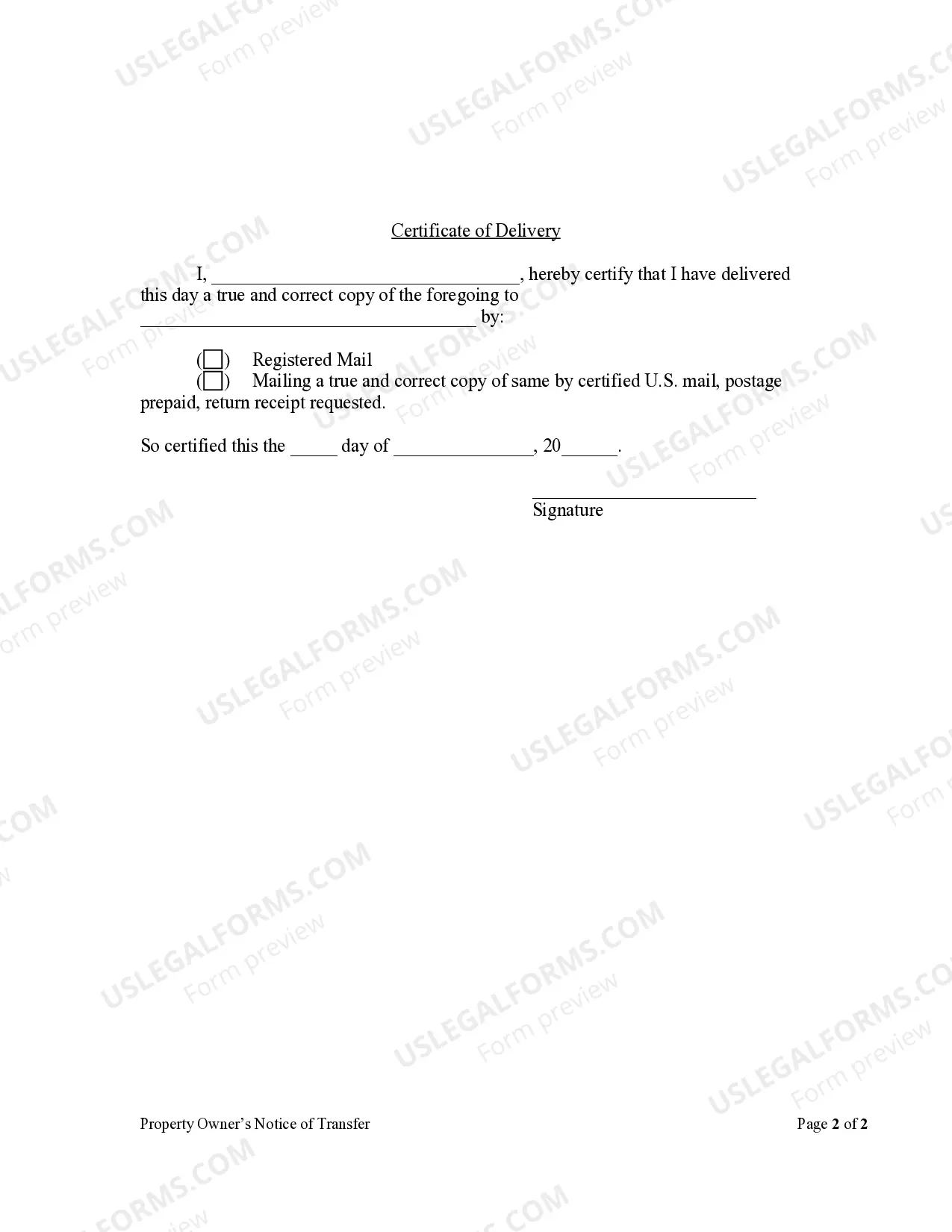
- Certification of delivery of the notice to relevant parties.
Common use cases
This form should be used when a corporation intends to transfer ownership or interest in a property and needs to notify existing lienors. It is particularly important following renovations, demolitions, or when the property is being abandoned, as timely notice helps protect the rights of lienholders and ensures compliance with local regulations.
Who this form is for
This form is intended for:
- Corporations owning real property.
- Representatives or agents acting on behalf of the corporation.
- Legal professionals managing property transfers involving corporations.
- Lienors who have filed a Notice of Nonpayment and need timely information about property transfers.
How to complete this form
- Identify the corporation and its representative responsible for the property.
- Specify the property location and description accurately.
- List all parties that filed a Notice of Nonpayment.
- Enter the details of the intended transfer, including the date.
- Sign and date the document, ensuring it is delivered to all notified parties.
Is notarization required?
Notarization is required for this form to take effect. Our online notarization service, powered by Notarize, lets you verify and sign documents remotely through an encrypted video session, available 24/7.
Get your form ready online
Our built-in tools help you complete, sign, share, and store your documents in one place.
Make edits, fill in missing information, and update formatting in US Legal Forms—just like you would in MS Word.
Download a copy, print it, send it by email, or mail it via USPS—whatever works best for your next step.
Sign and collect signatures with our SignNow integration. Send to multiple recipients, set reminders, and more. Go Premium to unlock E-Sign.
If this form requires notarization, complete it online through a secure video call—no need to meet a notary in person or wait for an appointment.
We protect your documents and personal data by following strict security and privacy standards.

Make edits, fill in missing information, and update formatting in US Legal Forms—just like you would in MS Word.

Download a copy, print it, send it by email, or mail it via USPS—whatever works best for your next step.

Sign and collect signatures with our SignNow integration. Send to multiple recipients, set reminders, and more. Go Premium to unlock E-Sign.

If this form requires notarization, complete it online through a secure video call—no need to meet a notary in person or wait for an appointment.

We protect your documents and personal data by following strict security and privacy standards.
Typical mistakes to avoid
- Failing to list all relevant lienors on the notice.
- Not providing adequate notice periods to affected parties.
- Omitting the correct details of the property description.
- Not signing the form before delivery.
Advantages of online completion
- Convenient download and access from anywhere at any time.
- Editable format for tailoring to specific needs without hassle.
- Ensured compliance with legal requirements through professionally drafted templates.
- Quick and efficient completion, minimizing potential legal complications.
Looking for another form?
Form popularity
FAQ
Probably the most obvious advantage to forming an LLC is protecting your personal assets by limiting the liability to the resources of the business itself. In most cases, the LLC will protect your personal assets from claims against the business, including lawsuits.There is also the tax benefit to an LLC.
LLC ownership can be expressed in two ways: (1) by percentage; and (2) by membership units, which are similar to shares of stock in a corporation. In either case, ownership confers the right to vote and the right to share in profits.
One of the main reasons to form a corporation or LLC for a small business is to avoid personal liability for the business' debts. As we mentioned earlier, corporations and LLCs have their own legal existence. It's the corporation or LLC that owns the business, its assets, debts, and liabilities.
An LLC can achieve pass-through taxation status without any of those restrictions. LLCs also offer more income tax choices in how you are taxed. By default, LLCs enjoy pass-through taxation under IRS rules. However, by making an IRS election, you could have your LLC taxed as a C corporation or an S Corporation.
A Limited Liability Company (LLC) is an entity created by state statute. Depending on elections made by the LLC and the number of members, the IRS will treat an LLC either as a corporation, partnership, or as part of the owner's tax return (a disregarded entity).
In an LLC, individuals with an ownership share are called members. In a corporation, they are called shareholders. One of the advantages an LLC has over a corporation is that in many states, a creditor cannot collect a member's dividends, whereas in a corporation dividends can be collected from shareholders.
LLC owners must pay self-employment taxes for all income. S-corp owners may pay less on this tax, provided they pay themselves a "reasonable salary." LLCs can have an unlimited number of members, while S-corps are limited to 100 shareholders.
What is a 'Notice of Determination'? You may have received, from the Office of the Tennessee Secretary of State (TN SOS) a 'Notice of Determination,' if the authorized member(s) of your LLC failed to file an Annual Report on the LLC's behalf (or for some other reason listed in T.C.A. § 48-245-301).
The owners of a limited liability company (LLC) are called members. Each member is an owner of the company; there are no owner shares, as in a corporation. An LLC is formed in a state by filing Articles of Organization or similar document in some states.