Tennessee Warranty Deed from Husband and Wife to a Trust
What this document covers
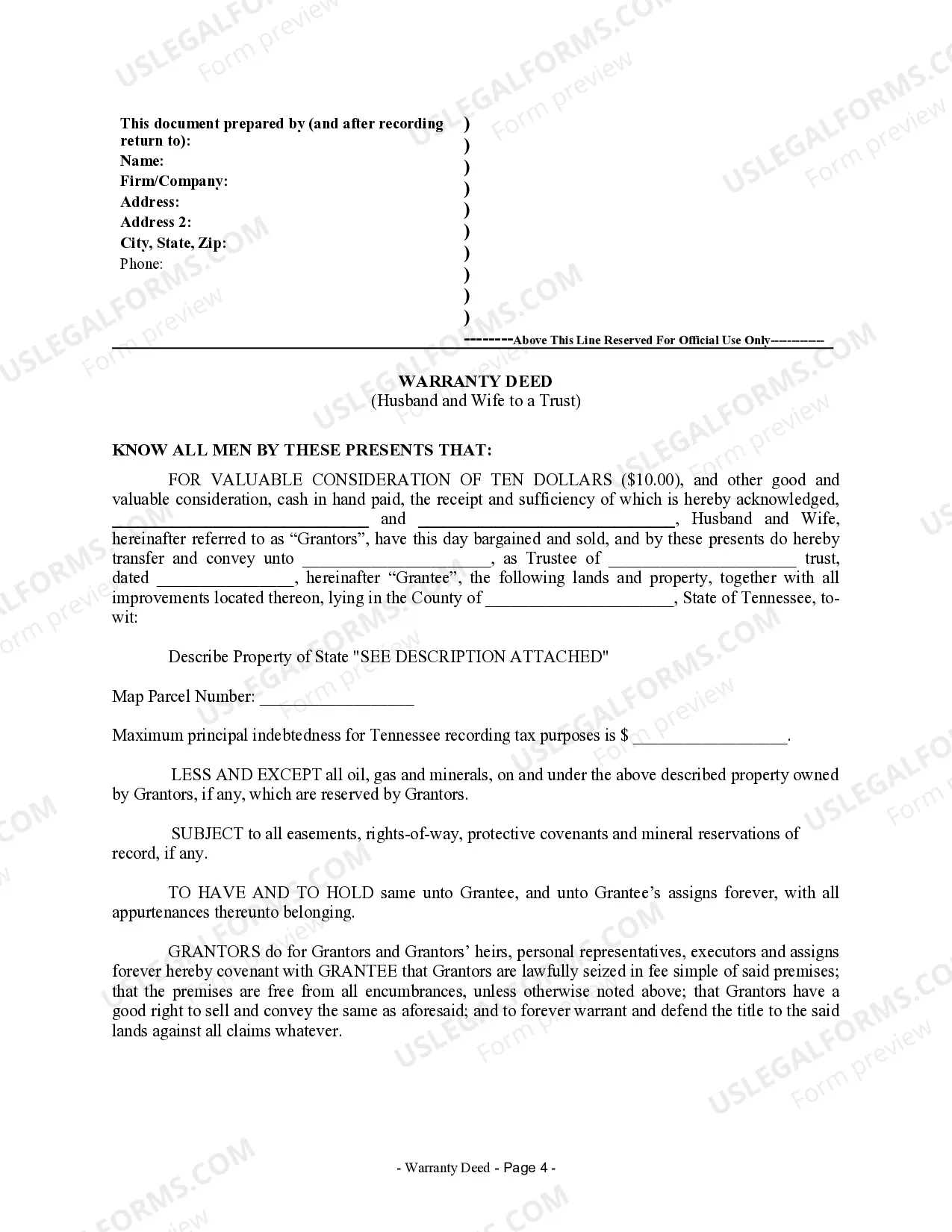
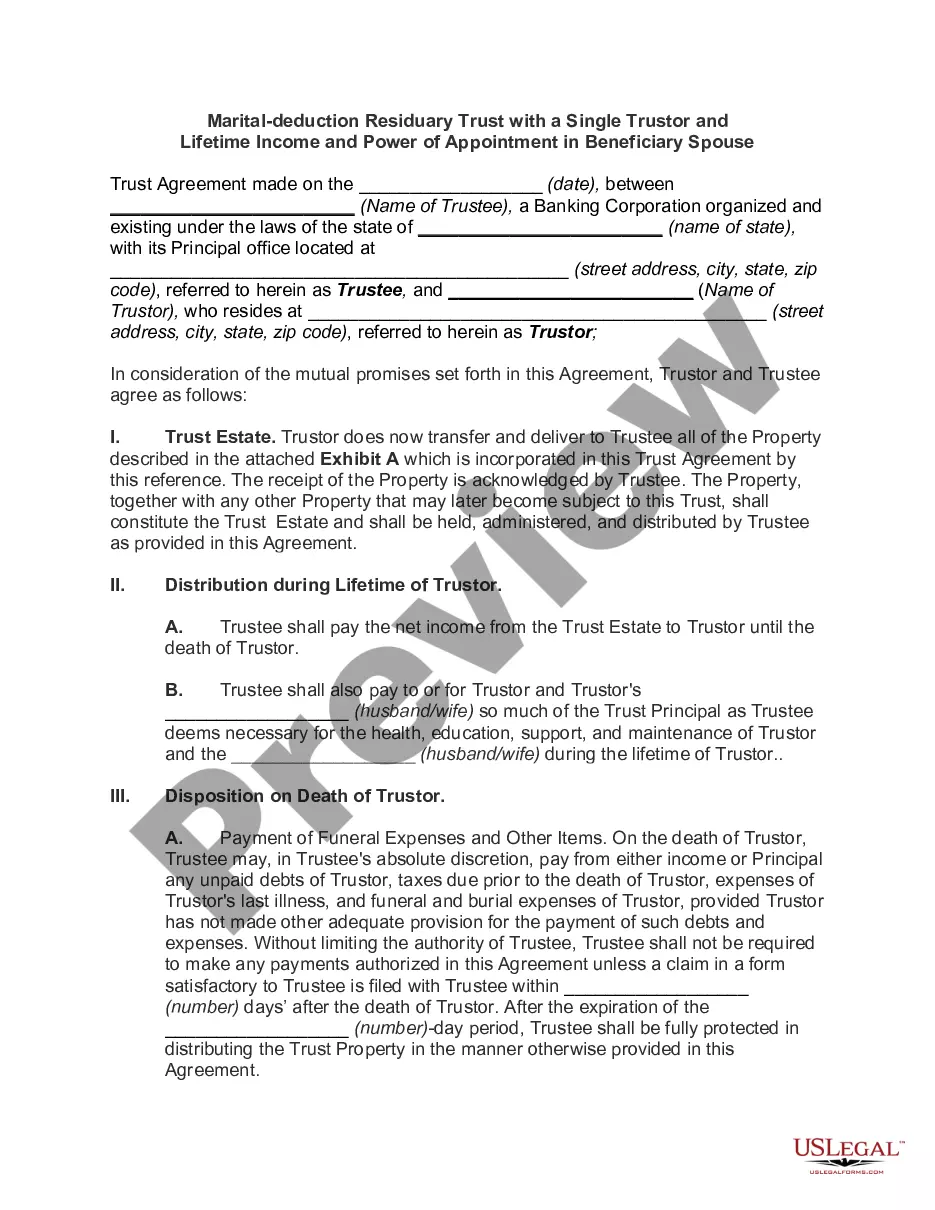
This Warranty Deed from Husband and Wife to a Trust is a legal document that enables a married couple (the grantors) to transfer ownership of their property to a designated trust (the grantee). This deed ensures that the property is conveyed with certain assurances about its title. This form is different from a regular deed as it establishes a trust as the recipient of the property, providing benefits such as asset protection and estate planning advantages.
Key parts of this document
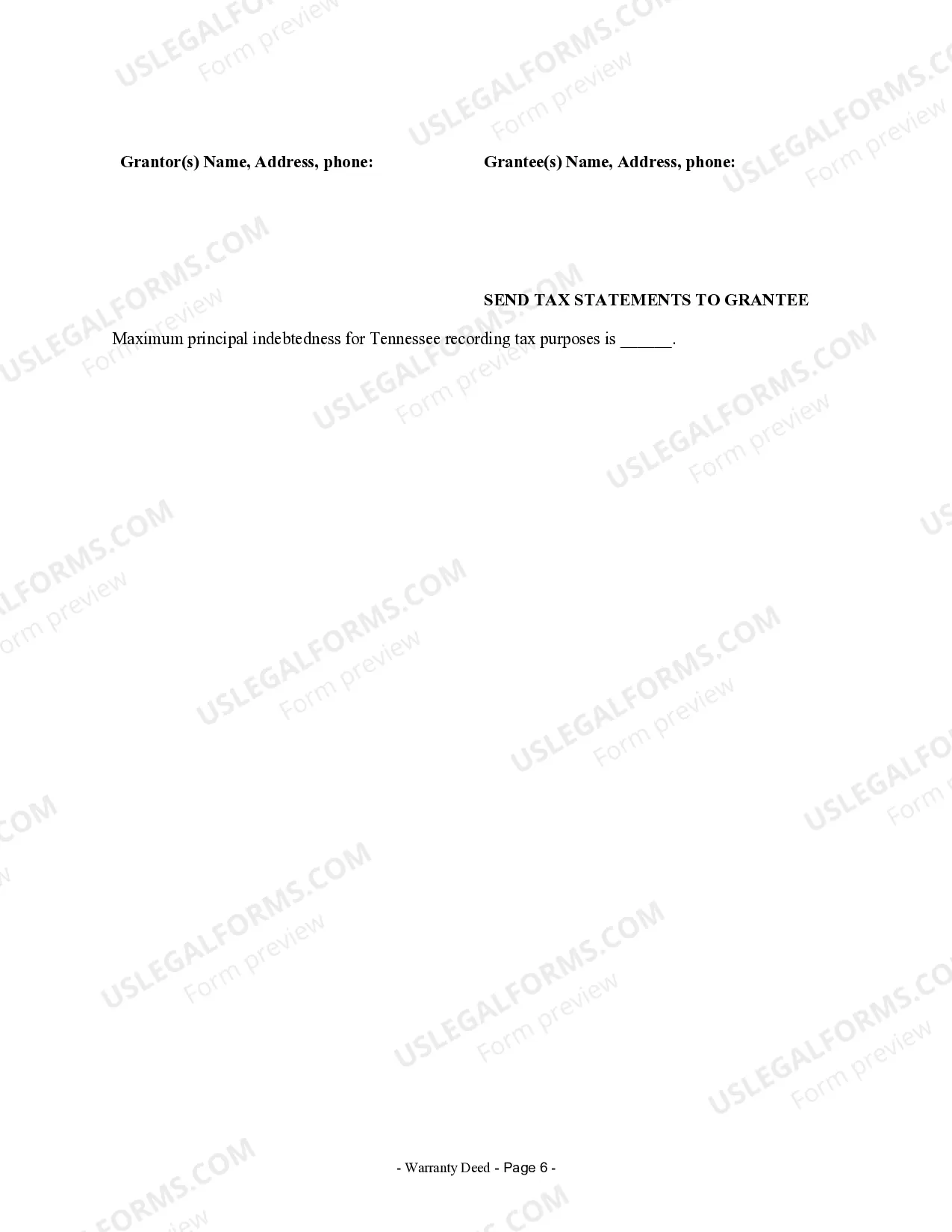
- Names and addresses of the grantors (husband and wife).
- Name of the trust and its trustee.
- Description of the property being transferred.
- Reservation of oil, gas, and mineral rights, if applicable.
- Covenants of the grantors regarding the property title.
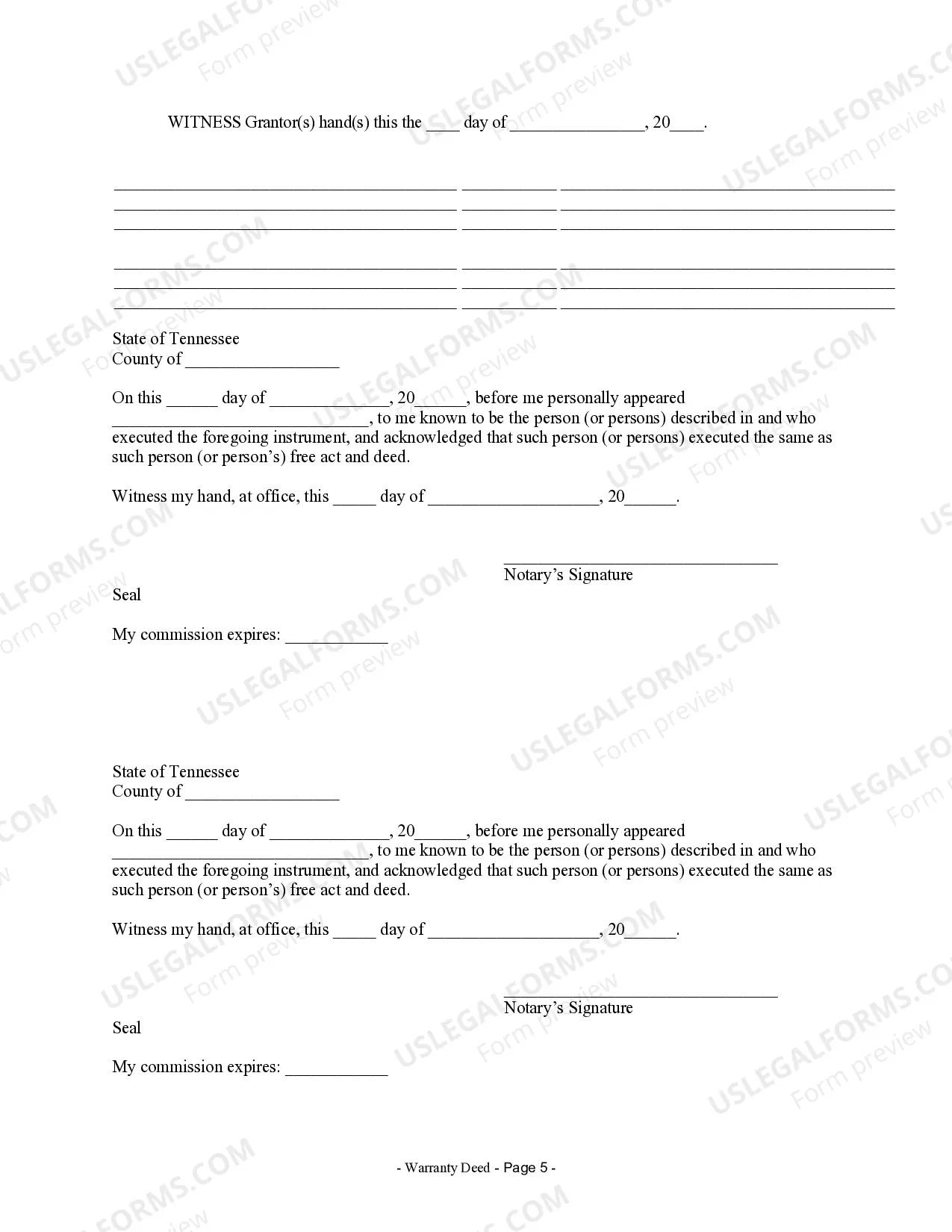
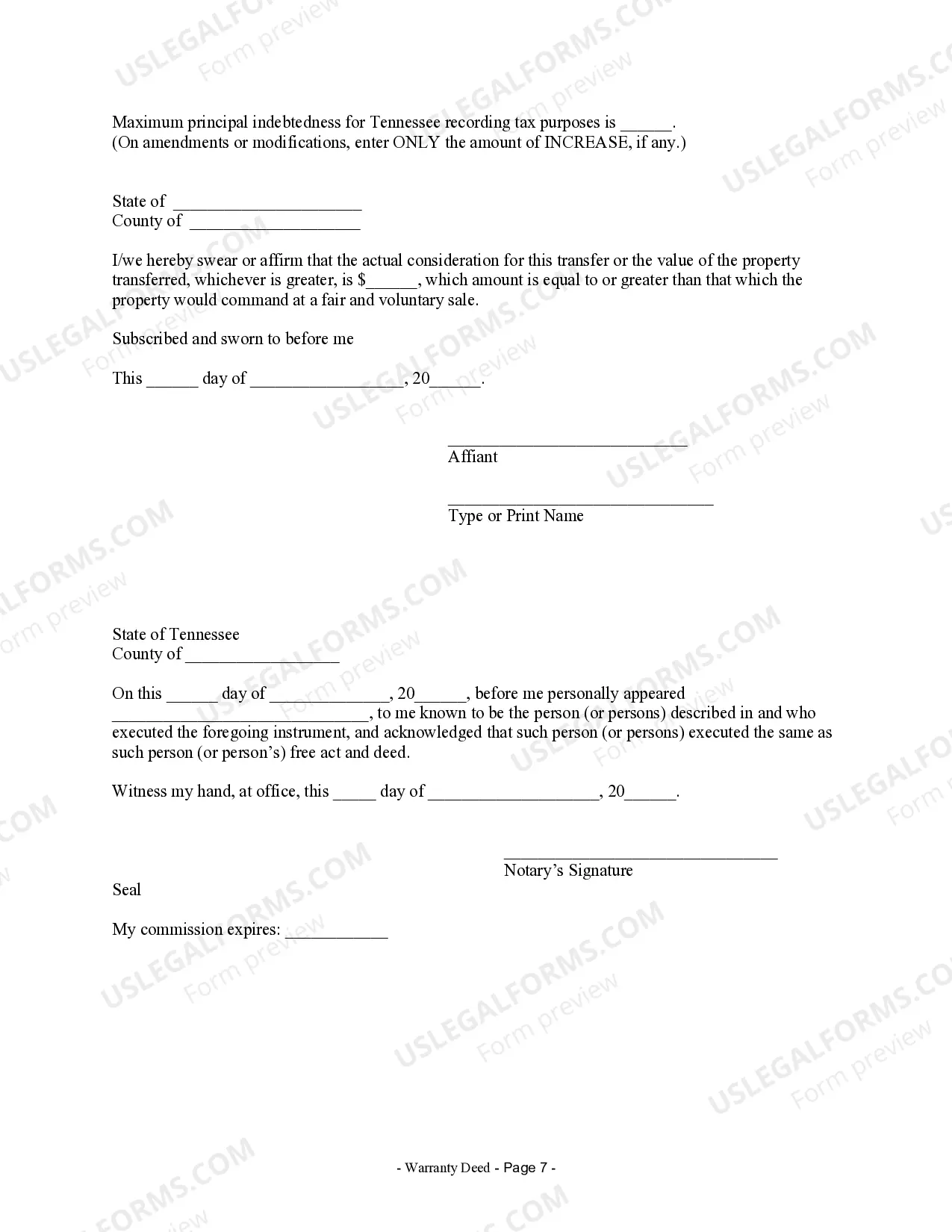
- Notary acknowledgment section for validation.




Common use cases
This form is useful when a husband and wife wish to transfer ownership of their real estate to a trust. It is often used for estate planning purposes, to avoid probate, or to protect assets from creditors. This deed can also be beneficial when the couple wants to simplify the management and distribution of their property in the event of death or incapacity.
Who needs this form
- Married couples looking to place their property into a trust.
- Individuals seeking to handle estate planning efficiently.
- Anyone who wants to protect their assets from probate.
Completing this form step by step
- Identify and enter the names and addresses of the husband and wife as grantors.
- Specify the name of the trust and the trustee responsible for managing it.
- Describe the property that is being transferred, including any specific parcel number.
- Include any reservations, like oil, gas, or mineral rights, if applicable.
- Provide the date of the transfer and ensure all parties sign in the designated areas.
Is notarization required?
This document requires notarization to meet legal standards. US Legal Forms provides secure online notarization powered by Notarize, allowing you to complete the process through a verified video call, available 24/7.
Get your form ready online
Our built-in tools help you complete, sign, share, and store your documents in one place.
Make edits, fill in missing information, and update formatting in US Legal Forms—just like you would in MS Word.
Download a copy, print it, send it by email, or mail it via USPS—whatever works best for your next step.
Sign and collect signatures with our SignNow integration. Send to multiple recipients, set reminders, and more. Go Premium to unlock E-Sign.
If this form requires notarization, complete it online through a secure video call—no need to meet a notary in person or wait for an appointment.
We protect your documents and personal data by following strict security and privacy standards.

Make edits, fill in missing information, and update formatting in US Legal Forms—just like you would in MS Word.

Download a copy, print it, send it by email, or mail it via USPS—whatever works best for your next step.

Sign and collect signatures with our SignNow integration. Send to multiple recipients, set reminders, and more. Go Premium to unlock E-Sign.

If this form requires notarization, complete it online through a secure video call—no need to meet a notary in person or wait for an appointment.

We protect your documents and personal data by following strict security and privacy standards.
Avoid these common issues
- Failing to accurately describe the property being transferred.
- Not including all necessary signatures from both grantors.
- Omitting the notary acknowledgment, which may invalidate the deed.
- Leaving out the specified reserved rights, which can lead to legal disputes later.
Benefits of completing this form online
- Convenience of completing the form at your own pace from home.
- Editable fields that allow for easy input of necessary information.
- Access to reliable and legally compliant templates drafted by licensed attorneys.
Main things to remember
- This Warranty Deed is essential for transferring property to a trust.
- Accurate completion and notarization are crucial for legal validity.
- Avoid common mistakes by reviewing the requirements carefully.
Looking for another form?

Form popularity
FAQ
In order to convey any real property or an interest in property in Tennessee, the deed must be in writing, acknowledged by the grantor, and registered in the county where the property is located. The Annotated Code of Tennessee allows for the transfer of real property through the usage of a variety of deeds.
Wives : A wife is entitled to an equal share of her husband's property like other entitled heirs. If there are no sharers, she has full right to the entire property.She is also entitled to maintenance, support and shelter from husband, and if staying in a joint family, from the family.
Both spouses will need to sign the deed to sell the home. However, if the home is titled as "tenants in common," a spouse can sell his share of the property without the other spouse's consent. Both parties have a separate and distinct interest in the home.
Tennessee does not allow real estate to be transferred with transfer-on-death deeds.
1Retrieve your original deed.2Get the appropriate deed form.3Draft the deed.4Sign the deed before a notary.5Record the deed with the county recorder.6Obtain the new original deed.
It is also crucial that a spouse know about the loan, even if he or she is not on the mortgage. In general, the spouse must sign a deed of trust, the Truth in Lending and Right to Cancel documents. By signing these documents, they are simply acknowledging the existence of the mortgage.
Tennessee deed forms convey interest in property from one party (the Grantor) to another (the Grantee). The documents can be prepared by anyone as long as the required information is written in the deed as outlined in § 66-5-103.
When it comes to property division during divorce, Tennessee is considered an equitable distribution state. Essentially, this means that marital property is divided fairly and reasonably, not necessarily 50-50.
Everyone who is on the title of the property is required to sign the deed of trust. There are exemptions. In a "purchase money mortgage" transaction in which only one spouse owns the property, the other spouse is not required to sign the deed of trust.