South Dakota Notice of Entry of Decree
About this form
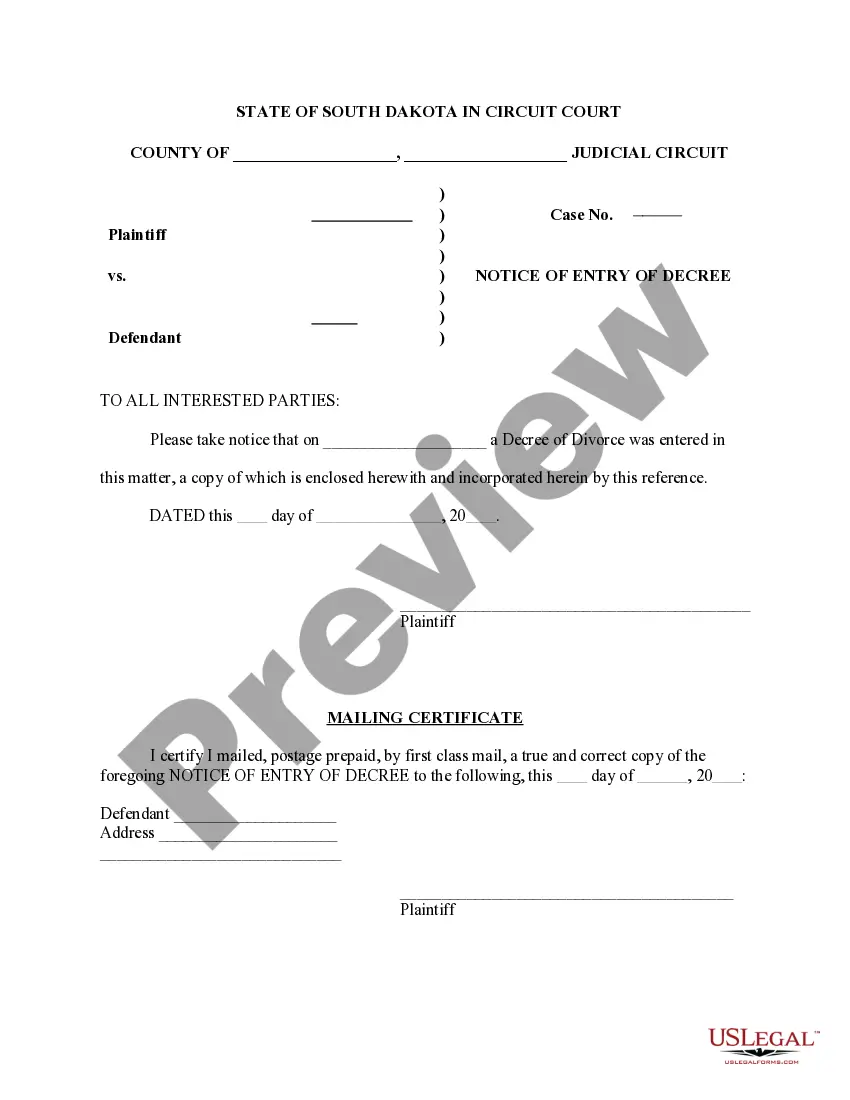
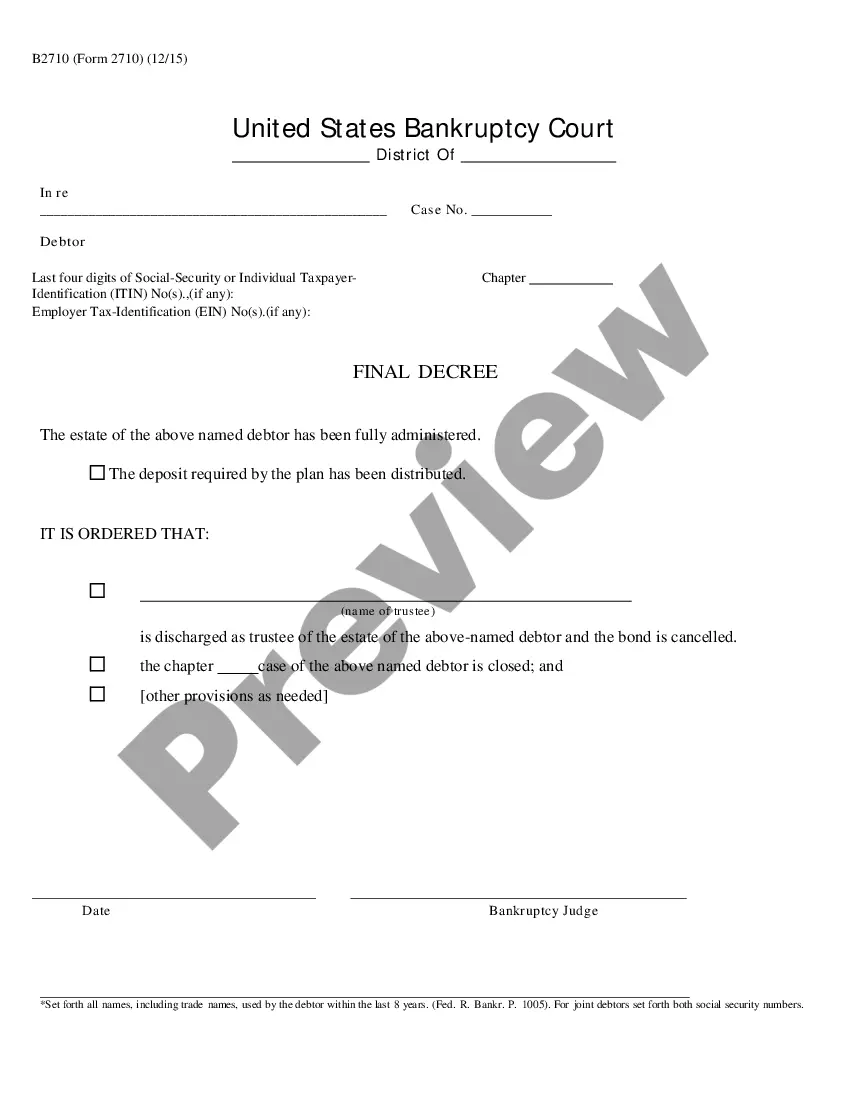
The Notice of Entry of Decree is a legal document required to inform interested parties that a Decree of Divorce has been officially entered by the court. This form is essential for maintaining proper legal procedures following the completion of divorce proceedings. Unlike other divorce-related forms, this document ensures that all parties involved are aware of the court's decision based on the signed Decree of Divorce.
What’s included in this form
- The case number, which identifies the divorce case.
- The date when the Decree of Divorce was entered.
- A statement indicating that a copy of the Decree is enclosed.
- The date of mailing the Notice to the defendant.
- The signature of the plaintiff, confirming the notice has been mailed.
- The defendant's address to ensure proper delivery.
When to use this form
You should use the Notice of Entry of Decree after a Decree of Divorce has been signed and filed with the court. This form is a necessary step to inform your spouse and any other interested parties that the divorce has been finalized. It is typically used when you have completed the process of divorce but need to fulfill legal notice requirements.
Who this form is for
- Individuals who are parties to a divorce case.
- Plaintiffs who have recently signed a Decree of Divorce.
- Anyone required to notify their spouse of the court's decision.
- Legal representatives handling divorce cases on behalf of clients.
Instructions for completing this form
- Enter the case number at the top of the form.
- Fill in the date when the Decree of Divorce was officially entered.
- Insert the date on which you are providing this notice.
- Include your spouse's name and address to ensure they receive the notice.
- Sign and date the form to certify that you have mailed it to the defendant.
- Attach a copy of the signed Decree of Divorce to the notice.
Is notarization required?
This form does not typically require notarization to be legally valid. However, some jurisdictions or document types may still require it. US Legal Forms provides secure online notarization powered by Notarize, available 24/7 for added convenience.
Get your form ready online
Our built-in tools help you complete, sign, share, and store your documents in one place.
Make edits, fill in missing information, and update formatting in US Legal Forms—just like you would in MS Word.
Download a copy, print it, send it by email, or mail it via USPS—whatever works best for your next step.
Sign and collect signatures with our SignNow integration. Send to multiple recipients, set reminders, and more. Go Premium to unlock E-Sign.
If this form requires notarization, complete it online through a secure video call—no need to meet a notary in person or wait for an appointment.
We protect your documents and personal data by following strict security and privacy standards.

Make edits, fill in missing information, and update formatting in US Legal Forms—just like you would in MS Word.

Download a copy, print it, send it by email, or mail it via USPS—whatever works best for your next step.

Sign and collect signatures with our SignNow integration. Send to multiple recipients, set reminders, and more. Go Premium to unlock E-Sign.

If this form requires notarization, complete it online through a secure video call—no need to meet a notary in person or wait for an appointment.

We protect your documents and personal data by following strict security and privacy standards.
Common mistakes to avoid
- Failing to include the case number, which can delay processing.
- Not signing the form, which makes it invalid.
- Incorrectly addressing the notice, leading to non-delivery.
- Neglecting to include a copy of the Decree of Divorce.
Benefits of using this form online
- Convenience of downloading the form in both Word and fillable PDF formats.
- Ability to complete the form at your own pace, ensuring accuracy.
- Access to templates drafted by licensed attorneys, enhancing reliability.
- Immediate access to updates or changes in legal requirements.
Looking for another form?
Form popularity
FAQ
To obtain a divorce in South Dakota, no length of residency or waiting period before beginning the action is required. However, you must be a resident in good faith.
South Dakota Divorce Overview In South Dakota, a divorce can be completed on average in a minimum of 60 days, with court fees of $95.00. Unlike many states, South Dakota does not have any divorce residency requirements determining how long the appellant must have lived in South Dakota prior to filing for divorce.
In California, the default filing procedure for divorce records is to make them public. Public divorce records mean that anyone can obtain a copy of the decree. California provides two kinds of certified copies authorized and informational.
Unlike some other states, South Dakota does not accept joint divorce petitions, even for uncontested divorces. Instead, the spouse who prepares and files the initial paperwork, the "plaintiff," must file the following documents with the court before the court proceeds with the case: Case Filing Statement.
Starting a Divorce First, complete the "Case Filing Statement" either in Word or Word form. For divorce, select "Divorce" under the Family section on the first page. Next, select Plaintiff/Petitioner under the Family section on the second page. Also complete your personal information.
Divorce proceedings are not considered vital records. Divorces are court proceedings, even when a divorce is uncontested or the parties adopted alternative dispute resolution (ADR) tools to achieve an amicable divorce, the divorce paperwork and the agreements reached must be filed in court.
The court fees for filing the paperwork for a basic divorce in a South Dakota court is $95.00. However, the total costs for a divorce can be much higher - especially in the case of a contested divorce, where attorney fees and mediation costs average from $15,000 to $20,000 or more.
Once the decree absolute has been pronounced in relation to a divorce, it is a matter of public record, and therefore, anybody will be able to obtain a copy of the decree absolute itself.The procedure to search for and obtain a copy of a decree absolute is set out in the relevant Government guidance.
Divorce Notice When it comes to listing them in the newspaper, they may be found in a number of different places, including in the court notices as well as being separate news items.This often required airing the dirty laundry in public, and sometimes that included mentions in the newspaper.