South Dakota Lien Statement - Individual
What this document covers
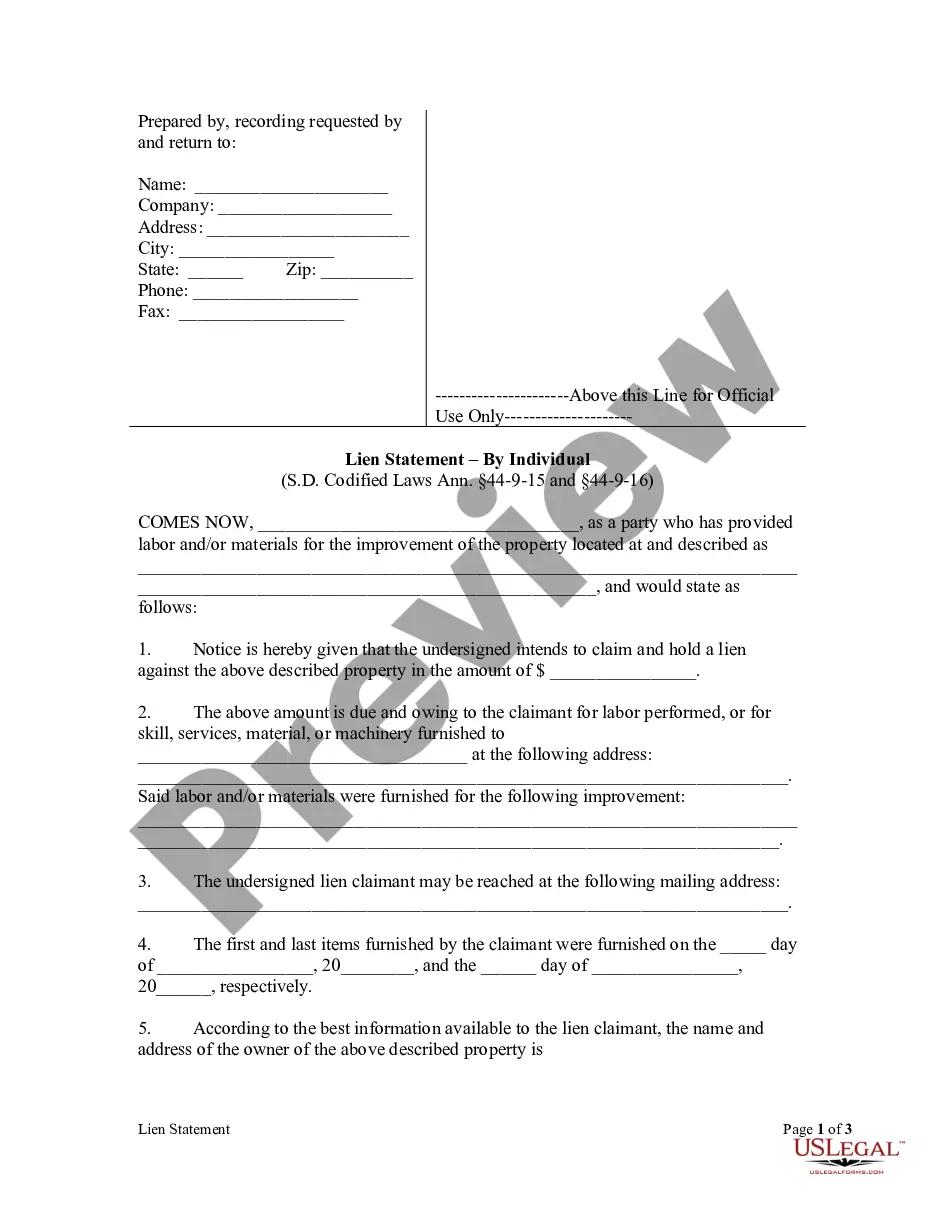
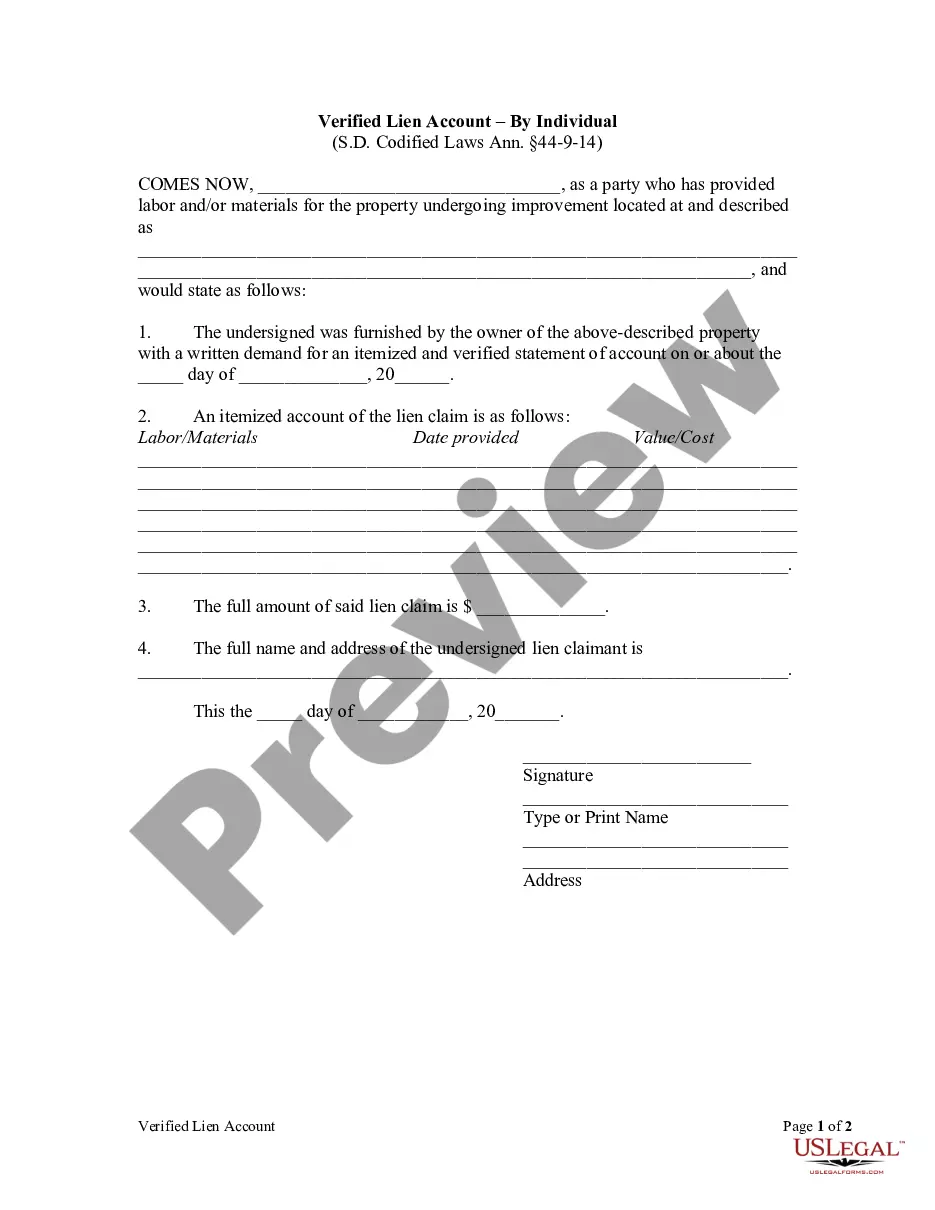
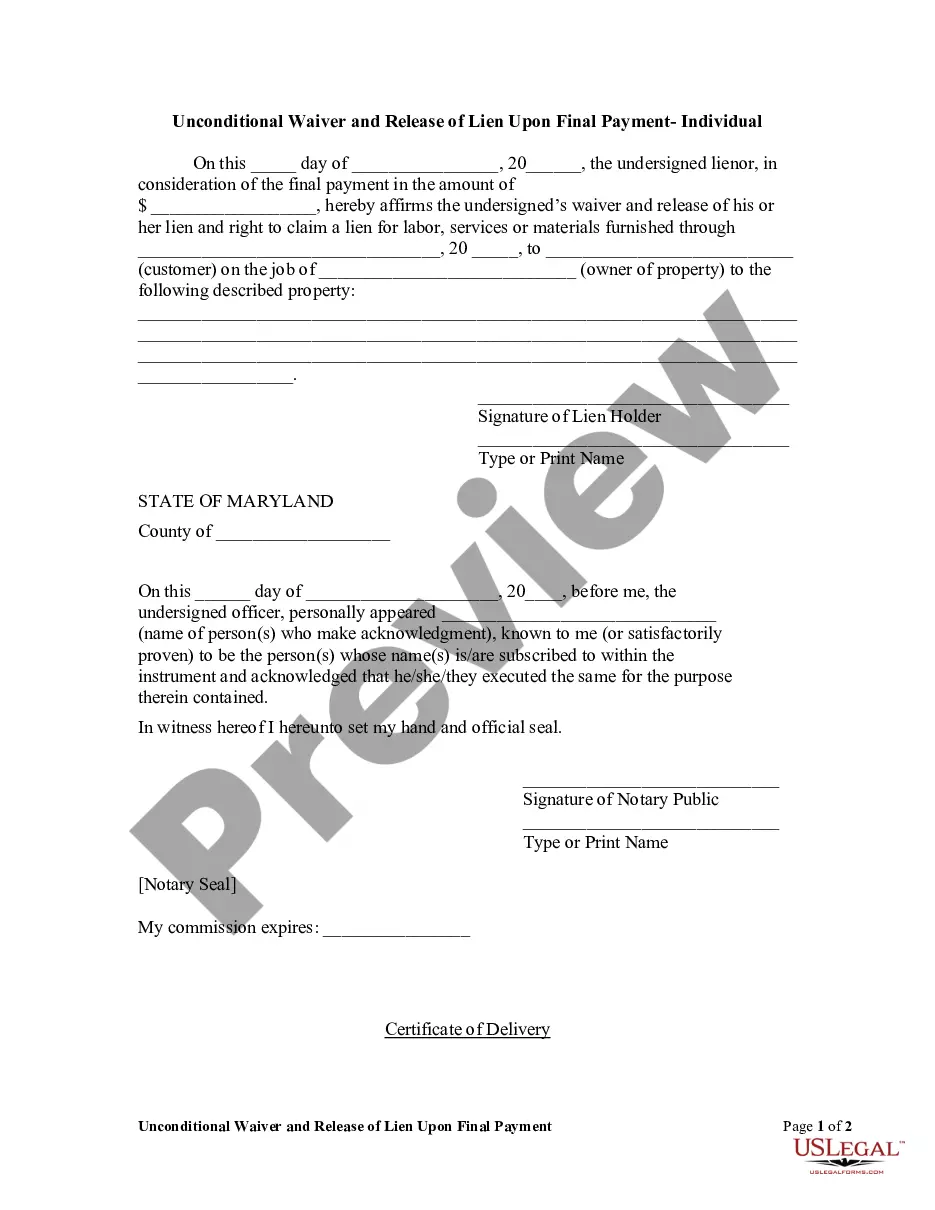
The Lien Statement - Individual is a legal document used by individuals who have provided labor or materials for property improvements to claim a lien against the property for payment. This form is essential in securing the right to payment before the lien expires. Unlike other forms, such as contractor lien forms, this document is specifically tailored for individuals and small businesses that have performed work directly on a property.
Key components of this form
- Claimantâs name and contact details
- Description of the property where work was performed
- Amount due for labor or materials provided
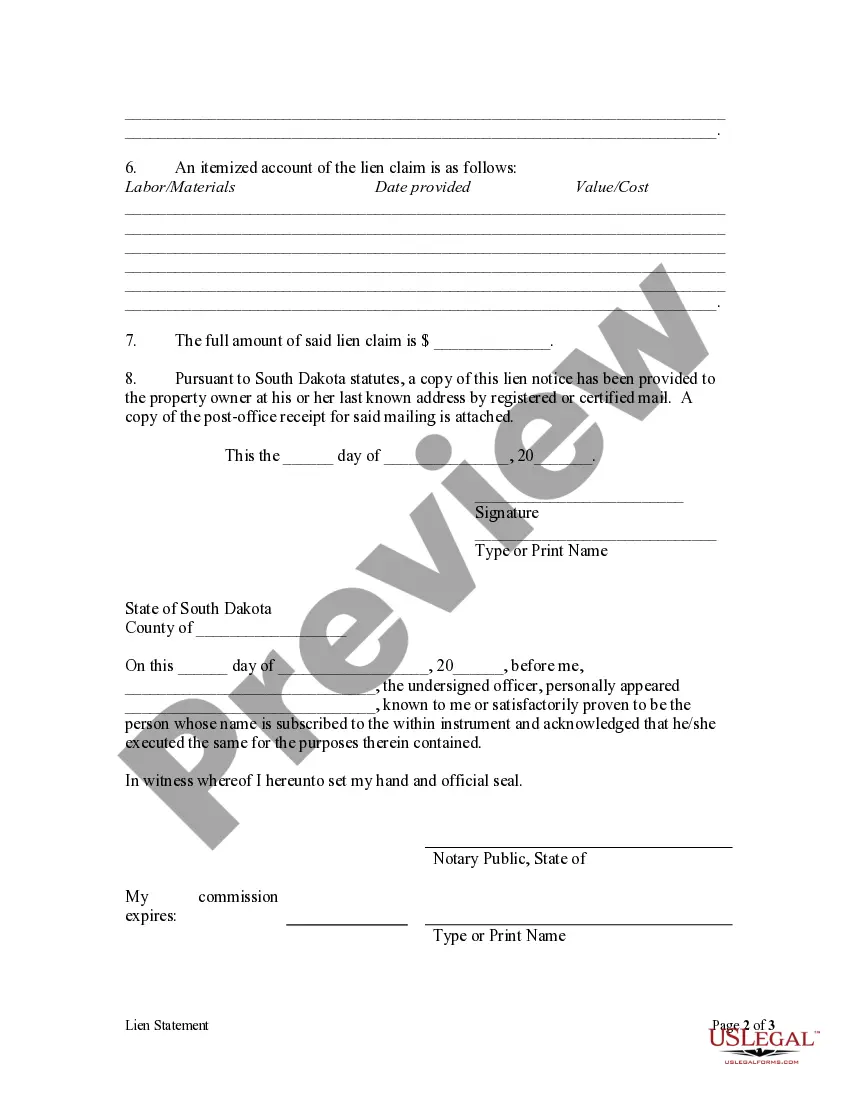
- Itemized account of services rendered and their respective values
- Dates when the first and last items were furnished
- Ownerâs details for the property in question
- Notarization section for legal validation
Common use cases
This form should be used when an individual has provided labor, materials, or services to improve a property and has not received payment. It is typically filed when the owner of the property has failed to pay the claimant within a reasonable time after completing the work or providing materials. Filing this lien statement is a step towards ensuring that the individual can collect the owed amount by legally attaching the claim to the property.
Who can use this document
- Independent contractors who provided services on a property
- Suppliers of materials used in construction or renovation
- Individuals performing repairs or improvements to residential or commercial properties
- Anyone seeking to secure a payment claim against a property owner
Completing this form step by step
- Identify the claimantâs information, including name, company, and contact details.
- Specify the property involved, including its location and description.
- Enter the amount owed for the work performed or materials supplied.
- Provide a detailed account of the labor or materials, including dates and values.
- Include the property owner's name and address.
- Sign and date the form in front of a notary public, if required.
Is notarization required?
Yes, this form must be notarized to be legally valid. After completing the document, the signature must be witnessed and acknowledged by a notary public. US Legal Forms offers integrated online notarization services, available 24/7, ensuring a secure and convenient way to obtain notarization without the need for travel.
Get your form ready online
Our built-in tools help you complete, sign, share, and store your documents in one place.
Make edits, fill in missing information, and update formatting in US Legal Forms—just like you would in MS Word.
Download a copy, print it, send it by email, or mail it via USPS—whatever works best for your next step.
Sign and collect signatures with our SignNow integration. Send to multiple recipients, set reminders, and more. Go Premium to unlock E-Sign.
If this form requires notarization, complete it online through a secure video call—no need to meet a notary in person or wait for an appointment.
We protect your documents and personal data by following strict security and privacy standards.
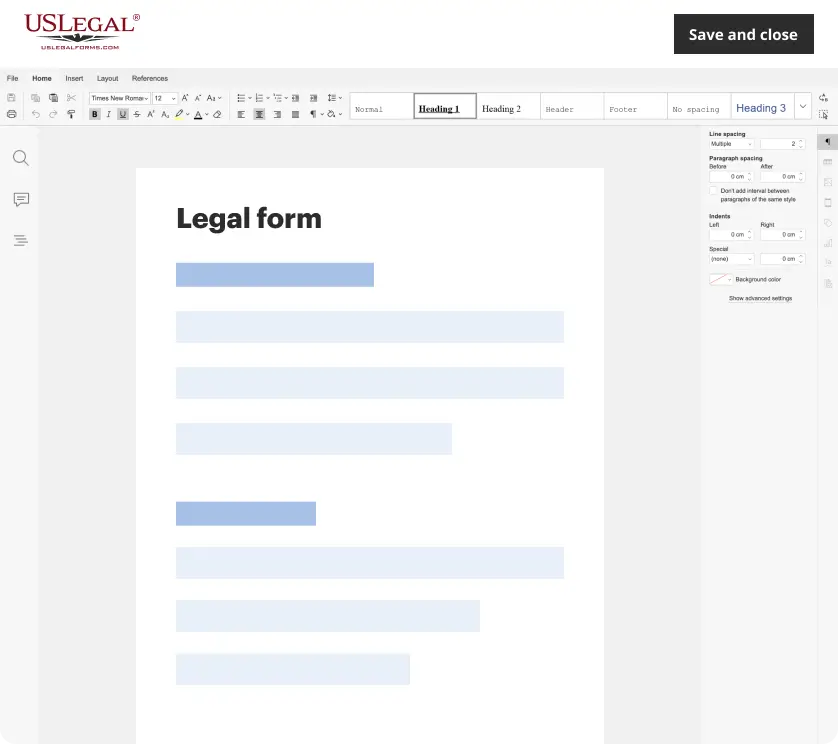
Make edits, fill in missing information, and update formatting in US Legal Forms—just like you would in MS Word.
Download a copy, print it, send it by email, or mail it via USPS—whatever works best for your next step.
Sign and collect signatures with our SignNow integration. Send to multiple recipients, set reminders, and more. Go Premium to unlock E-Sign.
If this form requires notarization, complete it online through a secure video call—no need to meet a notary in person or wait for an appointment.
We protect your documents and personal data by following strict security and privacy standards.
Mistakes to watch out for
- Failing to file the form within the specified time frame of one hundred and twenty days.
- Inaccurate property descriptions that may lead to challenges in enforcing the lien.
- Not providing detailed itemization of the work or materials claimed in the lien.
- Omitting the required signature or notarization, leading to invalid claims.
Why use this form online
- Easy access to the form from any location, allowing for efficient completion.
- Editable format that allows users to customize fields as needed.
- Quick download option for immediate use.
- Reliable templates drafted by licensed attorneys ensuring compliance with legal standards.
Legal use & context
- This Lien Statement is enforceable under South Dakota law, provided it is filed within the specified timeframe.
- Failure to file within one hundred and twenty days may result in the loss of the lien rights.
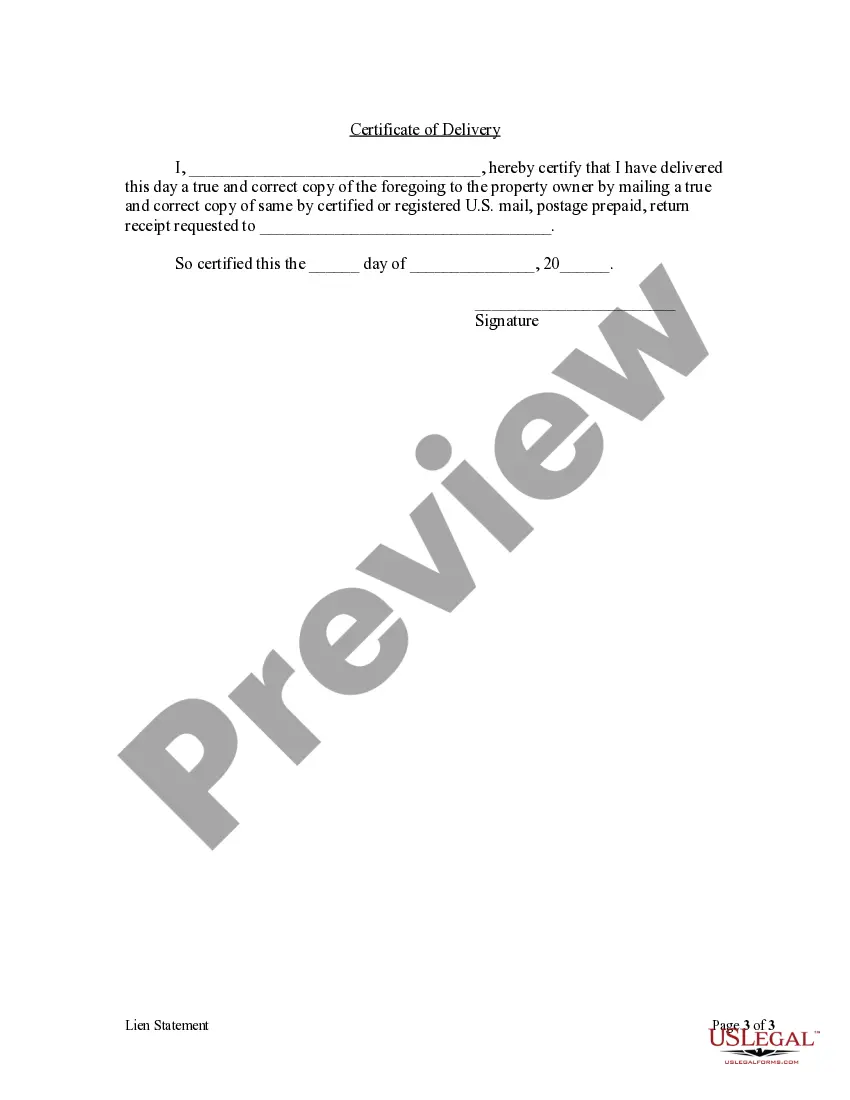
- The document must be served to the property owner to ensure they are aware of the lien claim.
Key takeaways
- The Lien Statement - Individual is used to claim payment for work done on property improvements.
- It is important to file this document promptly to secure lien rights.
- Accurate information and notarization are critical for a valid lien statement.
Looking for another form?
Form popularity
FAQ
Many lenders possess the title during the entire length of the car loan. Once you pay off the loan, the lender removes its name from the title. You then receive a copy of the title.
Motor vehicle titling and registration is handled through your local county treasurer's office. An Motor Vehicle or Boat Title & Registration Application must be signed by the record owner(s) or by an authorized agent for the record owner(s).
South Dakota has been an ELT state since October 2012.
How much is a title transfer in North Dakota? The general title transfer fees are $5. There is a $1.50 fee added for out of state transfers.
South Dakota allows residents to renew their registrations online 90 days before the registration is set to expire and up to 30 days after it has expired.
Complete a bill of sale with the buyer, and make sure both you sign it. Get a lien release. If the car is less than 10 years old, complete the odometer disclosure section on the Application for Motor Vehicle Title and Registration. Complete the Seller's Report of Sale from and file it with the county treasurer.
Michigan is one of only nine states that are non-title holding states, in which titles are mailed to the owner rather than the lien holder. These states include: Arizona, Kentucky, Maryland, Michigan, Minnesota, New York, Oklahoma, South Dakota and Wisconsin.
You will need your original out of state titles, a copy of your state driver license, social security number, and a Motor Vehicle and Boat Title & Registration Application. Take this paperwork to your local county treasurer's office to complete registration process.
A title-holding state is one where the lienholder (your lender) keeps the title until you've paid off the auto loan.The nine non-title holding states are: Michigan, Minnesota, New York, Arizona, Kentucky, Oklahoma, Wisconsin, Maryland, and South Dakota.