Oregon Notice of Assignment to Living Trust
Overview of this form
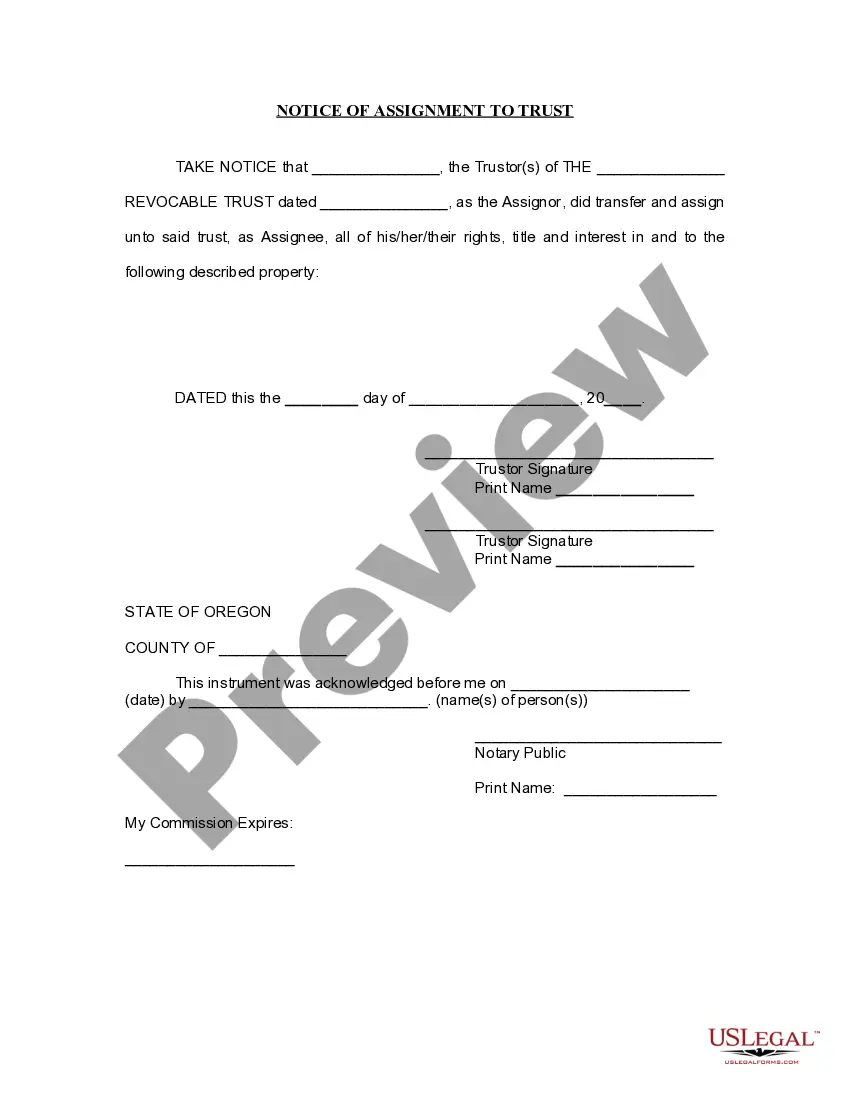
The Notice of Assignment to Living Trust is a legal document that officially communicates the transfer of certain assets by the trustor, or creator, of a revocable living trust into the trust entity. This form is essential in estate planning, distinguishing it from various other estate planning documents, such as wills or powers of attorney, by focusing on the assignment of specific property into the living trust.
Main sections of this form
- Names of the Trustor(s) and details of the living trust, including its date.
- Description of the property being transferred into the trust.
- The signature of the Trustor(s) to validate the transfer.
- Notarization section, including the acknowledgement of the Notary Public.
Situations where this form applies
This form is typically used when an individual wishes to formally transfer property into their living trust during their lifetime. This can include real estate, bank accounts, investments, or other valuable assets that are intended to be managed by the trust and passed on according to the trust's directives after the trustor's death.
Who needs this form
- Individuals creating a revocable living trust who want to ensure their assets are part of that trust.
- Trustors who have recently acquired new property and want to include it in their existing trust.
- Property owners looking to simplify their estate planning process and ensure smoother asset transfer upon death.
Steps to complete this form
- Identify the Trustor(s) and provide the name and date of the revocable trust.
- Clearly describe the property that is being assigned to the trust.
- Have the Trustor(s) sign the document to evidence the transfer.
- Complete the notary section, including the date and name of the notary public.
- Ensure the document is stored safely and that the living trust is updated accordingly.
Notarization guidance
This form needs to be notarized to ensure legal validity. US Legal Forms provides secure online notarization powered by Notarize, allowing you to complete the process through a verified video call, available anytime.
Get your form ready online
Our built-in tools help you complete, sign, share, and store your documents in one place.
Make edits, fill in missing information, and update formatting in US Legal Forms—just like you would in MS Word.
Download a copy, print it, send it by email, or mail it via USPS—whatever works best for your next step.
Sign and collect signatures with our SignNow integration. Send to multiple recipients, set reminders, and more. Go Premium to unlock E-Sign.
If this form requires notarization, complete it online through a secure video call—no need to meet a notary in person or wait for an appointment.
We protect your documents and personal data by following strict security and privacy standards.

Make edits, fill in missing information, and update formatting in US Legal Forms—just like you would in MS Word.

Download a copy, print it, send it by email, or mail it via USPS—whatever works best for your next step.

Sign and collect signatures with our SignNow integration. Send to multiple recipients, set reminders, and more. Go Premium to unlock E-Sign.

If this form requires notarization, complete it online through a secure video call—no need to meet a notary in person or wait for an appointment.

We protect your documents and personal data by following strict security and privacy standards.
Common mistakes
- Failing to provide a complete and clear description of the property being transferred.
- Not obtaining the necessary notarization, which can invalid the document.
- Inaccurately stating the date of the trust or names of the Trustor(s).
Why use this form online
- Convenience: Download and complete this form from the comfort of your home.
- Editability: Easily make changes to the form to suit your specific needs.
- Reliability: Forms are drafted by licensed attorneys, ensuring validity and compliance with legal standards.
Quick recap
- The Notice of Assignment to Living Trust is essential for transferring property into a living trust.
- Accurate completion ensures that the property is legally recognized as part of the trust assets.
- Notarization is required for the form to be valid.
Looking for another form?

Form popularity
FAQ
In order to transfer real property held in a living trust, the trustee executes a trustee's deed. The trustee's deed is one in a class of instruments named descriptively after the granting party, rather than the warranty of title conveyed (think administrator's deed, executor's deed, sheriff's deed).
The best way to find a trust is to ask the person who created it or the person who manages it. If the trust owns real estate, then a deed to the trust has probably been recorded in the county where the real estate is.
If a trust holds real estate, the trustee will need to sign a new deed, transferring the property to the new owner - the trust beneficiary.When you're ready to transfer trust real estate to the beneficiary who is named in the trust document to receive it, you'll need to prepare, sign, and record a deed.
A revocable living trust isn't subject to the same kind of rules as a will; it should be valid in any state, no matter where you signed it.If you acquire real estate in your new state, you'll probably want to hold it in the trust, so that it doesn't have to go through probate at your death.
To allow the settlor to keep his estate plans private, the trust instrument is generally not recorded, and the trustee uses the certification of trust in the place of disclosing the entire contents of the trust instrument.
Trusts are transferrable from state to state, but it always makes sense to have your estate plan reviewed when you move.
A basic trust plan may run anywhere from $2,000 to $3,000 or more, depending on complexity. There are additional costs for making changes and administration costs after your death. Different types of trusts and trustees can require different fees for administration and wealth management.
Can I contest a trust in California? Yes, you can contest a trust, and it is more common than most people think.