Oregon Bargain and Sale Deed - Individual to Individual
About this form
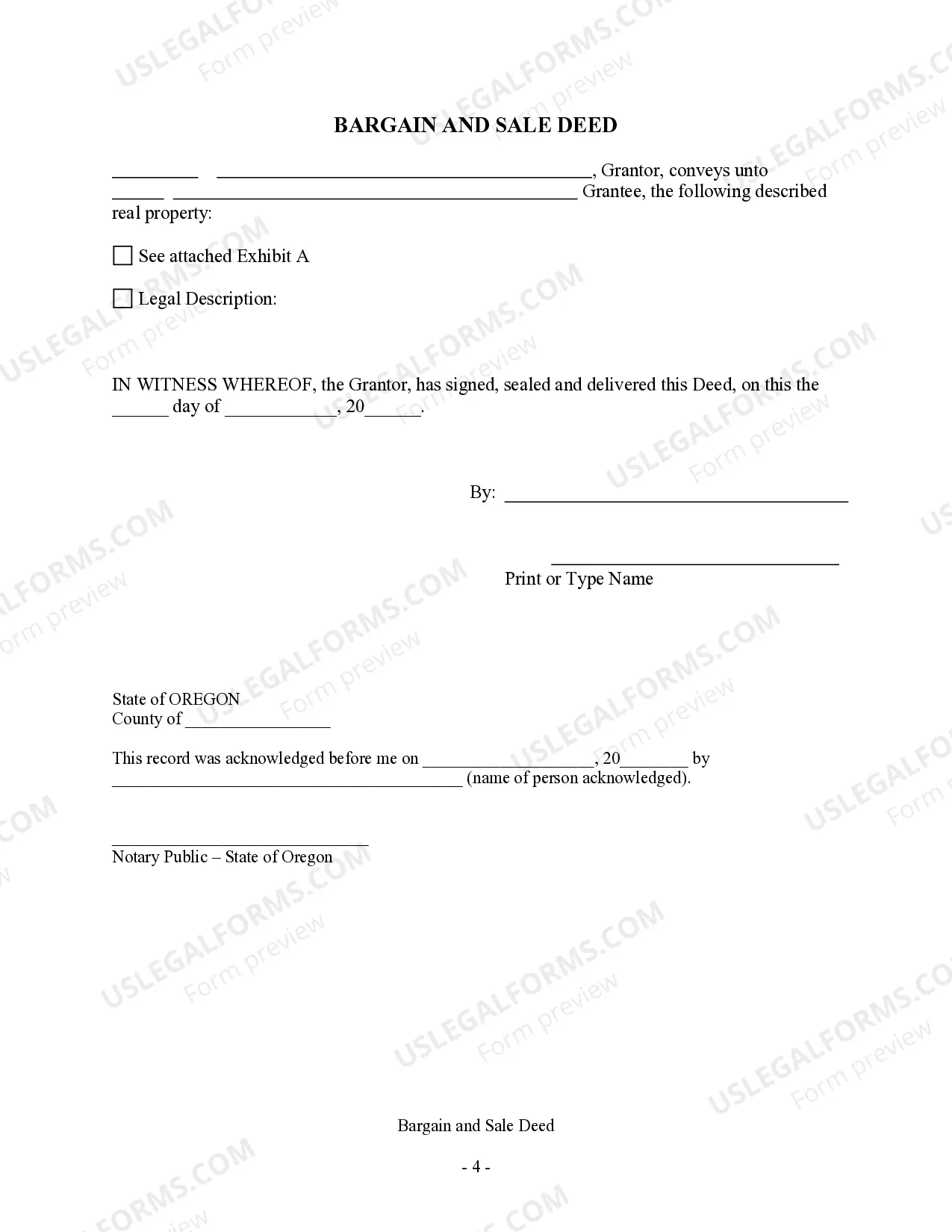
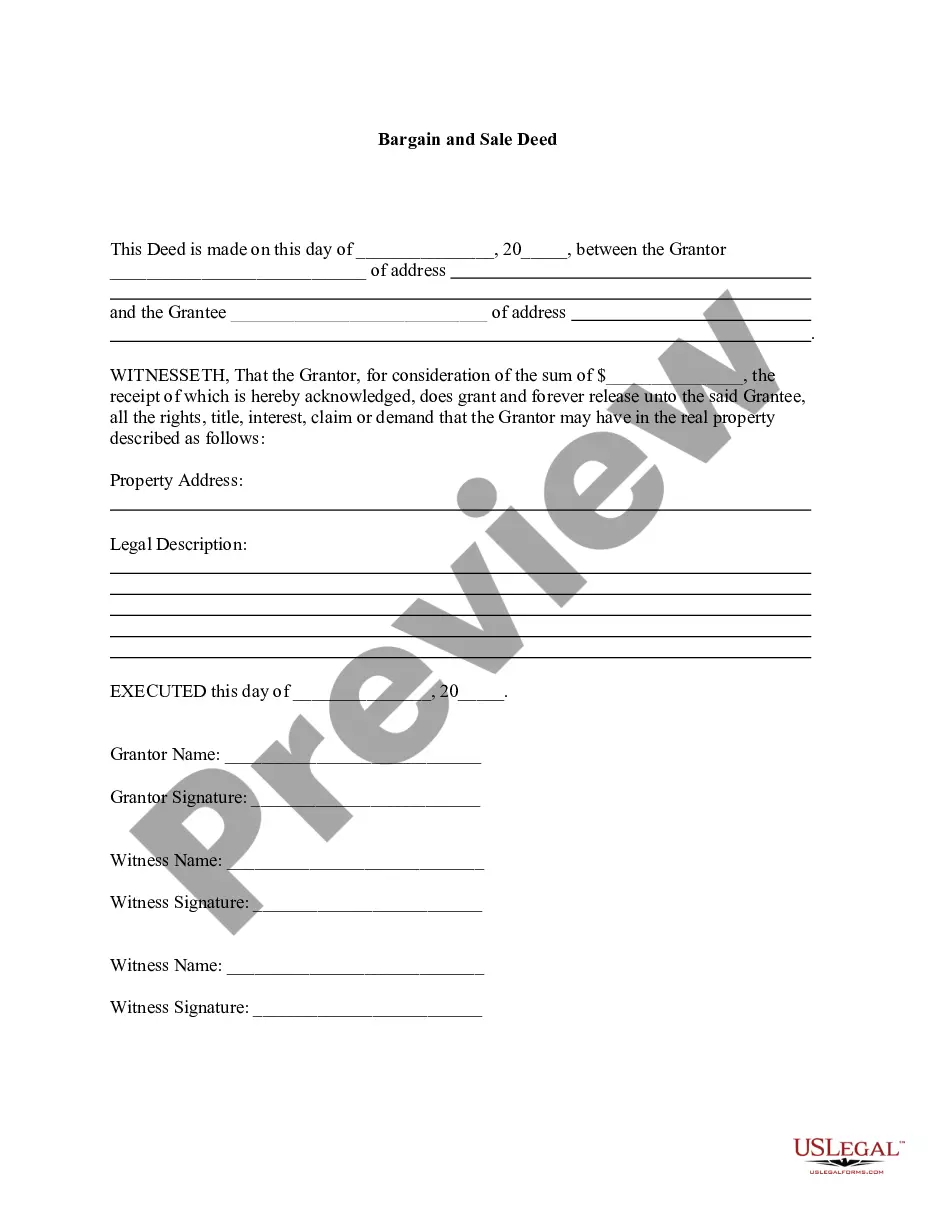
A Bargain and Sale Deed is a legal document used to transfer ownership of real estate from one individual to another. This form specifies that the grantor (the seller) conveys all title and interest in the property to the grantee (the buyer) without any warranties regarding the property's condition. This deed is particularly useful for individuals who wish to transfer property directly without involving a third party or real estate agent. It complies with all state statutory laws, ensuring legality and validity.
What’s included in this form
- Identification of the grantor and grantee.
- Legal description of the property being transferred.
- Declaration of the grantor's intent to convey the property.
- Notary acknowledgment for verification of signatures.
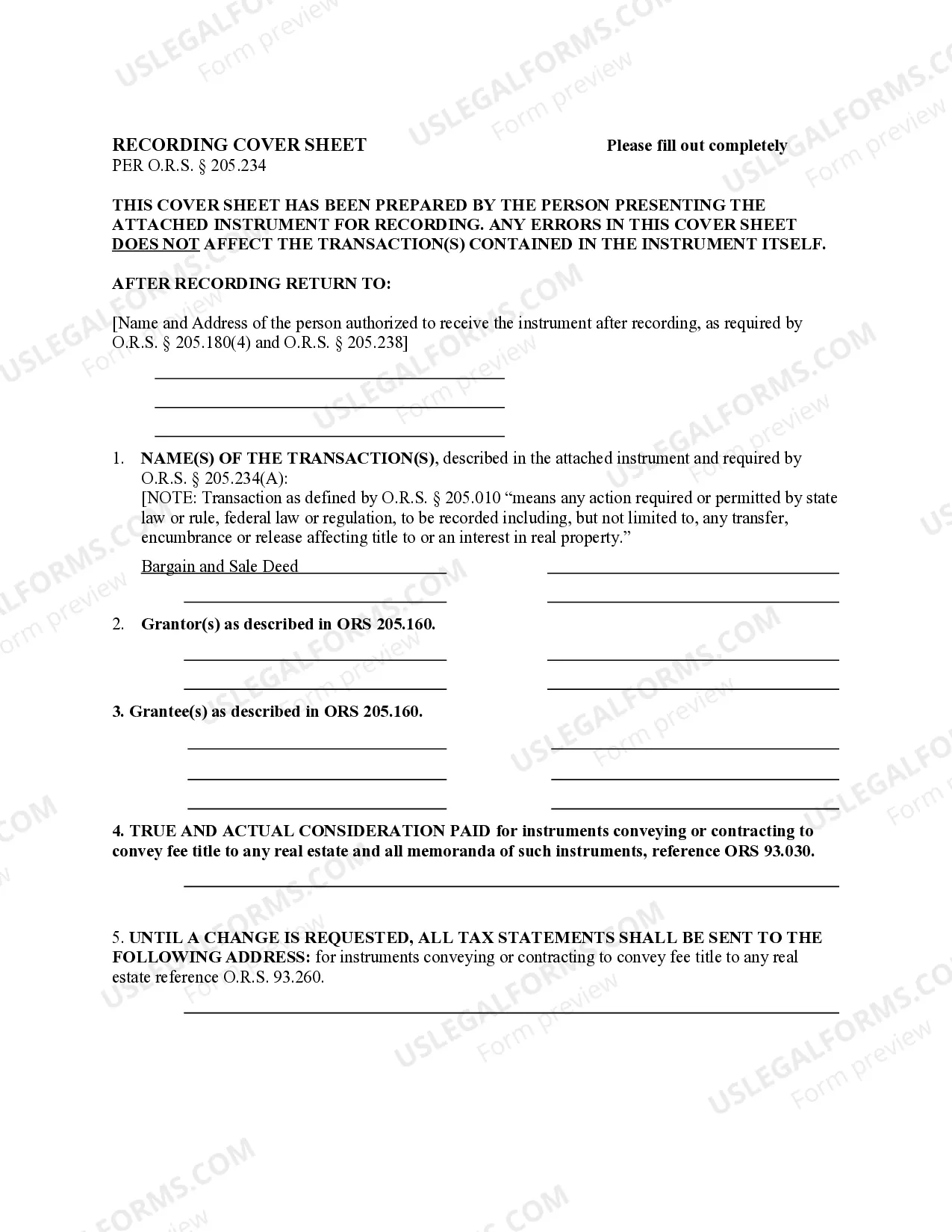
- Space for recording information with the appropriate authority.


When to use this document
This form is needed when an individual is selling or gifting property directly to another individual. It is applicable in situations where the grantor desires to transfer ownership without any warranties or guarantees, making it suitable for casual or straightforward transactions between familiar parties. Examples include family gifts, transfers between friends, or sales without real estate agents.
Who needs this form
This Bargain and Sale Deed is designed for:
- Individuals looking to transfer ownership of real property to another individual.
- Property owners who do not require legal guarantees or warranties about the property.
- Those familiar with the property transfer process or who have consulted with legal professionals.
How to prepare this document
- Identify the parties involved by filling in the grantor and grantee information.
- Specify the property by providing the legal description and address.
- Include details about the transfer, including any consideration (payment) if applicable.
- Have the grantor sign the deed in the appropriate section.
- Obtain a notary acknowledgment to validate the signatures and the transaction.
- Submit the completed deed to the local recording office as required by state law.
Does this document require notarization?
Yes, this form must be notarized to be legally valid. The notarization process helps verify the identities of the parties involved and ensures the authenticity of the signatures. US Legal Forms offers integrated online notarization services that are accessible 24/7, allowing you to complete this requirement via secure video call without the need for travel.
Get your form ready online
Our built-in tools help you complete, sign, share, and store your documents in one place.
Make edits, fill in missing information, and update formatting in US Legal Forms—just like you would in MS Word.
Download a copy, print it, send it by email, or mail it via USPS—whatever works best for your next step.
Sign and collect signatures with our SignNow integration. Send to multiple recipients, set reminders, and more. Go Premium to unlock E-Sign.
If this form requires notarization, complete it online through a secure video call—no need to meet a notary in person or wait for an appointment.
We protect your documents and personal data by following strict security and privacy standards.

Make edits, fill in missing information, and update formatting in US Legal Forms—just like you would in MS Word.

Download a copy, print it, send it by email, or mail it via USPS—whatever works best for your next step.

Sign and collect signatures with our SignNow integration. Send to multiple recipients, set reminders, and more. Go Premium to unlock E-Sign.

If this form requires notarization, complete it online through a secure video call—no need to meet a notary in person or wait for an appointment.

We protect your documents and personal data by following strict security and privacy standards.
Typical mistakes to avoid
- Failing to provide a complete description of the property.
- Not signing the deed or obtaining a notary acknowledgment.
- Leaving out important details regarding the grantee's information.
- Neglecting to record the deed which may lead to future disputes over ownership.
Why complete this form online
- Easy and quick access to a professionally drafted form.
- Editable and customizable to fit individual needs.
- Immediate download ensures you can begin the process right away.
- Compliance with state laws provides peace of mind when transferring property.
Looking for another form?

Form popularity
FAQ
The quitclaim deed provides no warranties; it conveys the interest the grantor had in the propertynothing more.The bargain and sale deed indicates that the grantor has title; but property might come with encumbrances and defects.
Adding someone to your house deed requires the filing of a legal form known as a quitclaim deed. When executed and notarized, the quitclaim deed legally overrides the current deed to your home. By filing the quitclaim deed, you can add someone to the title of your home, in effect transferring a share of ownership.
The drawback, quite simply, is that quitclaim deeds offer the grantee/recipient no protection or guarantees whatsoever about the property or their ownership of it. Maybe the grantor did not own the property at all, or maybe they only had partial ownership.
Bargain and sale deeds are most often used when property is transferred pursuant to a foreclosure, tax sale, or settlement of the estate of a deceased person. They may also be used in the same situations as a quitclaim deed, although they give the grantee a little more protection.
Buying property with this type of deed is not necessarily a bad idea, but it is advisable to take some precautions. If possible, a title search should be conducted to look for any clouds on the title and to see how difficult it would be to release them.
Quitclaim deeds are most often used to transfer property between family members. Examples include when an owner gets married and wants to add a spouse's name to the title or deed, or when the owners get divorced and one spouse's name is removed from the title or deed.
Signing - The selling party must sign the quit claim deed in front of a Notary Public (ORS 93.410). Recording - Once notarized, the quit claim deed must be filed with the County Court Clerk's Office in the jurisdiction in which the property is located, along with any adjoining fees.
Sale deed can be challenged only if there are sound legal grounds. If it has been executed by fraud, co ertion etc it can be challenged but one need to prove to the court the grounds on which it is challenged.
Bargain and sale deeds, as the term suggests, is used in a sale. Unlike a quitclaim, the bargain and sale deed indicates that the grantor has the title and can convey it to a buyer.The bargain and sale deed indicates that the grantor has title; but property might come with encumbrances and defects.