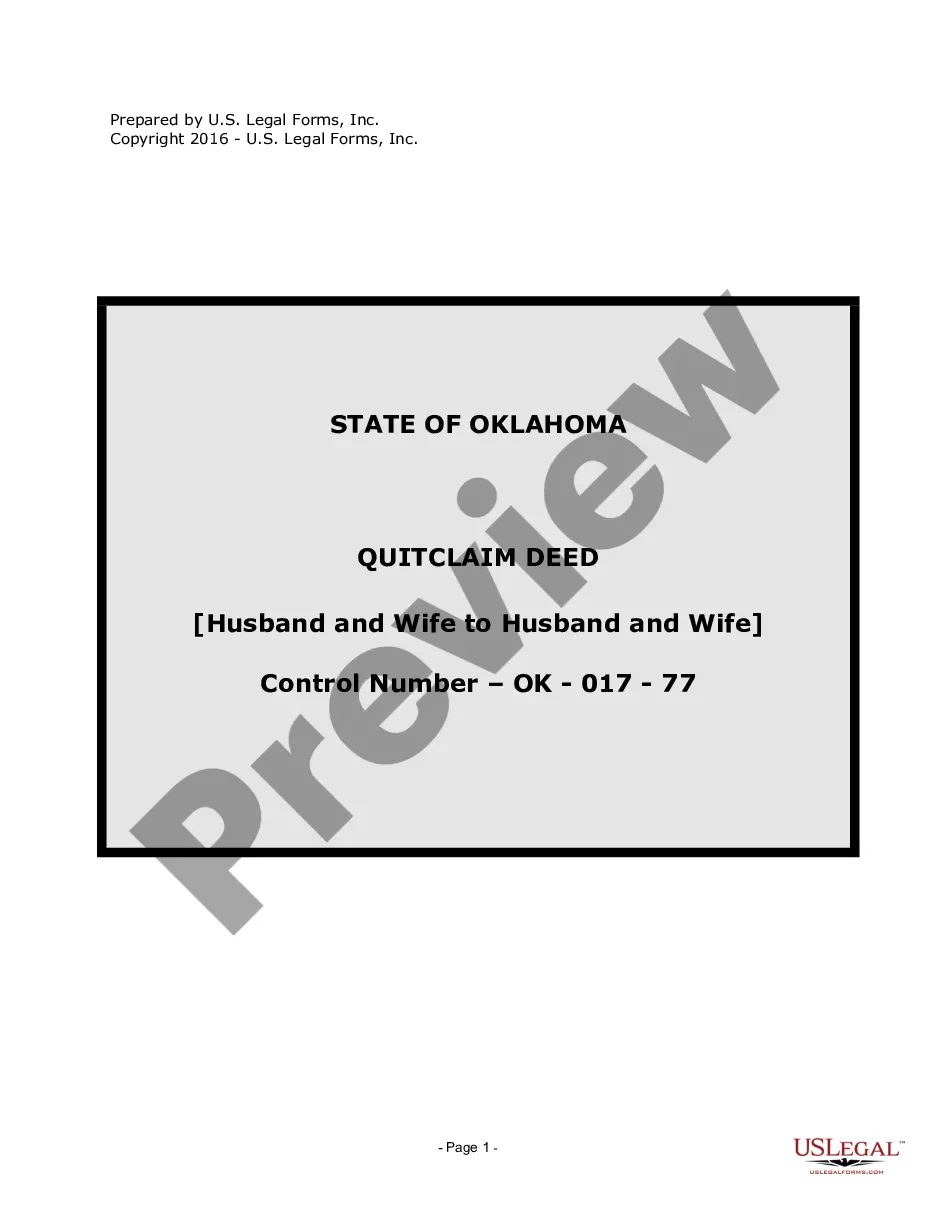
Oklahoma Quitclaim Deed from Husband and Wife to Husband and Wife
Overview of this form
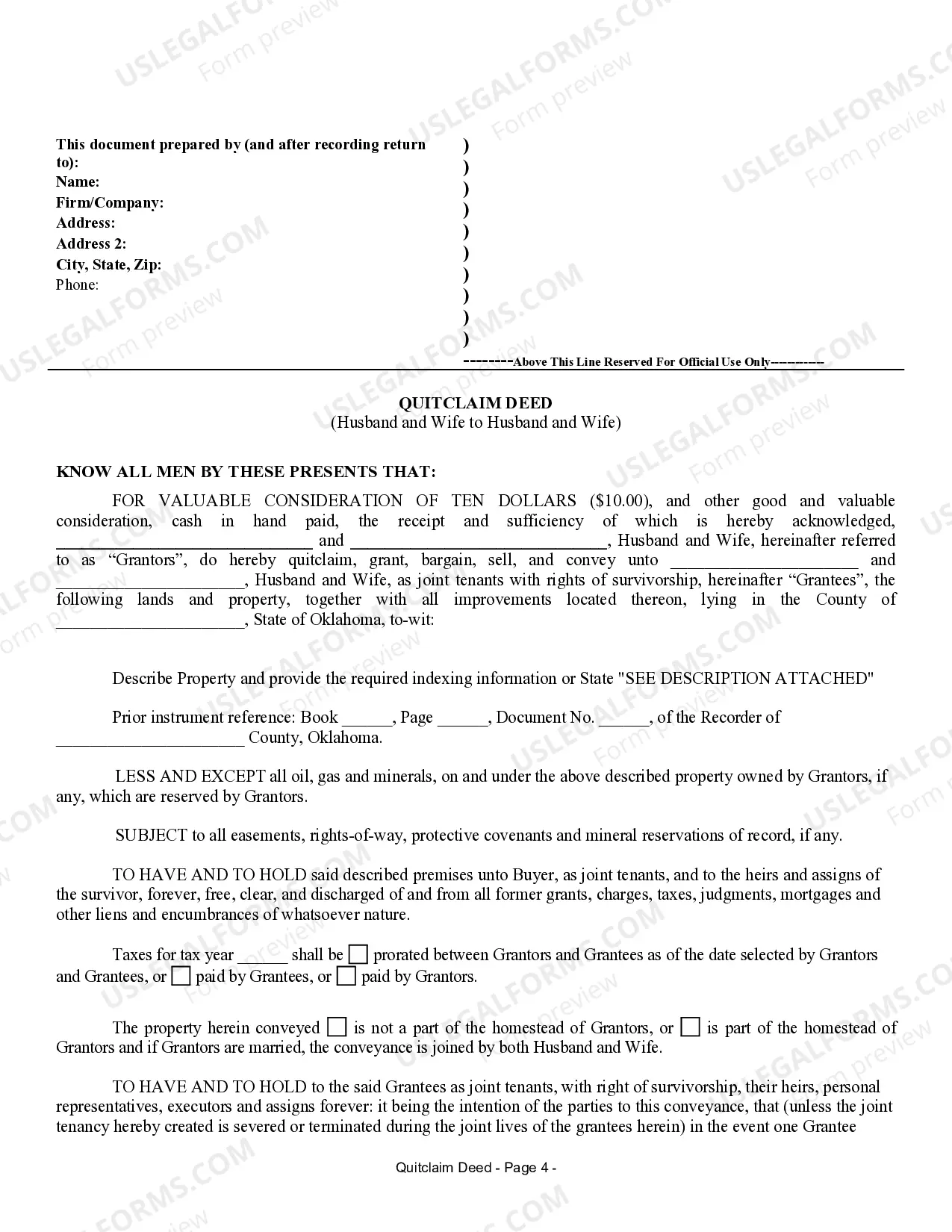
The Quitclaim Deed from Husband and Wife to Husband and Wife is a legal document that allows a married couple to transfer property ownership to each other. This form is unique because it specifically designates both parties as grantors and grantees, which means both spouses are equally involved in the transaction. Unlike warranty deeds, quitclaim deeds do not guarantee that the property is free from liens or other encumbrances, making it a simpler choice for transferring property between spouses.
Key components of this form
- Grantors and Grantees: Identifies both parties as husband and wife, indicating their mutual consent in the transfer.
- Property Description: Contains a detailed description of the property being transferred.
- Reservation of Rights: Clearly states any reserved rights concerning oil, gas, and minerals beneath the property.
- Joint Tenancy: Establishes the property transfer as joint tenants with rights of survivorship, specifying rights upon the death of one party.
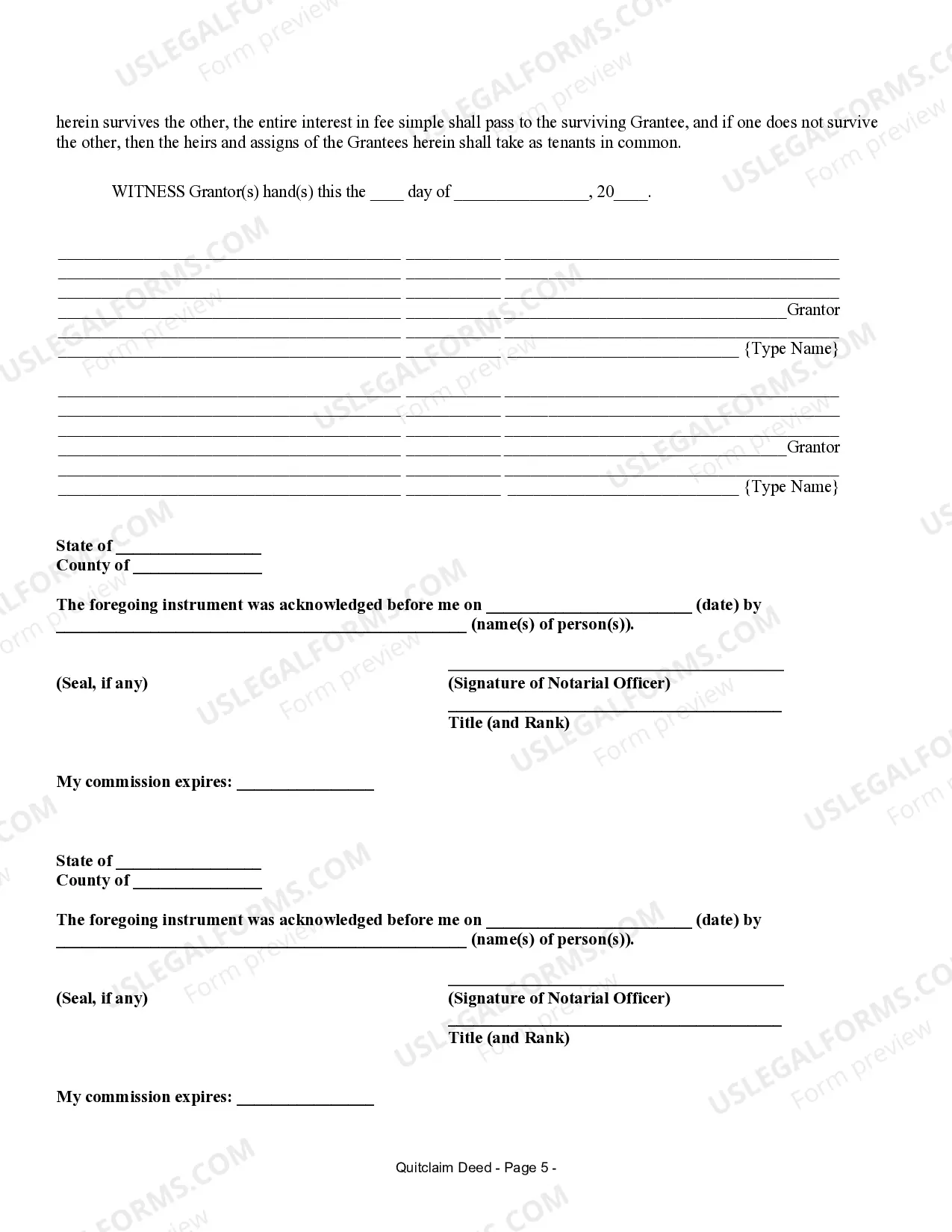
- Signatures and Notarization: Requires signatures from both grantors and the acknowledgment of a notary public to validate the deed.





When to use this form
This form is appropriate when a married couple wishes to transfer property ownership between themselves without selling it to a third party. It may be used for adding a spouse to the deed, transferring full ownership in a divorce, or clarifying ownership after a marriage. Additionally, it can serve in estate planning to facilitate straightforward transfers of property upon the death of one spouse.
Who should use this form
- Married couples who want to transfer property to each other.
- Individuals looking to clarify joint ownership of property.
- Spouses involved in estate planning or property division in divorce.
Steps to complete this form
- Identify the parties by entering the names of both husband and wife as grantors and grantees.
- Provide a detailed description of the property being transferred.
- Indicate any reserved rights regarding oil, gas, and minerals, if applicable.
- Ensure both parties sign the document in the designated areas.
- Have the form notarized to legally validate the deed.
Does this form need to be notarized?
Notarization is required for this form to take effect. Our online notarization service, powered by Notarize, lets you verify and sign documents remotely through an encrypted video session, available 24/7.
Get your form ready online
Our built-in tools help you complete, sign, share, and store your documents in one place.
Make edits, fill in missing information, and update formatting in US Legal Forms—just like you would in MS Word.
Download a copy, print it, send it by email, or mail it via USPS—whatever works best for your next step.
Sign and collect signatures with our SignNow integration. Send to multiple recipients, set reminders, and more. Go Premium to unlock E-Sign.
If this form requires notarization, complete it online through a secure video call—no need to meet a notary in person or wait for an appointment.
We protect your documents and personal data by following strict security and privacy standards.

Make edits, fill in missing information, and update formatting in US Legal Forms—just like you would in MS Word.

Download a copy, print it, send it by email, or mail it via USPS—whatever works best for your next step.

Sign and collect signatures with our SignNow integration. Send to multiple recipients, set reminders, and more. Go Premium to unlock E-Sign.

If this form requires notarization, complete it online through a secure video call—no need to meet a notary in person or wait for an appointment.

We protect your documents and personal data by following strict security and privacy standards.
Common mistakes
- Forgetting to include the property description or reservation clauses.
- Failing to have both parties sign the form.
- Not completing the notarization process, which can invalidate the deed.
Why use this form online
- Convenience of accessing and completing the form digitally.
- Ability to edit information easily before finalizing.
- Reliable templates drafted by licensed attorneys that comply with state laws.
Looking for another form?
Form popularity
FAQ
A quitclaim deed will remove the out-spouse (or departing spouse) from the title to the property, effectively relinquishing their equity or ownership in the home. The execution of a quitclaim deed is typically a requirement of a divorce settlement in order to complete the division of assets.
A person who signs a quitclaim deed to transfer property they do not own results in no title at all being transferred since there is no actual ownership interest. The quitclaim deed only transfers the type of title you own.
A quitclaim deed must meet all state and local standards for recorded instruments. Sign the deed in the presence of a notary public and record at the clerk's office in the county where the property is located for a valid transfer. Contact the same office to verify accepted forms of payment.
In order to transfer ownership of the marital home pursuant to a divorce, one spouse is going to need to sign a quitclaim deed, interspousal transfer deed, or a grant deed, in order to convey the title to the property.
In states like California and Florida, the spouses may use a quitclaim deed to transfer the property without warranting title. Other stateslike Texasrecognize a similar type of deed called a deed without warranty.
In Oklahoma, title to real property can be transferred from one party to another by executing a special warranty deed. A special warranty deed conveys an interest in real property to the named grantee with limited warranties of title.Generally, real property is owned in either sole ownership or in co-ownership.
If you sign a quitclaim deed to release yourself from ownership of the property or a claim to the title, then that doesn't mean you are no longer held accountable for the mortgage payment.Otherwise, you may be held responsible for unpaid payments despite no longer having a claim to the title.
You usually do this by filing a quitclaim deed, in which your ex-spouse gives up all rights to the property. Your ex should sign the quitclaim deed in front of a notary. One this document is notarized, you file it with the county. This publicly removes the former partner's name from the property deed and the mortgage.
It is also crucial that a spouse know about the loan, even if he or she is not on the mortgage. In general, the spouse must sign a deed of trust, the Truth in Lending and Right to Cancel documents. By signing these documents, they are simply acknowledging the existence of the mortgage.