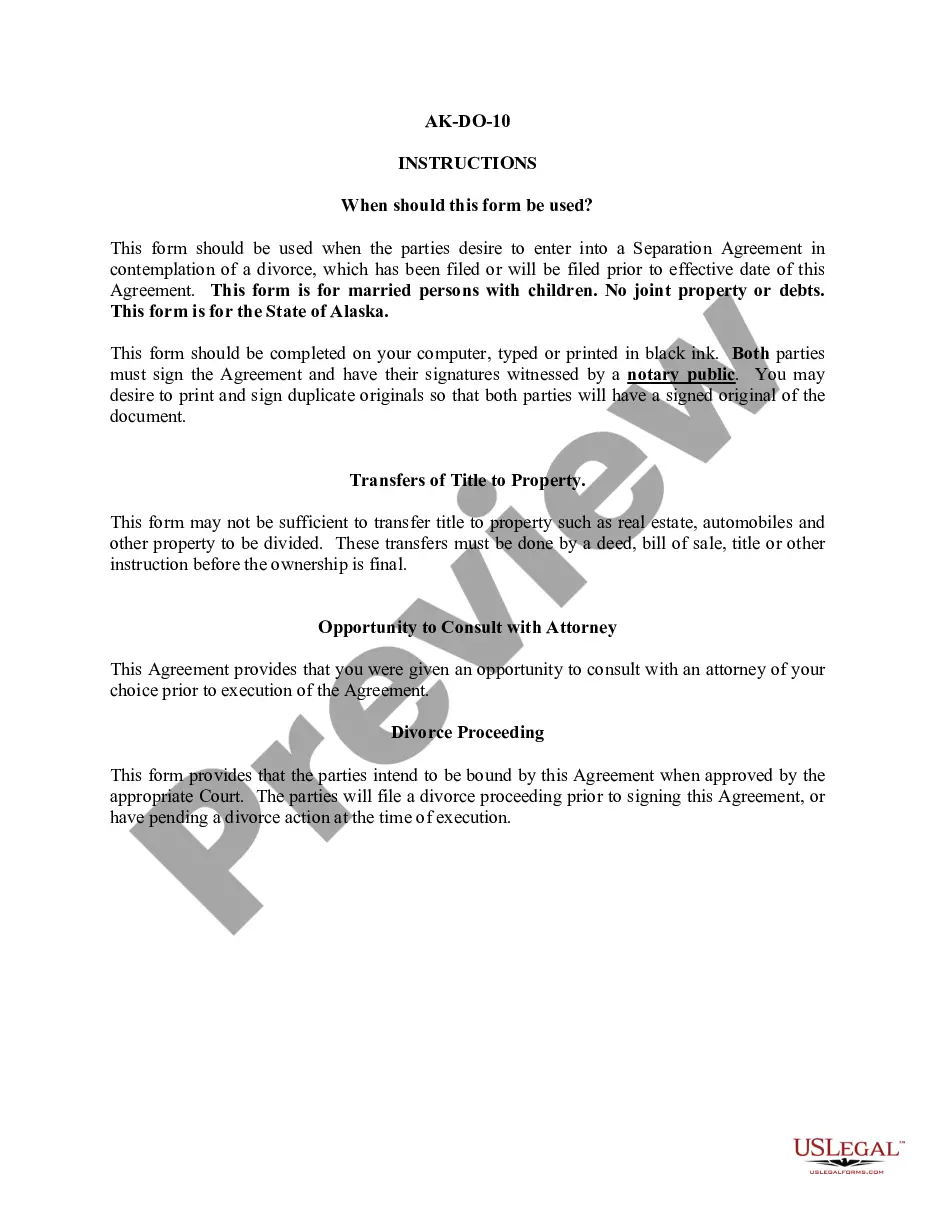
Ohio Request for Lien Information - Individual
What this document covers
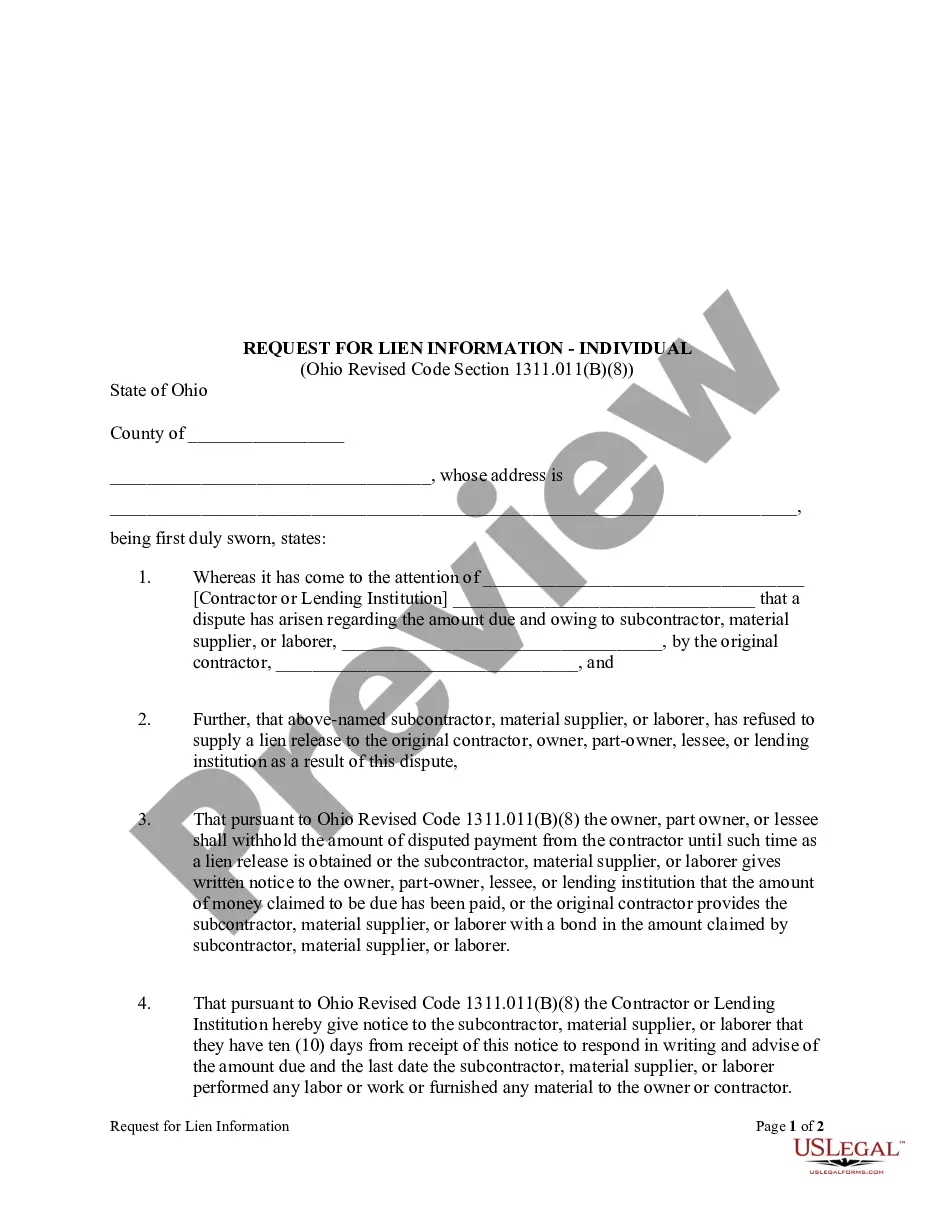
The Request for Lien Information - Individual is a legal document used in Ohio to request information about a disputed lien from a subcontractor, material supplier, or laborer. This form allows homeowners or lending institutions to formally ask for the specifics of the claimed amount due when there is a payment dispute between a contractor and those providing services or materials. It is particularly important as it helps protect the interests of the owner or lender by ensuring they have the necessary information to make informed decisions about payment withholding.
What’s included in this form
- Identification of the parties involved, including the contractor and subcontractor.
- Details of the payment dispute and the amount claimed by the subcontractor, material supplier, or laborer.
- Notification requirement for the subcontractor to respond within ten days.
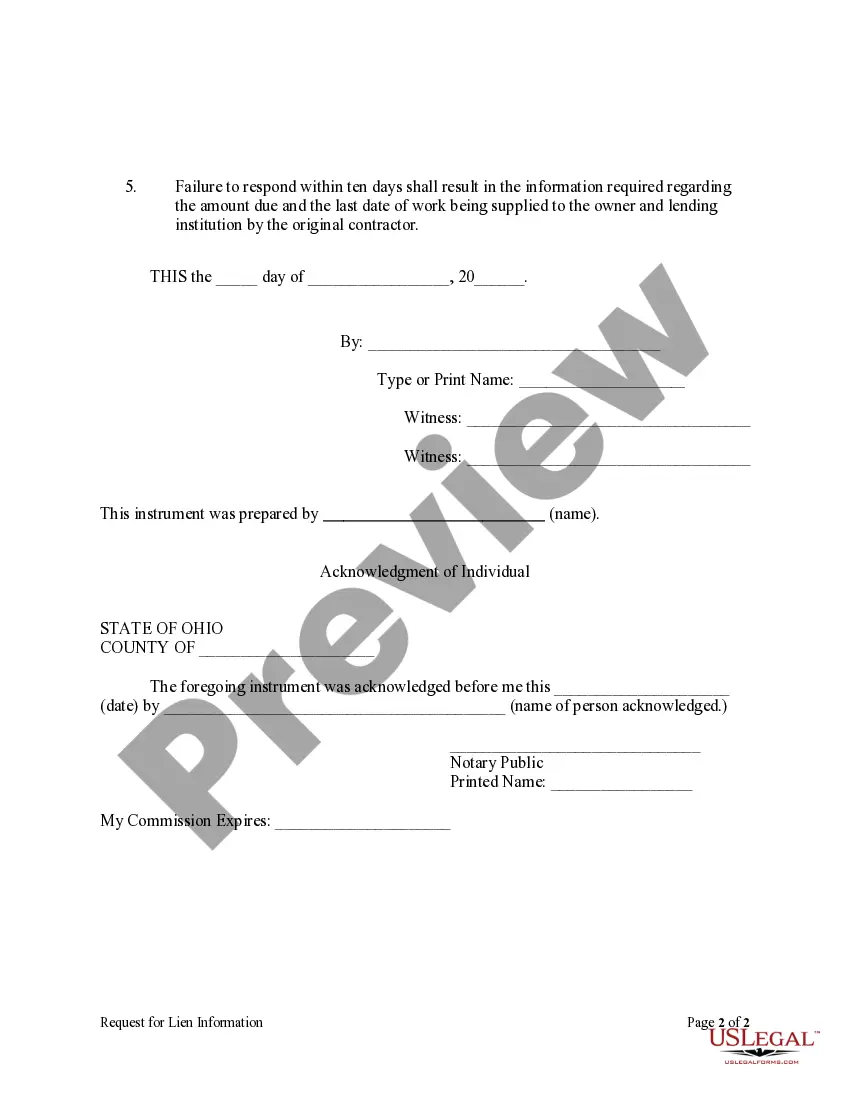
- Consequences for failure to respond, including the contractor's obligation to provide information to the owner or lender.
- Notary acknowledgment, ensuring the validity of the signatures involved.
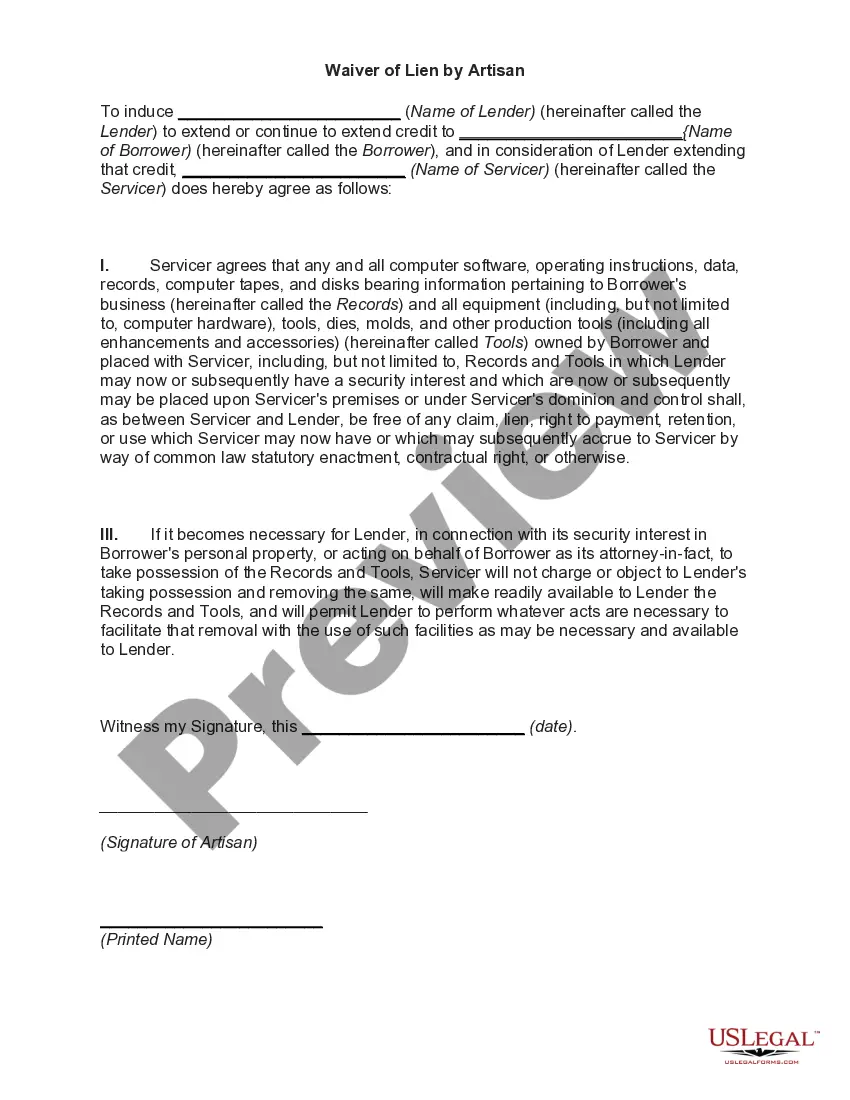
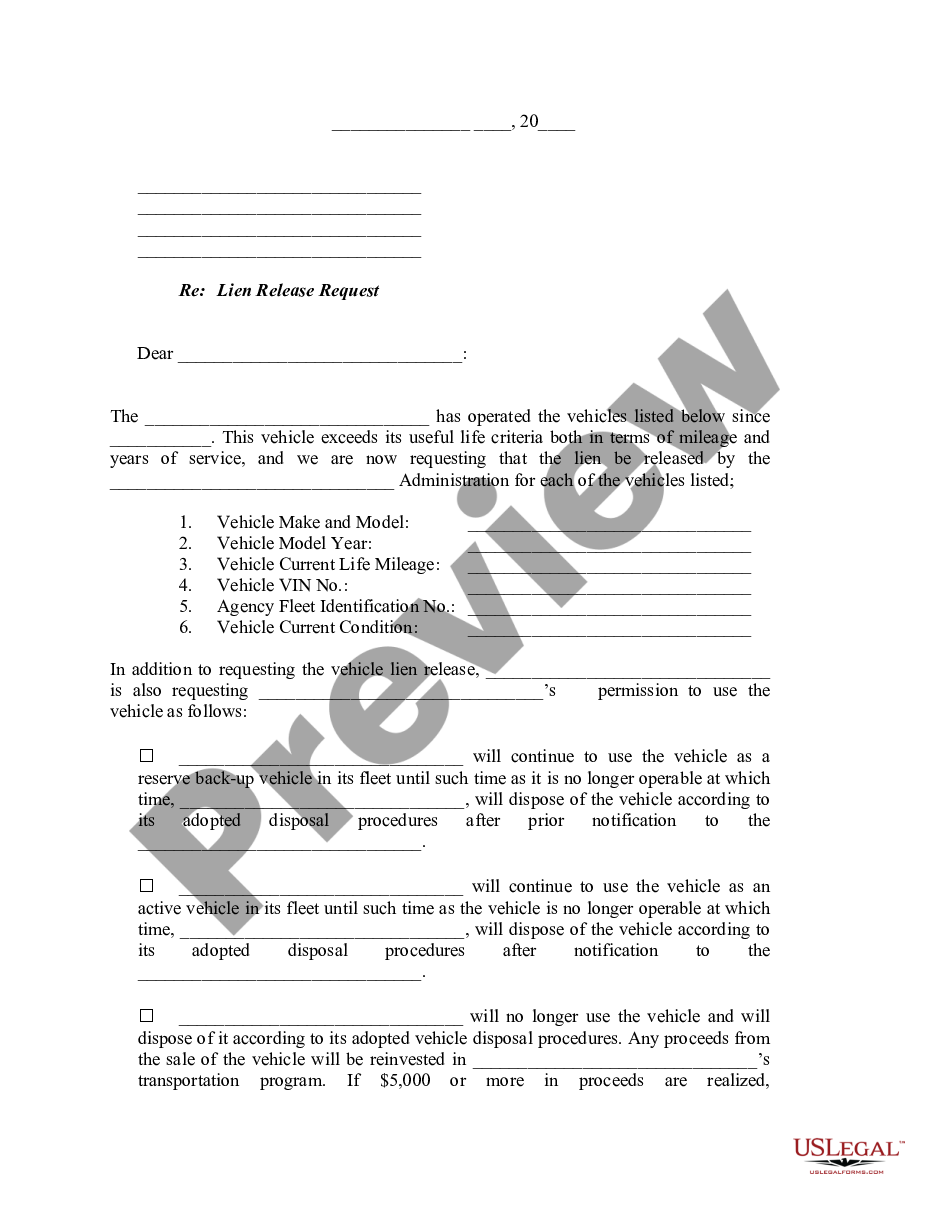
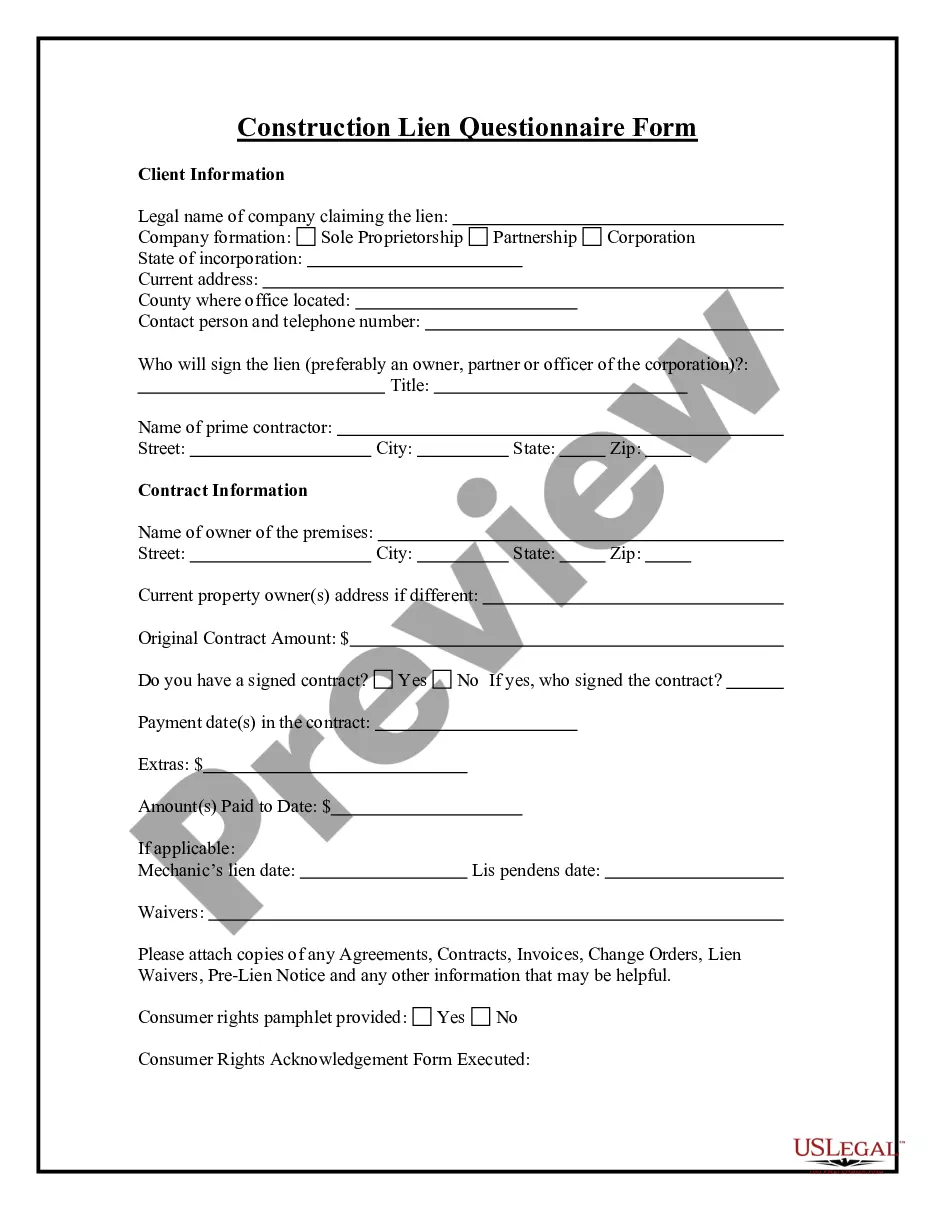
Common use cases
This form should be used when there is a disagreement over payments owed to a subcontractor, material supplier, or laborer for work completed. If the contractor has not received a lien release due to a dispute, and the owner or lender needs to withhold payment while clarifying the amount owed, this form is warranted. It is particularly useful in construction projects where multiple parties are involved and payment obligations are unclear.
Who can use this document
- Property owners who are involved in a payment dispute related to construction.
- Lending institutions that finance construction projects and need to secure their interests.
- Contractors who require verification of disputed amounts before proceeding with payments.
- Subcontractors, material suppliers, or laborers who want to formally clarify their claims related to unpaid work or services.
Steps to complete this form
- Identify and clearly state the names and addresses of all parties involved, including the contractor and the subcontractor or supplier.
- Describe the specific nature of the payment dispute, including the amount claimed and the basis for the disagreement.
- Include the deadline for the subcontractor or laborer to respond, noting the ten-day timeframe provided by law.
- Provide necessary signatures and ensure that the document is acknowledged by a notary public.
- Retain a copy of the completed form for your records and send it to the appropriate parties as required.
Notarization guidance
Yes, this form must be notarized to be legally valid. This ensures that the signatures are verified and that the parties involved have duly acknowledged their agreement under law. US Legal Forms offers integrated online notarization, available 24/7, which allows for a secure video call and legal equivalence without the need to travel.
Get your form ready online
Our built-in tools help you complete, sign, share, and store your documents in one place.
Make edits, fill in missing information, and update formatting in US Legal Forms—just like you would in MS Word.
Download a copy, print it, send it by email, or mail it via USPS—whatever works best for your next step.
Sign and collect signatures with our SignNow integration. Send to multiple recipients, set reminders, and more. Go Premium to unlock E-Sign.
If this form requires notarization, complete it online through a secure video call—no need to meet a notary in person or wait for an appointment.
We protect your documents and personal data by following strict security and privacy standards.

Make edits, fill in missing information, and update formatting in US Legal Forms—just like you would in MS Word.

Download a copy, print it, send it by email, or mail it via USPS—whatever works best for your next step.

Sign and collect signatures with our SignNow integration. Send to multiple recipients, set reminders, and more. Go Premium to unlock E-Sign.

If this form requires notarization, complete it online through a secure video call—no need to meet a notary in person or wait for an appointment.

We protect your documents and personal data by following strict security and privacy standards.
Typical mistakes to avoid
- Failing to provide all required names and addresses of the parties involved.
- Not specifying the exact amount in dispute or the last date services or materials were provided.
- Omitting the deadline for response, which is crucial for compliance with the law.
- Neglecting to have the form notarized, which could invalidate the request.
Why use this form online
- Convenient access to a legally vetted form crafted by licensed attorneys.
- Edit or customize the form to fit specific needs without needing legal expertise.
- Immediate download option, allowing users to act promptly in their legal matters.
- Secure storage of completed forms digitally for easy retrieval when needed.
Looking for another form?
Form popularity
FAQ
Electronic Titling Options. Ohio has a number of electronic titling options for entities who submit title transactions to Clerks of Courts on a regular basis. Each option carries with it a need to register with the Department of Public Safety (DPS) by completing the appropriate Participant Agreement for that option.
The state of Ohio allows county treasurers to pursue the delinquent property taxes directly, or the county treasurer may sell a tax lien certificate to the public.However, tax lien certificates are assignable and can be sold to investors to collect upon at a later time.
You can check the status of your Ohio refund online at the Ohio Department of Taxation website. by calling the Ohio Refund Hot Line at 1-800-282-1784. A taxpayer and/or spouse, if filing a joint return, who owes money for overpayment of public assistance.
In Ohio you can find out if your property has a lien on it by simply checking the records of the local county recorder and the local clerk of courts.
Congratulations on owning your vehicle free and clear. Now that your loan is paid off, you should receive a "letter of lien release" from the bank or financial institution that financed your vehicle.You cannot transfer ownership of a vehicle until the lien is cleared from the title.
If the title was lost after ownership was transferred, you can apply for a duplicate title. The State of Ohio requires that duplicate titles must be applied for by the owner of record at a county title office. The process requires a valid photo ID of the applicant and documentation of the vehicle identification number.
Go to the Ohio Bureau of Motor Vehicles website. Download and print out form BMV 3774, which is titled as an Application for Certificate of Title to a Motor Vehicle (see Resources). Fill out form 3774 with the information about the lien and lien holder included.
To obtain more information about the lien, contact the Attorney General's Office. For business taxes call 1-888-246-0488, for individual taxes call 1-888-301-8885.
According to Ohio law, the State can wait 7 years to hit you with a tax lien. And it can stay there for up to 40 years, unless of course you pay up. Jenkins only found out when the kept his tax refund. That's despite, he says, getting refunds for the past 15 years.